


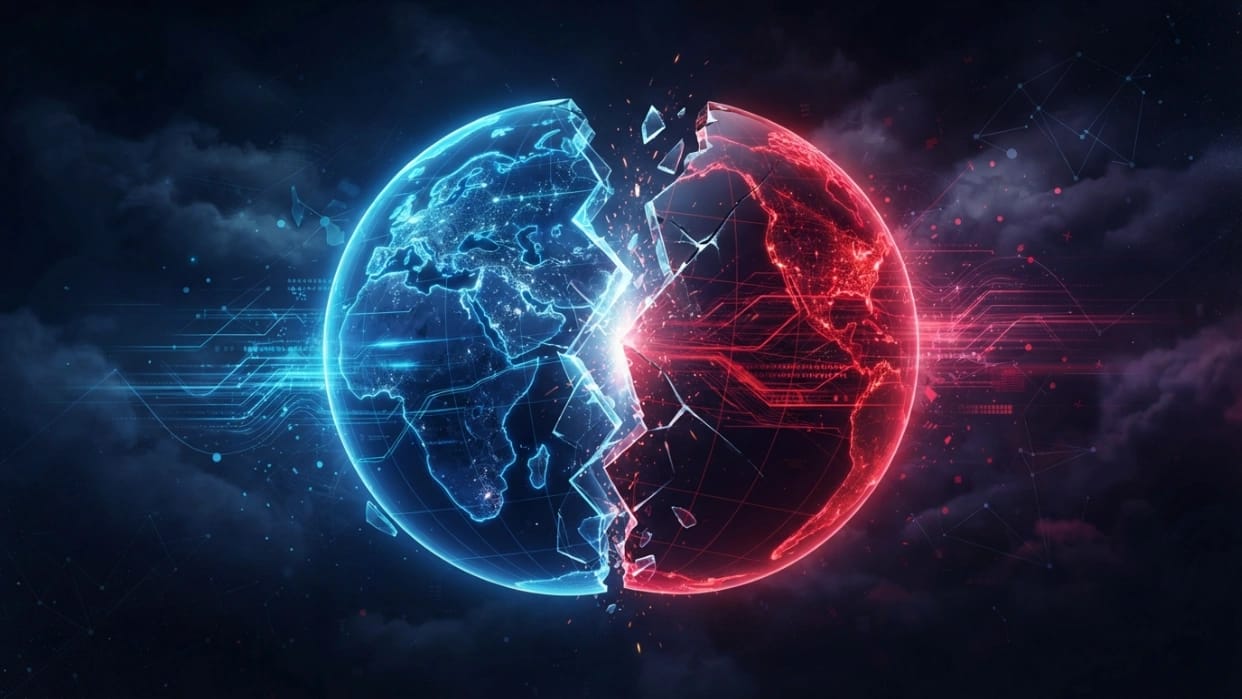
Global Geopolitics: How Rival Power Blocs Are Taking Shape
For decades, globalization was built around a relatively simple idea: countries could become richer by trading with one another, even when their political interests differed.
That model is under increasing pressure.
Today, governments are thinking about trade, technology, energy and investment through a different lens: national security.
The United States and China remain the central strategic rivals, while Europe is trying to strengthen its economic and security independence. Emerging economies are seeking greater room to maneuver between competing powers, and critical resources such as oil, rare earths and lithium are becoming strategic assets.
The result isn’t necessarily a new Cold War with two clearly defined camps.
Something more complicated may be emerging.
A fragmented world where countries cooperate, compete and hedge their bets at the same time.
The International Monetary Fund continues to identify geopolitical fragmentation and trade tensions as risks to the global economy, while the World Economic Forum reported in June that trade and financial fragmentation was already imposing substantial economic costs.
Here’s why this shift matters.
Globalization Is Being Rewritten
The old globalization model prioritized efficiency.
Companies searched the world for the cheapest suppliers. Governments encouraged international trade. Manufacturers built complex supply chains spanning dozens of countries.
That system created enormous economic benefits.
But it also created vulnerabilities.
If a critical component comes from one country, a geopolitical dispute can suddenly become a supply-chain crisis.
If an economy depends heavily on another country for energy, technology or minerals, political tensions can become an economic weapon.
This is the foundation of geoeconomic fragmentation.
The IMF defines the phenomenon as a potential reversal of global economic integration driven by geopolitical considerations, affecting trade, capital flows, technology diffusion and international cooperation.
The change is already visible.
The Banque de France has found evidence that geopolitical tensions have encouraged countries to trade relatively more within geopolitical blocs and less with opposing blocs.
The question is no longer whether geopolitics affects the global economy.
It is how deeply it will reshape it.
The U.S.-China Rivalry Is at the Center
The most important relationship in the emerging geopolitical system remains the one between the United States and China.
But this rivalry extends far beyond traditional military competition.
It now includes:
- Semiconductors
- Artificial intelligence
- Advanced manufacturing
- Critical minerals
- Telecommunications
- Trade
- Energy
- Investment
- Supply chains
Technology has become strategic infrastructure.
The ability to manufacture advanced chips, develop sophisticated AI systems and control key components can influence both economic competitiveness and military capabilities.
That is why Washington and Beijing increasingly treat technology as a national-security issue.
At the same time, neither country can simply erase its economic relationship with the other overnight.
That creates the defining contradiction of the relationship:
The world’s two most powerful economies can be strategic competitors while remaining economically interconnected.
Current analysis from the World Economic Forum describes the U.S.-China relationship as a critical factor shaping the future of China’s trade policy, while the Council on Foreign Relations describes the relationship as a defining element of the global economic system.
Europe Wants More Strategic Independence
Europe faces a different problem.
It has enormous economic influence but has also discovered that strategic dependence can become expensive during geopolitical crises.
Energy security became a particularly important issue following Russia’s invasion of Ukraine.
Now the broader question extends beyond energy.
Europe increasingly needs to consider:
Who supplies its technology?
Who provides its critical minerals?
Where are its industrial inputs manufactured?
Can it defend its own interests without relying excessively on another power?
This doesn’t mean Europe is becoming completely independent from either the United States or China.
Instead, Europe is attempting something more difficult:
strategic diversification.
That means maintaining alliances while reducing excessive dependence.
The Middle East Has Become Even More Strategic
The Middle East remains one of the most important geopolitical regions on Earth because its importance goes far beyond military conflict.
It connects:
Energy + shipping + trade + finance + regional security.
Oil remains crucial to the global economy, while major maritime routes connect producers and consumers across continents.
Our recent analysis of oil prices highlighted how disruptions to Middle Eastern production and shipping can quickly affect global energy markets.
But energy is only one piece of the puzzle.
The region also sits at the intersection of competing relationships involving the United States, China, Russia and regional powers.
That makes Middle Eastern geopolitics increasingly important to the wider global balance of power.
BRICS and the Rise of Strategic Autonomy
Another important development is the growing interest among emerging economies in strategic autonomy.
Countries don’t necessarily want to choose permanently between Washington and Beijing.
Instead, many want the freedom to cooperate with both depending on their interests.
That can mean:
- Trading with China
- Maintaining security relationships with the United States
- Buying energy from different suppliers
- Joining alternative economic partnerships
- Developing domestic industries
- Diversifying financial relationships
This is one reason the idea of a multipolar world has gained so much attention.
The emerging system may not be:
America vs. China
It could increasingly become:
America + China + several powerful middle and regional powers pursuing their own interests.
Recent analysis of BRICS in 2026 highlights both its growing importance and its internal divisions, demonstrating why it should not simply be treated as a unified anti-Western bloc.
That distinction matters.
Countries can cooperate without becoming permanent allies.
Critical Minerals Are Becoming Geopolitical Weapons
Oil dominated twentieth-century energy geopolitics.
The twenty-first century is adding a new category of strategic resources:
critical minerals.
Lithium.
Copper.
Cobalt.
Nickel.
Rare earth elements.
These materials are essential for:
- Batteries
- Electric vehicles
- Renewable energy
- Advanced electronics
- Defense systems
- Semiconductors
- AI infrastructure
The problem is that production and processing are geographically concentrated.
That means supply chains can become strategic vulnerabilities.
The IMF has warned that fragmentation in critical-mineral trade could make the energy transition more expensive and create significant price volatility.
And the competition is becoming increasingly visible.
Current reporting shows the United States is attempting to expand domestic lithium production partly to reduce dependence on China, but water availability and other practical constraints are creating additional challenges.
This illustrates a broader reality:
Replacing geopolitical dependence isn’t easy.
Building a mine is one thing.
Building the entire supply chain around it is another.
AI Has Become a Geopolitical Battlefield
Artificial intelligence is another major front in the competition.
At first, AI looked like a technology-sector race.
Now it is increasingly becoming a race over infrastructure and strategic capability.
Countries need:
Advanced chips
↓
Data centers
↓
Electricity
↓
Cooling
↓
Networks
↓
Capital
↓
Skilled workers
This means the AI competition overlaps with energy policy, semiconductor policy, industrial policy and national security.
Control over advanced computing can provide economic advantages, military advantages and technological influence.
That’s why restrictions surrounding advanced semiconductor technology have become so geopolitically significant.
The AI race is therefore not simply about who creates the smartest chatbot.
It’s about who controls the infrastructure required to build the next generation of intelligence.
Global Trade Is Moving From “Just in Time” to “Just in Case”
Perhaps the most important economic consequence of geopolitical fragmentation is the changing philosophy of supply chains.
For decades, companies prioritized efficiency.
Now resilience matters more.
Instead of asking:
“Who can manufacture this cheapest?”
Companies increasingly have to ask:
“What happens if this supplier becomes unavailable?”
That has encouraged:
- Nearshoring
- Friend-shoring
- Supplier diversification
- Domestic manufacturing
- Strategic stockpiling
- Regional supply chains
The result can be more resilient economies.
But resilience comes with a price.
Duplicating factories and suppliers costs money.
Moving production away from the cheapest location can increase costs.
And fragmented technology standards can reduce efficiency.
The IMF has warned that deeper fragmentation can weaken the benefits produced by international integration.
The Hidden Cost of a Fragmented World
Geopolitical fragmentation can sound abstract.
Its consequences aren’t.
It can mean:
Higher prices
Companies may have to use more expensive suppliers.
Slower trade
Additional tariffs and restrictions can reduce international commerce.
Higher inflation
More expensive production and transportation can eventually reach consumers.
Less efficient investment
Capital may be allocated according to strategic considerations rather than purely economic returns.
Duplicated infrastructure
Countries may build parallel supply chains to reduce dependence.
Slower technology diffusion
Technology restrictions can prevent innovations from spreading as quickly across borders.
The World Economic Forum estimated in June 2026 that trade and financial fragmentation was already costing the global economy between $213 billion and $307 billion annually, while adding roughly 0.2–0.3 percentage points to global inflation.
Those aren’t merely geopolitical statistics.
They eventually affect businesses and households.
The World May Not Divide Into Two Blocs
This is where the popular “new Cold War” analogy becomes misleading.
The future may be considerably messier.
Imagine three broad groups.
1. The U.S.-aligned ecosystem
The United States and many traditional allies continue to cooperate on security, technology and trade.
2. The China-centered ecosystem
China deepens economic relationships across Asia, Africa, the Middle East and other regions.
3. The strategic middle
Countries such as India, Indonesia, Gulf states and other emerging powers attempt to maintain relationships with multiple sides.
This third category could become increasingly influential.
These countries don’t necessarily want to choose a permanent camp.
They want leverage.
And in a multipolar system, leverage can be extremely valuable.
What Happens If Fragmentation Accelerates?
There are three broad possibilities.
Scenario 1: Managed Competition
Countries remain rivals but continue trading.
Technology restrictions exist, but global commerce remains largely functional.
This would be the least disruptive scenario.
Scenario 2: Deep Economic Fragmentation
Supply chains increasingly split into competing ecosystems.
Technology standards diverge.
Trade becomes more regional.
Investment becomes more politically influenced.
This could mean permanently higher costs.
Scenario 3: A Major Geopolitical Shock
A serious conflict or blockade disrupts a critical shipping route, energy supplier or technology supply chain.
The consequences could spread rapidly across global markets.
This is the scenario policymakers most want to prevent.
What Should Businesses and Consumers Watch?
You don’t need to follow every diplomatic statement to understand where the global system is heading.
Watch these five indicators:
1. Semiconductor restrictions
Technology controls reveal how strategic competition is developing.
2. Critical-mineral policies
Export controls and new mining investments can reshape entire industries.
3. Shipping routes
Major maritime chokepoints remain critical to global trade.
4. Supply-chain investment
New factories reveal where companies believe future geopolitical risks are concentrated.
5. Trade restrictions
Tariffs and export controls provide a direct measure of economic fragmentation.
The Light Span Perspective
The world isn’t necessarily returning to the Cold War.
Something more complicated is emerging.
Countries are becoming more cautious about dependence while remaining deeply connected.
The United States and China remain the central strategic competitors, but middle powers increasingly have room to pursue independent strategies. Meanwhile, critical minerals, AI, energy and trade are becoming intertwined with national security.
The IMF’s latest outlook continues to identify deeper geopolitical fragmentation and renewed trade tensions as potential threats to global growth.
That leaves the global economy facing a difficult contradiction:
The world needs cooperation to remain prosperous, but countries increasingly believe they need greater independence to remain secure.
That tension could define the next decade.
The most important question isn’t whether globalization will disappear.
It won’t.
The more important question is:
What kind of globalization comes next?
A world of completely separate economic blocs would be enormously expensive.
A world of unrestricted interdependence could leave countries dangerously exposed.
The likely future lies somewhere between the two:
more regional, more strategic and far more geopolitical.
And that means the biggest economic decisions of the coming years may increasingly be made not by markets alone—but by governments deciding who they trust, what they depend on and how much dependence they are willing to tolerate.
FAQs
What is geopolitical fragmentation?
Geopolitical fragmentation occurs when countries increasingly organize trade, investment, technology and economic relationships around political and security alliances rather than purely economic efficiency.
Is the world entering a new Cold War?
Not exactly. The U.S.-China relationship has elements of strategic rivalry, but today’s global system is more economically interconnected and includes powerful countries that don’t want to permanently align with either side.
Why are critical minerals becoming so important?
Critical minerals are essential for batteries, electronics, renewable energy, advanced manufacturing, defense technologies and other strategic industries. Their concentrated supply chains make them vulnerable to geopolitical disruption.
How does geopolitics affect ordinary consumers?
Geopolitical tensions can influence fuel prices, food costs, electronics prices, inflation, investment and the availability of imported products.
What is a multipolar world?
A multipolar world is an international system in which power is distributed among several major countries or regional centers rather than dominated by a single superpower.
Continue reading more

