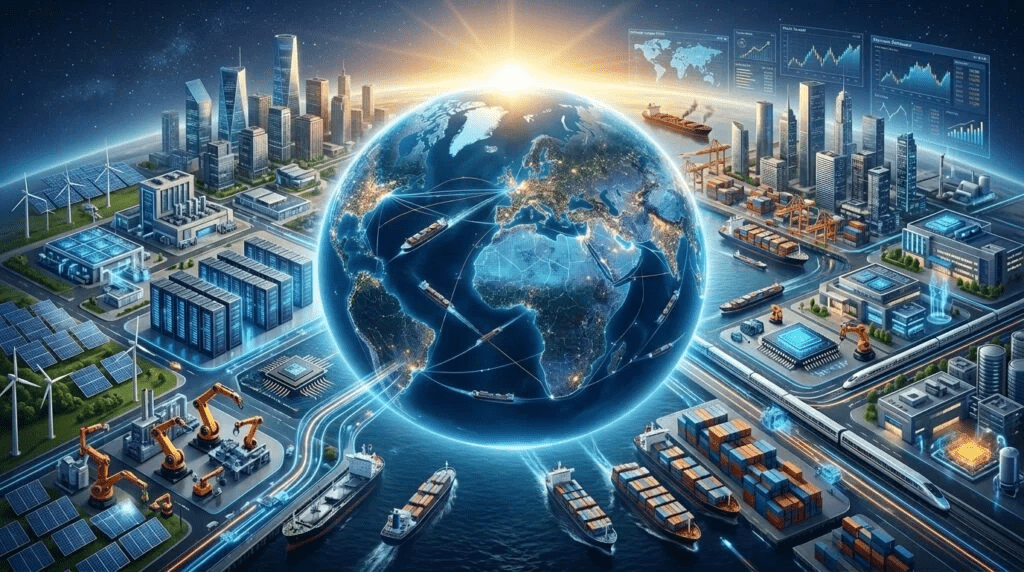



The global economy is not dividing into two perfectly sealed camps, but it is becoming more politically organized. Trade still crosses rival blocs every day, yet governments now treat semiconductors, energy, critical minerals, data and transport routes as security assets rather than ordinary commercial inputs.
The result is a more complicated form of globalization. Companies continue selling worldwide, but they are building backup suppliers, shifting production closer to customers and separating their most sensitive technology chains. The central question is no longer whether globalization survives. It is whether interdependence can continue when the United States, China and their partners increasingly write different rules for strategic industries.
Quick Take
- Globalization is not ending, but it is entering a new phase shaped by geopolitics, economic security, and technological competition.
- Governments are increasingly prioritizing resilient supply chains, domestic manufacturing, and trusted international partnerships over pure cost efficiency.
- Strategic rivalry between the United States and China is accelerating investment in semiconductors, artificial intelligence, clean energy, and critical infrastructure.
- Businesses are redesigning supply chains through diversification, regionalization, and “friend-shoring” to reduce geopolitical risk.
- The future global economy is likely to remain interconnected, but with stronger regional alliances and competing technology ecosystems.
Globalization Is Being Rewritten
For more than three decades, globalization transformed the world economy.
Manufacturers built supply chains that stretched across continents, investors searched globally for opportunities, and businesses focused on producing goods wherever costs were lowest. International trade expanded rapidly, lifting economic growth, reducing prices for consumers, and connecting markets more closely than ever before.
That model is now evolving.
The COVID-19 pandemic, geopolitical conflicts, technological rivalry, and supply chain disruptions exposed weaknesses in an economic system built primarily around efficiency. Governments and businesses realized that concentrating production in a limited number of regions could create significant economic and national security risks.
Today, the question is no longer simply “Where can products be made most cheaply?”
It has become “Where can products be made reliably, securely, and sustainably?”
This transformation is reshaping international trade, investment, technology, and global influence—and many economists describe it as the beginning of a new era of strategic globalization.
What Is Geoeconomic Fragmentation?
Geoeconomic fragmentation refers to the gradual reorganization of the global economy around strategic partnerships, political alliances, and national security priorities.
Rather than allowing markets alone to determine trade relationships, governments increasingly consider factors such as:
- National security
- Technology leadership
- Supply chain resilience
- Energy independence
- Critical infrastructure
- Cybersecurity
- Strategic industries
Countries are not abandoning international trade.
Instead, they are becoming more selective about where they invest, manufacture, and source essential goods.
Why It Matters
Economic decisions are becoming closely linked with geopolitical strategy, making international relations an increasingly important driver of global commerce.
The U.S.–China Relationship Is Reshaping the Global Economy
No relationship has influenced this transition more than the strategic competition between the United States and China.
Together, the two economies account for a significant share of global trade, manufacturing, technological innovation, and investment.
Both countries continue investing heavily in areas considered critical to long-term competitiveness, including:
- Artificial intelligence
- Semiconductor manufacturing
- Quantum computing
- Advanced telecommunications
- Clean energy technologies
- Biotechnology
- Defense innovation
The United States has introduced policies supporting domestic semiconductor production while imposing export controls on certain advanced technologies.
China has accelerated investment in domestic innovation, manufacturing capabilities, and international technology partnerships while expanding economic cooperation across Asia, Africa, Latin America, and the Middle East.
Rather than competing primarily through tariffs, both countries increasingly compete through technology, standards, investment, and industrial strategy.
Why It Matters
The future of global economic leadership will depend as much on technological capability as on traditional measures such as manufacturing output or trade volume.
Supply Chains Are Being Redesigned
Businesses have fundamentally changed how they think about global production.
Instead of relying heavily on a single manufacturing hub, many organizations now spread operations across multiple countries to reduce risk.
Common strategies include:
Friend-Shoring
Expanding production into countries with strong political and economic relationships.
Near-Shoring
Moving manufacturing closer to major consumer markets.
China Plus One
Maintaining operations in China while developing additional production capacity elsewhere.
Countries attracting increased investment include:
- India
- Vietnam
- Mexico
- Indonesia
- Poland
- Malaysia
This diversification helps businesses reduce exposure to future disruptions while maintaining access to global markets.
Why It Matters
Resilient supply chains are becoming a competitive advantage rather than simply a risk management strategy.
Technology Has Become a Strategic Resource
Technology now sits at the center of international competition.
Artificial intelligence, semiconductors, cloud computing, cybersecurity, and advanced telecommunications increasingly influence economic growth and national security.
Governments are investing heavily in:
- AI research
- Data centers
- Domestic semiconductor manufacturing
- Digital infrastructure
- Scientific research
- Advanced manufacturing
- Skilled workforce development
Technology leadership increasingly determines economic influence, productivity growth, and industrial competitiveness.
Why It Matters
The countries leading tomorrow’s technologies may also shape tomorrow’s global economy.
Energy Security Is Once Again a National Priority
Recent geopolitical tensions have reminded governments that reliable energy supplies remain essential for economic stability.
Energy policy is increasingly shaped by three objectives:
- Reliability
- Affordability
- Sustainability
Many countries are simultaneously investing in:
- Renewable energy
- Nuclear power
- Liquefied natural gas (LNG)
- Electricity grids
- Battery storage
- Domestic energy production
Rather than replacing one energy source with another overnight, governments are building more diversified energy systems capable of withstanding geopolitical and economic shocks.
Why It Matters
Energy security has become closely connected to national security, industrial policy, and long-term economic resilience.
Emerging Economies Are Becoming More Important
As multinational companies diversify supply chains, many emerging economies are attracting greater foreign investment.
Countries with strong infrastructure, political stability, competitive labor markets, and supportive business environments are becoming attractive manufacturing and technology hubs.
Beyond cost advantages, investors increasingly evaluate:
- Transportation infrastructure
- Digital connectivity
- Regulatory transparency
- Workforce skills
- Reliable electricity
- Political stability
These factors help determine which countries become long-term partners in the evolving global economy.
Why It Matters
The changing geography of investment is creating new opportunities for economic development across multiple regions.
Businesses Must Navigate a More Complex World
Global companies now operate in an environment where geopolitical developments can affect business performance almost as much as consumer demand.
Executives increasingly monitor:
- Trade agreements
- Export controls
- Economic sanctions
- Cybersecurity threats
- Political stability
- Regulatory changes
- Currency volatility
- Regional conflicts
Strategic planning now requires a broader understanding of international affairs alongside traditional business analysis.
Why It Matters
Corporate resilience increasingly depends on the ability to anticipate geopolitical risks as well as market opportunities.
What This Means for Investors
For investors, understanding geopolitics has become an essential part of evaluating long-term opportunities.
Several industries are expected to benefit from continued strategic investment, including:
- Artificial intelligence
- Semiconductor manufacturing
- Cybersecurity
- Clean energy
- Critical minerals
- Defense technology
- Logistics infrastructure
- Industrial automation
At the same time, investors must remain aware of risks such as trade disputes, regulatory changes, and slower global growth resulting from increased fragmentation.
Why It Matters
Political decisions now influence financial markets almost as strongly as interest rates, inflation, and corporate earnings.
Could the World Split Into Two Economic Blocs?
Although headlines often suggest the world is dividing into two competing economic systems, the reality is more nuanced.
International trade continues to grow, multinational companies continue operating across borders, and global financial markets remain deeply interconnected.
However, there is growing evidence that strategic industries are becoming more regionally organized.
Rather than a complete separation, economists increasingly expect a world characterized by:
- Multiple technology ecosystems
- Regional supply chains
- Strategic economic alliances
- Greater domestic manufacturing
- Continued—but more selective—global integration
This represents evolution rather than fragmentation in its purest sense.
Why It Matters
The future global economy is unlikely to become fully divided. Instead, it is becoming more diversified, regionalized, and strategically organized.
Looking Ahead: Strategic Globalization
The next chapter of globalization will likely look very different from the last.
Economic success will increasingly depend on balancing efficiency with resilience, openness with security, and innovation with responsible governance.
Governments will continue investing in critical industries, businesses will diversify operations across trusted partners, and emerging technologies will play an even larger role in shaping international competitiveness.
Rather than reversing globalization, the world is redesigning it for an era defined by technological transformation and geopolitical complexity.
What Selective Fragmentation Means Now
The global economy is not splitting into two completely separate worlds overnight.
Instead, it is adapting to new realities where economic security, technological leadership, and resilient supply chains carry greater importance than they have in decades.
Trade will continue.
Investment will continue.
Innovation will continue.
But the rules governing international commerce are changing.
Businesses that diversify intelligently, governments that invest strategically, and investors who understand the intersection of economics and geopolitics will likely be better positioned to succeed in this evolving landscape.
The age of globalization is far from over.
It is entering a more strategic, resilient, and technologically driven chapter.
Why a Complete Two-Bloc Split Is Unlikely
A simple map showing one American bloc and one Chinese bloc is attractive because it makes a confusing world easier to understand. Real trade networks are messier. Many countries depend on the United States for security, China for manufacturing, Europe for regulation and several regional powers for energy or food. They have strong incentives to avoid an exclusive choice.
The International Monetary Fund’s fragmentation research identifies several channels through which a split can damage growth: trade, capital flows, migration, technology diffusion and the provision of global public goods. Those costs help explain why governments may restrict a narrow group of strategic products while continuing broader commerce.
Strategic sectors will fragment first
Advanced chips, AI infrastructure, telecommunications, defense technology and some clean-energy components are most likely to face competing ecosystems. They combine high economic value with national-security importance. The debate over China’s AI diplomacy illustrates this change: access to models and computing power can shape standards, data practices and long-term political influence.
Critical minerals create a similar problem. Mining may occur in one country, processing in another and manufacturing in a third. Abruptly separating that chain is costly. Governments are therefore investing in diversification, recycling and alternative suppliers rather than expecting immediate independence. Our analysis of the critical-minerals race shows why control over refining can matter as much as control over the resource itself.
Businesses are building optionality
The practical corporate response is not total withdrawal from China or any other major market. It is optionality. A manufacturer may keep a large existing supplier while qualifying a second source in another country. A cloud company may use different data architectures for different regulatory regions. A logistics group may plan several shipping routes instead of relying on one corridor.
This is the logic behind the new supply-chain era. Redundancy raises costs, but it can reduce the damage caused by sanctions, conflict, export controls or natural disasters. The objective is no longer the cheapest possible system in normal conditions. It is a system that keeps operating when normal conditions disappear.
The middle powers may shape the outcome
India, the Gulf states, Southeast Asia, Latin America and parts of Africa are not passive spaces between two superpowers. They offer manufacturing capacity, energy, minerals, markets and diplomatic influence. By working with several partners, they can attract investment and negotiate better terms. Their decisions may prevent the world economy from hardening into two closed systems.
Energy adds another layer. Countries with diversified power systems and domestic generation have more room to maneuver than those exposed to a single supplier or shipping route. The global energy transition is therefore about economic autonomy as well as emissions.
The most likely future is selective fragmentation: intense competition in strategic technologies, more regional production, but continued trade in ordinary goods and services. That outcome is less dramatic than a new Cold War, yet more difficult for businesses to manage because the boundary between open commerce and restricted technology can change quickly.
The Light Span Perspective
Every era of globalization has reflected the priorities of its time. The post-Cold War economy emphasized efficiency and integration. Today’s world places greater value on resilience, technological leadership, and national security. At The Light Span, we believe this shift represents not the end of globalization, but its evolution. The countries and companies that thrive will be those that successfully balance international cooperation with strategic independence, creating a global economy that is both more connected and more resilient.
Continue reading more