


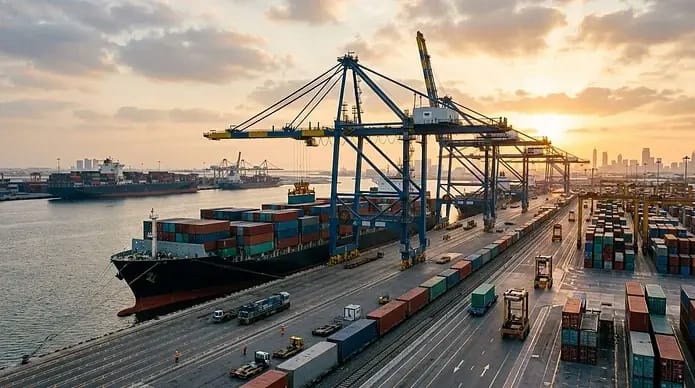
Global Trade: Supply Chain Changes and Their Trade-Offs
Global trade is not disappearing. It is being redesigned.
For decades, companies built international supply chains around one central goal: efficiency. They sourced materials from the lowest-cost supplier, concentrated production in specialized manufacturing hubs, and used inexpensive transportation to deliver products around the world.
That model generated enormous economic benefits. It lowered production costs, increased consumer choice, and allowed businesses to reach markets that once seemed inaccessible.
However, it also created hidden vulnerabilities.
Pandemic shutdowns, shipping delays, wars, trade restrictions, cyberattacks, extreme weather and shortages of critical components showed how quickly a highly efficient supply chain could become an operational weakness.
A company could have strong customer demand, sufficient financing and a modern factory—and still be unable to complete a product because one inexpensive component was unavailable.
The result is a new era of global trade. Businesses are no longer asking only, “Where can we produce this most cheaply?” They are also asking:
- Where can we produce it reliably?
- Which suppliers could replace one another?
- How exposed are we to political or transportation risks?
- How quickly can we respond to a disruption?
- Which components have no practical substitute?
The answer is not a complete retreat from globalization. It is a transition toward more diversified, regional and digitally connected supply networks.
Quick take
- Global trade continues to expand, but growth is uneven and vulnerable to geopolitical and energy shocks.
- Companies are replacing single-source supply chains with networks of qualified suppliers.
- Nearshoring and friend-shoring can reduce certain risks but cannot eliminate international dependence.
- Governments are influencing investment through tariffs, subsidies, export controls and industrial policies.
- Artificial intelligence is improving demand forecasting, supplier monitoring and logistics planning.
- Emerging economies can gain new manufacturing investment, but infrastructure and skills matter more than low wages alone.
- The greatest risk is replacing one concentrated dependency with another that remains hidden deeper in the supply chain.
Global trade is slowing—not collapsing
Headlines about deglobalization can create the impression that international commerce is shrinking rapidly. The reality is more complicated.
Trade remains essential to the world economy. Countries still depend on international markets for energy, food, machinery, chemicals, electronics, medicine and industrial materials. Modern products frequently cross several borders during production.
The World Trade Organization’s March 2026 outlook projected that merchandise trade volume would grow by 1.9% in 2026 after expanding by 4.6% in 2025. Commercial services trade was expected to grow faster than merchandise trade.
Meanwhile, UN Trade and Development estimated that the value of goods trade reached approximately $13.7 trillion during the first half of 2026, an increase of 12.5% from the same period in 2025.
These figures tell two different but compatible stories.
Trade values can rise because businesses exchange more products, because prices increase or because both happen simultaneously. Higher energy, shipping and commodity costs can push the value of trade upward even when the physical volume of goods grows much more slowly.
Global trade is therefore not ending. But the speed, composition and geography of trade are changing.
1. Supply-chain diversification is replacing maximum concentration
One of the largest changes is the move away from excessive dependence on a single factory, supplier or country.
Before recent disruptions, concentrating production often appeared sensible. A large supplier could deliver economies of scale, consistent quality and lower prices. Companies reduced complexity by maintaining fewer commercial relationships.
The weakness of this strategy became visible when disruptions affected the dominant supplier.
Diversification attempts to reduce this risk by developing additional sources of essential materials and components. A company might keep its main supplier while qualifying a second supplier in another region.
This sounds straightforward, but proper diversification requires more than collecting quotations from other factories.
A replacement supplier must be able to:
- Meet quality and safety standards
- Deliver the required volume
- Protect intellectual property
- Comply with regulations
- Maintain financial stability
- Access necessary raw materials
- Scale production during an emergency
- Connect to dependable transportation networks
A business may discover that two apparently independent suppliers rely on the same upstream processor. In that case, it has diversified commercial contracts without diversifying the underlying risk.
The most important lesson from the wider transformation of global trade in 2026 is that resilience must extend beyond direct suppliers.
2. Nearshoring is moving some production closer to customers
Nearshoring means relocating or expanding production in countries closer to a company’s major customers.
A business serving the United States might add production in Mexico. A Western European company might source more components from Central or Eastern Europe. An Asian manufacturer could establish facilities closer to its largest regional markets.
Potential benefits include:
- Shorter transportation times
- Lower freight exposure
- Easier communication
- Faster inventory replacement
- Greater management visibility
- Access to regional trade agreements
- Reduced exposure to distant shipping chokepoints
Nearshoring does not automatically produce lower costs. Wages, property, energy and regulatory compliance may be more expensive closer to the final market.
However, the cheapest factory price is not the same as the lowest total cost.
A distant supplier may offer a component for less, but that advantage can disappear when a company includes transportation, insurance, tariffs, large inventory requirements, financing costs and the risk of production delays.
Our detailed guide to why global supply chains are moving closer to home explains the differences between nearshoring, reshoring and friend-shoring. The essential point is that companies are choosing different locations for different parts of production rather than moving everything back to one country.
3. Friend-shoring is adding geopolitics to business decisions
Friend-shoring means concentrating important production and sourcing among countries viewed as politically reliable partners.
It reflects a significant change in global trade planning.
Companies once treated international political risk as a specialized concern. Today, export controls, sanctions, investment restrictions and competing technology rules can directly affect ordinary production decisions.
Businesses must evaluate whether a supplier could lose access to:
- Essential raw materials
- Advanced manufacturing equipment
- Semiconductor technologies
- International payment networks
- Shipping insurance
- Software or intellectual property
- Important export markets
Friend-shoring may reduce exposure to sudden political restrictions, but it also creates complications.
Political relationships can change. Elections can alter trade policies. Friendly countries may still prioritize their own industries during a shortage. Production concentrated entirely within one political bloc can remain vulnerable to a regional disaster or shared infrastructure failure.
The development of rival geopolitical power blocs shows why companies increasingly examine political alignment alongside price, quality and delivery time.
The goal should not be to predict every political event. It should be to understand which dependencies could become serious if relationships deteriorate.
4. Governments are shaping global trade more directly
Governments have always influenced trade. What is changing is the scale and strategic purpose of their involvement.
Industrial policy now affects semiconductors, batteries, electric vehicles, energy systems, pharmaceuticals, telecommunications and critical minerals. Governments are using grants, loans, tax incentives, tariffs, procurement rules and investment screening to encourage production they consider economically or strategically important.
These policies can create opportunities for businesses. Subsidies may make an otherwise expensive factory commercially viable. Infrastructure investment can transform a region into a competitive manufacturing center.
But government intervention can also create uncertainty.
A company may build its strategy around an incentive that changes after an election. Tariffs can protect one industry while increasing costs for another. Local-content rules can complicate sourcing, while retaliatory measures can reduce access to export markets.
Export restrictions are especially disruptive when a country controls a large share of processing capacity for a specialized material.
The problem is visible in the critical minerals race, where mining is only one part of the supply chain. Refining, processing and component manufacturing may be even more concentrated.
Businesses must therefore treat trade policy as an operational variable rather than background news.
5. Emerging economies are gaining manufacturing opportunities
Supply-chain diversification is creating new opportunities for countries seeking industrial investment.
India, Vietnam, Indonesia, Mexico and parts of Eastern Europe have attracted companies looking for additional manufacturing locations. Other economies may benefit as businesses search for specialized skills, strategic locations or access to growing consumer markets.
Low labor costs alone are no longer enough.
Modern manufacturers also evaluate:
- Electricity price and reliability
- Port and road infrastructure
- Customs efficiency
- Political and legal stability
- Workforce skills
- Supplier ecosystems
- Data connectivity
- Environmental compliance
- Access to financing
- Proximity to customers
- Trade-agreement coverage
A country may offer inexpensive labor but lose investment if manufacturers expect regular electricity interruptions or unpredictable customs delays.
The greatest gains usually emerge when an economy develops clusters. A major factory attracts component suppliers, logistics providers, technical schools and service companies. Those supporting businesses make the location more attractive to additional manufacturers.
This can create employment, exports and technological knowledge. But governments must avoid becoming dependent on a single foreign industry or allowing weak environmental protections to carry the hidden cost of expansion.
Supply-chain diversification is an opportunity, not a guarantee.
6. Artificial intelligence is making supply chains more responsive
Large international companies manage thousands of suppliers, shipments, components and customer orders. Human teams cannot manually analyze every signal across such a complicated network.
Artificial intelligence can help identify patterns and risks earlier.
Potential applications include:
- Forecasting customer demand
- Detecting unusual supplier delays
- Monitoring inventory levels
- Comparing transportation routes
- Predicting equipment failures
- Identifying changes in shipping times
- Evaluating weather disruptions
- Automating routine documentation
- Simulating shortage scenarios
- Finding potential alternative suppliers
Suppose a company’s system detects slower deliveries from a supplier, congestion at a nearby port and worsening weather along the shipping route. It could alert managers before the disruption reaches the final assembly line.
AI can also improve inventory planning. Businesses do not want to stockpile every component because excess inventory consumes cash, requires storage and may become obsolete. Better forecasting helps companies hold more of the items that create serious production risks while keeping ordinary inventory leaner.
The expansion of AI infrastructure investment is strengthening these capabilities. However, businesses still need accurate data and experienced people who understand the operational context.
AI can detect patterns. It cannot rescue a company that does not know who its upstream suppliers are.
7. Sustainability is becoming a trade requirement
Environmental performance is increasingly influencing supplier selection and market access.
Companies face pressure from customers, investors and regulators to understand the emissions, energy use, waste and labor conditions connected to their products. These expectations extend beyond a company’s own operations to its wider supply network.
This can encourage:
- Cleaner manufacturing processes
- More efficient transportation
- Renewable electricity use
- Better material traceability
- Repairable product designs
- Recycled inputs
- Reduced packaging
- More responsible mining
Nearshoring may reduce transportation distances, but local production is not automatically more sustainable. A nearby factory powered by highly polluting energy could create a larger footprint than a distant but efficient facility using cleaner electricity.
Companies need to evaluate the full product life cycle rather than rely on simple assumptions.
The global energy transition will also reshape trade flows. Demand for fossil fuels may change while trade in batteries, electricity equipment, critical minerals and low-carbon technologies expands.
Sustainability is therefore becoming both a compliance issue and a competitive factor.
The serious risk: diversification can be an illusion
The largest danger in the new era of global trade is believing a supply chain has become resilient when its most important dependency remains concentrated.
Consider a company that buys motors from three suppliers in three different countries. On the surface, the sourcing strategy appears diversified.
But all three manufacturers may obtain permanent magnets from the same producer. That magnet manufacturer may depend on rare earth elements processed in one country. A restriction at that upstream stage could interrupt all three suppliers simultaneously.
Similar hidden dependencies exist in:
- Semiconductor fabrication equipment
- Pharmaceutical ingredients
- Battery materials
- Industrial chemicals
- Cloud-computing infrastructure
- Specialized logistics services
- Shipping routes
- Electronic components
- Critical minerals
This is why supplier count alone is a poor measure of resilience.
Companies need visibility several levels into the supply chain. They must identify where apparently separate production networks converge on the same material, technology, transport route or facility.
The growing uncertainty surrounding global trade makes this deeper mapping increasingly important.
What businesses should do now
Companies do not need to abandon efficient global supply chains. They need to identify where maximum efficiency creates unacceptable risk.
A practical strategy begins with six actions.
Map critical dependencies
Identify the materials and components capable of stopping production. Trace them beyond direct suppliers whenever possible.
Separate critical inputs from ordinary ones
Not every item requires two or three suppliers. Diversification should focus first on components with long replacement times, few substitutes or high operational consequences.
Qualify alternatives before a crisis
Finding a potential supplier is not enough. Test quality, capacity and delivery performance while existing operations remain stable.
Model realistic disruption scenarios
Examine what would happen if a port closed, a supplier failed, a trade restriction appeared or transportation costs increased sharply.
Balance resilience with cost
Holding more inventory and maintaining additional suppliers costs money. Businesses should compare those expenses with the financial impact of a prolonged shutdown.
Assign responsibility
Supply-chain resilience cannot remain an occasional discussion. Specific people must monitor risks, maintain alternatives and update response plans.
What this new era means for consumers
Supply-chain diversification may raise some costs. Operating multiple supplier relationships, holding strategic inventory and producing in higher-cost regions can be more expensive than relying on one enormous low-cost factory.
Consumers may pay part of that resilience premium.
However, a well-designed system can also reduce shortages, extreme price increases and long delivery delays. Competition among manufacturing regions could encourage innovation, while production closer to customers may improve responsiveness.
The effect will vary by product.
Basic goods with easy substitutes may continue moving toward the lowest-cost locations. Strategic products, including semiconductors, medical supplies, energy equipment and critical components, are more likely to receive additional protection and investment.
The world is unlikely to become fully self-sufficient at the national level. International specialization remains too valuable.
Instead, consumers will increasingly buy products created through more regional and politically aware networks.
Frequently asked questions
Is globalization ending?
No. Goods, services, capital, technology and information continue crossing borders. Globalization is changing from a model centered on maximum efficiency toward one that gives greater importance to resilience and security.
What is supply-chain diversification?
It is the process of reducing dependence on a single supplier, country, facility or transportation route by developing credible alternatives.
What is the difference between nearshoring and reshoring?
Nearshoring moves production to a nearby country. Reshoring brings production back to the company’s home country.
What is friend-shoring?
Friend-shoring places important production in countries considered politically reliable trading partners.
Will diversified supply chains make products more expensive?
Some products may cost slightly more because businesses maintain additional suppliers, inventory or production capacity. That additional cost can function as insurance against severe disruptions.
Can AI prevent supply-chain disruptions?
AI can improve forecasts and provide earlier warnings, but it cannot eliminate geopolitical events, natural disasters or supplier failures. Its value depends on good data and effective human decision-making.
Which industries face the greatest supply-chain risks?
Semiconductors, pharmaceuticals, vehicles, energy equipment, aerospace, electronics and industries dependent on specialized minerals or chemicals are especially exposed.
Light Span Perspective
Global trade is entering a new era, but it is not turning away from international cooperation.
The strongest supply chains will combine global reach with regional flexibility. They will use international specialization without depending blindly on one supplier or location. They will use artificial intelligence to improve visibility while retaining human judgment and trusted commercial relationships.
Efficiency will remain essential. Consumers and businesses still care about price. But the cheapest supply chain is not truly cheap if one unexpected disruption can shut down production for months.
The companies most likely to succeed will understand the difference between apparent diversification and genuine resilience.
They will know where their critical components originate, which suppliers can replace one another and how quickly their network can respond when circumstances change.
That is the defining feature of the next era of global trade: not isolation, but intelligent connection.
Continue reading more

