


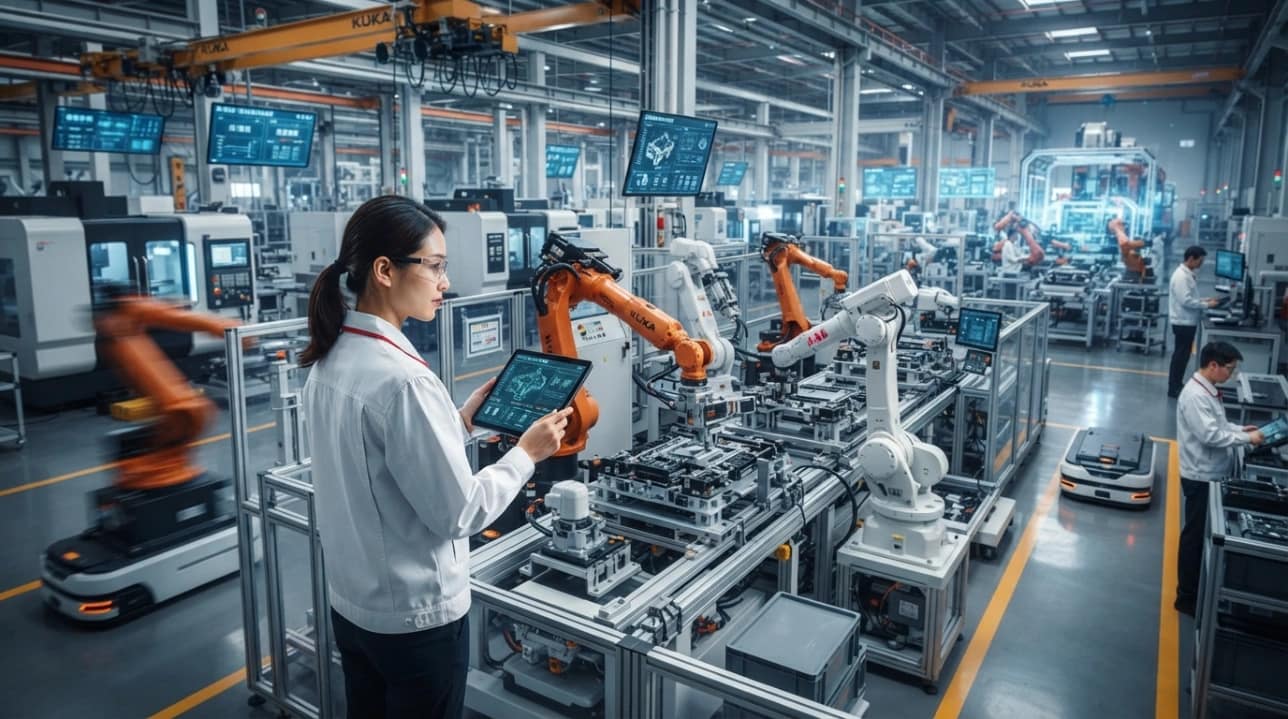
China Advanced Manufacturing: China is putting advanced manufacturing back at the center of its economic strategy. At a national conference in Beijing this week, President Xi Jinping called for the sector to become ‘bigger and stronger’ while urging tighter control over key industrial supply chains. Premier Li Qiang also emphasized intelligent manufacturing, digital upgrades and the development of high-end domestic technologies. The verified announcement matters because it connects several trends that are often discussed separately: artificial intelligence in factories, electric vehicles, industrial software, robotics, critical components and the broader push for technological self-reliance.
The story is not simply that China wants more factories. China already has enormous industrial capacity. The more consequential question is what kind of manufacturing system Beijing is trying to build next—and what that system could mean for companies, workers and competitors around the world.
That question matters because manufacturing is becoming more software-defined and more politically strategic at the same time. A modern industrial system is not only a collection of plants. It is a network of data centers, power contracts, chip suppliers, logistics hubs, standards bodies, engineering schools and financing channels. The Light Span has previously examined how AI infrastructure spending is changing the economics of computing. The same logic increasingly applies to factories: whoever controls the infrastructure can influence who scales, who pays and who remains dependent.
What China actually announced
According to reporting based on official Chinese statements, Xi said China should continue making advanced manufacturing “bigger and stronger” and improve the autonomy and controllability of industrial chains. That language is important. It suggests that the policy goal is not only higher output. It is also greater control over the components, machinery, software and technical standards needed to keep production running when foreign access is restricted.
Li’s remarks point in the same direction, with a focus on next-generation intelligent manufacturing and faster digital and AI-driven industrial upgrades. In practical terms, that can include factory automation, machine-vision systems, industrial robots, predictive maintenance, digital twins, smart logistics and software that coordinates production across multiple plants.
These are verified policy signals and official priorities. They are not proof that every factory has already adopted advanced systems, nor do they guarantee that the strategy will deliver faster growth or higher household incomes. That distinction matters because industrial policy announcements often describe objectives rather than completed outcomes.
China’s official economic and industrial communications can be followed through Xinhua’s national reporting, while international comparisons on manufacturing technology and workforce readiness can be checked against public research from organizations such as NIST’s Manufacturing Extension Partnership.
Why supply-chain control is the real issue
Modern manufacturing depends on far more than final assembly. A company may design a product domestically while relying on foreign lithography tools, imported sensors, specialized chemicals, software licenses, high-end bearings, precision machine tools or overseas cloud infrastructure. A disruption in one narrow link can slow the entire chain.
That is why “autonomy and controllability” is a more revealing phrase than the headline about expanding manufacturing. Beijing is signaling that it wants fewer points of vulnerability in sectors it considers strategically important. The approach resembles an insurance policy: even if domestic substitutes are not always the cheapest or most advanced option, they may be judged valuable because they reduce the risk of external pressure.
The trade-off is efficiency. Supply chains built around the lowest-cost global supplier can be cheaper in stable periods. Supply chains rebuilt around redundancy, domestic capacity and political resilience can be more expensive. The policy question is therefore not whether control is useful. It is how much cost China—and the rest of the world—is willing to absorb for it.
From property-led growth to industrial upgrading
China’s policy shift is also connected to a broader economic adjustment. The property sector has lost some of the role it once played in driving investment and demand, while industrial technology has received more attention. Officials increasingly describe advanced manufacturing as a foundation for productivity, export competitiveness and long-term national strength. That tension also appears in The Light Span’s recent analysis of uneven G20 economic growth: headline expansion can coexist with weak household confidence, regional divergence and fragile investment.
Industrial upgrading can therefore help China compete without solving every domestic problem. It may improve production capacity while leaving consumption, housing and income under pressure. The outcome depends on whether productivity gains spread beyond a small group of export champions and state-supported sectors.
That does not mean industrial investment can automatically replace housing or household consumption. A country can produce more electric vehicles, batteries and industrial equipment without creating equally strong growth in wages or consumer confidence. Reuters noted that China’s high-tech push has not yet translated into a clear improvement in household income and consumption. That is a critical warning against treating industrial output as a complete measure of economic health.
Manufacturing can support growth in several ways. It can raise export earnings, create demand for engineering services, expand supplier networks and improve the productivity of other sectors. But it can also produce excess capacity, intensify price competition and increase trade tensions if domestic demand is not strong enough to absorb the output.
Why electric vehicles and green technology are central
China’s advanced-manufacturing strategy is visible in electric vehicles, batteries, solar equipment and other green technologies. These industries combine large-scale production with heavy investment in engineering, software, materials science and supply-chain coordination.
That combination gives Chinese companies an important advantage in learning speed. When firms produce at scale, they can collect more operational data, refine designs faster and spread fixed costs across a larger volume of products. The result can be a feedback loop in which manufacturing capability improves the competitiveness of the next generation of products. Recent coverage of South Korea’s AI-chip-led export boom shows why this matters: concentrated strength in a strategic industrial cluster can lift national trade figures, but it can also increase exposure to a narrow group of customers and products.
The same learning effect can appear in batteries, industrial controls and robotics. Yet scale is not automatically a moat. Competitors can catch up through better process design, lower energy costs, stronger software or closer access to end markets. The advantage lasts only while firms keep converting production volume into better products and lower total costs.
But scale also creates political pressure. European governments and manufacturers are increasingly concerned about competition from Chinese electric vehicles and clean-tech exports. If imports rise faster than local producers can respond, governments may use tariffs, subsidies or local-content rules to protect domestic industries. Those measures can slow the spread of cheaper products while increasing the cost of the energy transition.
The result is a more fragmented industrial economy. Instead of one integrated global market with a single cost structure, companies may face regional production systems shaped by security concerns, trade rules and access to technology.
AI in factories is not the same as AI in software
Much of the discussion about AI focuses on chatbots and digital assistants. Manufacturing uses AI differently. It is often embedded in narrower systems that inspect products, forecast maintenance needs, optimize energy use, schedule production or coordinate robots.
This form of AI can create value without resembling a general-purpose conversational model. A factory does not need an AI system to write an essay. It needs a system that can detect a defect earlier, reduce downtime or keep a production line within tolerance.
That makes industrial AI more dependent on physical infrastructure and reliable data. Sensors must be calibrated. Data must be labeled. Models must be monitored when materials, machines or operating conditions change. A system that performs well in one plant may not transfer neatly to another.
China’s emphasis on intelligent manufacturing suggests that policymakers see AI as part of a broader industrial stack, not as a standalone software sector. The strategy is therefore likely to reward companies that can combine machines, chips, software, energy systems and operational expertise.
The global business consequences
For multinational companies, the immediate consequence is not that China becomes impossible to compete with. It is that the basis of competition changes. Price remains important, but so do speed, scale, supply-chain visibility and the ability to localize production.
Businesses that sell into Chinese industrial markets may benefit from demand for automation, sensors, industrial software and advanced equipment. At the same time, companies that rely heavily on one market or one manufacturing corridor may face higher geopolitical risk. That is similar to the concentration risk discussed in The Light Span’s analysis of the Qualcomm–Amazon AI chip relationship: a technology partnership can create opportunity, but it can also expose the wider ecosystem to supplier choices, procurement shifts and changing standards.
Procurement teams are already being asked questions that were once left to governments: Which components are strategically sensitive? Which suppliers can be replaced? Where is data stored? Which tools depend on foreign licenses? How quickly could production be moved if trade restrictions expand?
These questions can increase resilience, but they also raise operating costs. The companies most likely to adapt successfully will be those that treat supply-chain mapping as a continuing capability rather than a one-time exercise.
What competitors are likely to do
The United States, Europe, Japan, South Korea and other industrial economies are unlikely to ignore China’s manufacturing push. Their responses may include investment incentives, semiconductor controls, support for domestic production, tighter screening of foreign acquisitions and partnerships aimed at securing critical minerals and components.
That competition does not guarantee a simple split between two isolated blocs. Companies will still look for efficiency, and countries will still need access to markets, talent and specialized equipment. The more plausible outcome is selective decoupling: deeper separation in a limited number of strategic technologies, combined with continued commercial links elsewhere.
The policy challenge is to distinguish genuine security risks from ordinary competition. If every industrial product is treated as a national-security issue, trade becomes more expensive and innovation slows. If critical dependencies are ignored, a crisis can expose vulnerabilities that are difficult to repair quickly.
What to watch next
The most useful indicators will be concrete rather than rhetorical. Watch whether China’s announcements are followed by measurable investment in industrial software, domestic machine tools, robotics, semiconductor equipment and workforce training. Watch whether productivity improves outside the headline sectors. Watch whether household income and consumption strengthen alongside industrial output.
It is also worth tracking whether China’s export growth triggers new restrictions in Europe and elsewhere. If governments respond with broad protectionism, global companies may need to build parallel supply chains. If they respond with narrower standards and targeted controls, competition may remain more open.
Another important test is financial discipline. Advanced manufacturing requires large capital commitments. If investment flows into projects that cannot earn sustainable returns, the strategy could produce overcapacity rather than durable productivity gains. The risk is not limited to factories. It can also affect markets and investors, as seen in the site’s discussion of asset tokenization and the movement of finance on-chain: new infrastructure can attract capital quickly, but the quality of the underlying cash flows still determines whether the investment lasts.
Light Span Perspective
China’s advanced-manufacturing push is best understood as an effort to control the industrial systems that determine economic resilience, not merely as a campaign to build more factories. The emphasis on supply-chain autonomy, intelligent production and high-end domestic technology could strengthen China’s position in the next phase of global competition.
But policy ambition is not the same as economic success. The real test will be whether manufacturing upgrades raise productivity, support household incomes and create products that remain competitive without permanent protection. For the rest of the world, the lesson is equally clear: industrial strategy is returning as a central business issue, and companies that ignore the politics of production may discover that efficiency alone is no longer enough.

