


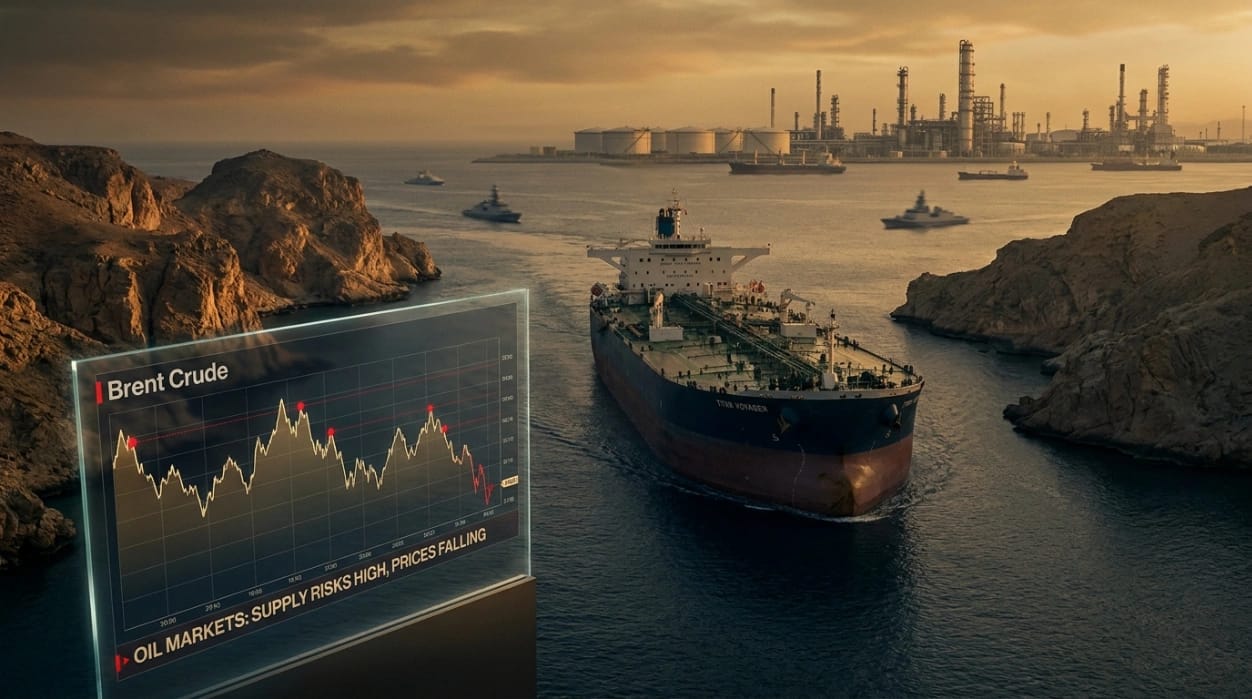
Oil Prices Are Falling: Why Supply Risks Remain
Oil prices are falling again—but the global energy market is nowhere near normal.
On August 13, crude prices came under renewed pressure after oil-market forecasters lowered their expectations for global demand. Brent crude was trading around the high-$80s per barrel, while West Texas Intermediate was in the low-$80s.
At first glance, that looks like good news.
Cheaper oil can reduce fuel costs, ease inflation and give consumers and businesses some breathing room.
But the current oil market is unusually complicated.
The latest data from the International Energy Agency show that global oil supply remains severely disrupted, inventories have fallen sharply and Middle East production remains constrained. At the same time, expensive fuel and disruptions are hurting oil consumption itself.
That creates a strange situation:
Oil prices are falling partly because the damage to the global economy is reducing demand for oil.
And that could make the next move in crude particularly important.
Why Oil Prices Are Falling
The immediate pressure on crude comes from the demand side.
The IEA’s August Oil Market Report cut its 2026 global oil-demand forecast. It now expects worldwide demand to decline by 1.6 million barrels per day in 2026, 510,000 barrels per day more negative than its previous estimate. The agency points to continued disruption around the Strait of Hormuz and elevated fuel prices as major reasons for the weaker outlook.
That’s a major change in the market narrative.
Earlier, supply shortages were dominating the oil story.
Now investors are increasingly asking:
What happens to oil consumption if high prices and economic disruption continue for months?
The answer could be significant.
If airlines cut flights, factories reduce production, consumers drive less and economies slow, oil demand falls.
That can eventually put downward pressure on crude prices—even when supply remains constrained.
But the Supply Problem Hasn’t Disappeared
This is where the oil market becomes dangerous.
The IEA estimates global oil supply increased by 2.4 million barrels per day in July to 101.5 million barrels per day, but production was still 6.3 million barrels per day below year-earlier levels.
Even more importantly, approximately 8.3 million barrels per day of Gulf output remained shut in at the time of the report.
That’s an enormous amount of disrupted production.
The agency expects global oil supply to decline by around 4.3 million barrels per day on average in 2026, before potentially rebounding sharply in 2027 if disruptions ease.
So the market is balancing two opposing forces:
Bearish force
Weakening oil demand.
Bullish force
Severely constrained supply.
That tug-of-war is likely to keep crude prices highly sensitive to every major geopolitical development.
The Strait of Hormuz Is Still the Biggest Wild Card
Few places matter more to the global oil market than the Strait of Hormuz.
A large share of the world’s petroleum trade passes through this narrow waterway.
The problem isn’t simply whether oil is physically available underground.
It is whether producers can move it to buyers.
The latest IEA report says an agreement allowing the reopening of Hormuz and unhindered transit through the Bab el-Mandeb Strait remains elusive. The agency therefore reduced its supply estimates for the remainder of the year.
The U.S. Energy Information Administration has also warned that Hormuz flows could remain severely constrained through August.
According to EIA estimates reported by Reuters, about 5.5 million barrels per day of Middle East oil output was shut in during July, representing more than 5% of global consumption.
That is why a seemingly modest geopolitical development can suddenly move crude prices by several dollars.
Why Oil Prices Have Become So Volatile
The IEA says benchmark crude prices traded within an extraordinary $40-per-barrel range during July.
North Sea Dated crude climbed by $25.67 per barrel during July alone, ending the month at $96.80 before trading around $92 at the time of the IEA report.
The reason is simple:
Oil traders are pricing uncertainty.
One headline can suggest that supply disruptions will ease.
The next can suggest they will last much longer.
That produces violent swings.
In July, prices briefly surged as high as approximately $105 per barrel when expectations around the Iran-US situation deteriorated.
For consumers, this creates a frustrating environment.
The price of crude can fall today and rise sharply tomorrow without any fundamental change in long-term production capacity.
The Global Economy Is Now Part of the Oil Supply Story
Normally, economists think about oil prices affecting the economy.
Higher oil prices:
→ increase transportation costs
→ raise production costs
→ increase inflation
→ reduce consumer spending
→ potentially slow economic growth
But today’s market creates the reverse feedback loop as well.
If oil becomes expensive enough:
→ consumers reduce consumption
→ businesses cut fuel usage
→ economic activity slows
→ oil demand falls
→ crude prices come under pressure
That’s one reason the current price decline shouldn’t automatically be interpreted as a return to normality.
Lower oil prices can sometimes be a warning sign rather than good news.
Refinery Markets Are Sending Another Warning
Crude prices aren’t the only thing to watch.
The IEA says global refinery crude throughput remained nearly 5 million barrels per day below year-earlier levels in July, at about 80.9 million barrels per day. Middle East product-export disruptions and attacks on Russian refineries further reduced expected third-quarter refinery runs.
At the same time, tight markets for gasoline and other refined products pushed refining margins sharply higher in some regions.
This matters because consumers don’t buy Brent crude.
They buy:
- Gasoline
- Diesel
- Jet fuel
- Heating products
So even if crude prices decline, fuel prices don’t necessarily fall at the same speed.
Refining capacity, transportation bottlenecks and regional inventories all matter.
Global Oil Inventories Are Falling
Another important warning sign is inventories.
The IEA says global observed oil inventories fell by 69 million barrels in July.
Total observed inventories were below 7.9 billion barrels, down approximately 410 million barrels since the beginning of the war, equivalent to an average decline of about 2.7 million barrels per day.
Falling inventories can make markets more vulnerable to another supply shock.
Think of inventories as a buffer.
When storage levels are comfortable, a temporary disruption may be manageable.
When inventories are already depleted, another disruption can create a much larger price reaction.
That’s why today’s relatively lower crude price shouldn’t make investors complacent.
So Where Could Oil Prices Go Next?
The answer depends heavily on what happens in the Middle East.
The EIA’s August outlook provides a useful baseline.
It expects Brent crude to average approximately $86.81 per barrel in 2026, compared with $80.88 for WTI.
For 2027, the EIA expects Brent to decline to around $69.39 per barrel, assuming Middle East production and global trade recover substantially.
That creates three broad scenarios.
Scenario 1: Supply disruptions ease
If Hormuz shipping normalizes and Middle East production gradually returns, oil could move substantially lower.
The EIA’s 2027 forecast of roughly $69 Brent illustrates how quickly prices could decline once supply constraints disappear.
Scenario 2: Disruptions persist
If production remains constrained while inventories continue falling, crude could rebound sharply.
This is the biggest upside risk for oil prices.
Scenario 3: Demand collapses faster
If expensive energy and geopolitical disruption produce a much deeper economic slowdown, oil consumption could weaken dramatically.
That would create a powerful downward force on prices.
What This Means for Inflation
Oil remains one of the most important variables for inflation.
When crude rises, the impact spreads through the economy.
Transportation becomes more expensive.
Airlines face higher fuel bills.
Shipping costs increase.
Manufacturers pay more to move goods.
Agriculture faces higher operating expenses.
Eventually, some of those costs reach consumers.
That means a sudden oil-price spike could complicate central-bank efforts to control inflation.
Conversely, sustained lower crude prices could help reduce inflationary pressure.
But there is a catch:
Oil prices can fall because the economy is weakening.
So central banks can’t simply celebrate cheaper crude without examining why it became cheaper.
What Consumers Should Watch
For ordinary consumers, the most important question isn’t:
“Is Brent crude at $88 or $90?”
It’s:
“Where is oil heading over the next several months?”
Watch these five indicators:
1. Strait of Hormuz traffic
A sustained return to normal shipping would be bearish for crude.
2. Middle East production
Every million barrels per day restored changes the supply balance.
3. Global inventories
Falling inventories increase vulnerability to another shock.
4. Oil demand forecasts
Repeated downgrades could signal broader economic weakness.
5. Refinery operations
Crude availability doesn’t automatically mean cheap gasoline or diesel.
The Bigger Story: Oil Is Becoming More Difficult to Predict
The traditional oil-market formula is straightforward:
Supply + Demand = Price
But geopolitical disruption adds another variable:
Supply + Demand + Transportation Risk + Geopolitics = Extreme Volatility
That’s why oil forecasting has become unusually difficult.
The latest IEA report itself describes an exceptionally wide trading range and continues to revise supply expectations as conditions change.
For consumers and businesses, that means planning around one oil-price assumption could be dangerous.
Flexibility is becoming increasingly valuable.
The Light Span Perspective
The recent decline in oil prices is encouraging—but it shouldn’t be mistaken for a clean resolution of the global energy crisis.
The market is being pulled in two opposite directions.
Demand is weakening.
But supply remains deeply disrupted.
The IEA expects global oil demand to decline by 1.6 million barrels per day this year while global supply is also projected to fall sharply.
Meanwhile, the EIA expects Brent to average around $86.81 in 2026 before falling toward $69.39 in 2027 if Middle East production and trade recover.
That tells us something important.
The future of oil prices isn’t simply about how much crude the world produces.
It’s about whether that crude can move freely, whether economies continue consuming it, and how quickly disrupted production can return.
For now, the oil market remains caught between a weakening-demand story and a potentially explosive supply-risk story.
And that means today’s falling prices could be temporary.
The next major geopolitical headline could matter more than the last $5 move in crude.
FAQs
Why are oil prices falling in August 2026?
Oil prices are under pressure because global oil-demand forecasts have weakened. The IEA significantly reduced its 2026 demand outlook, citing supply disruptions, elevated fuel prices and their impact on consumption.
What is pushing oil prices higher?
The major bullish factor is restricted supply, particularly Middle East production and shipping disruptions around key waterways.
What is the oil price forecast for 2026?
The EIA’s August forecast puts average 2026 Brent crude at approximately $86.81 per barrel and WTI at $80.88.
Could oil prices fall below $70?
Yes, particularly if Middle East production and shipping recover substantially. The EIA currently forecasts average Brent prices of about $69.39 for 2027 under its recovery assumptions.
Why does the Strait of Hormuz matter?
Hormuz is a critical oil-trading route. Prolonged disruption can restrict global supplies and cause prices to rise rapidly.
Continue reading more

