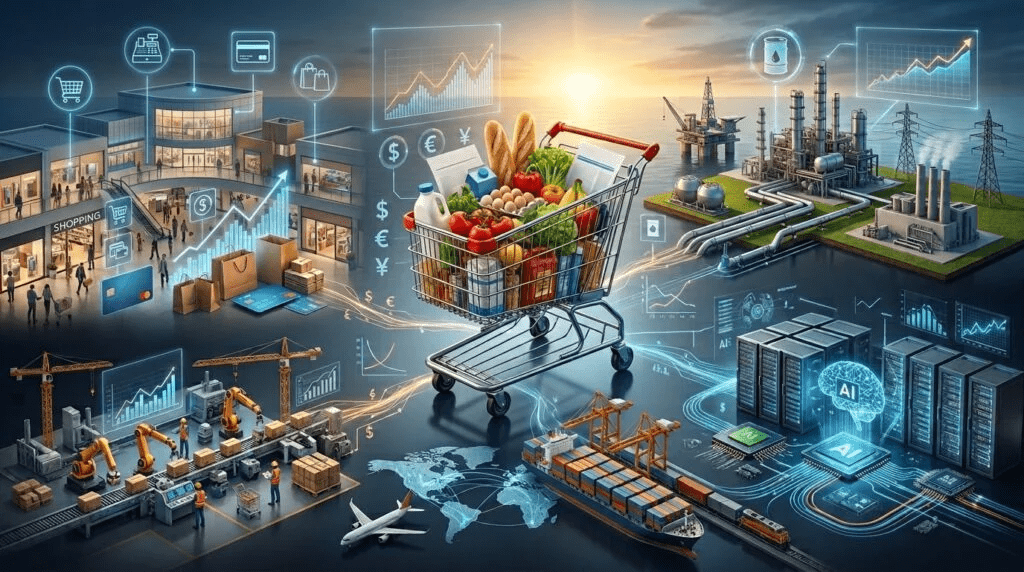



Inflation is not falling smoothly because the forces pushing prices down are colliding with new shocks and structural costs. Supply chains have normalized in some areas, but energy volatility, housing shortages, wage pressure and expensive investment in resilient infrastructure continue to influence what households and businesses pay.
It is also important to separate inflation from the price level. Lower inflation means prices are rising more slowly; it does not mean groceries, rent or services return to their previous cost. That is why official progress can coexist with continued financial pressure—and why the final stage of disinflation often feels harder than the first.
Quick Take
- Inflation has cooled significantly from its post-pandemic peak, but the pace of disinflation has slowed across many major economies.
- Higher prices today are being sustained by structural forces—including energy costs, labor shortages, supply chain changes, and massive investment in AI infrastructure.
- Central banks have made progress through higher interest rates, but monetary policy alone cannot resolve every source of inflation.
- Businesses and investors are adapting to an economy where resilience, energy security, and technology investment are becoming long-term inflation drivers.
- Understanding what’s keeping prices elevated can help households, businesses, and investors make better financial decisions.
If Inflation Is Falling, Why Does Everything Still Feel Expensive?
Many people hear that inflation is slowing and naturally expect prices to return to where they were a few years ago.
Then they visit the grocery store.
They renew their insurance policy.
They pay their electricity bill.
And they wonder why everyday life still feels so expensive.
The answer lies in a common misunderstanding about inflation.
Inflation measures how quickly prices are rising, not whether prices are falling. When inflation slows from 8% to 3%, prices are still increasing—just at a slower pace. Unless an economy experiences widespread deflation, prices rarely return to previous levels.
But there is another important reason.
Today’s inflation is no longer driven by a single shock. Instead, it reflects a combination of structural changes that are reshaping the global economy.
From energy markets and labor costs to artificial intelligence and supply chain resilience, multiple forces are keeping inflation more persistent than many economists expected.
1. Energy Costs Continue to Ripple Through the Economy
Energy remains one of the most influential components of inflation.
Oil, natural gas, and electricity affect far more than transportation.
Energy powers:
- Manufacturing facilities
- Cargo ships
- Trucks and rail networks
- Agricultural equipment
- Warehouses
- Data centers
- Commercial buildings
When energy prices increase, businesses often experience higher production and transportation costs.
Many eventually pass part of those costs on to consumers through higher prices.
Even when crude oil prices stabilize, electricity generation, utility investments, and regional supply constraints can keep energy bills elevated.
Recent geopolitical tensions have also reminded markets that global energy supplies remain vulnerable to disruption.
Why It Matters
Energy influences the cost of nearly every product and service, making it one of the most powerful long-term drivers of inflation.
2. The AI Infrastructure Boom Is Fueling New Demand
Artificial intelligence promises enormous productivity gains in the future.
But building that future requires unprecedented investment today.
Technology companies are spending hundreds of billions of dollars on:
- AI data centers
- Advanced semiconductors
- High-speed networking
- Cloud infrastructure
- Electricity generation
- Grid modernization
These projects create jobs, stimulate economic activity, and increase demand for construction materials, engineering services, specialized equipment, and skilled labor.
In some regions, expanding AI infrastructure is already contributing to higher electricity demand and increased investment across utilities and industrial sectors.
Over time, AI may help reduce costs through automation and productivity improvements.
In the short term, however, building the infrastructure requires substantial capital spending.
Why It Matters
The AI revolution is creating new sources of economic demand that can temporarily slow the pace of disinflation.
3. Supply Chains Are Being Rebuilt for Resilience
Before recent global disruptions, efficiency was often the primary goal of international supply chains.
Businesses concentrated manufacturing where production costs were lowest.
That strategy changed after the pandemic exposed the risks of relying heavily on limited suppliers and long-distance logistics.
Today, many companies are:
- Diversifying suppliers
- Expanding regional manufacturing
- Holding larger inventories
- Investing in domestic production
- Strengthening logistics networks
These changes improve resilience.
They also increase operating costs.
Producing goods across multiple locations generally costs more than concentrating production in one low-cost region.
Those additional costs eventually become part of product prices.
Why It Matters
Greater resilience improves long-term economic stability but often comes with higher production costs that contribute to persistent inflation.
4. Strong Labor Markets Continue Supporting Wage Growth
Inflation is influenced not only by products and commodities but also by labor markets.
Across many industries, employers continue competing for qualified workers.
Higher wages benefit households by increasing incomes and improving living standards.
However, they also raise operating costs for businesses.
Industries experiencing labor shortages—including healthcare, construction, hospitality, transportation, and skilled manufacturing—often face rising payroll expenses.
Businesses frequently respond by adjusting prices to maintain profitability.
Economists sometimes refer to this dynamic as services inflation, since labor represents a significant share of costs across service industries.
Why It Matters
Healthy employment markets support consumer spending, but sustained wage growth can slow the return to lower inflation.
5. Consumer Spending Has Remained Surprisingly Resilient
One of the primary goals of higher interest rates is to slow economic activity.
More expensive borrowing typically reduces spending, business investment, and demand.
Yet many major economies have proven more resilient than expected.
Several factors have supported continued spending, including:
- Strong employment
- Rising household incomes
- Government investment programs
- Infrastructure spending
- Corporate AI investment
- Continued business expansion
This resilience has helped prevent deeper economic slowdowns but has also reduced the speed at which inflation has returned to central bank targets.
Why It Matters
As long as demand remains relatively strong, businesses often retain greater ability to maintain higher prices.
Why Central Banks Can’t Solve Every Inflation Problem
Central banks play a crucial role in controlling inflation by adjusting interest rates and influencing financial conditions.
However, monetary policy has limitations.
Higher interest rates cannot:
- Produce more oil
- Build power plants faster
- Increase semiconductor manufacturing overnight
- Resolve geopolitical conflicts
- Expand global shipping capacity
- Accelerate workforce training
Many of today’s inflationary pressures originate on the supply side of the economy rather than the demand side.
As a result, reducing inflation increasingly requires improvements in productivity, infrastructure, energy production, and global supply chains alongside monetary policy.
Why It Matters
Today’s inflation reflects structural economic changes that extend beyond the reach of interest-rate decisions alone.
What Persistent Inflation Means for Households
Although individuals cannot influence global markets, they can make financial decisions that improve resilience during periods of elevated prices.
Practical strategies include:
- Reviewing recurring subscriptions and monthly expenses
- Comparing prices before significant purchases
- Building emergency savings where possible
- Reducing high-interest debt
- Paying close attention to variable-rate loans
- Maintaining a long-term financial plan
Perhaps most importantly, households should recognize that lower inflation does not necessarily mean lower prices.
Historically, living standards improve when wage growth and productivity eventually outpace inflation.
Why It Matters
Financial resilience becomes increasingly valuable when inflation remains above historical averages.
What Persistent Inflation Means for Investors
Inflation affects industries differently.
Some businesses possess strong pricing power and can pass higher costs on to customers with relatively little impact on demand.
Investors often monitor sectors including:
- Energy
- Utilities
- Infrastructure
- Industrial automation
- Technology
- Healthcare
- Consumer staples
At the same time, persistent inflation may influence bond markets, corporate borrowing costs, and central bank policy.
Rather than reacting to every monthly inflation report, long-term investors typically focus on broader structural trends affecting productivity, earnings, and economic growth.
Why It Matters
Understanding the underlying drivers of inflation often matters more than predicting the next monthly inflation reading.
Looking Ahead: Inflation May Follow a Different Path This Decade
Inflation is unlikely to disappear overnight.
Instead, many economists expect periods of moderation interrupted by new sources of upward pressure.
Artificial intelligence, energy investment, demographic changes, industrial policy, and supply chain restructuring are reshaping the global economy in ways that differ from previous decades.
These structural forces could produce a more complex inflation environment than the relatively stable period that characterized much of the early twenty-first century.
For policymakers, businesses, and investors, adapting to this new reality may prove just as important as reducing inflation itself.
What Persistent Inflation Means Now
Inflation today is more than the result of temporary economic disruptions.
It reflects a world undergoing profound transformation.
Energy security, resilient supply chains, labor markets, technological investment, and geopolitical uncertainty are all influencing prices simultaneously.
While inflation has eased from recent highs, these structural changes suggest the path back to long-term price stability may be slower and less predictable than many initially expected.
Understanding these broader forces helps explain why everyday expenses remain elevated—and why managing inflation in the years ahead will require far more than interest-rate adjustments alone.
The 2026 Inflation Picture Has Changed
The latest global outlook is less comfortable than the steady-disinflation story many expected. In its July 2026 update, the International Monetary Fund projected global headline inflation to rise from 4.1% in 2025 to 4.7% in 2026 before easing to 3.9% in 2027. The IMF said the disinflation trend had stalled, with higher energy and food prices playing an important role.
That global number hides major differences. Countries with domestic energy supply may absorb a commodity shock more easily than import-dependent economies. Currency weakness can make imported fuel, food and machinery more expensive even when world prices are stable. Housing markets and wage growth also vary widely, so one central bank may be ready to cut rates while another remains cautious.
Why interest-rate cuts may be slower
Central banks focus on whether inflation is moving sustainably toward target, not whether one monthly reading improves. Services inflation can remain persistent because wages, rent, insurance and other contracts adjust gradually. If energy costs rise at the same time, policymakers may fear that households and businesses will begin expecting higher inflation again.
That is why the actions of central banks and global markets remain tightly connected. Faster rate cuts can support borrowing and growth, but premature easing may weaken a currency or revive price pressure. Delayed cuts, meanwhile, increase stress on mortgages, business investment and government debt.
Structural investment can raise costs before it improves resilience
Governments and companies are spending heavily on energy grids, semiconductor plants, defense capacity and diversified supply chains. These investments may reduce vulnerability later, but in the short term they require labor, land, materials and financing. The rebuilding of global supply chains can therefore be mildly inflationary compared with the old model built around the lowest-cost producer.
The same is true of the AI infrastructure boom. Data centers create demand for electricity, transformers, cooling equipment and construction workers. Productivity gains may eventually lower costs across the economy, but the physical buildout arrives before all of those benefits.
What households can control
No household can control global inflation, but it can reduce exposure. Fixed-rate debt limits the impact of future rate changes. Comparing recurring bills can produce larger savings than focusing only on occasional purchases. An emergency fund matters more when food and energy shocks can quickly raise essential expenses.
Consumers should also avoid interpreting every oil move as permanent. The factors behind higher oil prices include supply, geopolitics, inventories and expectations. Some shocks fade; others pass through transport and production costs for months.
What businesses should watch
Businesses should separate temporary input shocks from lasting changes in wages, energy or regulation. Raising prices for every short-term cost can damage demand, while absorbing a permanent increase can destroy margins. Scenario planning—rather than a single inflation forecast—helps companies decide when to hedge, renegotiate contracts or redesign products.
The central lesson is that inflation in 2026 is being shaped by both cyclical shocks and structural transformation. It can fall again, but the path may remain uneven. That uncertainty is one reason the effects of global economic uncertainty are showing up in household budgets, hiring decisions and investment plans at the same time.
The Light Span Perspective
The inflation story of the 2020s is fundamentally different from the inflation episodes of the past. Instead of being driven primarily by excessive consumer demand, today’s price pressures are shaped by a world investing in resilience. Governments are rebuilding supply chains, expanding energy infrastructure, strengthening semiconductor manufacturing, and financing the AI revolution—all while navigating geopolitical uncertainty. At The Light Span, we believe understanding inflation today requires looking beyond monthly data releases and recognizing the deeper structural forces reshaping the global economy.
https://www.imf.org/-/media/files/publications/weo/2026/update/july/english/text.pdf