


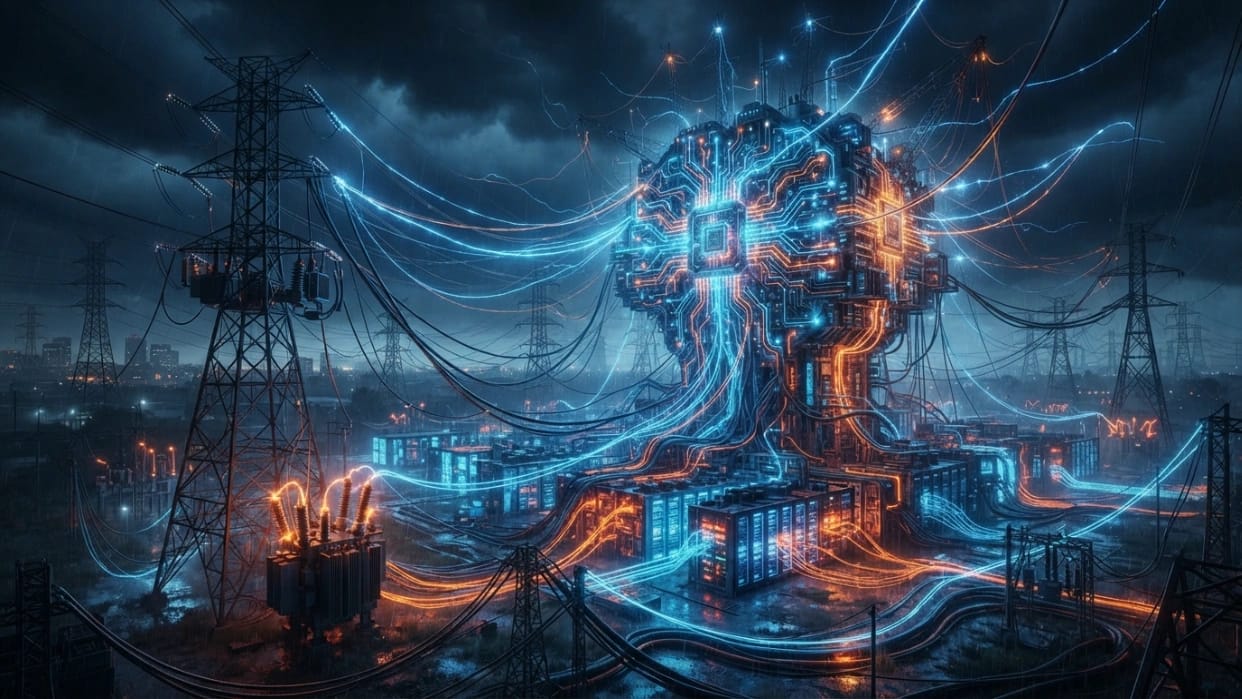
Artificial intelligence has spent the past several years running into one obvious bottleneck: computing power.
The race for better GPUs, faster AI accelerators, advanced networking and larger data centers has dominated the technology industry. But as AI systems become more powerful and widespread, another constraint is becoming increasingly difficult to ignore:
Electricity.
The world’s AI infrastructure is becoming an enormous electricity consumer. The International Energy Agency estimates that data centers used around 415 terawatt-hours (TWh) of electricity globally in 2024, equivalent to about 1.5% of worldwide electricity consumption. In its base case, the IEA expects data-center electricity consumption to more than double to around 945 TWh by 2030.
The U.S. is already experiencing the effect. The latest U.S. Energy Information Administration outlook expects American electricity consumption to reach new records in both 2026 and 2027, with AI and cryptocurrency data centers among the important drivers of rising demand.
But the story is more complicated than simply saying “AI is using too much electricity.”
The real challenge is where that electricity is needed, how quickly it is needed, and whether grids can connect new data centers quickly enough to supply it.
That could make electricity infrastructure one of the most important limits on the next phase of the AI boom.
The AI Boom Is Becoming an Electricity Boom
AI models do not run in the abstract.
Behind every chatbot response, image generation request, AI search result and automated software task are physical machines operating inside data centers.
Those facilities require electricity for:
- GPUs and other AI accelerators
- CPUs
- memory and storage
- networking equipment
- cooling systems
- power conversion
- backup systems
- lighting and facility operations
The IEA estimates that servers account for roughly 60% of electricity demand in modern data centers, although the exact share varies depending on the facility. Cooling and other infrastructure account for a substantial portion of the remainder.
As AI workloads become more computationally intensive, the electricity requirement grows.
Training frontier AI models requires enormous computing resources, but inference—the process of actually running models for users—could become just as important as AI adoption expands.
Millions of people and businesses using AI every day means millions of requests being processed continuously.
That creates a fundamental equation:
More AI adoption → more computing → more data centers → more electricity demand.
And that equation is beginning to reshape energy markets.
How Big Could AI’s Electricity Demand Become?
The numbers are large, but they need context.
The IEA estimates global data centers consumed around 415 TWh in 2024. Its base-case projection puts that figure near 945 TWh by 2030. That would represent more than a doubling in only six years.
The important detail is that data centers would still represent a relatively small share of total global electricity consumption.
The IEA expects them to account for just under 3% of global electricity demand in 2030 in its base case.
So claims that AI alone is about to consume an enormous percentage of all electricity worldwide can be misleading.
The bigger problem is concentration.
Data centers are not evenly distributed around the planet.
They tend to cluster where there is:
- reliable electricity
- fiber connectivity
- suitable land
- favorable regulation
- access to water or alternative cooling
- tax incentives
- existing infrastructure
That means a data center can be a relatively small part of global electricity demand while being a very large new customer for a particular regional grid.
The Grid Problem May Be Bigger Than the Electricity Problem
This is where the AI energy story gets especially interesting.
Imagine a region with enough electricity generation to serve its existing population and industries.
Then developers announce several enormous AI data centers.
The problem isn’t necessarily that the country has run out of electricity.
The problem is that the local grid may not have enough transmission capacity, substations or generation connected to the right location.
The IEA specifically highlights this geographic concentration as a major challenge. It notes that data centers tend to be concentrated in particular locations, making their integration into electricity grids more difficult than their relatively modest global share would suggest.
Recent research reaches a similar conclusion from another direction.
A study published in August 2026 argues that interconnection queues—not simply electricity prices—can determine where new data centers can actually be built.
That distinction matters.
A company can have billions of dollars available to build an AI facility.
It can have enough GPUs.
It can have the land.
It can have customers.
But if it cannot secure adequate power quickly enough, the project can still be delayed.
The U.S. Is Becoming the World’s Biggest Test Case
The United States is at the center of the AI infrastructure race.
It also has some of the world’s largest hyperscale data-center clusters.
The latest U.S. outlook shows electricity demand continuing to rise sharply.
According to the Energy Information Administration, U.S. electricity consumption reached approximately 4,195 billion kWh in 2025 and is projected to rise to about 4,268 billion kWh in 2026 and 4,391 billion kWh in 2027. AI and cryptocurrency data centers are among the drivers of the increase.
That doesn’t mean AI is responsible for all of the increase.
Electric vehicles, industrial activity, cooling demand, household electrification and other factors are also increasing electricity consumption.
But AI introduces something unusual:
large amounts of new electricity demand arriving in specific regions and on relatively short development timelines.
That creates pressure for utilities, grid operators and policymakers to move faster.
Why Building More Power Isn’t Enough
It might sound simple:
If AI needs more electricity, just build more power plants.
In reality, electricity infrastructure takes time.
A new generation project may require:
- Site selection
- Permitting
- Financing
- Construction
- Grid interconnection
- Transmission upgrades
- Testing
- Commercial operation
Transmission infrastructure can face an additional challenge: it often needs to cross multiple jurisdictions and coordinate with existing grid systems.
That creates a mismatch.
AI development can move in months.
Electricity infrastructure often moves in years.
This is one of the most important structural problems facing the AI industry.
The technology sector can upgrade a model or deploy new computing hardware extremely quickly.
The physical infrastructure supporting that computing cannot always move at the same speed.
Data Centers Are Changing Where Energy Investment Goes
The AI boom is therefore creating an unexpected second technology race:
the race to secure power.
The IEA expects renewables to provide a major share of the additional electricity needed by data centers through 2030. It also expects natural gas and nuclear power to play important roles, with nuclear becoming increasingly significant toward the end of the decade.
The result is a much broader investment landscape.
AI infrastructure increasingly involves:
- GPUs
- servers
- networking
- data centers
- transmission lines
- substations
- renewable generation
- natural gas generation
- batteries
- nuclear power
- cooling technology
The AI supply chain is becoming an energy supply chain.
Renewables Can Help—but They Don’t Solve Everything
Renewable energy is likely to play a major role in meeting rising data-center demand.
The IEA estimates renewables could meet nearly half of the growth in electricity demand from data centers through 2030.
Solar and wind can be built relatively quickly in favorable locations, and technology companies have increasingly used long-term power purchase agreements to secure renewable electricity.
But renewables have an obvious challenge:
AI data centers need reliable power around the clock.
Solar generation changes throughout the day.
Wind output varies.
Data centers, however, cannot simply shut down whenever renewable output falls.
That means renewable generation may need to be combined with:
- batteries
- grid connections
- hydroelectricity
- natural gas
- nuclear
- demand management
- other forms of firm capacity
The future AI power system is therefore unlikely to depend on one technology alone.
Why Nuclear Power Is Back in the AI Conversation
Nuclear energy has become increasingly interesting to the technology industry because it offers a source of large-scale, low-carbon electricity that can operate continuously.
The IEA expects nuclear generation to contribute significantly to meeting additional data-center electricity demand, particularly in the United States, China and Japan. It also expects small modular reactors to begin contributing around 2030.
But nuclear power cannot instantly solve today’s data-center power constraints.
New nuclear projects can take years.
That makes nuclear more relevant to the long-term infrastructure strategy than to every immediate power shortage.
In the short term, companies and utilities may rely on a combination of existing generation, grid upgrades, renewables, natural gas and efficiency improvements.
Natural Gas Could Benefit From the AI Boom
Natural gas presents a different proposition.
Gas-fired power plants can provide dispatchable electricity and can often complement intermittent renewable generation.
The IEA expects natural gas to play a substantial role in meeting additional data-center electricity demand through 2030.
That creates a potential contradiction for the AI industry.
Technology companies increasingly want to reduce their carbon footprints.
Yet rapidly expanding electricity demand may increase the attractiveness of dispatchable fossil-fuel generation in regions where cleaner alternatives cannot be deployed quickly enough.
This is one reason the AI boom is becoming an energy-policy issue rather than simply a technology story.
AI Could Also Make Its Own Energy Problem Better
There is another side to the equation.
AI doesn’t just consume electricity.
It can potentially help the energy industry use electricity more efficiently.
AI can be applied to:
- electricity-demand forecasting
- grid optimization
- predictive maintenance
- renewable-energy forecasting
- battery management
- power-market optimization
- fault detection
- industrial efficiency
The IEA’s work on energy and AI emphasizes that the relationship runs in both directions: AI requires electricity, but AI can also potentially improve the operation and efficiency of energy systems.
That means the long-term outcome isn’t predetermined.
AI could become a major source of electricity demand while simultaneously helping the grid become smarter and more efficient.
The Hidden Problem: Power Availability Could Influence Where AI Gets Built
One of the most important consequences could be geographic.
For years, technology companies competed for:
Talent
Chips
Cloud infrastructure
Data
Increasingly, they may also compete for:
Power.
A region with abundant electricity, transmission capacity and fast permitting could become much more attractive for AI infrastructure.
A region with long interconnection queues and constrained grids could lose investment even if it has excellent technology talent.
That could reshape the geography of the AI economy.
Countries and states that successfully combine:
- cheap electricity
- reliable grids
- abundant generation
- strong connectivity
- available land
- favorable regulation
could become major AI infrastructure hubs.
Could Electricity Actually Stop the AI Boom?
Probably not by itself.
But it could slow, redirect or make the AI boom more expensive.
The IEA’s projections show that data-center electricity demand is growing rapidly, but they also show that data centers remain a relatively small share of global electricity consumption.
The more realistic risk is not:
“The world will run out of electricity because of AI.”
It is:
AI expansion could run into regional power constraints that make new infrastructure slower and more expensive to build.
That distinction is critical.
If power becomes scarce in the locations where companies most want to build, developers may have to:
- move projects
- wait for grid upgrades
- build on-site generation
- sign long-term power contracts
- invest directly in energy infrastructure
- improve computing efficiency
- shift workloads geographically
The AI industry could therefore become increasingly involved in energy infrastructure.
Efficiency Could Become an AI Competitive Advantage
The next phase of the AI race may not simply be about who has the largest models.
It may increasingly be about:
Who can deliver the most useful AI with the least computing and electricity?
Hardware efficiency is already improving.
Model architectures are evolving.
Inference optimization is becoming more important.
Better cooling can reduce overhead.
More efficient chips can deliver more computation per unit of electricity.
These improvements matter because the IEA’s scenarios show that efficiency assumptions can materially change future data-center electricity demand. In its high-efficiency case, stronger improvements in hardware, software and infrastructure efficiency significantly reduce projected demand compared with the base case.
That means technological efficiency could become one of the most important ways to keep AI growth compatible with limited infrastructure.
What Happens Next?
The next stage of the AI boom will probably involve a race on two fronts.
The digital race
Companies will continue competing over:
- AI models
- chips
- agents
- applications
- data
- software
The physical race
At the same time, they will compete over:
- electricity
- data-center sites
- grid connections
- transmission
- cooling
- power generation
The winners may increasingly be companies and regions that can coordinate both.
A company with the world’s best AI model cannot scale it indefinitely if the infrastructure required to run that model cannot keep up.
7 Things to Watch in the AI Energy Race
1. Data-center electricity forecasts
Watch whether actual demand continues to exceed or fall below current projections.
2. Grid interconnection queues
These could become one of the biggest constraints on new AI infrastructure.
3. New power generation
Pay attention to natural gas, renewable, nuclear and storage projects tied to major data-center developments.
4. Electricity prices
Rapid demand growth could put upward pressure on prices in constrained regions, although the outcome will depend heavily on new supply and grid investment.
5. AI efficiency
If AI models and hardware become dramatically more efficient, some projected electricity growth could be moderated.
6. Data-center geography
Watch where the next generation of massive AI facilities is being built—and, just as importantly, where projects are delayed.
7. On-site power
The growth of behind-the-meter generation could signal that conventional grid connections are becoming too slow for some AI projects.
Further Context and Primary Sources
Further context from The Light Span includes AI infrastructure spending boom, global energy transition, rare-earth mineral bottlenecks, edge AI technology shift, and semiconductor market volatility. Together, these analyses show how technology, capital markets, energy systems and supply chains increasingly shape one another.
Readers can also examine the underlying evidence through International Energy Agency’s Energy and AI work and U.S. Energy Information Administration data. These primary resources provide useful context for tracking how the issue develops beyond a single news cycle.
The Light Span Perspective
The AI industry has spent years treating computing power as the ultimate scarce resource.
That may be changing.
The next bottleneck could be much more physical.
Electricity.
Not because AI is about to consume the world’s entire power supply, but because AI demand is arriving quickly and concentrating in specific locations where electricity infrastructure cannot always expand at the same speed.
The numbers tell an important story. Global data-center electricity consumption could more than double by 2030, while the United States is already heading toward record electricity consumption as data centers expand.
But the biggest lesson is not that AI is an energy disaster.
It is that AI has become an infrastructure story.
The companies building the next generation of AI will need more than chips and software. They will need access to reliable power, efficient cooling, transmission capacity and suitable locations.
That changes the competitive landscape.
The next AI superpower may not simply be the country with the best models.
It could be the country that can build the electricity infrastructure to run them at scale.
And that makes the AI electricity race one of the most important—and least understood—stories shaping the technology economy.
Frequently Asked Questions
How much electricity does AI use?
AI’s electricity consumption is difficult to isolate from total data-center consumption because AI workloads run alongside conventional computing. The IEA estimates global data centers consumed around 415 TWh of electricity in 2024 and projects total data-center consumption to reach around 945 TWh by 2030 in its base case.
Will AI cause an electricity shortage?
AI is unlikely to cause a worldwide electricity shortage by itself. The bigger concern is regional: data centers can concentrate enormous electricity demand in specific areas where generation, transmission or grid connections are constrained.
Why do AI data centers use so much electricity?
AI data centers use large amounts of electricity because they operate energy-intensive GPUs and other accelerators, alongside networking, storage, cooling and power-management systems.
Will renewable energy power AI?
Renewables are expected to supply a major share of new electricity demand from data centers. The IEA estimates renewables could meet nearly half of additional data-center electricity demand through 2030, although other sources—including natural gas and nuclear—will also contribute.
Is nuclear power necessary for AI?
Nuclear power is not the only solution, but it could become an important source of reliable, low-carbon electricity for growing data-center demand. The IEA expects nuclear generation to make an increasing contribution toward the end of this decade.
Could AI become more energy efficient?
Yes. Improvements in chips, model architectures, software optimization, cooling and data-center design can reduce the electricity required for each unit of AI computation. The IEA’s high-efficiency scenario demonstrates how substantially efficiency assumptions can affect long-term demand projections.
What is the biggest AI energy problem?
The biggest challenge may not be total global electricity supply. It is the combination of rapidly growing demand, geographic concentration, grid constraints and the time required to build new power infrastructure.
AI’s next major bottleneck may not be intelligence—it may be infrastructure.
The technology industry has become exceptionally good at developing new AI models and computing hardware. The harder challenge now may be supplying those systems with enough reliable electricity, in the right locations, quickly enough to support continued growth.
That makes energy infrastructure an increasingly important part of the AI race.
And for investors, businesses, policymakers and technology users, one question deserves much more attention:
When AI demand keeps rising, who will have the power to run it?
Continue reading more

