


Edge AI: Benefits, Uses and Security Risks
Artificial intelligence has largely been associated with enormous data centers.
When someone asks an AI assistant a question, uploads a photograph for analysis or generates an image, the request is normally sent through the internet to remote servers. Powerful processors analyze the information and return a result.
This cloud-based model has made advanced AI available to billions of devices that could never run the largest models independently.
But AI is beginning to move closer to users.
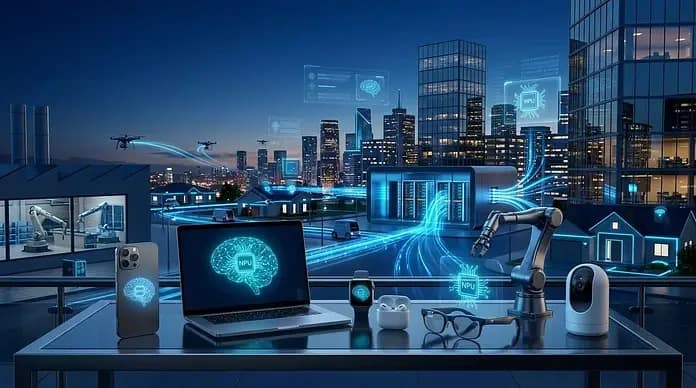
Smartphones, computers, cameras, vehicles, factory equipment and wearable devices are increasingly capable of running AI models locally. Instead of sending every piece of information to a distant data center, the device can analyze at least part of it where the data is created.
This is known as Edge AI.
Edge AI can make technology faster, more private and less dependent on a constant internet connection. It could help vehicles respond to hazards, factories detect failing equipment and smartphones provide personalized assistance without transmitting every interaction to the cloud.
The shift does not mean cloud AI will disappear. Edge and cloud systems will increasingly work together, assigning each task to the location that can handle it most efficiently.
That hybrid model could become one of the most important technology shifts of the next decade.
Quick take
- Edge AI runs artificial-intelligence models on or near the device producing the data.
- It can reduce response times because information does not always travel to a distant server.
- Local processing can improve privacy by keeping sensitive information on the device.
- Edge AI reduces bandwidth use and can continue operating during internet interruptions.
- Smartphones, vehicles, robots, cameras, medical devices and factories are major applications.
- Small devices have limited processing power, memory, battery capacity and cooling.
- Edge AI does not automatically guarantee privacy or security; poorly protected devices can create serious risks.
What is Edge AI?
Edge AI combines artificial intelligence with edge computing.
Edge computing processes information close to where it is created instead of sending everything to a centralized cloud platform. When AI models are deployed in that local environment, the result is Edge AI.
The “edge” can be:
- A smartphone
- A laptop
- A vehicle
- A security camera
- A factory machine
- A medical device
- A smart appliance
- A wearable sensor
- A robot
- A local server inside a store or warehouse
According to IBM’s Edge AI explanation, the technology deploys AI models directly on local edge devices, allowing them to process information without constant dependence on cloud infrastructure.
Imagine a factory camera checking products for defects.
In a cloud-only system, the camera may send continuous video to a remote data center. The server analyzes the footage and sends an instruction back to the production line.
With Edge AI, a processor near the camera can analyze the images locally. It may transmit only a warning, a selected image or a summary instead of uploading every second of video.
This difference can save time, reduce network traffic and allow the system to continue working when connectivity is interrupted.
How is Edge AI different from cloud AI?
Cloud AI and Edge AI provide different advantages.
Cloud data centers contain enormous amounts of computing power. They can store large datasets, train advanced models and handle complicated tasks that exceed the capabilities of a small device.
Edge devices have fewer resources, but they are located closer to the user and the information.
| Feature | Edge AI | Cloud AI |
|---|---|---|
| Processing location | On or near the device | Remote data center |
| Response time | Usually faster | Depends on network connection |
| Internet requirement | Can operate partially or fully offline | Usually requires connectivity |
| Privacy | Data can remain local | Data may leave the device |
| Computing capacity | Limited by local hardware | Extremely large and scalable |
| Power constraints | Battery and heat may be important | Supported by dedicated infrastructure |
| Best suited for | Immediate, private or offline tasks | Complex models and large datasets |
In practice, many systems will use both.
A smartphone might process wake words, facial recognition and routine personal information locally. It could send a difficult request to the cloud when it needs a larger model or access to current online information.
A factory could use Edge AI to stop a dangerous machine instantly while sending long-term performance data to the cloud for wider analysis.
This hybrid approach gives businesses the responsiveness of local processing and the scale of centralized infrastructure.
Why is Edge AI growing now?
Edge computing has existed for years, but several developments are accelerating Edge AI.
The first is better hardware.
Smartphones, laptops and embedded systems increasingly contain neural processing units designed for AI workloads. These components can perform machine-learning operations more efficiently than relying entirely on general-purpose processors.
The second development is model optimization.
Researchers can reduce the size of AI models through techniques such as:
- Quantization
- Pruning
- Distillation
- Compression
- Hardware-specific optimization
These methods help models run with less memory, lower energy use and fewer calculations.
The third development is demand for faster, more private AI.
Consumers and businesses want intelligent systems that respond immediately and do not upload every conversation, image or health measurement to remote servers.
Finally, the cloud itself is under pressure.
The enormous AI infrastructure spending boom reflects demand for centralized computing. Moving appropriate tasks onto devices can reduce some of the bandwidth and processing burden placed on those facilities.
1. Edge AI can deliver faster responses
Speed is one of the clearest benefits of Edge AI.
Sending information to a distant server introduces latency—the delay between a request and the response. Even a fast network can experience congestion, routing problems or weak coverage.
For an AI writing assistant, a small delay may be inconvenient. For a vehicle, robot or industrial safety system, the delay could be dangerous.
An autonomous machine may need to:
- Identify a person entering its path
- Detect an obstacle
- Recognize a warning signal
- Stop moving equipment
- Adjust its balance
- Respond to changing road conditions
These actions cannot always wait for a remote server.
Nvidia’s edge-computing overview explains that processing data locally can accelerate the AI pipeline and enable real-time decisions and autonomous operations.
Speed also improves ordinary consumer experiences. Local AI can help a phone enhance photographs, translate speech or understand voice commands with less noticeable delay.
2. Local processing can improve privacy
Many AI applications involve highly personal information.
A device may process:
- Private conversations
- Photographs
- Health measurements
- Financial information
- Location data
- Workplace documents
- Video from inside a home
- Biometric identifiers
Sending this information to the cloud creates additional exposure. The data travels across networks and may be stored or processed on systems controlled by another organization.
Edge AI can reduce that exposure by analyzing sensitive information locally.
For example, a security camera could identify unusual movement without continuously uploading footage from inside a home. A health-monitoring device might alert the user to an abnormal measurement while keeping the raw data on the device.
However, “processed locally” does not automatically mean “private.”
The device may still send results, usage statistics or selected information to the manufacturer. Its software could contain vulnerabilities, and users may not understand which tasks occur locally.
Companies need transparent policies explaining:
- What data is collected
- Where processing occurs
- What information leaves the device
- How long data is stored
- Whether users can disable cloud features
- How software updates are protected
Edge AI can improve privacy, but only when the complete system is designed responsibly.
3. Edge AI reduces bandwidth and cloud costs
Cameras, sensors and industrial machines can produce enormous quantities of data.
Uploading all of it is inefficient when most information is routine.
A camera monitoring a warehouse does not need to send every frame to the cloud if the objective is simply to detect an unauthorized person. Edge AI can analyze the video locally and transmit an alert only when something unusual happens.
This reduces:
- Network congestion
- Mobile data consumption
- Cloud-storage requirements
- Data-transfer charges
- Centralized processing demand
- Delays caused by limited connectivity
The savings can become significant when an organization operates thousands of devices.
Cloud computing remains valuable for model training, coordination and long-term analysis. But businesses can avoid paying to transmit and store data that has little lasting value.
Reducing unnecessary cloud workloads may also help moderate the accelerating AI data-center power demand, although the overall AI infrastructure market is still expected to grow.
4. Devices can work without reliable internet access
Cloud AI depends heavily on connectivity.
That can be a serious weakness in remote regions, underground facilities, ships, farms, disaster zones and moving vehicles.
Edge AI allows devices to perform selected tasks offline.
Examples include:
- Agricultural equipment identifying weeds
- Drones inspecting infrastructure
- Translation tools working during travel
- Medical equipment operating in remote clinics
- Mining machinery detecting hazards
- Vehicles recognizing road conditions
- Disaster-response robots searching damaged buildings
Offline capability does not mean a device never connects to the cloud. It may periodically download updated models or upload selected results when connectivity becomes available.
The key benefit is operational continuity.
A temporary network failure should not prevent an essential machine from recognizing danger or completing a basic task.
5. Smartphones and computers can become more personal
Consumer devices are among the most visible Edge AI platforms.
Modern phones and computers increasingly include processors designed for AI. These systems can support:
- Live transcription
- Noise removal
- Photo enhancement
- Language translation
- Document summaries
- Voice recognition
- Predictive text
- Accessibility tools
- Personalized recommendations
- Intelligent battery management
Local processing can make these features more responsive and private.
It also creates the possibility of more personalized AI assistants.
A device could understand the owner’s schedule, writing style, contacts and routine without transmitting an entire personal history to the cloud. The local model may coordinate selected cloud services while keeping the most sensitive context on the device.
Qualcomm’s on-device AI platform highlights real-time responsiveness, privacy and personalization as major benefits of running generative AI directly on smartphones.
This could change the way consumers evaluate new devices. AI processing capability may become as important as camera quality, battery life or storage.
6. Edge AI can transform factories and businesses
Industrial environments generate continuous streams of information from cameras, microphones, temperature sensors and production equipment.
Edge AI can analyze that data at the source.
Practical applications include:
Predictive maintenance
AI can identify unusual vibration, sound or heat that may indicate a machine is beginning to fail. The business can schedule maintenance before a costly breakdown.
Quality inspection
Cameras can examine products for defects while they move along a production line. Local processing makes it possible to reject defective items immediately.
Worker safety
Edge systems can detect whether employees have entered hazardous areas or whether protective equipment is missing.
Inventory management
Warehouse cameras and sensors can track stock movement without uploading continuous footage.
Energy management
AI can adjust equipment use, lighting or cooling based on current demand.
These applications can produce measurable savings because they address specific operational problems.
Businesses should still avoid deploying Edge AI simply because the technology is available. Each project needs a clear purpose, reliable data and a plan for maintaining devices over time.
7. Robots and vehicles can become more independent
AI is increasingly moving from digital applications into physical machines.
Robots need to understand their surroundings, plan movements and respond to unexpected events. Vehicles must identify road signs, pedestrians, lane boundaries and nearby traffic.
These tasks require local processing because decisions must happen quickly and connectivity cannot be guaranteed.
Edge AI could support:
- Warehouse robots
- Agricultural machines
- Delivery systems
- Manufacturing robots
- Inspection drones
- Driver-assistance technology
- Autonomous vehicles
- Medical robots
- Smart mobility aids
This is where Edge AI connects to the broader global race for AI leadership.
Leadership will not be determined only by which country develops the most capable language model. It will also depend on semiconductors, robotics, manufacturing expertise, sensors and the ability to deploy intelligence throughout the physical economy.
Healthcare could become a major Edge AI market
Healthcare illustrates both the promise and sensitivity of local AI processing.
Wearable devices can monitor heart rate, movement, sleep, oxygen levels and other measurements. Edge AI can analyze those signals continuously without uploading every raw measurement.
Potential applications include:
- Detecting irregular patterns
- Identifying falls
- Monitoring rehabilitation
- Supporting medical imaging
- Improving hearing devices
- Alerting caregivers
- Helping patients manage chronic conditions
Local processing can reduce latency and help protect sensitive medical information.
But medical AI requires careful validation. An inaccurate consumer recommendation may be annoying; an inaccurate health warning can cause serious harm.
Edge healthcare systems need strong security, reliable updates, regulatory oversight and clear explanations of their limitations. They should support qualified medical care rather than encouraging users to replace professional diagnosis with an unverified device.
The serious risk: millions of intelligent devices create new attack surfaces
Moving AI from a few protected data centers onto millions of devices distributes capability—but also distributes risk.
A compromised edge device could expose private information, provide false results or allow attackers to interfere with physical equipment.
Risks include:
- Weak passwords
- Outdated software
- Insecure wireless connections
- Manipulated AI models
- Malicious inputs
- Stolen devices
- Supply-chain vulnerabilities
- Unauthorized data collection
- Poorly protected update systems
- Physical tampering
Industrial and medical devices may remain in operation for many years. Their manufacturers need to provide security updates throughout the useful life of the product.
Model integrity is another concern.
Attackers may attempt to deceive a vision system using altered objects or patterns. A compromised model could intentionally overlook defects or classify dangerous activity as safe.
Companies deploying Edge AI should require:
- Encrypted data
- Secure startup processes
- Signed software updates
- Strong access controls
- Device inventories
- Network segmentation
- Continuous vulnerability monitoring
- Safe methods for removing retired devices
- Human oversight for high-risk decisions
Edge AI reduces some cloud-related privacy risks while creating new security responsibilities at the device level.
Other limitations of Edge AI
Edge AI is not suitable for every workload.
Limited computing power
Small devices cannot match the processing capacity of hyperscale data centers. The largest and most complex models may remain cloud-based.
Battery consumption
Continuous AI processing can drain mobile devices and wearables.
Heat
Powerful processors generate heat that compact devices may struggle to remove.
Memory restrictions
Local devices have limited storage and working memory compared with cloud systems.
Difficult updates
Organizations may need to maintain thousands of devices across numerous locations.
Model inconsistency
Different devices could run different model versions, producing inconsistent results.
Higher hardware costs
Adding capable AI processors can increase the price of consumer and industrial equipment.
These limitations make hybrid architecture especially important. The challenge is choosing which tasks belong on the device and which should be handled by the cloud.
What consumers should look for
The phrase “AI-powered” does not reveal whether a feature runs locally or depends on the cloud.
Before buying an AI device, consumers should ask:
- Which features work offline?
- What information is uploaded?
- Can cloud processing be disabled?
- How long will the device receive updates?
- Does AI processing affect battery life?
- Is an internet subscription required?
- Are promised features available immediately?
- Can personal data be deleted?
- Will important functions continue if the manufacturer closes the service?
Consumers should also be cautious about buying hardware solely for future AI features. A promised capability may arrive late, require a subscription or perform differently from marketing demonstrations.
What businesses should consider before deploying Edge AI
Businesses should begin with the operational problem rather than the technology.
A practical evaluation should cover:
Response time
Does the task require an immediate decision?
Connectivity
Will the device operate where internet access is unreliable or expensive?
Privacy
Would local processing reduce exposure of sensitive data?
Model size
Can the required model run effectively on available hardware?
Maintenance
How will the organization update and monitor every device?
Security
What happens if a device is stolen, manipulated or compromised?
Return on investment
Will the system reduce costs, improve quality or create measurable revenue?
A small pilot can reveal whether the expected benefits survive real operating conditions. Businesses should test accuracy, energy consumption, security and maintenance requirements before deploying thousands of devices.
Frequently asked questions
Is Edge AI the same as edge computing?
No. Edge computing refers broadly to processing data close to its source. Edge AI specifically involves running artificial-intelligence models in that local environment.
Does Edge AI work without the internet?
It can. Some applications operate completely offline, while others use local processing for routine tasks and connect to the cloud for more complex work.
Is Edge AI more private than cloud AI?
It can be because sensitive data may remain on the device. Privacy still depends on how the product collects, stores and transmits information.
Will Edge AI replace cloud computing?
No. Cloud systems remain essential for training large models, storing extensive datasets and handling complex workloads. Edge and cloud AI will increasingly complement each other.
What devices use Edge AI?
Smartphones, laptops, cameras, cars, robots, factory equipment, medical devices, wearables and smart-home products can all use Edge AI.
Why are AI chips important for Edge AI?
Dedicated neural processors can perform AI calculations using less energy and time than relying entirely on ordinary processors.
What is the biggest Edge AI challenge?
The main challenges include limited hardware resources, energy consumption, maintaining large numbers of devices and protecting them from security threats.
The Light Span Perspective
Edge AI represents a natural next step in the development of artificial intelligence.
Cloud infrastructure made powerful AI widely accessible. The edge will make that intelligence faster, more personal and more closely connected to the physical world.
The most successful systems will not choose between the edge and the cloud. They will combine them.
Immediate, sensitive and routine tasks can happen locally. Large-scale training, difficult analysis and coordination can remain in centralized data centers.
This balance could improve privacy, reduce unnecessary data transfers and allow intelligent devices to function in places where reliable connectivity is unavailable.
However, distributing AI across billions of devices also distributes responsibility. Manufacturers must provide clear privacy controls, long-term security updates and honest explanations of what their products can do.
Edge AI will matter not because every appliance needs artificial intelligence, but because the right intelligence in the right place can solve problems that the cloud alone cannot address.
Continue reading more

