


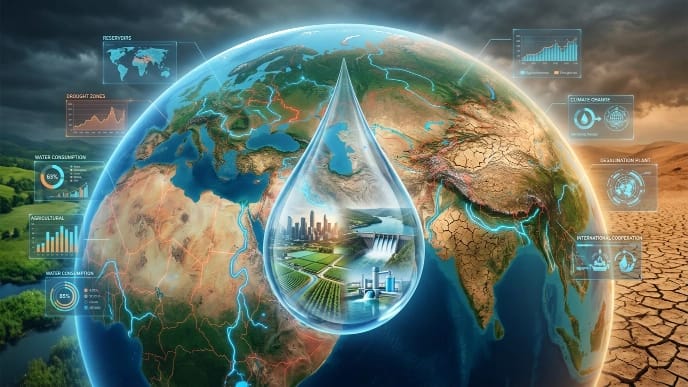
The short answer
Water security means having reliable access to enough safe water for
people, food production, ecosystems, energy and economic activity while
limiting the damage caused by floods, droughts and pollution.
It is becoming a geopolitical issue because rivers, aquifers and
rainfall do not follow political boundaries. Population growth,
urbanization, climate shocks, aging infrastructure and rising industrial
demand are increasing pressure on resources that several countries may
share.
The world is not simply “running out of water.” The deeper problem is
that usable water is unevenly distributed, poorly managed and
increasingly unpredictable. These seven risks explain why water security
now belongs alongside energy, food and technology in national
strategy.
Why water
security matters to the global economy
Water supports almost every productive system. Farms depend on
rainfall or irrigation. Power stations require water for cooling or
generation. Semiconductor plants, mines, factories and data centers need
dependable supplies. Cities require treatment, pipes and drainage.
When water becomes unreliable, the damage moves far beyond household
taps. Crop yields fall, electricity generation becomes harder, factories
reduce production and governments face pressure to subsidize food or
rebuild infrastructure.
The United Nations
Sustainable Development Goal 6 data show that safe water, sanitation
and sustainable management remain unfinished global challenges. Water
security is therefore simultaneously a public-health need, an economic
input and a source of political stability.
1. Climate
change is making supply less predictable
Climate change affects water through timing, location and intensity.
Some regions face longer dry periods, while others receive more
precipitation in short, destructive bursts. A year can contain both
drought and flooding without delivering a reliable supply.
Higher temperatures increase evaporation from soil and reservoirs.
Snowpack may melt earlier, reducing water availability later in the
season. Extreme rainfall can overwhelm drainage systems and contaminate
drinking-water sources.
This unpredictability complicates planning. Reservoirs, irrigation
systems and flood defenses were often designed around historical
patterns that may no longer provide a dependable guide.
Our analysis of extreme
weather and the global economy explains how climate shocks can
affect insurance, infrastructure, agriculture and public finances
simultaneously. Water is the channel through which many of those effects
reach communities.
Adaptation requires more than building larger dams. Countries need
updated forecasts, restored watersheds, drought plans, flood protection
and flexible systems that can respond to both scarcity and excess.
2. Agriculture faces
the largest pressure
Food production is one of the most water-intensive parts of the
economy. Irrigated agriculture supports important crops and rural
livelihoods, but inefficient systems can lose large volumes through
evaporation, leakage and poorly timed application.
When drought reduces water allocations, farmers may plant less,
switch crops or pump more groundwater. Those decisions can lower supply
and raise costs. The effects may travel through international markets,
especially when several exporting regions experience poor conditions
together.
The Food and Agriculture Organization’s AQUASTAT database provides
country-level information on water resources, use and agricultural
management. It illustrates why national conditions differ sharply and
why global averages can hide local stress.
The connection with global
food prices is direct. Water shortages can reduce harvests, increase
irrigation expenses and add volatility to commodities that households
purchase every day.
Solutions include precision irrigation, soil-moisture monitoring,
drought-tolerant crops, reduced leakage and pricing systems that protect
basic needs while discouraging waste. Technology helps, but farmers also
require credit, training and predictable water rights.
3. Shared
rivers can become political pressure points
Many important rivers cross national borders. Decisions made upstream
can affect electricity, irrigation, ecosystems and drinking water
downstream.
Shared water does not inevitably cause conflict. It can encourage
cooperation because countries gain from exchanging data, coordinating
reservoirs and planning drought responses. Problems arise when
agreements are weak, information is withheld or new infrastructure
changes the balance.
Climate uncertainty makes existing arrangements harder to manage. A
treaty designed around average river flows may become politically
strained during several dry years. Domestic leaders may face pressure to
prioritize national needs even when neighbors depend on the same
system.
Effective river-basin governance requires transparent measurements,
permanent institutions and procedures for exceptional conditions.
Countries need to decide in advance how shortages will be shared rather
than negotiate only after a crisis begins.
Water diplomacy is most durable when it covers benefits, not merely
volumes. Joint electricity trading, flood control, navigation and
ecosystem management can give each participant a reason to preserve
cooperation.
4. Groundwater is
being depleted out of sight
Rivers and reservoirs are visible. Aquifers are not, which makes
groundwater depletion easier to ignore.
Farmers, industries and cities can pump underground water during
droughts, providing a vital buffer when rainfall fails. But extraction
becomes unsustainable when withdrawals repeatedly exceed natural
recharge.
Falling water tables increase pumping costs and can make shallow
wells unusable. In coastal areas, excessive extraction can draw
saltwater into freshwater supplies. Land may also subside as underground
formations compact, damaging roads and buildings.
Groundwater is difficult to govern because thousands of users may
draw from the same hidden resource. Metering can be incomplete,
ownership rules unclear and enforcement politically sensitive.
Countries need aquifer mapping, monitoring wells, withdrawal records
and plans that connect groundwater with surface-water management.
Treating the two as separate systems encourages overuse because they
often replenish and support each other.
The most important step is visibility. Governments cannot manage a
reserve they do not measure.
5. Water
infrastructure is aging and underfunded
Scarcity is not always caused by nature. Water may exist but fail to
reach people because pipes leak, pumps fail or treatment facilities lack
capacity.
Utilities need stable revenue to maintain networks, yet pricing water
is politically difficult. Rates that are too low can leave systems
without money for repairs. Rates that rise without protection can make
essential service unaffordable for low-income households.
Good policy separates affordability from waste. Governments can
support a basic household allowance while charging more for excessive
consumption. Utilities should publish leakage, quality and investment
data so customers understand where money goes.
Infrastructure planning must also account for urban growth. Informal
settlements may expand faster than networks, forcing residents to
purchase expensive water from private vendors or rely on unsafe
sources.
Investment should cover maintenance, not only visible new projects.
Replacing pipes, improving pressure management and detecting leaks can
create new effective supply without extracting more from rivers or
aquifers.
6.
Energy and technology are increasing competition for water
Water and energy are tightly connected. Hydropower depends on river
flows. Thermal and nuclear power plants may require cooling. Producing
fuels and minerals can consume or contaminate water, while pumping and
treating water requires electricity.
The global energy transition changes this relationship rather than
eliminating it. Some low-carbon technologies have modest operating-water
needs, while mining and processing their materials can place pressure on
water-stressed regions. Our coverage of the global
energy transition shows why infrastructure choices must be assessed
across their complete supply chains.
Digital growth adds another demand. Data centers use water directly
for some cooling systems and indirectly through electricity generation.
The issue is intensely local: a facility that looks small in national
statistics may compete with households and farms in one watershed.
The AI
energy boom demonstrates how supposedly digital industries depend on
physical resources. Companies should disclose water use, evaluate
seasonal scarcity and avoid counting recycled or non-potable water as
equivalent to fresh drinking water.
Planning decisions should compare economic benefits with opportunity
costs. A project’s water demand matters most during the driest period,
not only as an annual average.
7.
Water insecurity can accelerate migration and instability
Water rarely acts as a single cause of migration or conflict. People
move because of a combination of livelihoods, prices, safety, services
and political conditions.
However, repeated drought can destroy rural income, raise food costs
and intensify competition over land. Flooding can displace entire
neighborhoods. Weak institutions may turn a manageable environmental
shock into a crisis.
Cities receiving displaced people need housing, jobs and expanded
services. If governments cannot respond, resentment can grow between
communities. Water security is therefore part of resilience and social
policy, not merely environmental management.
Early-warning systems can help governments release assistance before
households sell productive assets or leave permanently. Insurance, cash
support, drought-resistant livelihoods and planned urban investment can
reduce the human cost.
The goal is not to label every water-stressed region a future
conflict zone. That exaggeration can obscure the policy choices that
make cooperation and adaptation possible.
The
Panama Canal shows why water is economic infrastructure
The Panama Canal offers a clear example of the connection between
rainfall and global commerce. Its locks depend on freshwater, meaning
drought can restrict vessel numbers or cargo capacity.
Our report on the Panama
Canal drought explains how a local water constraint can affect
shipping schedules, costs and supply-chain planning thousands of
kilometers away.
The lesson extends beyond one route. Ports, rivers, farms, power
systems and industrial centers are exposed to water conditions that
businesses may previously have treated as background assumptions.
Companies should map water dependence across suppliers and transport
routes, not only their own facilities.
What governments should do
Measure the complete system
Publish information on rainfall, river flows, groundwater, reservoir
levels, withdrawals and water quality. Data should be timely enough to
guide decisions.
Reduce losses
Repair urban networks, improve irrigation and enforce pollution
controls. The cheapest new source is often water that is currently
wasted or made unusable.
Protect basic access
Every pricing and allocation system should preserve safe household
water and sanitation. Affordability support should be targeted and
transparent.
Plan for extremes
Use scenarios that include prolonged drought, severe floods and
simultaneous failures. Emergency rules should be agreed before
reservoirs reach critical levels.
Cooperate across borders
Create permanent river-basin institutions, share measurements and
establish dispute-resolution procedures. Cooperation is easier when
relationships already exist.
Diversify supply responsibly
Recycling, rainwater capture, desalination and managed aquifer
recharge can help in appropriate locations. Each option has energy, cost
and environmental tradeoffs.
What businesses should do
Businesses should identify how water affects facilities, suppliers,
energy and transport. Risk assessment must examine both quantity and
quality.
A manufacturer may have enough water overall but face a shutdown if
contamination makes it unsuitable for a sensitive process. A food
company may use little water directly while depending heavily on farms
in drought-prone regions.
Set watershed-specific targets rather than announcing one global
percentage. Engage utilities and communities because efficiency inside a
factory cannot compensate for a collapsing local system.
Investment should prioritize real reductions, reuse and pollution
prevention. Purchasing certificates without understanding local
conditions does not secure operations or public trust.
Frequently asked questions
What is water security?
Water security is the reliable availability of safe water for people,
economies and ecosystems, together with protection from water-related
hazards such as drought, floods and pollution.
Is the world running out of
water?
The planet retains a water cycle, but accessible freshwater is
unevenly distributed and can become polluted, overused or unavailable
when needed. The practical crisis concerns usable water in specific
places and seasons.
Can water shortages cause
wars?
Water stress can worsen political tensions, but shared resources also
create incentives for cooperation. Institutions, treaties, data sharing
and domestic governance strongly influence the outcome.
How does water
security affect food prices?
Drought and unreliable irrigation can reduce yields and increase
production costs. When important farming regions are affected, the
consequences can spread through global commodity markets.
The Light Span Perspective
Water security is often treated as a distant environmental concern
until a reservoir falls, a harvest fails or a city imposes
restrictions.
That view is becoming impossible to sustain. Water is infrastructure.
It supports food, energy, manufacturing, transport, technology and
public health. Its value appears not only in what people drink but in
almost everything an economy produces.
The most dangerous assumption is that historical availability will
continue automatically. Climate volatility, groundwater depletion and
growing demand are changing the reliability of systems built for another
era.
There is no single global solution because water is local.
Desalination may suit one coastal city, while another region gains more
from leak repair, efficient irrigation or watershed restoration. The
common requirement is honest measurement and long-term management.
Countries that treat water as a strategic public asset can reduce
risk before scarcity becomes emergency. Those that delay may discover
that economic growth, social stability and geopolitical influence all
depend on a resource they once took for granted.

