


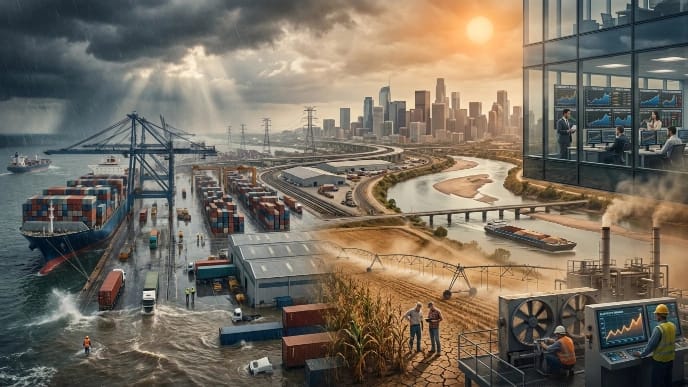
The short answer
Extreme weather is becoming an economic problem because modern
prosperity depends on tightly connected systems. A flood can close a
factory, delay a port, damage homes, raise insurance losses and
interrupt suppliers far beyond the disaster zone. Drought can reduce
crops, hydropower and river transport at the same time.
The cost is shaped by more than the hazard itself. Population growth,
expensive development in exposed areas, aging infrastructure and
inadequate preparation determine how much damage occurs.
Climate shocks will not affect every country or industry equally. Yet
their effects increasingly appear in prices, public budgets, insurance,
energy and trade. These seven channels explain why the bill can spread
through the global economy.
Why extreme
weather has become an economic issue
Weather has always disrupted economic life. What has changed is the
amount of infrastructure and wealth exposed to danger, the complexity of
global supply chains and the growing influence of climate change on some
extremes.
The IPCC’s Sixth
Assessment synthesis concludes that human-caused climate change has
already affected weather and climate extremes in every region. The
economic result depends on exposure and vulnerability as well as the
physical event.
A powerful storm in a resilient place can cause less lasting damage
than a weaker storm where buildings, drainage and public institutions
are fragile. That distinction matters because adaptation can reduce
losses even when the hazard cannot be prevented.
1. Food prices become more
volatile
Agriculture depends on temperature, rainfall, soil moisture and
predictable seasons. Drought reduces yields; floods destroy crops and
storage; extreme heat harms livestock and workers.
One poor harvest does not always create a global shortage. Producers
in other regions may compensate, inventories can absorb part of the
shock and consumers can substitute. Trouble grows when several exporting
regions face stress or when governments restrict exports to protect
domestic supply.
The shock then travels through feed, processing, transport and
retail. Lower-income households experience the greatest pressure because
food takes a larger share of their budgets.
Our guide to global
food prices explains why weather interacts with energy, currencies
and trade policy. Climate is an important cause, but it rarely acts
alone.
2. Insurance
becomes expensive—or unavailable
Insurance converts uncertain disaster loss into a regular premium.
That system weakens when losses become frequent, concentrated or
difficult to price.
Insurers may raise premiums, increase deductibles, restrict coverage
or leave a market. Reinsurers—the firms that insure insurers—can also
increase prices after global losses.
Homeowners then face more than a larger annual bill. Properties can
become difficult to finance or sell if adequate insurance is
unavailable. Banks and local tax bases inherit part of the risk.
Public insurance programs may protect access, but they can transfer
underpriced risk to taxpayers. Sustainable policy needs risk-based
information alongside support for households that cannot afford safer
homes or higher premiums.
3. Infrastructure
suffers repeated damage
Roads, bridges, power grids, ports and water systems were designed
around assumptions about heat, rainfall, sea level and storm intensity.
Changing conditions can push them beyond those design limits.
Heat can reduce transmission efficiency and damage rail lines.
Flooding can undermine roads and overwhelm drainage. Wildfire can
destroy power infrastructure and force precautionary shutdowns.
Repeated repair creates a fiscal trap. Governments spend to restore
the same asset while postponing upgrades that would reduce future
loss.
Resilience often costs more initially but saves money across an
asset’s life. Useful measures include stronger building codes, flood
storage, elevated equipment, vegetation management, backup power and
designs that account for future—not only historical—conditions.
4.
Energy systems face pressure from both supply and demand
Extreme heat increases demand for cooling at the same time it can
reduce the efficiency of power plants and networks. Drought can weaken
hydropower and limit cooling water. Storms and wildfire can interrupt
transmission and fuel logistics.
The challenge is not simply producing enough electricity over a year.
The system must meet peak demand at the right location and hour.
This matters as economies electrify transport, heating and industry.
The global
energy transition requires new generation, but it also requires
resilient grids, storage and flexible demand.
Businesses should assess outage duration and critical loads. Backup
systems need fuel, maintenance and regular testing; equipment that
exists only on paper is not resilience.
5. Supply
chains transmit local disasters globally
A component can be inexpensive yet essential. If its factory sits in
one exposed region, a local flood or storm may stop production
elsewhere.
Ports and canals create another concentration. Low water can restrict
vessel drafts and daily transits. Storms can close terminals. Rail and
road failures prevent goods from reaching an operating port.
The Panama
Canal drought illustrates how climate conditions at a single trade
artery can affect routes, schedules and costs far beyond the
watershed.
Companies need visibility beyond direct suppliers. Critical
dependencies may sit several tiers upstream. Dual sourcing, strategic
inventory and regional alternatives reduce interruption but add cost, so
resilience should focus on components whose failure would stop the
business.
6. Workers and productivity
suffer
Extreme heat reduces the amount of safe physical work possible
outdoors and in inadequately cooled buildings. Construction,
agriculture, logistics and manufacturing can lose productive hours.
Smoke, flooding and storms disrupt commuting, schools and healthcare.
Employees may be physically safe yet unable to work because transport,
power or caregiving arrangements have failed.
The economic cost includes absenteeism, lower output, illness and
turnover. Employers should treat heat and disaster plans as operating
requirements rather than occasional emergency documents.
Measures can include changed schedules, rest and hydration, cooling,
clean-air spaces, remote-work contingencies and paid recovery time.
Worker protection and business continuity often reinforce each
other.
7. Public finances
absorb hidden liabilities
Governments pay for emergency response, reconstruction, public
insurance, healthcare and support for affected households. At the same
time, damaged businesses and properties can reduce tax revenue.
Local governments may be particularly exposed because their revenue
depends on the same geography they must rebuild. A shrinking tax base
can make borrowing more expensive just when investment is needed.
National governments have greater capacity to spread risk, but
repeated disasters compete with education, healthcare and long-term
infrastructure budgets. Countries with high borrowing costs have less
room to respond.
This connects climate resilience with the global
government debt challenge. Disaster liabilities may not appear
clearly on a balance sheet before the event, but they are real fiscal
risks.
How climate shocks
move through the economy
The first-round damage is visible: destroyed buildings, crops and
machinery. The second-round effects can be wider.
A closed factory reduces wages and orders from suppliers. A port
delay raises inventory needs. An insurance payout affects the insurer’s
capital. A government reconstruction program increases demand for labor
and materials, which can raise local prices.
Some spending after a disaster increases measured economic activity,
but rebuilding is not free prosperity. Resources used to replace a
destroyed asset cannot be used for a new school, home or productive
investment.
Loss estimates also omit some harm. Mental health, ecosystem damage,
unpaid care and small-business closure can be difficult to measure
consistently.
Why
disaster costs can rise even without stronger hazards
More people and valuable assets have moved into coasts, floodplains
and fire-prone regions. A similar event therefore encounters more to
damage.
Inflation raises replacement costs. Complex equipment and long supply
chains can make downtime more expensive. Deferred maintenance increases
vulnerability.
Climate Central’s U.S.
billion-dollar disasters database, which continues the earlier NOAA
dataset and methodology, explains that rising losses reflect a
combination of exposure, vulnerability, climate variability and changes
in some extremes.
This is why responsible analysis should avoid attributing every
dollar to one cause. It should also avoid using uncertainty as an excuse
for inaction. Exposure and vulnerability are areas where policy and
investment can make an immediate difference.
What businesses should do
Map physical dependencies
Identify facilities, warehouses, data centers, suppliers and
transport routes exposed to heat, flood, fire, drought and storm.
Include utilities and upstream vendors.
Model interruption, not only
damage
A building may survive while power, water, staff access or a supplier
fails. Estimate how long the business can operate under each
scenario.
Set priorities by
criticality
Protect the processes whose failure would create the greatest
customer, safety or financial consequence. Not every asset needs the
same investment.
Review insurance carefully
Understand exclusions, deductibles, business-interruption terms and
documentation requirements. Insurance complements prevention; it does
not replace it.
Test continuity plans
Run exercises with decision-makers and frontline teams. Update
contacts and clarify who can authorize spending, shutdowns and customer
communication.
Work with suppliers
Ask where critical components originate and what alternatives exist.
Contract language is not useful if every vendor depends on the same
exposed sub-supplier.
What governments can do
Publish usable risk
information
People and firms need current maps, building standards and scenario
data. Risk should be disclosed before investment decisions, not
discovered after loss.
Invest before disaster
Drainage, grid hardening, water management and stronger buildings can
lower recovery costs. Maintenance is often less visible than
reconstruction but more valuable.
The water
security challenge shows why systems need to manage scarcity,
flooding, quality and infrastructure together.
Align incentives
Subsidies and insurance rules should help vulnerable households while
encouraging safer construction and relocation where protection is no
longer practical.
Coordinate across borders
Weather does not respect national boundaries, and supply-chain
effects cross them quickly. Shared forecasts, disaster finance and trade
cooperation can limit cascading harm.
Protect the most exposed
Low-income communities often have weaker infrastructure, fewer
savings and less access to insurance. Adaptation that ignores
distribution can deepen inequality.
What households can do
Understand the hazards relevant to the property rather than relying
on a general regional label. Review insurance limits and exclusions.
Keep digital copies of essential documents and a home inventory.
Build a basic emergency fund and avoid storing every backup in the
same place. Plan how family members will communicate if mobile networks
fail.
For homeowners, routine maintenance—roof, drainage, vegetation and
electrical systems—can reduce some losses. Renters should still
understand evacuation routes, insurance options and the building’s
emergency procedures.
No household can solve infrastructure or climate risk alone.
Individual preparation is most effective when public systems are
reliable.
Economic winners and losers
Extreme weather creates demand for engineering, resilient
construction, forecasting, cooling, grid technology and insurance
analytics. Some regions may gain agricultural or shipping advantages as
conditions change.
But adaptation spending should not be confused with a net benefit
from destruction. The opportunity exists because other assets and
communities face loss.
Companies that accurately price physical risk may allocate capital
more effectively. Those that ignore it can discover that an apparently
cheap site, supplier or property carried a large hidden liability.
Investors should examine where revenue, assets and suppliers are
located, how insurance is changing and whether capital spending accounts
for future conditions.
Frequently asked questions
Is
every extreme weather event caused by climate change?
No. Weather events have multiple causes. Climate change can alter the
probability or intensity of some extremes, and attribution depends on
the event and region.
Why are insured losses
rising?
More and costlier assets are exposed, rebuilding costs have increased
and some hazards are changing. Coverage and reporting also affect
measured losses.
Can adaptation prevent all
damage?
No. It can reduce exposure, vulnerability and recovery time. Some
locations may eventually require relocation or a different use.
How does extreme
weather affect inflation?
It can raise food, energy, transport, construction and insurance
costs. The size and duration depend on inventories, spare capacity,
policy and the geographic scale of the event.
The Light Span Perspective
Extreme weather becomes an economic crisis when a physical shock
meets fragile systems.
That insight is serious but useful. Societies cannot control every
storm, drought or heatwave, yet they can influence where assets are
built, how infrastructure is maintained, what risks are disclosed and
how quickly essential services recover.
The bill for resilience arrives before a disaster and is easy to
postpone. The bill for failure arrives afterward, usually with higher
human and financial costs.
Climate adaptation should therefore be treated as productive
investment. Stronger grids, safer buildings, diversified supply chains
and credible insurance do more than reduce loss. They protect the
confidence and continuity on which economic growth depends.
The global economy will not become weather-proof. It can become less
surprised, less fragile and faster to recover.

