


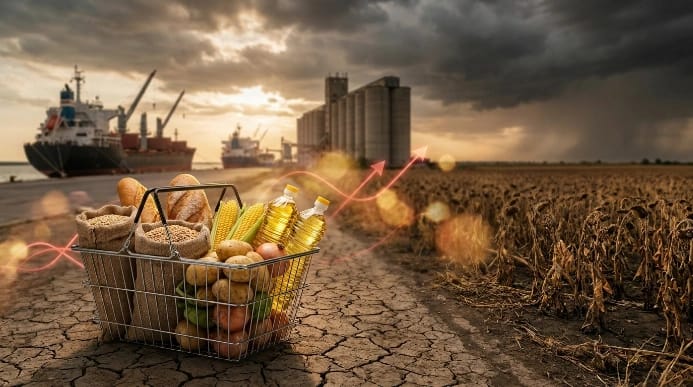
Global food prices are climbing again even though the world is producing more food than it did during earlier crises. That apparent contradiction is one of the most important economic stories for households, businesses and governments.
The latest FAO Food Price Index averaged 131.1 points in July 2026, rising 0.6 percent from June and 1 percent from a year earlier. The index remained well below its March 2022 peak, but cereal prices were 6.9 percent higher than a year earlier and wheat prices jumped 5.8 percent in a single month.
Those figures show why a lower global index does not necessarily mean cheaper groceries. International commodity prices are only the beginning of the journey from farm to supermarket. Energy, fertilizer, shipping, processing, labor, currency movements, taxes and retail competition all influence the amount consumers finally pay.
Here are seven dangerous forces that could keep global food prices elevated—and what households, businesses and policymakers should watch next.
Key Takeaways
- The FAO’s global benchmark rose in July as cereals, sugar and vegetable oils became more expensive.
- International prices can fall without producing an immediate decline in supermarket prices.
- Extreme weather is making harvests less predictable across major producing regions.
- Energy and fertilizer costs affect farming, processing, refrigeration and transport.
- Conflict and shipping disruption can separate available food from the people who need it.
- Weak currencies make imported food more expensive even when dollar prices are stable.
- The best response is resilient production, open trade and targeted household support—not panic controls.
Why Global Commodity Prices and Grocery Bills Diverge
The first step in understanding global food prices is separating commodity markets from retail markets.
The FAO index tracks internationally traded food commodities, including cereals, vegetable oils, dairy products, meat and sugar. It does not measure the full price of a supermarket basket in every country.
A loaf of bread contains wheat, but consumers also pay for milling, electricity, packaging, transport, wages, rent and retail margins. Wheat can become cheaper while several of those other costs remain high. Businesses may also need time to use inventory purchased under older contracts before lower commodity prices reach store shelves.
Currency movements create another gap. A commodity can remain stable in U.S. dollars but become more expensive for an importer whose currency loses value. Governments may reduce the effect through subsidies or tax changes, but those policies carry fiscal costs.
This helps explain why food inflation often feels more persistent than market headlines suggest. The World Bank’s June 2026 Food and Nutrition Security Update reported that maize, wheat and rice prices remained above their January 2020 levels. The global shock has eased from its peak, but the price base confronting households is still high.
1. Extreme Weather Is Damaging Predictability
The first force behind global food prices is not simply bad weather. It is the growing unpredictability of weather across several agricultural regions at once.
Heatwaves can reduce wheat, maize and rice yields during sensitive growing stages. Drought lowers soil moisture, restricts irrigation and reduces pasture for livestock. Floods destroy crops, damage rural roads and delay planting. Even when total global production looks adequate, a shock in a major exporting country can move prices quickly.
FAO linked July’s wheat increase partly to heatwaves affecting yields in important producing regions. Traders do not wait for the final harvest to react. Futures prices can rise as soon as forecasts suggest lower output or poorer crop quality.
This risk connects directly with The Light Span’s analysis of extreme weather and the global economy. Agriculture is especially exposed because production depends on temperature, rainfall and timing in ways that factories generally do not.
The economic problem is volatility. Farmers, food companies and governments must prepare for a wider range of outcomes, increasing insurance, storage and financing costs even when supplies remain sufficient.
2. Energy and Fertilizer Costs Move Through the Food System
The second force affecting global food prices is energy.
Modern agriculture uses fuel for tractors, irrigation pumps, harvesting equipment and trucks. Natural gas is a critical input for nitrogen fertilizer. Food then requires processing, refrigeration, packaging and transport before it reaches consumers.
When oil and gas become more expensive, those costs appear throughout the supply chain. Farmers may respond by reducing fertilizer use, delaying machinery purchases or planting less profitable crops. That can protect cash flow in the short term while weakening future yields.
Higher energy prices can also pull crops into fuel markets. Strong demand for ethanol or biodiesel can increase competition for maize, sugar and vegetable oils. FAO noted that firm biodiesel demand contributed to higher palm-oil prices in July.
The recent oil prices update showed how geopolitical tension can raise transport and production costs before a physical shortage occurs. For global food prices, the effect is rarely limited to one product. Energy is embedded in almost every stage of the system.
This is why stable energy policy matters for food security. More efficient irrigation, renewable power on farms, better storage and precise fertilizer application can reduce exposure, but those improvements require capital that smaller producers may struggle to obtain.
3. Conflict and Shipping Disruptions Separate Supply From Demand
The third force shaping global food prices is geopolitical disruption.
Food can exist in sufficient quantities globally and still be unavailable where it is needed. War can destroy farms, ports, storage facilities and roads. Sanctions, insurance restrictions and security threats can discourage carriers. Delays can be particularly costly for fresh and refrigerated products.
Black Sea export flows remain important for wheat, maize and vegetable oil markets. A disruption involving a major exporter can change purchasing decisions across North Africa, the Middle East and Asia. Importers compete for alternative supplies, pushing up freight and commodity prices.
Maritime chokepoints add another layer of risk. The published analysis of the Panama Canal drought explains how fewer transit slots can increase waiting times and shipping costs. Similar pressure at other canals or strategic straits can force vessels onto longer routes.
Conflict also raises humanitarian demand while making aid delivery harder. The World Food Programme’s global hunger assessment says as many as 266 million people face acute food insecurity in 2026, with conflict remaining a primary driver.
The implication for global food prices is clear: production statistics alone are not enough. Markets need safe ports, predictable trade rules, affordable insurance and functioning transport corridors.
4. Export Restrictions Can Turn Concern Into Scarcity
The fourth force driving global food prices is government policy.
When domestic prices rise, governments face pressure to restrict food exports. The political logic is understandable: keeping more grain, rice, sugar or cooking oil at home may appear to protect local consumers.
The global effect can be damaging. Export restrictions reduce the amount available to importing countries and encourage other governments to secure supplies. Prices rise, buyers rush to build inventories and additional exporters may impose controls of their own.
This feedback loop can transform a manageable supply concern into a broader crisis. It is especially dangerous for countries that depend heavily on imported staples and lack the fiscal resources to subsidize food.
Tariffs, sanctions and shifting trade alliances can have a similar effect by making supply chains less efficient. The Light Span’s report on global trade uncertainty described how companies are balancing low costs against resilience. Food businesses now face the same decision: concentrate purchases in the cheapest market or pay more for several reliable suppliers.
Governments need emergency tools, but blanket export bans should be used cautiously. Transparent stock data, international coordination and targeted domestic assistance usually create less disruption than sudden restrictions.
5. Weak Currencies Make Imported Food More Expensive
The fifth force affecting global food prices is exchange-rate pressure.
Most internationally traded commodities are priced in U.S. dollars. When an importing country’s currency weakens, the local cost of wheat, cooking oil, fertilizer and fuel rises—even if the dollar price has not changed.
The effect can be severe in economies carrying high external debt or limited foreign-exchange reserves. Governments must decide whether to spend scarce dollars on food, energy, medicine or debt payments. Importers may struggle to obtain credit, while banks demand more collateral for volatile transactions.
Currency weakness also increases the cost of servicing foreign loans used for farming, storage and processing. Businesses pass part of that pressure to consumers or reduce investment. Either response can make the food system less resilient.
The Light Span’s guide to currency fluctuations and household money explains why exchange rates influence everyday purchasing power. Food is where that connection becomes most visible because households cannot indefinitely postpone eating.
For policymakers, defending an unrealistic exchange rate can consume reserves without solving the underlying problem. More durable protection comes from credible economic policy, diverse export earnings, efficient domestic agriculture and targeted help for vulnerable households.
6. Animal Disease and Crop Pests Create Sudden Shortages
The sixth force affecting global food prices is biological risk.
Animal diseases can force farms to cull poultry, pigs or cattle. Crop pests and plant diseases can spread across borders, reduce yields and increase pesticide costs. These shocks are difficult to predict and can affect specific food categories much more than the broad index suggests.
The latest USDA Food Price Outlook illustrates this unevenness. U.S. food prices in July 2026 were 3 percent higher than a year earlier, but individual categories moved very differently. Sugar and sweets were up 7.4 percent, while farm-level egg prices had fallen sharply from unusually high year-earlier levels as production recovered.
That pattern matters globally. A disease outbreak may not create a universal food crisis, but it can produce a painful shock for households that depend on one affordable source of protein. It can also redirect demand toward substitute products, spreading price pressure.
Biosecurity, veterinary surveillance, seed diversity and early-warning systems are therefore economic infrastructure. Cutting those programs may save money in a normal year but create much larger costs when an outbreak arrives.
7. Water Stress and Underinvestment Limit Future Supply
The seventh force behind global food prices is structural.
Agriculture competes with cities, industry and ecosystems for water. Groundwater is being depleted in several important farming regions, while aging canals and inefficient irrigation waste part of the available supply.
The Light Span’s analysis of global water security showed why water is becoming both an economic and geopolitical issue. Food production sits at the center of that challenge.
At the same time, many farmers face high borrowing costs and uncertain returns. They may postpone investment in irrigation, storage, improved seed, soil health or machinery. Low-income countries often lack reliable rural roads and cold storage, causing significant food loss after harvest.
These weaknesses do not always create an immediate price spike. Instead, they reduce the system’s ability to respond when demand rises or weather damages a major crop. Global food prices then react more sharply because spare capacity is limited.
The encouraging part is that investment can produce several benefits at once. Better water management, resilient crops, local storage and efficient logistics can increase supply, reduce waste and protect farm incomes.
What Higher Food Prices Mean for Households
Higher global food prices are regressive because lower-income households spend a larger share of their budgets on basic necessities. A modest increase can force families to reduce diet quality, postpone healthcare, withdraw children from school or take on expensive debt.
Households can protect themselves partly by planning meals, reducing waste, comparing unit prices and substituting between similar foods. Those steps help, but they cannot solve a systemic affordability problem.
Governments should focus assistance on households most at risk. Targeted cash transfers, school meals and nutrition programs usually provide more value than broad subsidies that also benefit high-income consumers. Support should be designed carefully so it does not discourage local production.
What Food Businesses Should Do
Food producers, restaurants and retailers should treat global food prices as a planning issue rather than a temporary emergency.
Useful actions include:
- Diversifying suppliers across regions with different climate risks.
- Monitoring energy, fertilizer, freight and currency exposure together.
- Reducing waste in storage, processing and delivery.
- Reviewing contracts for price-adjustment and force-majeure terms.
- Maintaining sensible safety stocks for critical ingredients.
- Offering affordable substitutions when one category becomes expensive.
- Communicating price changes transparently instead of surprising customers.
The goal is not to stockpile every product. Resilience means identifying which inputs can be substituted and which could stop operations if supply is interrupted.
Frequently Asked Questions
Are global food prices rising now?
The FAO Food Price Index rose 0.6 percent in July 2026 and stood 1 percent above its year-earlier level. Global food prices varied by category, with cereals, sugar and vegetable oils rising while meat and dairy declined.
Why are groceries expensive if commodity prices are below their peak?
Retail prices include processing, labor, packaging, energy, rent, transport and taxes. Currency weakness and delayed contract adjustments can also prevent lower commodity prices from reaching consumers quickly.
Which foods are most vulnerable to price shocks?
Cereals, vegetable oils, sugar, meat and products dependent on refrigeration or imported feed can be vulnerable. The exact risk changes with weather, disease, energy prices and trade policy.
Can governments control food prices?
Governments can reduce hardship through targeted support, competition policy and temporary tax measures. Broad price controls can create shortages if producers and retailers cannot recover their costs.
Will global food prices return to pre-pandemic levels?
Some commodities may fall, but a complete return is uncertain because wages, energy, transport and other costs have changed. Climate volatility and geopolitical risk could keep the overall price environment unstable.
September 2026 Update: Food Prices Still Need Monitoring
The latest FAO Food Price Index release, published September 4, reported that the index rose in August amid broad-based increases led by sugar. The index is a monthly measure of international prices for a basket of food commodities, so it does not translate directly into the grocery bill in every country.
The update nevertheless matters for the risks discussed in this article. Food prices can be affected by energy costs, weather, transport disruption, fertilizer availability and trade restrictions at the same time. For households, the important question is not whether one monthly index move guarantees higher retail prices, but whether several input costs remain elevated long enough to pass through supply chains.
Source: Food and Agriculture Organization, Food Price Index.
The Light Span Perspective
The central risk is not that the world suddenly runs out of food. It is that repeated shocks make food less affordable and less accessible for millions of people.
Global markets have shown real resilience. Farmers adapt, trade routes change and production responds to higher prices. The FAO index remains below its 2022 peak, and improving harvests can still provide relief.
But resilience has limits when weather, conflict, energy costs, weak currencies and trade restrictions arrive together.
The future of global food prices will depend on whether governments treat food systems as strategic infrastructure. That means investing in water, storage, transport, agricultural research, market information and social protection before the next crisis.
Consumers cannot control global wheat markets or shipping routes. Businesses cannot eliminate weather risk. Governments cannot guarantee that every harvest will succeed.
They can, however, build systems that absorb shocks without turning every disruption into hunger or panic.
That is the practical lesson behind today’s food-price pressure: the world needs more than abundant production. It needs reliable access, open trade and the capacity to move food affordably from where it is grown to where it is needed.

