


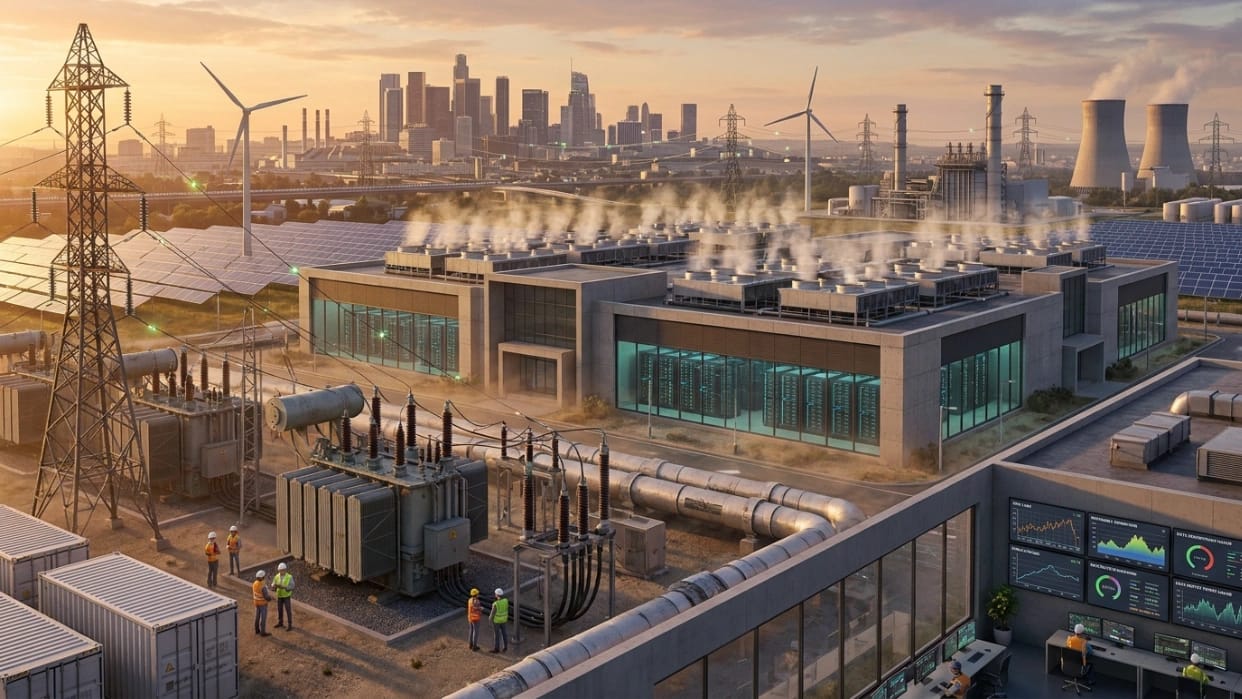
Artificial intelligence looks digital.
But behind every AI-generated image, chatbot response, video, search result, and automated business task is something very physical:
electricity.
And as AI models become more capable, the infrastructure required to run them is expanding rapidly.
Data centers are being built at enormous scale. Power companies are planning new generation and transmission capacity. Technology companies are signing energy contracts. Governments are increasingly asking whether local grids, water supplies, and communities can absorb the expansion.
The International Energy Agency estimates that global electricity consumption by data centers could more than double to around 945 terawatt-hours by 2030, with AI one of the most important drivers. That would represent almost 3% of global electricity consumption.
That sounds like a problem for technology companies.
It isn’t.
The AI energy boom could eventually affect business costs, electricity infrastructure, investment, economic growth, and potentially consumers themselves.
Here’s what you need to understand.
The pressure is already visible across the wider AI data-center power demand story, the emerging AI power shortage, and the risk of an AI-driven grid bottleneck. It also explains why data centers have become central to the global AI infrastructure race. The International Energy Agency’s modeling projects rapid electricity-demand growth, while the U.S. Department of Energy’s data-center resource hub shows why generation, transmission, efficiency, and local planning must advance together.
Why Does AI Need So Much Electricity?
AI models require enormous amounts of computing power.
Training advanced models can require large clusters of specialized processors operating for extended periods.
But training isn’t the only source of energy consumption.
Once an AI model becomes available, millions of people and businesses can use it simultaneously.
Every request requires computing resources.
This is called inference.
As AI becomes embedded in:
- Search engines
- Office software
- Customer service
- Coding
- Healthcare
- Finance
- Advertising
- Autonomous systems
- Video generation
the amount of computing required to operate those services can increase substantially.
The IEA estimates that electricity consumption from accelerated servers—largely driven by AI adoption—is growing much faster than conventional server consumption.
So the AI revolution isn’t simply increasing demand for chips.
It’s increasing demand for power infrastructure.
7 Ways the AI Energy Boom Could Affect You
1. Electricity Demand Could Rise in Data-Center Regions
The first effect is straightforward:
More AI → more data centers → more electricity demand.
But the important detail is where that electricity is needed.
A data center isn’t spread evenly across a country.
It is concentrated in a specific location.
That means a region can experience a much larger increase in electricity demand than national averages suggest.
The IEA expects U.S. electricity demand to grow by close to 2% annually through 2030, with data-center expansion accounting for about half of the increase.
That creates an infrastructure challenge.
Power plants aren’t the only requirement.
Regions may also need:
- Transmission lines
- Substations
- Transformers
- Backup generation
- Battery storage
- Cooling infrastructure
- Grid-management systems
And those projects can take years to develop.
What this means for consumers
If you live in a region experiencing rapid data-center growth, AI infrastructure could become part of the local electricity conversation—even if you never use an AI model yourself.
2. Electricity Prices Could Become a Bigger Local Issue
This is where the debate becomes much more personal.
Data centers create enormous electricity demand.
Someone ultimately has to pay for the generation and infrastructure required to serve that demand.
The answer depends heavily on local electricity-market rules and how utilities allocate costs.
If new infrastructure costs are fairly assigned to the companies creating the demand, the impact on other consumers can be limited.
If costs are spread more broadly, households and smaller businesses could potentially face additional pressure.
That is one reason data-center expansion has become politically controversial.
New York imposed a one-year moratorium in July 2026 on construction of large new data centers consuming at least 50 megawatts, citing concerns including electricity costs, water consumption, land use, and community impacts.
The debate is therefore no longer simply:
“How much AI should we build?”
It is increasingly:
“Who should pay for the infrastructure required to power it?”
3. The Power Grid Could Become the Real AI Bottleneck
AI companies can develop a new model relatively quickly.
Electricity infrastructure doesn’t work that way.
A new data center may be constructed in a few years, while transmission networks, substations, and new generation projects can require considerably longer planning and permitting timelines.
The IEA highlights this mismatch as an important uncertainty: data centers can become operational in roughly two to three years, while broader energy infrastructure requires longer lead times and substantial investment.
This creates a potential bottleneck.
Imagine a technology company has:
- The chips
- The servers
- The capital
- The building
- The AI model
but doesn’t have enough reliable electricity.
The project can’t operate at full capacity.
That makes access to power a strategic advantage.
4. AI Could Accelerate Investment in New Energy
There is a more positive side to the story.
AI’s growing electricity demand could encourage massive investment in energy infrastructure.
The IEA expects renewables to meet nearly half of the additional electricity demand from data centers through 2030, while natural gas and nuclear also play important roles.
This could accelerate development of:
- Solar power
- Wind power
- Battery storage
- Natural gas generation
- Nuclear power
- Geothermal energy
- Transmission networks
- Grid-management technology
Technology companies are increasingly interested in securing reliable electricity because their AI infrastructure depends on it.
That could turn AI from merely an energy consumer into a powerful source of energy investment demand.
5. Water Could Become Another Hidden Constraint
Electricity gets most of the attention.
But data centers also need cooling.
High-performance computing equipment generates significant heat.
Cooling systems therefore become a critical part of data-center design.
Depending on the technology and location, cooling can involve substantial water use.
This becomes particularly sensitive when data centers are built in regions already facing water stress.
Texas is a good example.
The state recently ordered a pause on approvals for new data-center projects seeking grid connections while authorities conduct an audit examining electricity demand, water usage, infrastructure impacts, and other factors. Reuters reported that roughly 90% of the 474 gigawatts of proposed electricity demand under review came from data-center projects.
The message is becoming clear:
AI infrastructure needs more than electricity.
It needs physical resources.
6. AI Infrastructure Could Reshape Investment
The AI boom isn’t only creating opportunities for companies that build AI models.
It is creating demand throughout a much larger ecosystem.
Think about everything an AI data center needs:
Chips → Servers → Data Centers → Electricity → Cooling → Networking → Transmission → Construction → Security → Maintenance
That creates potential opportunities across multiple industries.
Energy companies may benefit from rising demand.
Utilities may need new infrastructure.
Construction firms may receive large contracts.
Equipment manufacturers may supply transformers and cooling systems.
Renewable developers may secure long-term contracts.
Battery companies may benefit from growing demand for flexible power.
This means investors trying to understand the AI economy need to look beyond the famous AI companies.
The infrastructure underneath AI may become one of the most important parts of the story.
7. The Cost of AI Could Eventually Reach Everyday Businesses
You don’t need to own a data center to be affected by the AI energy boom.
Businesses increasingly depend on cloud computing and AI services.
That includes:
- Online retailers
- Banks
- Software companies
- Marketing agencies
- Media companies
- Healthcare providers
- Manufacturers
- Small businesses
If the infrastructure required to provide those services becomes more expensive, some of those costs may eventually appear in the prices businesses pay for cloud and AI services.
At the same time, AI could reduce costs through automation and productivity gains.
That creates an important economic tradeoff:
Higher infrastructure costs vs. higher productivity.
The long-term outcome will depend on which effect is larger.
Is AI Actually Creating an Energy Crisis?
Not necessarily.
This distinction matters.
The IEA expects data-center electricity consumption to rise sharply, but even around 945 TWh in 2030 would still represent just under 3% of global electricity consumption in its base case.
So saying “AI will consume all the world’s electricity” would be misleading.
The bigger concern is local concentration.
A country might have enough electricity overall.
But a particular region could still struggle to provide enough power to a cluster of massive data centers.
This is why grid planning matters so much.
The AI Energy Problem Is Really a Timing Problem
There is another important issue.
AI development is moving incredibly quickly.
Energy infrastructure moves much more slowly.
That creates a potential mismatch:
AI demand can accelerate in months.
Power infrastructure can take years.
If technology companies build computing capacity faster than utilities can build supporting infrastructure, bottlenecks can emerge.
This is already becoming visible in parts of the United States.
California, for example, has experienced rising renewable-energy curtailment as clean-energy generation has grown faster than transmission and grid infrastructure in some areas. Reuters reported that 4.5 million MWh of solar and wind generation was curtailed during the first half of 2026—already exceeding the full-year 2025 total.
The lesson is important:
Generating electricity isn’t enough.
You also need to deliver it to the right place at the right time.
Why AI Could Actually Help the Energy Sector
The relationship between AI and energy isn’t one-way.
AI consumes electricity.
But it can also improve energy systems.
AI can potentially help with:
- Demand forecasting
- Grid optimization
- Predictive maintenance
- Renewable-energy forecasting
- Battery management
- Power trading
- Building efficiency
- Industrial energy management
The IEA describes AI as having the potential to transform the energy sector while simultaneously driving greater electricity demand.
That creates a fascinating feedback loop:
More AI → More electricity demand
but also:
Better AI → Potentially smarter energy systems
The question is whether efficiency improvements can keep pace with expanding demand.
What Businesses Should Do Now
Businesses that rely heavily on cloud computing or AI should start thinking about energy as part of their technology strategy.
1. Understand Your AI Costs
Don’t measure AI only by subscription fees.
Consider:
- API usage
- Cloud computing
- Storage
- Data processing
- Model inference
- Automation costs
2. Measure AI Productivity Gains
If AI increases electricity and computing expenses, businesses should know whether the productivity gains justify those costs.
3. Avoid Unnecessary AI Usage
Not every task requires the most powerful model.
Use smaller or more efficient models when they can deliver the required result.
4. Diversify Critical Technology Providers
Excessive dependence on one cloud or AI provider can create operational risk.
5. Watch Energy Markets
For energy-intensive businesses, electricity availability and pricing may become increasingly important strategic variables.
What Consumers Should Watch
Most people won’t need to calculate how many kilowatt-hours an AI query consumes.
Instead, watch for broader signals.
Pay attention to:
- Local electricity-price changes
- New data-center projects
- Utility infrastructure investments
- Grid reliability
- Government regulation
- Water-use disputes
- Energy-company investment
- Cloud-service pricing
These developments can reveal where the economic effects of AI are becoming tangible.
What Investors Should Watch
The AI energy boom could create winners and losers.
Potential beneficiaries may include:
- Utilities
- Grid-equipment manufacturers
- Renewable-energy companies
- Natural-gas producers
- Nuclear developers
- Battery companies
- Cooling-system providers
- Data-center infrastructure companies
- Construction firms
But investors should avoid assuming every company associated with AI will automatically benefit.
The critical questions are:
Who has pricing power?
Who owns scarce infrastructure?
Who can secure reliable electricity?
Who can build capacity fast enough?
Who faces the greatest regulatory risk?
Those questions may become more important than simply asking which company has the best AI model.
The Geographic Battle for AI Power
Energy availability could increasingly influence where AI infrastructure is built.
Historically, companies considered:
- Land
- Labor
- Taxes
- Internet connectivity
- Regulation
Now another factor is becoming critical:
Power availability.
A region with abundant electricity, transmission capacity, water resources, and favorable regulation can become extremely attractive to data-center developers.
A region with expensive electricity, limited grid capacity, or water shortages may struggle to compete.
That could reshape the geography of the global AI industry.
What Happens Next?
The AI-energy relationship is likely to become one of the defining infrastructure stories of the next several years.
The IEA projects global data-center electricity consumption to rise to around 945 TWh by 2030, while its broader Electricity 2026 outlook expects global electricity demand to grow at an average annual rate of 3.6% through 2030.
At the same time, governments and regulators are beginning to scrutinize where data centers are built, how much electricity and water they consume, and who pays for supporting infrastructure.
Texas has now ordered an audit of proposed data-center projects, while New York has imposed a temporary moratorium on large new facilities.
This suggests that the next phase of AI growth won’t be determined by technology alone.
It will also depend on:
Power.
Water.
Grid capacity.
Regulation.
Capital.
Infrastructure.
The Bottom Line
AI may be a digital revolution, but it is powered by very physical resources.
Every new data center requires electricity.
Every AI server produces heat.
Every major computing cluster requires cooling.
Every new facility puts additional demands on infrastructure.
And every region hosting massive AI projects has to decide how those costs and benefits should be distributed.
The good news is that AI could also stimulate enormous investment in renewable energy, nuclear power, batteries, transmission, and smarter electricity systems.
The real challenge is timing.
If AI infrastructure grows faster than the energy system supporting it, electricity and grid capacity could become bottlenecks for the AI economy.
For consumers, the most important thing isn’t to panic about an “AI energy crisis.”
It’s to understand that the AI revolution is increasingly becoming an energy and infrastructure story.
Frequently Asked Questions
Will AI make electricity more expensive?
It can increase local costs where new data-center demand arrives faster than generation and grid capacity. The outcome depends on tariffs, infrastructure funding, efficiency, and utility regulation.
Can cleaner energy meet the demand?
Renewables, storage, nuclear power, natural gas, transmission, and efficiency will all contribute. No single source can solve every regional constraint.
The Light Span Perspective
The AI debate often focuses on models, chips, valuations, and productivity.
But there is another question hiding underneath all of them:
Where will the electricity come from?
That question could become one of the defining constraints on AI expansion.
The IEA’s forecasts show just how significant the change could be, with data-center electricity consumption potentially more than doubling by 2030.
Yet the story isn’t simply negative.
AI could simultaneously create enormous demand for electricity while helping energy companies operate grids more intelligently and efficiently.
At The Light Span, we believe this is the bigger story readers should watch.
The future of AI won’t be decided inside a chatbot window alone.
It will also be decided inside power plants, transmission networks, data centers, cooling systems, battery facilities, and government offices.
The companies and countries that solve the energy problem may ultimately have an advantage in the AI race.

