


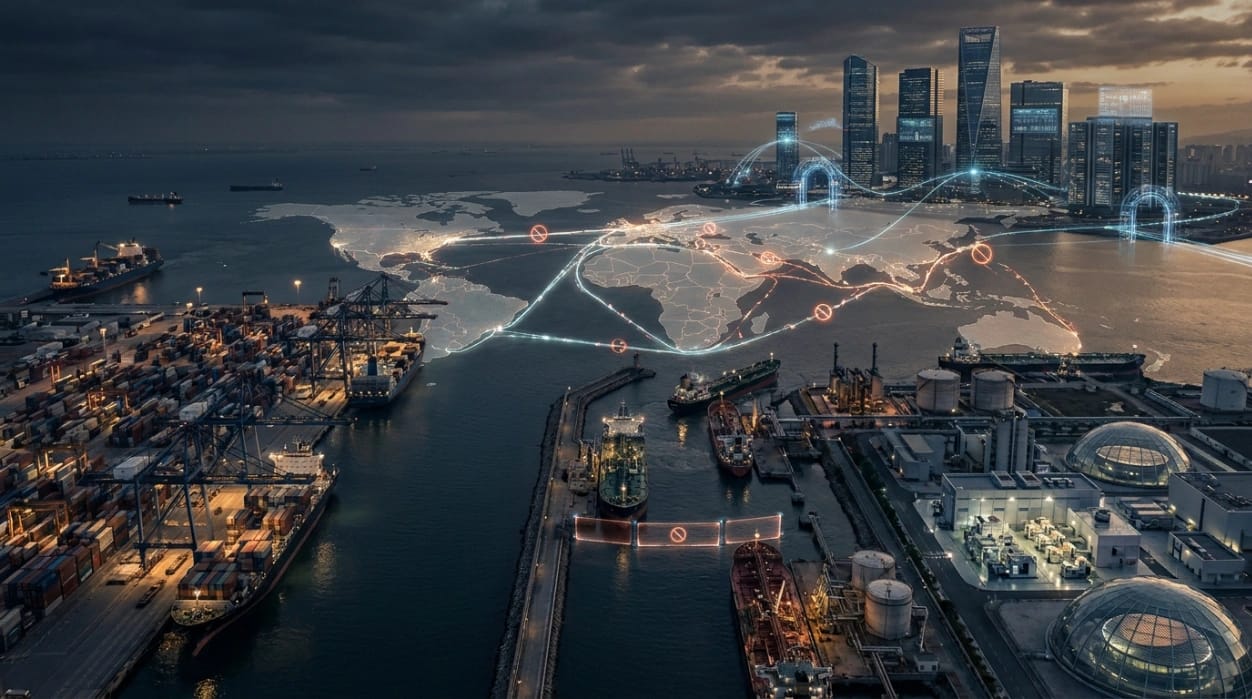
Economic Warfare 2026: Tools Used Beyond the Battlefield
Wars are traditionally fought with soldiers, missiles, aircraft and ships.
But some of the most important conflicts shaping the world in 2026 are also being fought through banks, ports, computer chips, oil shipments and international trade.
Governments are increasingly using economic tools to pressure rivals without relying entirely on conventional military force.
Sanctions can freeze access to money.
Tariffs can make a rival’s exports more expensive.
Export controls can restrict advanced technology.
Financial restrictions can isolate companies from international banking.
Energy measures can reduce government revenue.
Supply-chain controls can deny access to critical materials.
Together, these tools form what is increasingly described as economic warfare or economic coercion.
The strategy is highly visible in the current confrontation involving the United States and Iran. Washington has intensified pressure on Tehran’s financial networks and oil trade, while the wider conflict has disrupted energy flows and pulled countries such as China into increasingly difficult geopolitical decisions.
The U.S. Treasury’s official Iran sanctions program shows how extensive the system has become, with new Iran-related designations continuing through 2026.
But Iran is only one part of a much bigger transformation.
Economic pressure is increasingly visible in relations between the United States and China, Western governments and Russia, and countries competing over semiconductors, energy, shipping routes and critical supply chains.
The world is not abandoning traditional military power.
Instead, economic power is becoming another battlefield.
Here are seven ways economic warfare in 2026 is changing geopolitics.
1. Sanctions Have Become a Front-Line Geopolitical Weapon
Sanctions are not new.
Governments have used trade restrictions and financial penalties for centuries.
What has changed is their sophistication.
Modern sanctions can target individual banks, executives, shipping companies, oil traders, cryptocurrency platforms or entire sectors of an economy.
The objective is often to increase the economic cost of a government’s policies without immediately escalating to direct military action.
Iran provides one of the clearest current examples.
On August 7, the U.S. Treasury announced action against financial networks it says helped Iran move hundreds of millions of dollars through a shadow banking system. The measures targeted networks operating across several countries.
The Treasury also moved against digital-asset exchanges and corporate networks it accused of helping Iranian entities maintain access to international finance.
This demonstrates how sanctions have evolved.
Blocking a country’s official bank may no longer be enough.
Governments now follow the networks created to bypass previous restrictions.
When money moves through another bank, that bank can become a target.
When trade shifts through intermediaries, those intermediaries can become targets.
When cryptocurrency becomes an alternative financial channel, digital exchanges can become targets.
The result is an ongoing contest between sanctions and sanctions evasion.
That makes modern economic warfare less like closing one door and more like continually finding and closing new doors as they appear.
2. Secondary Sanctions Can Force Other Countries to Choose
Traditional sanctions focus on the target country.
Secondary sanctions go further.
They can threaten companies or institutions in third countries with penalties for continuing certain business with the sanctioned state.
This dramatically expands the reach of economic pressure.
Imagine a Chinese company buying sanctioned Iranian oil.
The company may have little direct business in the United States.
But its bank might depend on access to dollar transactions.
Its shipping partners may operate internationally.
Its insurers may have exposure to Western markets.
Its suppliers may depend on U.S. technology.
Economic pressure can therefore travel through the global financial system.
This is becoming particularly important in the Iran confrontation.
Reuters reported this week that Washington is considering additional measures involving Chinese refiners and potentially other entities facilitating Iranian trade as it seeks to increase economic pressure on Tehran.
The strategy creates a larger geopolitical question.
How much pressure can the United States place on Iran without turning the confrontation into a wider economic dispute with China?
China is enormously more difficult to isolate than Iran.
It is deeply integrated into global manufacturing, trade and finance.
That means aggressive secondary measures can impose costs not only on the target but also on countries enforcing them.
This is one reason the global economy is increasingly at risk of splitting into competing economic blocs.
Economic warfare becomes much more consequential when neutral countries are pushed toward choosing sides.
3. Technology Is Becoming a Strategic Weapon
Some of the world’s most important trade restrictions no longer involve oil or steel.
They involve computer chips.
Advanced semiconductors are essential for:
artificial intelligence,
data centers,
telecommunications,
advanced manufacturing,
scientific research,
and military systems.
That has turned access to computing technology into a national-security issue.
The U.S. has spent years developing restrictions intended to limit China’s access to some advanced semiconductor technologies.
The rules continue evolving.
In January 2026, the U.S. Commerce Department’s Bureau of Industry and Security changed its licensing policy for certain advanced chips exported to China. Applications involving processors including Nvidia’s H200 and AMD’s MI325X could be considered case by case, provided specified security and compliance conditions were met.
The Commerce Department’s semiconductor export-control policy illustrates a fundamental change in trade policy.
Governments are no longer asking only:
“Will this export help our economy?”
They are also asking:
“Could this technology strengthen a strategic competitor?”
That changes globalization.
A chip can be both a commercial product and a strategic resource.
The same increasingly applies to AI systems, quantum technologies, telecommunications equipment and semiconductor-manufacturing machinery.
Our analysis of Taiwan-China tensions explains why this competition becomes even more important when advanced chip manufacturing is geographically concentrated.
Technology policy has become foreign policy.
4. Energy Can Be Used to Apply Political Pressure
Energy has always influenced geopolitics.
In the age of economic warfare, it becomes even more powerful.
Oil and gas exporters depend on revenue.
Importers depend on reliable supplies.
Shipping routes connect the two.
Disrupt any part of that system and the economic consequences can spread far beyond the countries directly involved.
Iran demonstrates the mechanism clearly.
China has historically been the dominant destination for shipped Iranian oil. But Reuters reported on August 21 that offers of Iranian crude to Chinese buyers had fallen significantly as restrictions tightened and available supply became scarcer.
Iranian oil shipments were reported at around 534,000 barrels per day in August, compared with an average of about 1.4 million barrels per day in 2025.
That affects several players simultaneously.
Iran loses export revenue.
Chinese refiners need alternative supplies.
Competing oil exporters can gain customers.
Shipping patterns change.
And global crude prices respond to expectations about future supply.
This is why our analysis of oil prices and the global economy matters far beyond energy investors.
Oil is not simply a commodity.
It is a geopolitical asset.
Economic warfare involving a major producer can eventually reach ordinary consumers through fuel prices, transportation expenses and inflation.
5. Supply Chains Are Becoming Instruments of National Power
For decades, companies designed supply chains around efficiency.
Find the cheapest supplier.
Manufacture where costs are lowest.
Keep inventories lean.
Move products globally.
Geopolitical competition is changing those assumptions.
Governments now worry about becoming dangerously dependent on rivals for critical goods.
That can include:
semiconductors,
rare-earth minerals,
pharmaceutical ingredients,
batteries,
energy,
telecommunications equipment,
and defense components.
Dependence creates vulnerability.
If Country A controls something Country B desperately needs, trade can become leverage.
Governments and businesses are responding by diversifying suppliers, building domestic capacity and moving production toward politically trusted partners.
The shift is already visible in the changing global supply chain, where strategies such as friend-shoring, nearshoring and “China Plus One” increasingly emphasize resilience rather than simply the lowest cost.
This has an important consequence.
Efficiency can decline.
Building duplicate supply chains costs money.
Moving factories can cost money.
Maintaining larger inventories costs money.
Buying from a politically safer but more expensive supplier costs money.
That means economic security may create an economic-security premium.
Consumers and businesses effectively pay more in exchange for reducing geopolitical vulnerability.
In a stable world, that looks inefficient.
In a fragmented world, it can look like insurance.
6. Financial Networks Have Become Part of the Battlefield
The global financial system gives some countries extraordinary economic influence.
International commerce depends on:
banks,
payment networks,
insurance,
trade finance,
reserve currencies,
and access to capital markets.
Restricting access to those systems can create enormous pressure without physically destroying anything.
This is one reason the U.S. dollar plays such an important role in sanctions.
Companies may operate outside the United States but still depend on dollar transactions or institutions connected to the American financial system.
Washington can use that connection as leverage.
Target countries naturally try to reduce the vulnerability.
Iranian officials this week called for stronger use of national currencies in regional trade as part of efforts to reduce dependence on dollar-based financial channels.
Other countries are also exploring alternative payment arrangements.
This does not mean the dollar is about to disappear as the world’s dominant international currency.
Replacing a deeply established financial system is extraordinarily difficult.
But sanctions create an incentive for targeted governments to build alternatives.
That produces an interesting paradox.
The more powerful financial sanctions become, the more motivated sanctioned countries are to reduce their exposure to the system making those sanctions effective.
The process could take decades.
But it is one reason the new global economy is becoming more politically complicated.
Finance is no longer merely infrastructure supporting trade.
It is increasingly part of geopolitical strategy.
7. Maritime Trade Can Turn Economic Pressure Into a Global Shock
Economic warfare becomes especially dangerous when it reaches shipping.
The global economy still depends heavily on maritime trade.
Oil.
Natural gas.
Food.
Manufactured products.
Raw materials.
All travel through a relatively small number of critical sea routes.
The Strait of Hormuz is one of the most important.
The current Iran conflict has shown how quickly pressure around a strategic waterway can affect energy markets.
This matters because maritime disruption does not remain confined to the countries involved.
A ship forced to reroute travels farther.
Longer routes consume more fuel.
Insurance costs can rise.
Delivery times increase.
Inventories become harder to manage.
Commodity prices can respond.
Those costs then move through global supply chains.
Our guide to global shipping routes and geopolitics explains why narrow waterways such as Hormuz, the Suez route and other maritime chokepoints can have economic importance far beyond their physical size.
This is where the boundary between economic and conventional warfare becomes less clear.
A tariff is clearly an economic instrument.
A naval restriction affecting commercial trade has both economic and military dimensions.
That makes blockades particularly dangerous.
They can create enormous economic pressure while simultaneously increasing the risk of direct confrontation.
Does Economic Warfare Actually Work?
This is the difficult question.
Sanctions can unquestionably cause economic damage.
They can reduce revenue.
Restrict access to technology.
Make international payments harder.
Increase transaction costs.
Discourage investment.
And force governments to spend resources building alternatives.
But causing economic pain is not the same as achieving political objectives.
Governments under pressure can adapt.
Iran has spent years developing networks for sanctions evasion.
Russia redirected portions of its trade after Western restrictions expanded.
China has invested heavily in domestic semiconductor capabilities partly because foreign technology restrictions created a strategic incentive to reduce dependence.
Economic pressure can therefore produce two effects simultaneously:
short-term vulnerability and long-term adaptation.
This is why policymakers face a difficult balance.
Weak sanctions may not change behavior.
Extremely aggressive sanctions can encourage the target to redesign its economy around avoiding future pressure.
And broad measures can hurt ordinary people far more quickly than political leaders.
Economic warfare is powerful.
It is not automatic.
Why Economic Warfare Could Accelerate Global Fragmentation
The larger consequence may not be whether one particular sanctions package succeeds.
It may be how repeated economic coercion changes the global system.
Countries are learning that economic dependence creates geopolitical risk.
That encourages governments to seek:
alternative suppliers,
domestic manufacturing,
larger strategic reserves,
new payment mechanisms,
regional trade partners,
and independent technology ecosystems.
The result is not necessarily the end of globalization.
It is a different kind of globalization.
Trade continues, but political alignment matters more.
Companies continue operating internationally, but they consider geopolitical exposure.
Governments still want foreign investment, but they increasingly distinguish between ordinary industries and strategic industries.
This trend has already become visible across the broader fragmentation of the global economy.
The world may remain deeply connected while becoming less economically trusting.
What Economic Warfare Means for Ordinary People
Geoeconomic conflict can sound distant.
Its consequences are not.
Sanctions affecting oil can change fuel prices.
Tariffs can increase the cost of imported products.
Technology restrictions can alter electronics supply.
Shipping disruption can increase transportation costs.
Supply-chain diversification can raise manufacturing expenses.
Financial instability can affect currencies and investment.
Eventually, some of those costs reach households.
That does not automatically mean economic restrictions are wrong.
Governments sometimes decide that national-security objectives justify economic costs.
But those costs should be understood.
A geopolitical confrontation does not need missiles landing in your country to affect your household budget.
Modern economic interdependence transmits pressure internationally.
That is what makes economic warfare so powerful—and so difficult to contain.
FAQs
What is economic warfare?
Economic warfare is the use of financial, trade, technological or resource-related measures to weaken, constrain or influence another country. Tools can include sanctions, tariffs, export controls, financial restrictions and pressure on strategic trade.
Are economic sanctions the same as economic warfare?
Sanctions are one tool of economic coercion. Economic warfare is a broader concept that can include sanctions alongside trade restrictions, technology controls, energy pressure and other measures.
Why are secondary sanctions powerful?
Secondary sanctions can pressure third-country companies and financial institutions to stop doing business with a targeted country by threatening their access to important markets or financial systems.
How are semiconductors used in geopolitical competition?
Advanced chips are essential for AI, computing and some military applications. Governments can use export controls and licensing requirements to restrict a rival’s access to certain technologies.
Can economic warfare raise oil prices?
Yes. Restrictions affecting major energy producers or shipping routes can reduce available supply, increase transportation risk and contribute to higher prices.
Could economic warfare split the global economy?
It could accelerate fragmentation as countries diversify suppliers, build domestic industries and strengthen trade with politically aligned partners.
The Light Span Perspective
The most important change in modern geopolitics is not that economic warfare has replaced military conflict.
It hasn’t.
The current world provides painful evidence that conventional war remains very real.
What has changed is that countries now possess an extraordinary range of tools that sit between ordinary diplomacy and direct military force.
A government can restrict access to its financial system.
Block technology exports.
Pressure shipping companies.
Target oil buyers.
Raise tariffs.
Freeze assets.
Sanction banks.
Or force companies to reconsider which international markets they can safely serve.
These measures can reshape an economy without destroying a factory or firing a missile.
That makes economic warfare attractive.
But it also creates risks.
Every economic weapon encourages someone to develop a defense.
Sanctions encourage alternative payment systems.
Export controls encourage domestic technology development.
Supply-chain pressure encourages diversification.
Energy vulnerability encourages strategic reserves and alternative suppliers.
Tariffs encourage companies to move production.
The result is a continuous geopolitical adaptation cycle.
The deeper consequence could be a world economy that becomes more resilient within political blocs but less efficient globally.
Countries may duplicate manufacturing.
Businesses may pay more for secure suppliers.
Governments may subsidize strategic industries that would otherwise be produced elsewhere.
Consumers may ultimately pay part of the cost.
That is the trade-off at the center of geoeconomics in 2026:
efficiency versus security.
For decades, globalization rewarded countries and companies for maximizing efficiency.
Today’s geopolitical environment increasingly rewards them for surviving disruption.
That is a profound change.
The United States–Iran confrontation provides an immediate example. Economic pressure is increasingly targeting the networks that allow Tehran to earn revenue and move money. But those measures also affect Chinese buyers, regional trade, oil markets and international financial relationships.
The effects do not stop at Iran’s borders.
That is the defining characteristic of modern economic warfare.
In an interconnected global economy, targeting one country’s economic lifelines can send pressure through dozens of others.
The same logic applies to semiconductors, critical minerals, shipping and finance.
The world is therefore entering an era in which economic strength is becoming inseparable from geopolitical strength.
Countries will still count aircraft, ships and missiles.
But increasingly, they will also count:
factories,
energy supplies,
semiconductor capacity,
critical minerals,
financial networks,
shipping access,
and resilient supply chains.
Those resources determine how much pressure a country can withstand—and how much pressure it can impose on others.
The wars of the future may still be fought on battlefields.
But some of the most consequential struggles for global power will also be fought through the systems that keep the world economy running.
And in economic warfare, the most powerful weapon may sometimes be something as ordinary as deciding who is allowed to buy, sell, ship, finance or manufacture.
Continue reading more

