


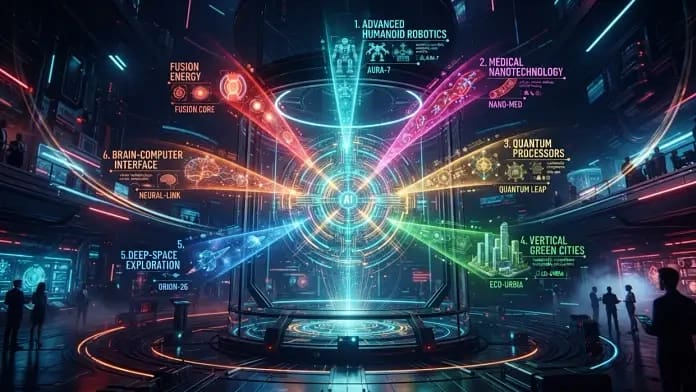
AI Breakthroughs 2026: Advances and Their Practical Limits
Artificial intelligence is changing so quickly that capabilities considered extraordinary only a few years ago are becoming normal.
AI can generate realistic images and video.
It can write and debug software.
It can analyze large documents.
It can reason through increasingly difficult problems.
It can operate software tools.
And researchers are increasingly connecting artificial intelligence with robots, scientific research and real-world decision-making.
But the biggest AI breakthroughs of 2026 are not simply about making chatbots better.
Something much larger is happening.
Artificial intelligence is beginning to move from systems that primarily respond to humans toward systems that can increasingly reason, plan, use tools and act.
At the same time, AI is expanding beyond screens.
Researchers are building models that interact with robots, understand physical environments, predict weather, assist scientific discovery and operate across text, images, audio and video.
This transition could ultimately matter more than any individual chatbot release.
It suggests that artificial intelligence is becoming a general technological layer that could influence almost every major industry.
The transformation also helps explain why countries and companies are spending enormous amounts of money on AI infrastructure. The Light Span’s analysis of the global race for AI leadership shows that governments increasingly view AI capabilities as a source of economic and strategic power.
So what developments actually matter?
Here are seven of the biggest AI breakthroughs shaping 2026—and what they could mean for the future.
1. AI Is Becoming Much Better at Reasoning
For years, large language models were primarily prediction systems.
Give them text and they generated a statistically likely continuation.
That capability alone produced remarkably useful systems.
But it also created weaknesses.
Models could produce convincing answers without actually handling complex problems reliably. They could lose track of multi-step tasks, make logical mistakes or confidently generate incorrect information.
One of the biggest changes in modern AI is the growing emphasis on reasoning.
Instead of immediately producing an answer, newer systems can devote more computation to working through difficult problems.
This approach is especially valuable for tasks involving:
mathematics,
software development,
scientific analysis,
planning,
and complex decision-making.
The distinction matters.
Imagine asking an AI to write a short email.
That does not require extensive reasoning.
Now imagine asking the same system to analyze a complicated business problem involving dozens of variables and develop a step-by-step strategy.
That is a fundamentally different task.
Improved reasoning allows AI to become useful in areas where simply generating fluent language is not enough.
The result could be an important shift in how businesses use artificial intelligence.
Instead of AI being primarily a content-generation tool, it can increasingly become a problem-solving tool.
This does not mean AI reasoning is equivalent to human reasoning.
Models can still make mistakes.
Their answers still need verification, particularly in high-stakes situations.
But the direction is important.
The value of AI increases dramatically when it can help solve difficult problems rather than simply communicate information.
And reasoning is enabling another breakthrough that may become even more consequential.
2. AI Agents Are Moving From Answers to Actions
Traditional AI assistants wait for instructions.
You ask a question.
The AI responds.
Then you decide what happens next.
AI agents change that relationship.
Agentic AI systems are designed to reason about a goal, create a plan and take multiple actions toward completing it.
NVIDIA describes agentic AI as systems capable of sophisticated reasoning and planning for complex, multi-step problems, turning information into actions rather than merely generating responses.
NVIDIA’s overview of agentic AI
Imagine telling an AI:
“Research competitors and prepare a market report.”
A conventional chatbot might explain how you could perform the research.
An advanced AI agent could potentially:
search relevant information,
organize findings,
compare companies,
analyze data,
prepare a report,
and request your approval when an important decision is required.
The difference is enormous.
The AI is no longer only generating information.
It is participating in the workflow.
This could eventually affect millions of office tasks.
Customer support agents could resolve multi-step issues.
Software agents could identify bugs, modify code and test solutions.
Research agents could search databases and organize evidence.
Administrative agents could coordinate information across applications.
Marketing agents could analyze campaign performance and prepare recommendations.
Businesses are therefore beginning to think about AI differently.
The question is moving from:
“What can employees ask AI?”
toward:
“What processes can AI help complete?”
This transition also creates significant challenges.
Agents need permissions to use software and access information.
That creates security risks.
An AI system that can only generate text has limited ability to cause real-world damage.
An AI system authorized to modify files, send communications or interact with business systems has much greater responsibility.
The rise of agents therefore makes AI reliability, cybersecurity and human oversight more important—not less.
3. Multimodal AI Is Beginning to Understand the World More Naturally
Humans do not experience the world as text.
We see.
We hear.
We speak.
We watch movement.
We interpret physical environments.
Early generative AI systems were much more limited.
Language models processed text.
Image generators produced images.
Speech systems processed audio.
Those boundaries are increasingly disappearing.
Modern AI is becoming multimodal.
A multimodal model can work across several types of information within the same system.
For example, an AI assistant may be able to examine a photograph, understand spoken instructions, analyze a document and respond naturally in voice.
This makes interaction much closer to how humans communicate.
It also dramatically expands potential applications.
A technician could show AI a damaged machine component and ask what might be wrong.
A student could point a camera at a mathematics problem and request an explanation.
A business could analyze documents containing text, charts and photographs together.
A robot could combine visual information with language instructions.
A medical system could potentially help specialists interpret multiple forms of clinical information.
The importance of multimodal AI therefore goes beyond convenience.
It gives artificial intelligence a richer understanding of context.
And that becomes particularly important when AI leaves the computer screen and enters the physical world.
4. AI Robotics Is Moving Toward General-Purpose Intelligence
Robots have worked in factories for decades.
But traditional industrial robots are extremely different from the intelligent machines researchers are now trying to develop.
A conventional factory robot might perform the same movement thousands of times.
It works brilliantly as long as its environment remains predictable.
Change the object.
Move the workstation.
Introduce an unexpected obstacle.
The robot may struggle.
Artificial intelligence could change that.
Modern robotics research increasingly combines:
computer vision,
language models,
reasoning,
simulation,
motion planning,
and reinforcement learning.
The goal is to create machines capable of understanding instructions and adapting to changing physical environments.
Google DeepMind’s current research illustrates the direction clearly.
Its Gemini Robotics work focuses on models that can perceive, reason, use tools and interact with the physical world. In July 2026, DeepMind highlighted Gemini Robotics ER 2, extending the work toward video understanding, task orchestration and collaboration involving multiple robots.
Google DeepMind’s latest AI research
NVIDIA is pursuing the same broader opportunity through robotics foundation models, simulation and accelerated computing designed to help autonomous machines perceive their surroundings and make decisions in real time.
This is sometimes described as physical AI.
And it could become one of the most economically important AI developments of the next decade.
Software AI automates digital work.
Physical AI could automate parts of physical work.
Potential applications include:
warehouses,
manufacturing,
logistics,
agriculture,
construction,
healthcare,
and eventually household assistance.
But robotics also exposes AI to a much harder problem.
A chatbot making a mistake may produce an incorrect sentence.
A robot making a mistake can damage equipment or injure someone.
Physical AI therefore requires extremely high levels of reliability.
That is one reason general-purpose robotics is likely to develop more slowly than consumer AI software.
But if researchers solve those challenges, the economic consequences could be enormous.
5. AI Is Becoming a Tool for Scientific Discovery
Some of the most important AI breakthroughs may never appear in a consumer chatbot.
They may happen inside laboratories.
Scientific research often involves enormous search spaces.
Researchers must examine huge numbers of:
molecules,
proteins,
materials,
weather patterns,
genetic sequences,
and possible experiments.
AI can help scientists analyze those possibilities much faster.
This is already changing how researchers approach fields such as biology, chemistry, medicine, materials science and climate modeling.
One particularly important direction is weather forecasting.
Google DeepMind currently highlights WeatherNext, an AI system aimed at improving weather prediction, and in August 2026 reported a breakthrough focused on forecasting cyclones.
The larger opportunity extends far beyond weather.
Imagine AI helping researchers identify promising battery materials before physically testing them.
Or helping scientists prioritize drug candidates from millions of possible molecules.
Or predicting how proteins interact.
Or helping design new industrial materials.
AI does not eliminate laboratory work.
A predicted molecule still needs to be tested.
A proposed material still needs to be manufactured.
A weather forecast still needs verification against reality.
But AI can reduce the number of possibilities researchers must investigate manually.
That could make scientific discovery faster.
And unlike another consumer chatbot feature, faster scientific progress can produce entirely new industries.
Better batteries could transform energy storage.
New materials could improve semiconductors.
Drug discovery could accelerate.
More accurate weather forecasting could help governments prepare for disasters.
This may ultimately become one of AI’s greatest contributions.
Not replacing scientists.
Giving scientists better tools for exploring possibilities.
6. AI Infrastructure Is Becoming a Technological Breakthrough of Its Own
Every advanced AI system depends on an enormous physical machine hidden behind the software.
Data centers contain thousands of specialized processors connected through extremely fast networks.
Those processors require:
advanced memory,
high-speed networking,
cooling systems,
electricity,
and sophisticated software.
As AI models become more capable, the infrastructure supporting them has become increasingly complex.
NVIDIA’s Rubin platform, introduced in 2026, illustrates how AI computing is evolving from individual chips toward integrated platforms involving processors, networking and software. The company has also been expanding open models and computing systems for robotics, healthcare, climate science and autonomous machines.
This is important because the future of AI may not depend only on who invents the smartest algorithm.
It may depend on who can build the infrastructure required to run it.
The Light Span’s analysis of the AI infrastructure spending boom shows how semiconductor manufacturing, data centers, networking and electricity are becoming part of one enormous investment cycle.
The numbers involved are extraordinary.
And electricity has become a particularly important constraint.
As we explored in why AI data centers use so much electricity, advanced AI requires enormous amounts of computing power running continuously.
That means AI progress increasingly depends on physical infrastructure.
Better chips improve performance per watt.
Better memory allows processors to access information faster.
Better networking connects enormous clusters.
Better cooling lets those processors operate efficiently.
Better electricity infrastructure allows data centers to expand.
The AI revolution is therefore becoming simultaneously a software revolution and an industrial infrastructure boom.
7. AI Is Moving From Experiment to Real Economic Deployment
Perhaps the most important breakthrough is not a single model at all.
It is adoption.
For several years, businesses experimented with generative AI.
Employees used chatbots.
Companies launched pilot programs.
Developers tested coding assistants.
Marketing departments experimented with content generation.
Those experiments were useful, but experimentation alone does not transform an economy.
The next stage is different.
Businesses are increasingly asking how AI can become part of actual workflows.
That means integrating AI with:
customer service,
software development,
research,
fraud detection,
manufacturing,
logistics,
finance,
marketing,
and internal knowledge systems.
This transition matters because technological revolutions create their largest economic effects when businesses reorganize around them.
The internet existed before most companies learned how to build businesses around it.
Electricity existed before factories redesigned production around electric machinery.
AI could follow a similar pattern.
The Light Span’s analysis of the AI productivity paradox explains why this process takes time. Companies need to redesign workflows, train employees, integrate legacy systems and build infrastructure before productivity gains appear across the wider economy.
That means 2026 may represent an important transition point.
AI is moving from:
“What can this technology do?”
toward:
“How should organizations change because this technology exists?”
The second question is much more economically important.
What Connects All Seven AI Breakthroughs?
At first glance, reasoning models, agents, robotics, scientific AI and new computing infrastructure seem like separate developments.
They are actually connected.
Better reasoning allows AI to solve more difficult problems.
Agentic systems turn reasoning into actions.
Multimodal models give AI richer information about the world.
Robotics connects AI with physical environments.
Scientific AI applies these capabilities to discovery.
New computing infrastructure provides the processing power required to run increasingly sophisticated systems.
And enterprise adoption converts technological capability into economic activity.
Together, these developments show where artificial intelligence is heading.
AI is becoming less like a single product and more like a general-purpose technology platform.
That is why the current AI boom is attracting such enormous investment.
Companies are not simply betting on better chatbots.
They are betting that artificial intelligence eventually becomes embedded throughout the global economy.
Does This Mean Artificial General Intelligence Is Here?
No.
Rapid AI progress should not be confused with proof that artificial general intelligence, or AGI, has been achieved.
There is also no universally accepted definition of AGI.
Today’s systems remain inconsistent.
They can perform extremely difficult tasks in one situation and make surprisingly basic mistakes in another.
They can generate useful analysis while also producing false information.
They often require human oversight.
They do not possess the broad, dependable competence humans associate with general intelligence.
That distinction matters because exaggerated claims make it harder to understand the genuine progress occurring.
AI does not need to become AGI to transform industries.
A system that reliably automates 20% of a complicated workflow could create enormous economic value even if it remains incapable of many tasks humans find easy.
The more useful question is therefore not:
“Has AI become human?”
It is:
“Which tasks can AI now perform reliably that it could not perform before?”
That question produces a much clearer picture of technological progress.
What Could Slow AI Progress?
The extraordinary pace of AI development does not guarantee that progress continues smoothly.
Several constraints are becoming increasingly important.
Computing costs
Frontier AI systems require enormous amounts of expensive hardware.
Electricity
AI data centers are placing growing pressure on electricity systems and grid infrastructure.
Data
High-quality training data is valuable and not unlimited.
Reliability
AI systems still make mistakes, particularly in complicated real-world situations.
Regulation
Governments are developing rules around safety, privacy, copyright and accountability.
Security
More capable AI agents create new cybersecurity and misuse risks.
Economics
Ultimately, businesses must generate enough value from AI to justify enormous infrastructure spending.
These limitations do not mean the AI boom is ending.
They mean the next phase may depend as much on engineering and economics as on model intelligence.
Which AI Breakthrough Could Matter Most?
AI agents may create the largest near-term change in how people work.
Robotics could eventually have the largest effect on physical industries.
Scientific AI could create the most valuable long-term breakthroughs.
And infrastructure may determine how quickly everything else develops.
But there may not be one winner.
The most powerful outcome comes from combining these technologies.
Imagine a future scientific AI agent capable of reasoning about a research problem, analyzing multimodal laboratory data, proposing experiments and coordinating robotic laboratory equipment.
Each individual capability already has research behind it.
Combining them could create something far more powerful.
That is the larger story of AI in 2026.
The technologies are beginning to converge.
What Should Businesses Watch Next?
Businesses do not need to chase every new model release.
Instead, watch capabilities.
Can AI reliably complete longer tasks?
Can agents operate software with fewer errors?
Can multimodal models understand complicated documents and environments?
Can companies demonstrate measurable productivity improvements?
Can robots perform useful work outside carefully controlled demonstrations?
Can AI infrastructure become more energy-efficient?
Those questions matter more than benchmark headlines.
The next stage of artificial intelligence will be determined by reliability and usefulness, not simply impressive demonstrations.
FAQs
What are the biggest AI breakthroughs of 2026?
Major developments include improved AI reasoning, agentic AI, multimodal systems, AI-powered robotics, AI-assisted scientific discovery, next-generation computing infrastructure and broader enterprise deployment.
What is agentic AI?
Agentic AI refers to systems capable of reasoning about goals, planning multiple steps and taking actions using tools or software rather than simply generating a single response.
What is physical AI?
Physical AI combines artificial intelligence with machines such as robots and autonomous systems so they can perceive, reason about and interact with physical environments.
Is AI being used for scientific discovery?
Yes. Researchers are applying AI to areas including biology, chemistry, materials research, medicine and weather prediction. Google DeepMind’s current research includes AI-based weather and cyclone forecasting.
Is AGI available in 2026?
There is no broadly accepted evidence that artificial general intelligence has been achieved, and there is no universally agreed definition or test for AGI.
Why does AI require so much computing infrastructure?
Advanced AI models require large numbers of specialized processors, high-speed networking, memory, storage, cooling and electricity for both training and serving users.
Will AI replace human workers?
AI is likely to automate some tasks and change many jobs, but the effects vary significantly by occupation. In many areas, the more immediate change is humans using AI to complete parts of existing workflows more efficiently.
The Light Span Perspective
The biggest AI breakthroughs of 2026 reveal something more important than another year of faster models.
Artificial intelligence is changing form.
The first phase of the generative AI revolution was about creation.
AI could write.
AI could generate images.
AI could answer questions.
The emerging phase is about capability.
AI can increasingly reason.
It can use tools.
It can interpret different types of information.
It can participate in multi-step workflows.
It is beginning to control machines.
And it is becoming a serious instrument for scientific research.
That does not mean every futuristic prediction will come true.
AI systems still make mistakes.
Robotics remains extraordinarily difficult.
Building frontier models requires enormous amounts of capital and electricity.
Businesses still need to prove that AI investments generate sustainable returns.
And human oversight remains essential in many applications.
But focusing only on those limitations would miss the broader transformation.
AI is moving beyond the chatbot.
That is the defining development.
The technology is gradually becoming a layer connecting software, scientific research, industrial machinery, business processes and physical infrastructure.
The implications extend beyond Silicon Valley.
Countries are investing in AI because they believe it will influence economic competitiveness. Companies are rebuilding computing infrastructure because they expect AI demand to grow. Energy providers are preparing for data-center expansion. Manufacturers are experimenting with intelligent robots. Scientists are integrating machine learning into research.
The transformation will not happen everywhere at the same speed.
Some AI applications will fail.
Some investments will disappoint.
Some predictions will prove wildly optimistic.
But the direction is becoming difficult to ignore.
The biggest AI breakthrough may ultimately not be one model, one robot or one semiconductor.
It may be the moment when all of these technologies begin working together.
And in 2026, that convergence is starting to become visible.
Continue reading more

