


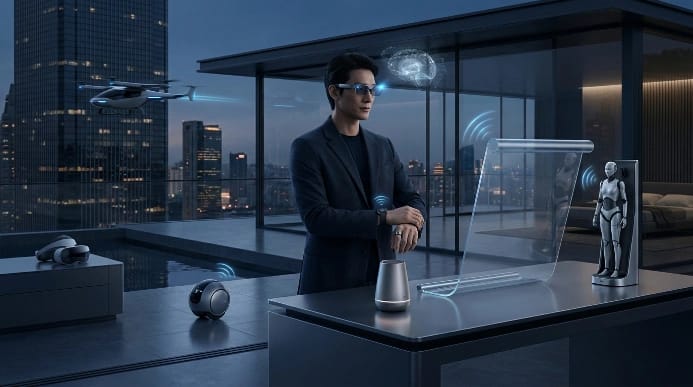
Future Gadgets 2026: Devices and Technologies to Watch
For years, the future of consumer technology seemed easy to predict.
Phones would get faster.
Cameras would get better.
Laptops would become thinner.
Televisions would become larger.
That pattern is starting to change.
The most interesting future gadgets of 2026 are no longer simply upgraded versions of devices we already own. Artificial intelligence, spatial computing, robotics, flexible displays and advanced sensors are beginning to change what a personal device can actually do.
Smart glasses are becoming AI assistants that can understand what you are looking at.
Extended-reality headsets are turning rooms into digital workspaces.
Foldable displays are giving manufacturers new ways to rethink phones and computers.
Robots are moving beyond factories.
Wearables are becoming more aware of our surroundings and daily routines.
The change is important because artificial intelligence is moving away from being something we access only through a chatbot.
AI is becoming embedded directly inside physical products.
That shift connects closely with the broader AI breakthroughs of 2026. As AI becomes multimodal—able to understand images, sound, speech and physical environments—the devices surrounding us can become much more useful.
Not every futuristic prototype will become a successful product.
Some will be too expensive.
Some will struggle with battery life.
Others may create privacy concerns or simply fail to solve a real problem.
But several technologies are now moving beyond demonstrations toward products people can actually use.
Here are 10 of the most exciting future gadgets of 2026 and beyond worth watching.
1. AI Smart Glasses That Understand What You See
Smart glasses have spent years searching for a reason to exist.
Early attempts often felt like miniature computers awkwardly attached to someone’s face.
Artificial intelligence may finally provide the missing purpose.
Google announced at I/O 2026 that intelligent eyewear powered by Gemini is coming in two major forms: audio glasses and display glasses. The first audio models are scheduled to arrive in fall 2026 through partnerships involving Samsung, Gentle Monster and Warby Parker.
Google’s Android XR intelligent eyewear announcement
What makes these glasses interesting is not simply that they contain a camera.
Gemini can use the camera and other sensors to understand the wearer’s surroundings.
Imagine walking through an unfamiliar city and asking your glasses about a building.
Or looking at a confusing parking sign and asking what it means.
You could request directions without repeatedly checking your phone, send messages, take photographs or ask about something directly in front of you.
Display versions could eventually place information directly in your field of view.
That might include navigation arrows, translation captions, notifications or contextual information.
This could create a major shift in personal computing.
For almost two decades, the smartphone has been the device we repeatedly pull from our pockets whenever we need digital information.
Smart glasses attempt to make computing ambient.
Information comes to you when needed rather than requiring you to constantly look down at a screen.
The challenge will be making them socially acceptable, comfortable and trustworthy.
Always-available cameras and microphones naturally raise privacy concerns. Battery life also becomes difficult when everything must fit inside lightweight frames.
Still, AI has given smart glasses a much clearer purpose than they had a few years ago.
2. XR Glasses That Turn Any Space Into a Giant Screen
Smart glasses are designed to blend into everyday life.
XR glasses take a different approach.
Their goal is to place large digital displays into your physical environment.
One important example is XREAL AURA, an Android XR device scheduled for fall 2026. Google says the wired XR glasses use Android XR and Qualcomm’s Snapdragon Reality Elite platform.
Instead of carrying several physical monitors, imagine connecting lightweight glasses and creating multiple virtual displays around you.
One screen could contain your browser.
Another could display a video.
A third could hold your messaging or productivity apps.
The idea is especially interesting for travelers and remote workers.
A laptop screen has obvious physical limits.
Virtual screens do not.
XR could therefore create a portable multi-monitor workspace that fits into a small bag.
The technology is already moving in this direction.
Google’s Android XR updates now include the ability to pin apps to surfaces, improve hand and eye tracking and transform conventional 2D content into more immersive experiences.
The long-term question is whether XR can become comfortable enough for several hours of normal use.
If manufacturers solve weight, heat, battery and visual-comfort problems, portable displays could become one of the most practical uses of spatial computing.
3. Spatial Computers That Make Apps Part of the Room
The smartphone puts apps on a small rectangle.
Spatial computing attempts to put apps around you.
Devices such as Apple Vision Pro and Samsung Galaxy XR are helping develop this category.
Apple’s current Vision Pro uses the M5 chip, which Apple says provides faster app loading, more responsive browsing and up to twice the AI workload performance of the previous configuration.
Meanwhile, Samsung’s Galaxy XR became the first device built around Google’s Android XR platform. Google describes the system as combining digital content with physical surroundings while integrating Gemini as an AI assistant.
The most interesting part is not simply immersive video.
It is the idea of removing the physical boundaries of a traditional computer display.
Imagine working with several giant windows positioned around a room.
A designer could examine a three-dimensional object.
A student could explore a virtual representation of the human body.
An engineer could examine a model at realistic scale.
Sports viewers could watch several feeds simultaneously.
The technology remains expensive and relatively bulky compared with phones and laptops.
But today’s headsets may be similar to the earliest personal computers: imperfect products demonstrating ideas that later become much smaller and more practical.
If spatial computing eventually moves from headsets into lightweight glasses, it could fundamentally change what we think of as a computer screen.
4. Foldable Phones That Finally Feel Mainstream
Foldable phones are no longer science-fiction prototypes.
The more important question in 2026 is whether they can become normal consumer devices.
Manufacturers have steadily improved hinges, screen durability, thickness and external displays.
Motorola’s Razr 2026, for example, combines a 6.9-inch internal AMOLED display with a 3.6-inch external screen in a compact flip-phone design.
The broader foldable category continues expanding because flexible screens solve a basic contradiction.
People want large displays.
They also want devices that fit comfortably into pockets.
Folding allows manufacturers to offer both.
The same concept could eventually move beyond phones.
Foldable tablets can become laptop-sized displays.
Portable gaming systems can provide larger screens without becoming permanently larger devices.
Rollable screens could potentially expand only when needed.
The most important improvements may therefore not be dramatic new features.
They may simply be better engineering.
Thinner hinges.
Smaller creases.
Lower weight.
Better battery life.
Greater durability.
Lower prices.
When users stop thinking about the fold itself, the technology may finally have succeeded.
5. AI Earbuds That Become Invisible Personal Assistants
Smart glasses receive more attention because they look futuristic.
But earbuds may actually become one of the most practical AI interfaces.
Millions of people already wear wireless earbuds for hours every day.
They already contain microphones.
They already connect to smartphones.
And users are comfortable speaking while wearing them.
Adding sophisticated AI creates intriguing possibilities.
An AI-enabled earbud could eventually summarize notifications, translate conversations, answer contextual questions, remind you about tasks and provide navigation without requiring you to look at a screen.
This is important because not every useful AI interaction needs a display.
If you ask:
“When is my next meeting?”
you probably do not need a screen.
If you ask for a quick translation, directions or a reminder, spoken information may be enough.
Audio wearables could therefore become one of the simplest ways to make AI constantly available.
The challenge is context.
For an assistant to become genuinely useful, it needs to understand what information is relevant without constantly interrupting the user.
That requires improvements in personalization and privacy.
The best future AI assistant may not be the one that talks the most.
It may be the one that understands when not to talk.
6. Home Robots That Can Learn Multiple Tasks
The robot future has been predicted for decades.
Yet most homes still contain relatively simple machines such as robotic vacuum cleaners.
AI could finally expand what household robots can do.
The breakthrough comes from combining robotics with the same advances transforming AI software:
computer vision,
multimodal models,
language understanding,
reasoning,
and machine learning.
Instead of programming a robot for one rigid sequence, engineers are working toward machines capable of interpreting natural-language instructions and adapting to unfamiliar environments.
A useful home robot might eventually:
carry objects,
load appliances,
tidy rooms,
assist older people,
monitor parts of the home,
or perform simple repetitive chores.
But homes are extraordinarily difficult environments for robots.
Factories are controlled.
Homes are chaotic.
Objects move.
Children and pets behave unpredictably.
Rooms differ.
A robot must understand not only what an object is but how it should safely interact with it.
That is why physical AI is such an important part of the global race for AI leadership. Countries including Japan, China, South Korea and the United States see robotics as an important extension of AI development.
The first genuinely useful household robots may be expensive and limited.
But if the technology improves, home robotics could eventually become as significant as smartphones.
7. Wearables That Move Beyond Counting Steps
The first generation of wearables focused heavily on simple metrics.
Steps.
Heart rate.
Calories.
Sleep duration.
Future wearables are moving toward something more ambitious: interpreting multiple signals together to provide more useful context.
Rings, watches, earbuds, glasses and other sensors could increasingly work as an ecosystem rather than isolated products.
The goal is not simply to produce more data.
Most people already have more health and activity data than they know what to do with.
The real opportunity is turning that information into understandable guidance.
For example, instead of showing several disconnected measurements, an intelligent wearable could recognize that poor sleep, unusual activity patterns and other sensor changes suggest that the user should adjust a routine.
But this is also an area where technology needs restraint.
Consumer devices are not replacements for medical professionals.
More data does not automatically mean better health.
And highly personal sensor information requires strong privacy protection.
The most successful future wearables may therefore be the devices that turn complicated data into a few genuinely useful insights without overwhelming users.
8. AI-Powered Devices That Work Without Constant Cloud Access
Most people associate advanced AI with enormous data centers.
But another technological shift is happening in the opposite direction.
AI is increasingly moving directly onto devices.
This is known as edge AI.
Instead of sending every request to a remote server, phones, laptops, cameras, vehicles and other gadgets can process more information locally.
This has several advantages.
Responses can be faster.
Some features can work without internet access.
Private information may remain on the device.
Cloud-computing costs can fall.
And devices can respond to their environments in real time.
The trend depends heavily on more efficient processors and memory.
AI models that once required enormous computing systems are being compressed and optimized for smaller hardware.
This is particularly important because the AI industry is facing enormous infrastructure requirements. The Light Span’s analysis of the AI infrastructure spending boom shows how much capital is already flowing into chips, data centers and supporting infrastructure.
Moving some intelligence onto personal devices could reduce dependence on centralized computing for everyday tasks.
That makes future gadgets potentially smarter and more independent.
9. Personal Devices That Understand Their Surroundings
One of the most important changes in consumer technology is the shift from devices that wait for input toward devices that understand context.
Your phone knows its location.
Your watch knows something about your activity.
Your earbuds can hear you.
Smart glasses can see what you see.
AI allows these signals to become more useful when combined.
Imagine arriving at an airport.
A contextual device might understand your location, identify the relevant flight from your itinerary and provide directions to the correct terminal.
During travel, it could translate signs or spoken language.
When you reach your hotel, it could surface the reservation without requiring you to search through email.
None of these individual capabilities sounds revolutionary.
The breakthrough is connecting them.
Google’s intelligent eyewear demonstrates the direction. The company says its upcoming glasses can understand what users see, provide navigation based on their position and direction, manage communication and access Gemini hands-free.
This may represent the biggest change in gadget design since touchscreens.
Devices will become less dependent on users navigating menus.
Instead, they may increasingly understand intent and context.
10. Modular and Multi-Form Devices Could Blur Product Categories
The final trend is less about one specific product and more about what happens when traditional device categories begin disappearing.
Is a foldable phone still a phone when unfolded into a tablet?
Are AI glasses a wearable or a computer?
Is an XR headset a monitor, television, gaming system or workstation?
Is a home robot an appliance or a computer?
The answer may increasingly be: all of them.
For decades, consumer electronics developed around clearly defined categories.
Phones did phone things.
Computers did computer things.
Televisions displayed entertainment.
Cameras took photographs.
AI and flexible hardware are weakening those boundaries.
A future device may adapt its role based on where you are and what you need.
That idea fits the broader direction identified by the World Economic Forum’s Top 10 Emerging Technologies of 2026, which emphasizes technologies moving from scientific development toward real-world deployment across computing, energy, health and materials.
World Economic Forum — Top 10 Emerging Technologies of 2026
The future gadget market may therefore be defined less by individual categories and more by interconnected systems.
Your glasses, earbuds, phone, watch, home devices and vehicle could operate as different interfaces to the same intelligent computing environment.
Why AI Is Changing the Gadget Industry
There is one obvious connection between almost every device on this list.
Artificial intelligence.
For years, consumer-electronics improvements were largely driven by hardware.
More megapixels.
Faster processors.
Higher-resolution screens.
Larger batteries.
Those improvements still matter.
But AI creates another layer of differentiation.
The question becomes not only what hardware a device contains, but what the device understands.
Can the camera recognize what matters in the scene?
Can the glasses understand what the wearer is looking at?
Can the robot understand an instruction it has never heard before?
Can the earbud decide which notification matters?
Can the laptop perform useful AI work locally?
That explains why the future gadget story connects so closely with AI investment.
The technology industry is spending heavily on the infrastructure required to build increasingly capable models, while consumer-electronics companies are trying to bring those capabilities into everyday products.
The winners will not necessarily be the gadgets with the most AI features.
They will be the products where AI solves a genuine problem.
Three Challenges That Could Slow These Future Gadgets
The technology looks exciting, but three obstacles should not be underestimated.
Battery life
AI processing, cameras, displays and wireless connectivity consume energy.
That becomes particularly difficult in glasses, earbuds and other small wearables where there is little physical room for batteries.
Efficiency may therefore matter as much as raw processing power.
Privacy
Context-aware gadgets can collect extremely sensitive information.
A pair of smart glasses may potentially see where you go.
An earbud can contain always-available microphones.
A health wearable can collect personal sensor data.
Companies will need to prove that these products can be useful without turning everyday life into continuous surveillance.
Price
Many breakthrough technologies begin as expensive premium products.
Spatial-computing headsets are a clear example.
For new gadget categories to become mainstream, manufacturers need to make them cheaper without removing the features that make them valuable.
The smartphone revolution accelerated when powerful mobile computing became accessible to hundreds of millions of people.
Future devices will face the same test.
Which Future Gadget Could Replace the Smartphone?
The smartphone is extraordinarily difficult to replace because it combines so many functions in one convenient product.
Smart glasses are probably the strongest candidate to reduce how often we look at phones.
But even they may initially depend on smartphones for connectivity and processing.
A more realistic future is not that one gadget suddenly kills the phone.
Instead, computing may become distributed.
Glasses handle visual information.
Earbuds handle audio.
Watches and rings handle sensors.
Phones provide processing and connectivity.
XR devices provide large virtual workspaces.
Robots interact with the physical environment.
The smartphone could gradually become the invisible hub connecting all of them.
In that sense, the phone may not disappear.
The screen may simply stop being the center of our digital lives.
FAQs
What are the most exciting future gadgets of 2026?
Some of the strongest categories include AI smart glasses, Android XR devices, spatial-computing headsets, foldable phones, AI wearables, home robots and edge-AI devices.
Are Google’s AI smart glasses coming in 2026?
Yes. Google says its first audio intelligent eyewear developed with partners including Samsung, Gentle Monster and Warby Parker will arrive in fall 2026.
What is Android XR?
Android XR is Google’s platform for next-generation headsets and glasses, developed with Samsung and Qualcomm and designed around AI, augmented reality and virtual-reality experiences.
Will smart glasses replace smartphones?
Probably not immediately. Smart glasses may reduce the need to repeatedly look at phones, but smartphones are likely to remain important computing and connectivity hubs for years.
Are home robots ready for mainstream consumers?
General-purpose household robots remain an emerging technology. AI is improving robotic perception and reasoning, but cost, reliability, safety and manipulation of unpredictable real-world environments remain major challenges.
Why is edge AI important for future gadgets?
Edge AI allows more processing to happen directly on a device, potentially improving speed, offline functionality, privacy and efficiency.
The Light Span Perspective
The most exciting thing about the future gadgets of 2026 is not that our devices are becoming more powerful.
That has been happening for decades.
The bigger change is that they are becoming more aware.
Phones understand more context.
Glasses can see what we see.
Earbuds can connect us directly with AI.
Wearables can interpret more signals.
Robots are learning how to operate in environments that were previously too unpredictable.
Spatial computers are beginning to remove the physical boundaries of conventional displays.
Together, these developments point toward a different relationship with technology.
Today, we adapt ourselves to computers.
We open apps.
We navigate menus.
We type searches.
We repeatedly look at screens.
Future gadgets increasingly attempt to reverse that relationship.
The computer learns more about what we are doing and provides the right capability when we need it.
That future is not guaranteed.
There are serious challenges involving privacy, battery life, reliability, social acceptance and price.
Some of today’s most impressive gadgets will disappear.
Others will remain niche products.
And some technologies that receive relatively little attention today may eventually become enormous markets.
That uncertainty is normal.
The early internet was full of ideas that failed alongside the few that transformed society.
Smartphones went through years of experimentation before the modern touchscreen model became dominant.
AI-powered personal technology is likely to follow a similar path.
What matters is the direction.
Artificial intelligence is escaping the chatbot window and moving into the physical devices surrounding us.
And if that transition continues, the most important gadget of the next decade may not simply be a better smartphone.
It may be the first device that makes us stop reaching for our smartphone at all.
Continue reading more

