


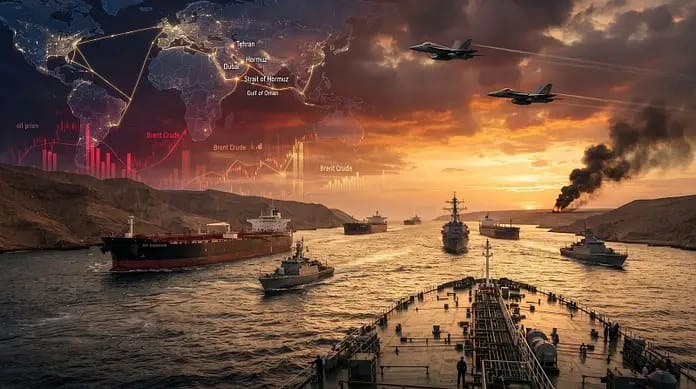
U.S.-Iran Conflict 2026: Economic and Energy Risks
Updated August 28, 2026.
The U.S.-Iran conflict in 2026 has entered a new diplomatic and maritime phase.
Diplomatic efforts led by Qatar are now focused on restoring commercial traffic through the Strait of Hormuz after earlier ceasefire efforts broke down. Iran has agreed to draft conditions for a proposed transit corridor, while the United States continues to rely heavily on economic pressure. Reuters reported on August 28 that overall traffic through the strait remained at only a fraction of normal levels.
This creates a fragile situation: diplomacy may reduce the immediate risk of escalation, but shipping restrictions, sanctions and unresolved security demands continue to threaten energy supplies and the global economy.
Meanwhile, one of the world’s most important energy routes remains at the center of the confrontation.
The Strait of Hormuz has become both an economic weapon and a strategic pressure point.
That matters because this conflict is no longer only about Iran’s nuclear ambitions or the military balance between Washington and Tehran.
It affects oil.
It affects shipping.
It affects inflation.
It affects neighboring Gulf economies.
And it increasingly affects financial markets around the world.
The economic consequences are already visible. Brent crude was trading near $92 per barrel on August 20, after rising for four consecutive sessions, as traders assessed continued uncertainty around Hormuz and the wider conflict.
The situation is especially difficult because neither side appears to have achieved a decisive outcome.
Iran remains under severe military and economic pressure, but it retains tools capable of disrupting regional trade and energy flows.
The United States possesses overwhelming conventional military power, but military superiority does not automatically produce a political settlement.
That leaves the world facing an uncomfortable possibility:
What if the conflict continues without either side being able to end it?
Here are seven risks that could determine what happens next.
1. The Strait of Hormuz Remains the World’s Biggest Economic Pressure Point
The Strait of Hormuz may look small on a map, but its importance to the global economy is enormous.
The narrow waterway connects the Persian Gulf with the Gulf of Oman and Arabian Sea.
Before the current conflict severely disrupted shipping, it was one of the most important energy transit routes on Earth.
According to the U.S. Energy Information Administration, approximately 20.9 million barrels per day of petroleum liquids moved through Hormuz during the first half of 2025. That was equivalent to roughly 20% of global petroleum liquids consumption and about one-quarter of maritime-traded oil.
EIA analysis of the Strait of Hormuz
The 2026 conflict demonstrated what happens when that flow is disrupted.
EIA estimates that petroleum liquids moving through Hormuz averaged only about 4.9 million barrels per day during the second quarter of 2026, compared with approximately 21.6 million barrels per day during the fourth quarter of 2025 before the conflict began.
That is an extraordinary reduction.
Alternative pipelines exist through Saudi Arabia, the UAE and Iran, but they cannot fully replace normal Hormuz traffic. EIA estimates that the major Saudi and UAE bypass pipelines together provide around 4.7 million barrels per day of capacity.
This explains why the strait has become such a powerful bargaining tool.
Iran does not need to eliminate every shipment to influence the global economy.
Even uncertainty can make shipowners cautious, raise insurance costs and force traders to reconsider supply routes.
The result is a direct connection between military developments and what consumers eventually pay for energy.
Our weekly coverage of oil, markets and global power shifts has highlighted exactly this problem: energy remains one of the fastest ways geopolitical instability can spread into the wider economy.
2. Oil Could Remain the Conflict’s Most Powerful Global Weapon
Wars are fought with aircraft, missiles and ships.
But this conflict is also being fought through energy markets.
The scale of the oil disruption became clear earlier this year.
Brent crude entered the second quarter above $100 per barrel and reached approximately $118 on April 29, as disruption through Hormuz restricted access to Gulf crude. By June 26, Brent had fallen as low as $72 as expectations around shipping conditions changed.
That enormous range illustrates the sensitivity of oil prices to the conflict.
The volatility returned in July.
EIA says Brent fell as low as $69 on July 2 after the June memorandum between the United States and Iran encouraged expectations of improved shipping. Renewed tanker attacks later pushed Brent as high as $105 on July 23.
Oil has since moved back above $90 as the diplomatic process deteriorated again.
This is why the conflict cannot be treated as a regional issue.
Oil is embedded throughout the global economy.
Higher crude prices affect gasoline.
They affect diesel.
They affect aviation fuel.
They affect shipping and manufacturing.
They can increase agricultural costs.
And if elevated prices persist, they can make inflation harder for central banks to control.
This is precisely why our existing analysis of why oil prices were rising again should remain an important supporting page for this article.
The geopolitical story and the oil story are different search topics, but economically they are inseparable.
3. Neither Washington Nor Tehran Has an Easy Path to Victory
The conflict’s most dangerous characteristic may be the absence of a clear exit.
The United States has enormous military advantages.
It can strike Iranian targets, pressure maritime activity and impose severe economic sanctions.
But military power cannot automatically force Tehran to accept Washington’s preferred political settlement.
Iran faces a different problem.
It cannot match U.S. conventional military power directly.
Instead, its leverage comes partly from geography, regional relationships, missile capabilities and its ability to create economic costs around strategic waterways.
That creates an asymmetric confrontation.
The United States can impose enormous military damage.
Iran can attempt to make continued confrontation economically and politically expensive.
The failed 60-day diplomatic period demonstrates the difficulty.
The June arrangement was supposed to create space for negotiations and progress toward reopening Hormuz. Yet by August 17, the deadline had expired without a permanent settlement.
Iran has since threatened to move toward a more offensive military posture if diplomacy fails, while Washington has maintained pressure rather than agreeing to another straightforward extension.
This raises the risk of a strategic stalemate.
And stalemates can be dangerous because each side may believe additional pressure will eventually force the other to compromise.
That can encourage escalation instead of settlement.
4. The Conflict Could Pull Gulf Economies Deeper Into the Crisis
One of the largest risks is that the confrontation stops being primarily U.S.-Iranian.
Recent developments involving the United Arab Emirates demonstrate how easily the conflict can spread.
On August 19, the UAE suspended trade and financial transactions with Iran after reporting renewed ballistic missile threats against maritime traffic. Iran rejected the UAE’s allegations.
This matters because the UAE has historically been an important commercial link for Iran.
A prolonged economic break between the two countries could further isolate Tehran while also disrupting regional trade.
Other Gulf countries face their own difficult calculations.
Saudi Arabia, Qatar, Kuwait, Bahrain, Oman and the UAE all have different relationships with Washington and Tehran.
They also share one powerful interest:
regional stability.
These economies have spent years trying to attract investment, expand tourism, diversify beyond oil and establish themselves as global financial and logistics centers.
A prolonged regional war threatens those ambitions.
Shipping disruptions increase costs.
Missile threats discourage investment.
Insurance becomes more expensive.
Tourism can weaken.
Energy infrastructure becomes vulnerable.
The broader global economy outlook for 2026 already identifies geopolitical instability as one of the major risks facing businesses and international trade.
The Gulf conflict shows exactly how quickly geopolitical risk can become economic risk.
5. A Wider Regional Escalation Remains the Most Dangerous Scenario
The most severe outcome would be a chain reaction that draws additional countries and armed groups into direct confrontation.
Regional conflicts rarely expand because every participant planned a larger war from the beginning.
They can expand through miscalculation.
A missile hits the wrong target.
A tanker is attacked.
A military commander interprets an action as preparation for a larger strike.
One country retaliates.
Another responds.
Soon, each participant believes escalation is necessary to restore deterrence.
The current environment contains many potential flashpoints.
Hormuz remains unstable.
Red Sea shipping routes face separate security risks.
Gulf countries are under pressure.
U.S. military forces operate across the region.
Israel remains a central actor in the broader confrontation.
Iran also retains relationships with armed groups across the Middle East.
The danger is therefore not simply a deliberate decision by Washington or Tehran to launch a dramatically larger war.
The danger is uncontrolled escalation.
Recent Reuters analysis has raised exactly this concern as attacks, retaliatory actions and conflicting claims surrounding regional shipping increasingly create the impression of a confrontation capable of developing its own momentum.
This is why diplomatic channels remain important even when negotiations appear unsuccessful.
Communication does not require trust.
It can simply reduce the possibility that one side misunderstands what the other is doing.
6. The Global Economy Could Become Another Battlefield
The economic consequences extend beyond oil.
International shipping is particularly vulnerable.
When shipowners believe a route is dangerous, they may avoid it even if governments technically describe the route as open.
That distinction matters today.
The United States says Hormuz is open, while Iran disputes the status of the waterway, and many commercial shipowners remain cautious.
Shipping companies respond to risk rather than political language.
If vessels need additional security, insurance or alternative routes, transportation becomes more expensive.
Those costs can move through supply chains.
Energy-importing countries face another problem.
Countries heavily dependent on imported oil are exposed to both higher prices and physical supply uncertainty.
That can weaken trade balances and place pressure on currencies.
Businesses then face higher input costs.
Consumers lose purchasing power.
Central banks may become more cautious about cutting interest rates.
This is how a conflict centered thousands of miles away can eventually influence mortgages, corporate borrowing and consumer prices elsewhere.
It also reinforces a broader trend identified in The Light Span’s coverage: energy security remains central even while countries invest heavily in renewable technologies.
The energy transition is real.
But the 2026 Iran conflict demonstrates that the global economy still depends heavily on traditional energy infrastructure.
7. Diplomacy Is Still the Best Exit—But the Bargaining Positions Are Far Apart
Military developments dominate headlines.
Ultimately, however, the conflict is likely to require a political solution.
The challenge is that the two sides remain far apart.
Iran wants relief from economic and military pressure and greater control over the conditions surrounding regional shipping.
Washington wants guarantees surrounding Hormuz and broader security issues, including Iran’s nuclear activities.
The expiration of the 60-day negotiation period shows that finding common ground remains extremely difficult.
Oman has played an important mediation role.
Other regional and international actors also have incentives to prevent escalation because the economic consequences spread far beyond the countries actually fighting.
Diplomacy does not require either side to suddenly trust the other.
A more realistic process could begin with narrower agreements.
Shipping security.
Humanitarian arrangements.
Rules designed to prevent accidental military escalation.
Limited economic concessions tied to verifiable actions.
Nuclear monitoring.
Temporary military de-escalation zones.
Smaller agreements can sometimes create enough confidence to support larger negotiations.
The alternative is continuing a conflict in which neither side appears capable of achieving a clean victory.
Why the Strait of Hormuz Matters So Much
Hormuz deserves special attention because it illustrates how geography can create enormous economic power.
At its narrowest point, the shipping lanes are only a few miles wide.
Yet historically, around one-fifth of global petroleum liquids consumption has moved through the strait.
China, India, Japan, South Korea and other Asian economies are particularly exposed to Gulf energy flows.
That means Hormuz is not simply an American or Middle Eastern concern.
It is an Asian energy-security issue.
It is a European inflation issue.
It is a global shipping issue.
And it is a financial-market issue.
This is why alternative energy routes have become increasingly important.
Saudi Arabia and the UAE have pipelines capable of bypassing part of the strait, but their combined alternative capacity is far smaller than normal Hormuz flows.
The logical long-term response is diversification.
More pipelines.
More strategic petroleum reserves.
More suppliers.
More renewable energy.
More nuclear generation.
More electric transportation.
The conflict therefore strengthens the economic argument for energy diversification even for countries that are not primarily motivated by climate policy.
What Happens to Oil If the Conflict Worsens?
Oil prices will depend heavily on the severity and duration of disruption.
A complete and sustained shutdown of Hormuz would represent the most dangerous scenario.
The world could use strategic inventories.
Other producers could increase supply where possible.
Alternative pipelines could move some Gulf crude.
Consumers could reduce demand.
But replacing the full volume historically transported through Hormuz would be extraordinarily difficult.
The current EIA data demonstrate how disruptive even partial restrictions can become.
During the second quarter, reduced Hormuz traffic contributed to Brent reaching $118 before expectations of diplomatic progress helped push prices lower.
Markets therefore do not need an absolute closure to react dramatically.
The expectation of future scarcity can be enough.
This is also why oil can fall rapidly if credible diplomatic progress appears.
Energy markets price the future.
A believable agreement that restores normal shipping could remove a large geopolitical risk premium even before every barrel returns.
Three Scenarios for What Happens Next
The first and most positive scenario is gradual de-escalation.
Negotiations restart, limited agreements improve maritime security and Hormuz traffic moves closer to normal levels.
Oil prices could fall as the geopolitical premium declines.
The second scenario is prolonged stalemate.
Military pressure continues, negotiations remain ineffective and Hormuz operates far below normal capacity.
This may actually be the most economically damaging medium-term outcome because uncertainty persists without a decisive event forcing a settlement.
The third scenario is major regional escalation.
Additional Gulf states become directly involved, attacks on shipping or energy infrastructure increase, and oil supply falls further.
This would create the greatest risk of another sharp oil spike, renewed inflation and weaker global growth.
Nobody can reliably assign precise probabilities to these outcomes.
But understanding them is more useful than pretending the conflict has one predictable path.
What Businesses and Investors Should Watch
The daily military headlines matter less than a few structural indicators.
Watch Hormuz tanker traffic.
Physical shipping activity tells us more about energy availability than political claims about whether the strait is technically open.
Watch Brent crude prices and global inventories.
Watch U.S.-Iran negotiations, particularly whether Oman or other mediators can restart a credible process.
Watch Gulf involvement.
Further deterioration between Iran and the UAE or other regional economies would signal a widening conflict.
And watch nuclear negotiations.
The original security dispute cannot be separated permanently from Iran’s nuclear program.
Without progress on the underlying political issues, temporary ceasefires may continue breaking down.
FAQs
Why is the U.S. in conflict with Iran in 2026?
The confrontation involves Iran’s nuclear program, regional security, U.S. and Israeli military actions, sanctions, maritime control and competing strategic interests across the Middle East.
Is the Strait of Hormuz closed?
Shipping remains heavily disrupted and its status is contested. Commercial traffic is far below normal levels, and many shipowners remain cautious despite U.S. statements that the waterway is open.
Why is Hormuz so important?
Before the conflict, roughly one-fifth of global petroleum liquids consumption passed through the strait, making it one of the world’s most important energy chokepoints.
Could the U.S.-Iran conflict push oil prices higher?
Yes. Further disruption to Gulf production or Hormuz shipping could increase oil prices sharply. Earlier in the conflict, Brent reached approximately $118 per barrel.
Could diplomacy still end the conflict?
Yes, but the expiration of the 60-day diplomatic period without a permanent settlement shows how far apart the two sides remain. Mediation and narrower agreements may provide a route back toward negotiations.
The Light Span Perspective
The most important lesson from the U.S.-Iran conflict in 2026 is that modern wars do not remain confined to battlefields.
A missile can affect oil prices.
A tanker attack can affect inflation.
A shipping disruption can affect manufacturing.
A failed negotiation can influence financial markets thousands of miles away.
The Strait of Hormuz connects all of these forces.
That is why the conflict has consequences far beyond Iran and the United States.
Neither side appears to have found an easy route to victory.
Washington can impose enormous military and economic pressure, but pressure alone has not produced a permanent political settlement.
Iran cannot match U.S. military power directly, but geography gives Tehran ways to create global economic costs.
That imbalance helps explain why the conflict can continue even when neither side benefits from prolonged instability.
The most dangerous outcome may therefore not be a dramatic final battle.
It may be a long stalemate in which periodic attacks, sanctions, shipping disruptions and failed negotiations become normal.
That would keep energy markets unstable, make investment more difficult across the Gulf and create recurring inflation risks for the wider global economy.
The better outcome remains diplomacy—not because the disagreements have disappeared, but because the economic cost of managing them through military escalation is becoming increasingly difficult to contain.
The coming months will reveal whether Washington and Tehran can find a political exit.
Until then, the world will continue watching one narrow waterway for clues about the direction of energy prices, inflation and the global economy.
Cintinue reading more

