


AI Infrastructure Spending: Who Benefits and Where Risks Lie
Artificial intelligence may appear to be a software revolution, but the investment boom behind it is intensely physical.
Every advanced chatbot, AI search engine, coding assistant and image generator depends on data centers filled with specialized processors. Those processors need high-speed networks, memory, storage, cooling systems, electricity and secure buildings.
Businesses are consequently spending enormous amounts of money to build the infrastructure required to train and operate artificial intelligence.
AI infrastructure spending is now moving beyond technology companies. It is influencing construction, electricity generation, semiconductor manufacturing, industrial equipment, commercial property and corporate financing.
The scale of the buildout has also created a crucial question:
Will AI eventually generate enough revenue and productivity to justify the investment?
The answer will shape corporate profits, stock-market valuations and economic growth for years. If AI adoption expands quickly, today’s infrastructure could support a new productivity era. If commercial returns arrive more slowly, some companies may find themselves carrying expensive assets that become outdated rapidly.
Understanding AI infrastructure spending therefore means looking beyond the excitement surrounding individual AI products. It requires examining the physical and financial system supporting the entire industry.
Quick take
- AI infrastructure includes processors, servers, data centers, networking, electricity, cooling and cloud platforms.
- Technology companies are committing hundreds of billions of dollars to expand computing capacity.
- Semiconductor and networking suppliers are among the most direct beneficiaries.
- Electricity availability is becoming a more serious constraint than access to money or land in some regions.
- Construction, engineering and cooling companies are gaining opportunities from the data-center expansion.
- Businesses are increasingly renting AI capacity through cloud platforms instead of owning all the required hardware.
- The greatest risk is that infrastructure spending grows faster than profitable AI demand.
What does AI infrastructure spending include?
AI infrastructure spending refers to the money invested in the physical and digital systems needed to develop, train, deploy and operate artificial intelligence.
The most visible component is the AI processor. However, a processor cannot work in isolation.
A complete AI infrastructure system can include:
- Graphics processing units and other accelerators
- Central processing units
- High-bandwidth memory
- Data-storage systems
- High-speed networking equipment
- Cloud-computing platforms
- Data-center buildings
- Electrical substations and transmission connections
- Backup generation and battery systems
- Cooling equipment
- Cybersecurity systems
- Fiber-optic connections
- Software for managing computing clusters
- Engineers and technical workers
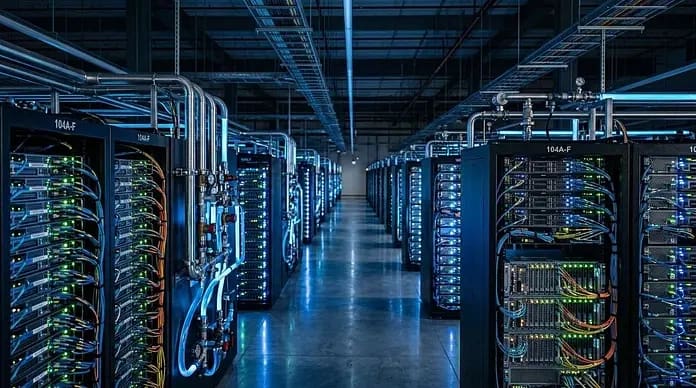
A large AI data center is closer to an advanced industrial facility than a traditional office building. It consumes significant electricity, produces considerable heat and requires carefully designed systems to operate thousands of processors together.
This is why the rise of AI factories represents more than a change in computing terminology. These facilities are becoming the production centers of the AI economy.
Instead of manufacturing cars or appliances, an AI factory produces computing capacity and digital intelligence.
Why is AI infrastructure spending accelerating?
Several connected forces are pushing investment higher.
AI models are becoming more capable, but training the most advanced systems can require enormous computing resources. Once trained, popular models may also need substantial capacity to serve millions of users.
Demand is growing from:
- Consumer AI applications
- Corporate software
- Search engines
- Coding platforms
- Scientific research
- Autonomous systems
- Cybersecurity
- Robotics
- Healthcare
- Advertising
- Financial services
- Government and defense
Companies also fear being left behind.
Cloud providers want sufficient capacity to serve developers and corporate customers. Technology platforms want to integrate AI into their products. AI laboratories need reliable access to chips, while governments increasingly view computing infrastructure as a strategic national asset.
This creates a competitive investment cycle. When one company announces a large expansion, rivals face pressure to increase their own capacity.
The spending is also spreading beyond the United States. Countries in Europe, Asia, the Middle East and Latin America are investing in national computing systems and trying to attract data-center development.
The International Monetary Fund has cited estimates suggesting that global data centers may require approximately $6.7 trillion in capital expenditure by 2030 to meet expected demand.
Not all of this investment will be dedicated solely to AI. Nevertheless, artificial intelligence has become one of the strongest forces behind the expansion.
1. Semiconductor companies are the most visible winners
AI infrastructure spending begins with computing hardware.
Advanced AI systems require processors capable of performing enormous numbers of calculations in parallel. This has created exceptional demand for graphics processing units and specialized accelerators.
The opportunity extends far beyond processor designers.
Producing a modern AI server requires:
- Semiconductor foundries
- Chip-design software
- Lithography equipment
- Advanced packaging
- High-bandwidth memory
- Power-management components
- Networking chips
- Printed circuit boards
- Testing and assembly services
A constraint affecting any one of these areas can delay complete systems.
This helps explain why the performance of semiconductor companies has become closely connected to expectations about corporate AI spending. The recent volatility in AI chip stocks does not necessarily mean infrastructure demand is collapsing. It can instead reflect concerns about valuation, competition or how long extraordinary growth can continue.
Investors should distinguish between demand for AI computing and the price already built into a company’s shares. A strong industry can still produce disappointing investment returns if expectations become unrealistic.
2. Data-center construction is creating a new industrial market
Buying processors is only one part of the investment.
Those processors must be installed in secure facilities with power, cooling, networking and fire-protection systems. As computing clusters become larger and denser, traditional data-center designs may no longer be sufficient.
Developers need:
- Large parcels of suitable land
- Reliable connections to electricity grids
- Fiber-optic infrastructure
- Access to water or alternative cooling systems
- Construction contractors
- Electrical engineers
- Specialized maintenance teams
- Local regulatory approval
- Physical and digital security
This is creating opportunities for engineering firms, construction companies, electrical-equipment manufacturers and data-center operators.
Location decisions are also changing.
A site that appears attractive because of inexpensive land may become unsuitable if the local grid cannot provide enough electricity. A region with plentiful power may lack fiber connections or the specialized workforce needed to operate advanced facilities.
Our analysis of the AI infrastructure race for data-center locations explains why access to power, connectivity and regulatory support is transforming certain areas into strategically valuable digital hubs.
Data centers are no longer ordinary commercial properties. They are critical infrastructure supporting economic activity, government systems and corporate operations.
3. Electricity companies are becoming central to the AI economy
The AI boom depends on an industry far older than computing: electricity.
Large data centers can require as much power as industrial facilities or small cities. Their demand is also concentrated geographically, creating pressure on local generation and transmission systems.
According to the International Energy Agency, global data-center electricity consumption increased by 17% in 2025. Electricity consumption at AI-focused facilities reportedly increased by approximately 50%.
The IEA projects that electricity generation needed to supply data centers could grow from roughly 460 terawatt-hours in 2024 to more than 1,000 terawatt-hours in 2030.
Meeting that demand will require investment in:
- Renewable energy
- Natural-gas generation
- Nuclear power
- Energy storage
- Transmission lines
- Substations
- Grid-management software
- Backup power
- Energy-efficiency technology
Technology companies are signing long-term electricity agreements and investing in new energy projects. Some are exploring advanced nuclear reactors, while others are adding renewable generation and battery systems.
The AI energy boom could accelerate the development of cleaner and more reliable power systems. But it could also increase electricity prices or extend fossil-fuel use if clean generation and grid capacity cannot expand quickly enough.
Electricity is becoming one of the most important limits on AI infrastructure spending. A company can raise capital and order processors, but those investments produce little value if the local grid cannot power them.
4. Cooling and water technology are gaining importance
Advanced processors generate enormous amounts of heat.
As more chips are installed within each computing rack, cooling becomes more difficult. Conventional air cooling may be inadequate for the densest AI systems, encouraging investment in liquid cooling and other specialized technologies.
Potential solutions include:
- Direct-to-chip liquid cooling
- Immersion cooling
- Improved heat exchangers
- More efficient pumps
- Recycled-water systems
- Heat-reuse projects
- AI-assisted temperature management
- Data-center designs suited to cooler climates
Cooling affects both performance and cost.
Processors that become too hot may reduce their operating speed, while unreliable cooling can damage expensive equipment. Cooling systems also consume electricity and, depending on their design, significant quantities of water.
This can create conflict in regions facing water shortages.
Communities may support new investment and employment but question whether large data centers should receive substantial electricity and water allocations. Developers will face growing pressure to show how their facilities affect local resources.
The companies producing efficient cooling and water-management systems could therefore become important indirect beneficiaries of AI infrastructure spending.
5. Cloud platforms are turning computing into a utility
Most businesses cannot build their own AI data centers.
The equipment is expensive, processors become outdated quickly and operating large computing clusters requires specialized expertise. Cloud platforms allow companies to rent computing capacity when they need it.
This model can reduce the initial cost of adopting AI.
A company can experiment with an AI system without purchasing hundreds of processors or constructing a dedicated facility. If the application succeeds, it can increase usage. If it fails, it can discontinue the project without being left with a building full of hardware.
Cloud providers benefit because they can distribute infrastructure costs across many customers.
However, the model also creates risks.
Businesses may become dependent on a small number of platforms. Moving data and applications between providers can be technically difficult and expensive. Prices may change, while shortages of high-performance capacity can limit access.
Corporate buyers should evaluate:
- Total computing costs
- Data-security requirements
- Service availability
- Portability between providers
- Regulatory obligations
- Dependence on proprietary tools
- Long-term contract terms
- Data-transfer charges
AI infrastructure spending is consequently strengthening cloud platforms while raising new questions about market concentration and corporate dependence.
6. Corporate investment is spreading beyond Big Tech
The largest technology companies dominate infrastructure headlines, but AI spending is spreading through the wider economy.
Banks are developing systems for fraud detection, customer service and risk analysis. Manufacturers are investing in predictive maintenance and quality control. Retailers are using AI for inventory planning, advertising and product recommendations.
Healthcare companies are exploring diagnostic support and drug discovery. Logistics providers are improving routing, while energy companies are using AI to manage grids and equipment.
This creates two kinds of corporate investment.
The first is direct infrastructure spending: purchasing hardware, building private data centers or signing long-term capacity agreements.
The second is application spending: buying software, reorganizing workflows, connecting corporate data and training employees.
The second category may ultimately determine whether the first produces sufficient returns.
Building computing capacity does not automatically create productivity. Businesses must identify valuable uses, integrate AI with existing systems and convince employees and customers to adopt new tools.
The companies that gain the most will not necessarily be those that spend the largest amount. They will be those that connect investment to measurable improvements.
7. AI infrastructure is supporting wider economic growth
AI infrastructure spending flows through numerous industries.
A data-center project can generate demand for:
- Steel and concrete
- Transformers and cables
- Construction workers
- Electrical engineers
- Land and property services
- Renewable-energy projects
- Backup generators
- Cybersecurity
- Telecommunications
- Financial services
- Transportation and logistics
This multiplier effect helps explain why AI investment can influence national economic growth before AI software produces its full expected productivity benefits.
The IMF’s July 2026 economic outlook identified technology momentum as an important economic tailwind, while warning that growth remained uneven.
Countries connected to semiconductor production, data-center development or the wider technology supply chain can benefit disproportionately. Regions without reliable electricity, digital infrastructure or skilled workers may capture much less of the opportunity.
This could widen the economic divide examined in the global race for AI leadership. AI competitiveness is increasingly determined not only by research talent but also by access to chips, energy, capital and infrastructure.
The alarming risk: spending may outrun profitable demand
The greatest danger is not that AI has no economic value. It is that infrastructure investment may grow faster than profitable applications.
Companies are spending today based on expectations about future demand. If businesses and consumers adopt AI quickly, the capacity could support rapidly expanding revenue.
But several developments could weaken returns:
- AI services become highly competitive and inexpensive.
- Businesses struggle to convert experiments into profitable deployments.
- More efficient models reduce computing requirements.
- Customers resist higher subscription prices.
- Regulation slows adoption in sensitive industries.
- Energy and equipment costs remain elevated.
- Hardware becomes obsolete sooner than expected.
- Data-center capacity is built in unsuitable locations.
Depreciation creates another challenge.
Companies may pay for servers immediately but recognize their cost gradually over several years. A large investment wave can therefore pressure future profits even if today’s earnings appear strong.
AI hardware also advances quickly. A processor that is highly valuable now may be far less competitive after a new generation becomes available. That creates a risk of stranded or underused capacity.
The comparison with earlier infrastructure booms is useful. Railways, telecommunications networks and the internet generated enormous long-term value, but individual investors and companies did not always benefit. Excessive investment, weak business models and unrealistic valuations caused major financial losses even when the underlying technology transformed society.
AI could follow a similar pattern: revolutionary for the economy, but unforgiving for companies that spend without a credible return.
How companies should evaluate AI infrastructure spending
Businesses should resist the pressure to invest simply because competitors are doing so.
A strong investment case should answer five questions.
What problem will the AI system solve?
The proposed application should improve revenue, cost, speed, quality, risk management or customer experience.
Is suitable data available?
AI systems need accurate, relevant and legally usable information. Poor corporate data can make expensive infrastructure ineffective.
Should the company build or rent?
Most businesses will benefit from renting cloud capacity initially. Dedicated infrastructure may make sense for organizations with sufficient scale, specialized requirements or strict data controls.
What is the complete cost?
The budget should include software, integration, electricity, networking, security, maintenance, employee training and ongoing model operation—not just processors.
How will success be measured?
Companies should establish clear performance measures before expanding experimental projects.
AI investment should be treated as a business transformation, not merely an information-technology purchase.
What investors should watch
Investors evaluating the AI infrastructure boom should monitor more than spending announcements.
Important indicators include:
- Cloud revenue growth
- Data-center utilization
- AI service pricing
- Corporate AI adoption
- Processor delivery times
- Electricity availability
- Profit margins
- Capital expenditure guidance
- Depreciation expenses
- Free cash flow
- Returns on invested capital
- Customer concentration
A company receiving large orders today may still face difficulty if customers reduce spending later. Conversely, infrastructure providers with recurring revenue and diversified customers may prove more resilient.
The central question is whether revenue generated by AI expands alongside the capital required to support it.
Frequently asked questions
What is AI infrastructure?
AI infrastructure includes the processors, servers, data centers, cloud platforms, networking, storage, electricity and cooling systems required to develop and run artificial intelligence.
Why does AI require specialized chips?
AI workloads involve many calculations that can be performed simultaneously. GPUs and specialized accelerators are designed to handle these operations more efficiently than ordinary processors.
Who benefits from AI infrastructure spending?
Potential beneficiaries include semiconductor companies, cloud providers, data-center developers, electrical-equipment manufacturers, construction firms, utilities, cooling specialists and network providers.
Why does AI consume so much electricity?
Training and operating advanced models requires large numbers of powerful processors. Those processors consume electricity directly and generate heat that must be removed by cooling systems.
Could companies build too many data centers?
Yes. If AI demand or revenue grows more slowly than expected, some facilities could operate below capacity or deliver weak financial returns.
Will AI infrastructure spending continue?
Spending is likely to remain substantial because demand is growing and companies are competing for capacity. The pace could still fluctuate with economic conditions, technological improvements and evidence about financial returns.
Is AI infrastructure a good investment?
It can be, but the sector contains significant valuation, competition, energy and technology risks. Industry growth does not guarantee that every project or company will be profitable.
The Light Span Perspective
AI infrastructure spending is becoming one of the largest corporate investment cycles of the modern technology era.
Its influence extends well beyond chips and software. It is reshaping energy markets, construction, commercial property, cloud computing, corporate finance and competition between countries.
The opportunity is real. Artificial intelligence could improve scientific research, automate repetitive work, create better products and raise productivity across the economy.
But infrastructure does not create value simply because it exists.
The companies that succeed will connect computing capacity to services that people and businesses genuinely need. They will control costs, secure reliable energy and adapt as hardware and models become more efficient.
The winners may include some of today’s largest technology platforms. They may also include less visible businesses supplying electricity equipment, cooling systems, networking, construction and specialized industrial components.
The biggest lesson is straightforward: AI may be digital, but the race to build it is physical—and extraordinarily expensive.
Continue reading more

