


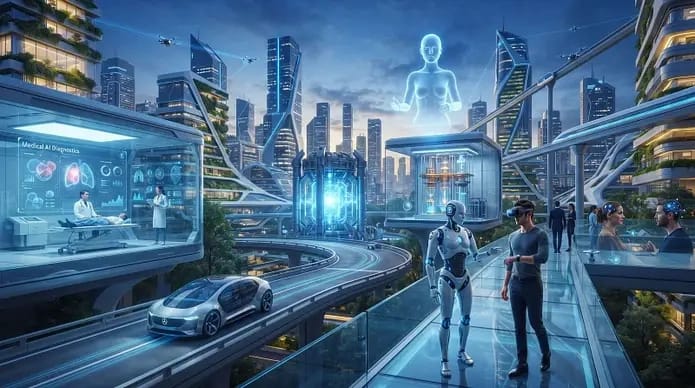
Breakthrough Technologies 2030: What Could Change Daily Life
Technology predictions often fail for one simple reason: exciting experiments are mistaken for technologies ready to change everyday life.
Flying cars have supposedly been just around the corner for decades. Virtual reality has repeatedly been declared the next dominant computing platform. Nuclear fusion has long carried the joke that commercial power is always decades away.
Yet something genuinely important is happening as 2030 approaches.
Several technologies that spent years inside research laboratories are beginning to cross into real-world deployment. Artificial intelligence is moving from answering questions to performing multi-step work. Brain-computer interfaces are helping people with paralysis communicate. Quantum computers are tackling increasingly sophisticated scientific problems. Robots are becoming more capable outside carefully controlled factory environments.
The key question is therefore not which futuristic idea sounds most impressive.
It is:
Which breakthrough technologies could become useful enough before 2030 to materially change how people live and work?
Some technologies on this list may become mainstream. Others may remain expensive or specialized. But all ten have reached a stage where their progress deserves serious attention.
Here are the breakthrough technologies 2030 could bring much closer to everyday life.
1. Quantum Computing Could Move Beyond Experiments
Quantum computing has been discussed for years, but the rest of this decade could determine whether it becomes commercially useful.
Traditional computers process information using bits represented as either 0 or 1. Quantum computers use quantum bits, or qubits, whose quantum properties allow certain types of problems to be approached differently.
That does not mean quantum computers will replace laptops or smartphones.
Their potential lies in specialized problems that are exceptionally difficult for classical systems.
Possible applications include molecular simulation, materials research, optimization and some areas of chemistry.
The important development is that researchers are increasingly focusing on quantum advantage—problems where quantum systems provide meaningful computational value beyond practical classical alternatives.
IBM’s current quantum development roadmap targets examples of quantum advantage in 2026 and large-scale fault-tolerant computing later in the decade. IBM says its Nighthawk platform is expected to support circuits involving 7,500 gates in 2026 while work continues on real-time error correction.
In July, IBM and researchers also reported demonstrations they describe as meeting criteria for quantum advantage in specific scientific computations.
The likely future is not a quantum computer sitting on your desk.
Instead, quantum processors could operate alongside conventional supercomputers, with each system handling the problems it solves best.
If that approach succeeds, quantum computing may quietly influence medicines, materials and industrial optimization long before most consumers interact directly with a quantum machine.
2. Brain-Computer Interfaces Could Restore Lost Abilities
Few technologies sound more futuristic than connecting the human brain directly to a computer.
But brain-computer interfaces are already producing meaningful medical results.
A BCI records neural activity and translates patterns in those signals into commands a computer can understand.
One of the most promising applications involves people who have lost the ability to communicate because of paralysis.
In 2026, an NIH-funded research team demonstrated a particularly important step: a man with ALS used a brain-computer interface in his own home to communicate by translating attempted speech from brain activity into words.
The system was not merely a laboratory demonstration. Caregivers were able to set it up, and the participant could use it independently over long periods. The National Institutes of Health reported the results in July.
That distinction matters.
A technology becomes transformative when it moves from a controlled demonstration toward something people can actually use.
Before 2030, BCIs may increasingly help people with paralysis:
communicate,
control computers,
operate assistive devices,
and regain forms of independence.
More speculative applications involving consumer brain enhancement may take considerably longer.
The near-term BCI revolution is much more likely to begin in medicine.
And that may ultimately be more important than the science-fiction version.
3. Humanoid Robots Could Enter Real Workplaces
Industrial robots are already everywhere.
But traditional robots usually perform carefully defined tasks inside structured environments.
Humanoid robots attempt something much harder.
They are designed to operate in environments originally built for humans.
Stairs.
Doors.
Shelves.
Tools.
Warehouses.
Factories.
Instead of redesigning an entire workplace around specialized machines, businesses could eventually deploy robots capable of using existing infrastructure.
AI is accelerating this possibility.
Computer vision helps robots understand surroundings. Modern AI models improve instruction following and planning. Better sensors improve movement, while advances in batteries and actuators are making machines more capable.
But expectations should remain realistic.
Humanoid robots still face significant challenges involving reliability, dexterity, battery life, safety and cost.
Before 2030, their largest impact may therefore come from controlled commercial environments rather than household robots doing every chore.
Factories and warehouses are particularly attractive because tasks are repetitive and environments can be monitored.
If deployment succeeds, humanoid robotics could become another part of the automation transformation already reshaping the global job market.
The biggest change may not be robots replacing entire professions.
It could be machines taking over physically repetitive, dangerous or difficult portions of human jobs.
4. Solid-State Batteries Could Change Electric Technology
Many futuristic technologies depend on something surprisingly ordinary:
better batteries.
Electric vehicles need longer range.
Robots need longer operating time.
Drones need greater endurance.
Portable electronics need more energy without becoming heavier.
Renewable electricity systems need affordable storage.
Today’s lithium-ion batteries are remarkably capable, but engineers continue searching for technologies offering greater energy density, improved safety and longer life.
Solid-state batteries are among the leading candidates.
Conventional lithium-ion batteries generally use liquid electrolytes. Solid-state designs replace that component with a solid material.
The potential benefits can include greater energy density and improved safety, although actual performance depends heavily on chemistry and design.
Commercialization remains difficult.
Manufacturers must solve challenges involving durability, production yields, interfaces between materials and cost.
That means 2030 should not be treated as a guaranteed deadline for universal solid-state adoption.
A more realistic scenario is gradual introduction into selected premium applications, followed by wider adoption if manufacturing becomes economical.
The significance goes beyond cars.
Battery breakthroughs create enabling technology.
A better battery can improve several industries simultaneously.
That is why energy storage deserves a place among the most important breakthrough technologies of 2030.
5. Fusion Energy Could Move Closer to Commercial Reality
Fusion has one of the biggest promises in science.
Instead of splitting heavy atoms as conventional nuclear fission does, fusion combines lighter nuclei and releases enormous quantities of energy.
It is the process that powers stars.
The attraction is obvious: abundant fuel possibilities, low operational carbon emissions and no chain reaction like that used in conventional fission reactors.
The difficulty is equally enormous.
Scientists must create and control conditions where fusion reactions can occur while developing materials and engineering systems capable of turning those reactions into reliable electricity.
Recent progress has increased investment and scientific confidence, but commercial fusion power by 2030 remains far from guaranteed.
The U.S. Department of Energy’s 2026 Fusion Science and Technology Roadmap lays out coordinated technical milestones for closing the scientific and engineering gaps required to move toward fusion energy.
That makes the remainder of this decade important even if fusion does not power millions of homes by 2030.
The breakthrough could be proving the technologies needed for commercially relevant plants.
That distinction matters.
Fusion does not need to dominate the electricity grid by 2030 to become one of the decade’s most consequential technological developments.
It needs to demonstrate a credible path from scientific achievement toward engineering reality.
6. AI Agents Could Turn Software Into Digital Labor
Generative AI began by producing outputs.
Ask a question.
Receive an answer.
Generate an image.
Write an email.
AI agents push the idea further.
Instead of simply generating content, an agent can potentially receive a goal, create a plan, use software tools, gather information, make decisions and continue working through multiple steps.
That means AI increasingly becomes something people delegate work to, rather than merely something they consult.
An AI agent might research competitors, organize documents, analyze spreadsheets, write software, manage customer requests or monitor information.
This transition is already underway.
Our deeper analysis of how AI agents are beginning to do the work explores why 2026 has become an important year for this shift. The Light Span’s earlier coverage of AI agents as digital employees also examines how businesses are beginning to integrate autonomous systems into everyday workflows.
By 2030, interacting with an AI system could feel less like searching the internet and more like assigning work to an assistant.
That creates enormous potential for productivity.
It also introduces problems involving reliability, cybersecurity, privacy, accountability and employment.
The technology could therefore become one of the decade’s most transformative—and controversial—developments.
7. Autonomous Transportation Could Become Normal in Some Cities
The dream of a completely self-driving car available everywhere has taken longer than early predictions suggested.
But that does not mean autonomous transportation has failed.
The technology is developing unevenly.
Driving in a carefully mapped city under favorable conditions is very different from driving anywhere in the world through snow, construction zones, rural roads and unpredictable traffic.
That means autonomous vehicles are likely to spread geographically rather than becoming universal overnight.
Robotaxis may operate in more selected cities.
Autonomous systems could expand in logistics.
Ports, warehouses and industrial sites could use specialized autonomous vehicles.
Long-distance trucking may adopt increasing levels of automation on suitable routes.
Meanwhile, conventional cars will continue gaining more advanced driver-assistance features.
By 2030, autonomous transportation may therefore be common in particular environments while remaining limited elsewhere.
That is a useful lesson for technology forecasting.
A technology does not need to work everywhere to transform an industry.
It needs to work reliably and economically somewhere important.
8. Smart Materials Could Make Physical Objects More Adaptive
Most materials are passive.
A wall remains a wall.
A window remains a window.
A piece of fabric behaves roughly the same until it wears out.
Smart materials challenge that assumption.
These materials are engineered to respond to environmental conditions such as temperature, pressure, light, electricity or moisture.
Possible applications include windows that adjust their optical properties, medical materials that respond to biological conditions, structures capable of detecting damage, and surfaces whose properties change when stimulated.
Self-healing materials are particularly interesting.
Infrastructure maintenance costs governments and businesses enormous amounts of money.
Materials capable of repairing small cracks or slowing damage could extend the life of buildings, roads, aircraft and industrial equipment.
Other advanced materials may improve energy efficiency, electronics or healthcare.
This technology will probably arrive quietly.
Consumers may never describe their building, clothing or medical device as containing “smart materials.”
They may simply notice products becoming lighter, stronger, more adaptive or longer lasting.
Many important technological revolutions work exactly this way.
The breakthrough disappears into the product.
9. Personalized Medicine Could Become Far More Powerful
Healthcare has traditionally been reactive.
A patient develops symptoms.
A doctor performs tests.
Treatment begins.
Emerging technology could move more healthcare toward continuous monitoring, earlier detection and increasingly personalized treatment.
Several technologies are converging:
artificial intelligence,
genomics,
wearable sensors,
advanced medical imaging,
digital health records,
and biological data.
AI systems can analyze patterns across enormous datasets.
Wearable devices can continuously collect information about certain aspects of health.
Genetic information can reveal individual biological differences.
Together, these tools could help healthcare become more personalized.
Rather than giving every patient with a broad diagnosis the same treatment, medicine can increasingly ask which treatment is most likely to work for this particular person.
AI is already playing a growing role in research and medical analysis, part of the broader set of AI breakthroughs changing industries.
Important limits remain.
Medical AI needs rigorous validation.
Patient data requires strong privacy protections.
Algorithms can reproduce bias.
Doctors remain responsible for complex clinical decisions.
But by 2030, the biggest healthcare technology shift may not be an autonomous robot doctor.
It could be something more practical:
giving human doctors better information about individual patients earlier.
10. Spatial Computing Could Change How We Use Computers
For decades, personal computing has revolved around rectangles.
Desktop monitors.
Laptop screens.
Smartphones.
Tablets.
Spatial computing attempts to move digital information beyond those boundaries.
Virtual reality creates entirely digital environments.
Augmented reality overlays information on the physical world.
Mixed-reality systems combine the two.
The technology has already found uses in training, engineering, design, medicine and entertainment.
The obstacle is hardware.
Headsets can be expensive, heavy or socially awkward. Battery life is limited. Interfaces need improvement.
For spatial computing to become an everyday platform, devices need to become considerably lighter, more comfortable and more useful.
AI could help.
An intelligent wearable that can see what its user sees, understand context and provide relevant information may be far more compelling than a headset that simply displays virtual windows.
This is why spatial computing and AI increasingly overlap.
The consumer-facing possibilities also connect with our earlier look at future gadgets coming before 2030, but the distinction is important: gadgets are the products people buy, while spatial computing is the underlying platform that could power many of them.
The smartphone probably will not disappear by 2030.
But the first credible successor may become much easier to see.
Which Breakthrough Technology Could Have the Biggest Impact?
Artificial intelligence is the obvious candidate because it can accelerate many of the other technologies on this list.
AI can assist scientific research.
It can help analyze quantum experiments.
It can improve robot control.
It can support materials discovery.
It can analyze medical information.
It can make spatial computers more useful.
And all of this requires increasingly powerful computing infrastructure.
That is why the expansion of AI factories and next-generation data centers matters. Breakthrough software increasingly depends on enormous physical infrastructure behind the scenes.
But AI is not the only technology worth watching.
A commercially viable fusion system could eventually transform energy.
A practical quantum computer could accelerate scientific discovery.
Better batteries could reshape transportation and robotics.
BCIs could restore abilities once thought permanently lost.
Technological progress increasingly happens through convergence.
The biggest breakthrough may therefore come when several technologies begin strengthening one another.
Why Some Predictions for 2030 Will Be Wrong
Forecasting technology is difficult because invention is only the first step.
A technology must also become:
reliable,
affordable,
manufacturable,
safe,
regulated,
and useful enough that people actually adopt it.
Those stages can take much longer than expected.
Artificial intelligence demonstrates the opposite possibility.
A technology can also advance faster than conventional forecasts when several improvements arrive simultaneously.
This is why 2030 should not be treated as a deadline.
It is better understood as a checkpoint.
Some technologies on this list will probably exceed expectations.
Others will disappoint.
And one or two breakthroughs that currently receive little attention could become surprisingly important.
What These Technologies Mean for Everyday Life
The most important technological changes rarely remain isolated inside one industry.
Better batteries can lower electric-vehicle costs.
AI can change office work.
Robotics can affect manufacturing.
Personalized medicine can change healthcare.
Quantum computing can accelerate materials research.
New materials can improve energy systems.
The effects spread.
This also means society will need to adapt.
Workers will need new skills.
Governments will need updated regulations.
Companies will need cybersecurity.
Healthcare systems will need rules for sensitive data.
Energy systems will need infrastructure.
And societies will need to decide where automation should—and should not—replace human decision-making.
The technological question is only half the story.
The other half is how people choose to use what becomes possible.
FAQs
What are the biggest breakthrough technologies expected by 2030?
Leading candidates include artificial intelligence and AI agents, quantum computing, advanced robotics, brain-computer interfaces, improved batteries, fusion technology, autonomous transportation, advanced materials, personalized medicine and spatial computing.
Will quantum computers replace normal computers by 2030?
No. Quantum computers are designed for specialized problems. Conventional computers will remain essential, while quantum processors may increasingly work alongside classical high-performance systems.
Will fusion energy be commercially available by 2030?
Commercial deployment at meaningful scale remains uncertain. However, the remainder of the decade could deliver important scientific and engineering milestones needed for future fusion power plants.
Are brain-computer interfaces already working?
Yes, in experimental medical settings. NIH-supported research reported in 2026 demonstrated long-term home use of an intracortical BCI that allowed a person with paralysis to communicate.
Will humanoid robots be common in homes by 2030?
Possibly in limited cases, but workplaces such as factories and warehouses are more likely to see significant adoption first because their environments and tasks are more structured.
Which technology is most likely to affect everyday life before 2030?
AI is currently the strongest candidate because it is already widely deployed and is increasingly being integrated into software, healthcare, research, robotics and consumer devices.
The Light Span Perspective
The most useful way to think about breakthrough technologies 2030 is not to imagine one dramatic morning when the future suddenly arrives.
Technological revolutions rarely happen like that.
They arrive piece by piece.
An AI system begins completing work that once required several applications.
A person who cannot speak communicates through neural signals.
A robot performs a difficult warehouse task reliably enough to justify its cost.
A quantum processor solves a scientific problem that was previously impractical.
A battery gives an electric vehicle noticeably greater range.
A medical system identifies a risk earlier than conventional screening would have.
Individually, each development can look incremental.
Together, they can reshape an economy.
The most important pattern is therefore convergence.
AI is becoming connected with robotics.
AI is assisting scientific discovery.
Quantum computing is being integrated with classical supercomputers.
Advanced materials can improve batteries.
Better batteries make robots and autonomous vehicles more practical.
AI and wearable sensors can make healthcare more personalized.
Spatial computing can combine AI, sensors and digital information into a new type of interface.
These technologies are not developing in isolation.
They are beginning to reinforce one another.
That makes the years leading to 2030 particularly important.
But there is also a reason to remain skeptical of dramatic predictions.
A laboratory breakthrough is not the same as a commercial product.
A prototype is not the same as mass manufacturing.
A successful trial is not the same as widespread adoption.
And a technically impressive technology does not automatically become economically useful.
The technologies that truly transform everyday life will be the ones that cross all of those barriers.
They must work.
They must be reliable.
They must become affordable.
And they must solve problems people actually care about.
That is why some seemingly less dramatic innovations may ultimately matter more than flashy demonstrations.
A better battery can quietly transform transportation.
A medical BCI can transform one person’s ability to communicate.
A more efficient material can reduce energy consumption across millions of buildings.
A useful AI agent can return hours of time every week.
The future does not need to look like science fiction to be revolutionary.
By 2030, many of today’s breakthrough technologies may still be evolving.
Quantum computers may remain specialized.
Fusion may still be approaching commercialization.
Humanoid robots may be concentrated in industry.
Brain-computer interfaces may primarily serve medical patients.
But even those outcomes would represent enormous progress.
The most important question is therefore not whether every prediction comes true by December 31, 2030.
It is whether these technologies cross the point where they begin creating meaningful real-world value.
Several already are.
And that suggests the technological transformation of the rest of this decade may be less about one spectacular invention—and more about multiple once-experimental technologies finally becoming useful at the same time.
Continue reading more

