


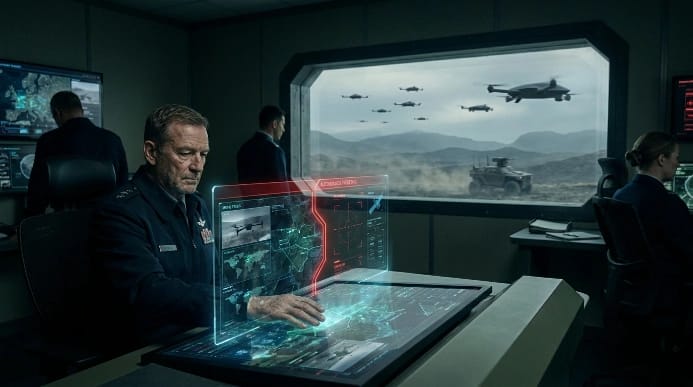
AI in Warfare 2026: The Dangerous Race to Automate Military Decisions
Artificial intelligence is moving rapidly from offices, smartphones and data centers into the world’s military systems.
Armed forces already use AI to analyze satellite images, detect cyber threats, predict equipment failures, organize supplies and identify patterns across enormous quantities of intelligence.
Some of these applications could make military operations more accurate and defensive systems more effective. Others raise a far more difficult question:
Should an algorithm ever be allowed to decide who becomes a target and when lethal force is used?
That debate became unusually visible on August 27, 2026, when a U.S. federal judge blocked the Pentagon’s decision to designate AI company Anthropic as a national-security supply-chain risk. The dispute began after Anthropic resisted military use of its models for domestic surveillance and autonomous weapons.
The judge found that the designation was unsupported and unlawfully retaliatory. The Pentagon had argued that restrictions imposed by a private AI company could create uncertainty during military operations.
The case is larger than one company or government contract. It reveals a growing struggle over who should set the boundaries for AI in warfare: governments, military commanders, technology companies, courts or international law.
As AI systems become faster and more autonomous, the world may have only a limited period to establish clear rules.
Quick take
- Militaries use AI for intelligence, logistics, cybersecurity, surveillance, navigation and decision support.
- AI can process information faster than human teams and may help identify threats earlier.
- Autonomous weapons can potentially select and attack targets after activation without further human intervention.
- Unpredictable behavior, incorrect identification and cyberattacks create serious risks.
- Responsibility becomes unclear when an algorithm contributes to an unlawful or mistaken attack.
- An AI arms race could pressure governments to deploy systems before they are fully tested.
- AI should support military judgment, but decisions involving human life require meaningful human control.
What does AI in warfare actually mean?
AI in warfare does not describe one weapon or a single level of automation.
It covers a wide collection of technologies used before, during and after military operations.
Common applications include:
- Analyzing satellite and drone imagery
- Detecting objects and unusual movements
- Translating intercepted communications
- Identifying cybersecurity threats
- Planning transportation and supplies
- Predicting maintenance requirements
- Navigating unmanned vehicles
- Coordinating groups of drones
- Supporting air and missile defense
- Recommending potential courses of action
- Selecting or prioritizing possible targets
The amount of human control can vary considerably.
In one system, AI may highlight an object in an image while a trained analyst reviews the evidence. In another, a defensive weapon may automatically respond to an incoming missile because there is not enough time for a person to act.
The most controversial systems go further. After activation, they may search for, select and engage targets using sensors and software without a human approving each individual strike.
The International Committee of the Red Cross defines autonomous weapon systems around this ability to select and apply force without human intervention after activation.
The critical issue is therefore not whether a military system contains AI. It is how much authority the system receives and whether a human retains meaningful control over the use of force.
Why militaries want artificial intelligence
Modern warfare produces more information than human teams can analyze manually.
Satellites, aircraft, drones, ships, radar installations, cyber systems and ground sensors continuously generate data. AI can help filter that information and direct people toward the most important signals.
Military planners also believe AI could produce several operational advantages.
Faster decisions
AI can examine large datasets and detect patterns much faster than a person working alone.
Better defensive awareness
Systems may identify incoming missiles, drones or cyberattacks early enough to improve the chance of stopping them.
Reduced workload
Automating routine analysis can allow trained personnel to focus on more complicated decisions.
Safer reconnaissance
Uncrewed systems can enter dangerous areas without immediately exposing soldiers.
More efficient logistics
Predictive systems can improve maintenance, fuel distribution and supply planning.
Greater precision
Accurate identification and navigation could theoretically reduce unintended damage when compared with less precise weapons.
These capabilities help explain why military power has become an important part of the global race for AI leadership.
Countries do not view artificial intelligence only as a commercial opportunity. They see it as a technology that could influence surveillance, cyber defense, intelligence and future battlefield power.
The powerful benefit: AI could improve defensive decisions
AI in warfare is often discussed only through its worst possible outcomes. However, carefully designed systems could provide meaningful defensive benefits.
An AI system might detect an incoming drone, recognize an unusual cyber intrusion or identify mechanical signs that an aircraft component is about to fail.
Faster detection could save civilian and military lives.
AI could also help analysts compare information from several sources rather than relying on one uncertain signal. For example, imagery, radar, communications and location data could be evaluated together before a warning is issued.
Another possible benefit is reducing human fatigue.
People working under intense pressure can become tired, overlook information or make poor decisions. AI may serve as a second analytical layer that identifies inconsistencies and encourages further review.
However, a useful decision-support tool is different from an independent decision-maker.
AI should show evidence, communicate uncertainty and allow trained people to question its recommendation. A system that produces a confident answer without explaining its weaknesses can create false trust rather than better judgment.
The goal should be stronger human decision-making—not the removal of human responsibility.
1. AI can identify the wrong target
Military environments are confusing.
Smoke, damaged buildings, incomplete communications, poor weather and deliberate deception can make it difficult to distinguish combatants from civilians.
AI systems learn patterns from data. If their training information is incomplete, biased or different from the environment in which they are deployed, their performance can deteriorate.
A targeting system might incorrectly classify:
- A civilian vehicle as military transport
- A farmer carrying equipment as an armed person
- A hospital generator as military infrastructure
- A surrendering soldier as an active threat
- Children or injured people as combatants
- An ordinary communication signal as hostile activity
Humans also make identification errors. The question is whether AI makes errors in ways that operators understand and can detect.
The danger increases when military personnel assume a computer-generated recommendation must be objective.
Automation bias occurs when people trust a system’s output even when other evidence suggests it may be wrong. Under time pressure, an AI recommendation can become a decision in practice even if a human technically remains responsible.
Meaningful control requires enough time, information and authority for the person to reject the machine’s conclusion.
2. Complex AI systems can behave unpredictably
Traditional weapons are not perfectly predictable, but their basic operation can usually be tested and explained.
Advanced AI systems may respond differently when encountering situations absent from their training data. Small changes in lighting, terrain, sensor quality or communications can affect their conclusions.
The ICRC’s updated military AI guidance warns that autonomous weapons can be difficult to predict and control, increasing the risk of indiscriminate or otherwise unlawful attacks.
This uncertainty becomes more dangerous when systems interact.
Imagine several autonomous aircraft, ground robots, surveillance platforms and defense systems operating in the same area. Each may respond to the behavior of the others, creating outcomes that no designer anticipated.
Testing every possible battlefield condition is impossible.
Responsible deployment therefore requires:
- Clearly limited operating environments
- Defined targets and mission duration
- Rigorous testing under realistic conditions
- Safe failure modes
- Human override mechanisms
- Continuous monitoring
- Automatic shutdown when conditions change
- Detailed records for later investigation
A system that works well in a controlled demonstration may not be ready for a crowded and deceptive battlefield.
3. Cyberattacks could turn AI systems against their users
Every connected military AI system creates a potential target for cyberattack.
An adversary may not need to destroy a weapon physically. It could attempt to manipulate its sensors, software, training data or communications.
Possible attacks include:
- Feeding false information into sensors
- Corrupting an AI model
- Taking control of communications
- Changing target data
- Hiding a real threat
- Making civilian objects appear hostile
- Stealing sensitive military information
- Disabling the system during an operation
AI systems can also be deceived through adversarial inputs—carefully designed patterns or signals that cause a model to make a mistake.
A visual-recognition system might perform accurately during testing but fail when an opponent deliberately changes the appearance of a vehicle or object.
Cybersecurity must therefore be built into every stage of military AI, from chip and software suppliers to deployment and maintenance.
The dispute between Anthropic and the Pentagon also demonstrates why AI companies can become strategically important suppliers. Governments may fear depending on a vendor that can restrict a system, while vendors may fear losing control over how their technology is used.
That tension will grow as general AI models become connected to defense systems.
4. Accountability becomes dangerously unclear
When a human knowingly orders an unlawful attack, legal responsibility can be investigated.
Responsibility becomes harder to establish when AI contributes to the decision.
Who is accountable if an autonomous weapon attacks the wrong target?
Possible parties include:
- The military commander
- The system operator
- The software developer
- The model provider
- The weapons manufacturer
- The data supplier
- The government approving deployment
A commander may argue that the system behaved unexpectedly. A developer may say the weapon was used outside its designed conditions. An operator may claim there was no practical opportunity to override it.
This accountability gap is one reason human control remains essential.
A person should not be treated as meaningfully responsible simply because they pressed an activation button hours before an autonomous system selected a particular target.
Clear responsibility requires that commanders understand:
- What the system can do
- What information it uses
- How reliable it is
- Where it may fail
- Which decisions remain human
- When the system must be stopped
NATO’s principles for responsible military AI emphasize lawfulness, accountability, explainability, reliability, governability and bias mitigation.
Those principles matter only if they influence actual procurement, testing and battlefield decisions.
5. Autonomous weapons could lower the barrier to conflict
Political leaders may hesitate to begin a war when they expect large numbers of their own soldiers to be killed.
Autonomous systems could change that calculation.
If a government believes robots and drones can fight while keeping its personnel away from danger, military action may appear less politically costly.
But reducing risk for one side does not reduce harm for civilians living in the conflict area.
The deployment of inexpensive autonomous systems could also allow smaller states or armed groups to create powerful capabilities without building traditional air forces.
Thousands of coordinated drones may overwhelm defenses through scale rather than individual sophistication.
This creates a proliferation problem.
Advanced missiles and aircraft are difficult to manufacture. Software can be copied, modified and distributed much more easily. Commercial cameras, processors and drones may be adapted for military purposes.
Once autonomous targeting technology spreads, preventing it from reaching criminal groups or non-state actors could become extremely difficult.
The dangerous new era of global geopolitics makes that risk more urgent as countries build competing technology and security blocs.
6. Speed could cause accidental escalation
Military AI is attractive partly because it can operate quickly. That speed may also become its most dangerous feature.
During a crisis, one country’s system could interpret an aircraft movement, cyber event or missile warning as an attack. It might recommend or initiate a rapid response before officials understand what happened.
The opposing side’s automated systems could then detect that response and escalate again.
This creates a feedback loop in which machines act faster than diplomats or commanders can communicate.
False alarms have occurred throughout the history of military warning systems. Human judgment prevented some of them from becoming disasters.
Connecting AI too closely to strategic weapons could reduce the time available for that judgment.
The risk is especially serious around nuclear command, early-warning and missile-defense systems. Our analysis of AI and nuclear weapons explains why unreliable data, cyberattacks and shortened decision times could create catastrophic consequences.
AI may support the analysis of strategic threats, but it should not receive independent authority over nuclear decisions.
7. An AI arms race could weaken safety standards
No major military wants to believe an opponent is deploying a transformative technology first.
That fear creates pressure to move quickly.
If one country announces autonomous drone swarms, rivals may accelerate their own programs. Testing periods may shrink, ethical concerns may be dismissed and temporary safeguards may gradually disappear.
The situation resembles a security dilemma.
One country describes its development as defensive. Another interprets the same capability as a threat and expands its weapons. Both sides eventually become less secure.
Military AI competition is already connected to:
- Advanced semiconductor restrictions
- Data-center investment
- Robotics
- Satellite networks
- Cyber capabilities
- Export controls
- Technology alliances
China is using international partnerships and technology standards as part of its wider AI diplomacy strategy. The United States and its allies are similarly building defense and technology relationships.
Countries may agree that human control is important while disagreeing about what “meaningful” control requires.
A vague voluntary principle can allow every government to claim compliance while building very different systems.
The Anthropic–Pentagon dispute explained
The legal conflict provides a practical example of the struggle over military AI boundaries.
Anthropic had opposed the use of its models for domestic mass surveillance and lethal autonomous weapons. The Pentagon argued that allowing a private supplier to impose operational restrictions could make the technology unreliable for military use.
After Anthropic refused to remove its conditions, the company was designated a national-security supply-chain risk and excluded from certain military business.
On August 27, U.S. District Judge Rita Lin blocked that designation. The court ruling reported by Reuters found that the Pentagon’s action was unsupported and unlawfully retaliatory.
Related litigation may continue, and the government can still pursue different suppliers.
The deeper questions remain unresolved:
- Can an AI company control military use after licensing its model?
- Should governments accept private safety restrictions?
- Can a military depend on software that a vendor might disable?
- Who determines whether a use is lawful or safe?
- Should general AI models be connected to weapon systems at all?
Governments need dependable tools. Technology companies remain responsible for foreseeable misuse of their products. A sustainable system must address both concerns through clear contracts and public rules—not improvised confrontations during a crisis.
What international law currently requires
International humanitarian law already applies to weapons using artificial intelligence.
Governments do not receive an exemption because a decision was produced by software. Military operations must still follow rules involving distinction, proportionality and precautions in attack.
Parties must distinguish military targets from civilians and civilian objects. Expected civilian harm cannot be excessive compared with the anticipated military advantage.
The difficulty is determining whether a particular autonomous system can comply reliably in a complicated environment.
The U.S. Department of Defense’s Directive 3000.09 requires appropriate levels of human judgment, testing, system safety and legal review for autonomous and semi-autonomous weapons.
Internationally, the United Nations has continued discussions through the Convention on Certain Conventional Weapons. The UN Secretary-General has called for a legally binding instrument establishing prohibitions and restrictions on autonomous weapons.
The ICRC recommends prohibiting unpredictable autonomous weapons and systems designed to target people, while strictly regulating any autonomous weapons that remain permitted.
The debate is no longer about whether law applies. It is whether existing rules provide enough clarity before technology advances further.
What meaningful human control should involve
“Human in the loop” can become an empty phrase if the person lacks time, information or authority to intervene.
Meaningful human control should include several practical requirements.
A clearly defined mission
The system should operate only within a limited area, timeframe and target category.
Understandable information
Operators need to know what the AI detected, its confidence and the evidence supporting its conclusion.
Time to intervene
A human should have a realistic opportunity to stop an attack, not a theoretical button that cannot be used quickly enough.
Reliable communication
Control should not depend on a fragile connection that can be jammed or interrupted.
Safe failure
When sensors, software or communications become unreliable, the system should disengage rather than continue attacking.
Identifiable responsibility
Specific commanders and institutions must remain accountable for deployment and use.
Independent review
High-risk systems should receive technical, legal and ethical examination before deployment and throughout their operational lives.
Human oversight is not a single switch. It is a complete structure connecting design, training, command and accountability.
Could an international treaty work?
An international agreement would be difficult but still valuable.
Countries may disagree about definitions and fear that rivals will secretly violate restrictions. Software can also be updated more quickly than conventional weapons.
Nevertheless, agreements can establish boundaries and stigmatize unacceptable behavior.
A practical framework could:
- Prohibit systems that cannot be sufficiently predicted or controlled
- Ban autonomous weapons designed to target people without human approval
- Require meaningful human control over lethal force
- Protect nuclear command from autonomous decision-making
- Establish weapons-review requirements
- Require records of AI-assisted targeting decisions
- Create standards for testing and cybersecurity
- Limit exports to irresponsible users
- Encourage reporting of serious failures
Verification will be challenging, but imperfect regulation is not the same as useless regulation.
Arms-control agreements have often begun with basic norms before developing stronger mechanisms.
What businesses and AI developers should do
Military AI governance is not a responsibility for governments alone.
Companies developing models, chips, sensors and robotic systems should establish clear policies before military customers request access.
Responsible practices include:
- Defining prohibited uses
- Assessing high-risk customers
- Building secure audit logs
- Testing systems against deliberate manipulation
- Protecting employees who raise safety concerns
- Reporting discovered vulnerabilities
- Clarifying update and termination conditions
- Requiring human authorization for high-consequence actions
General-purpose AI can become part of military systems even when it was not designed as a weapon.
The growing ability of AI to replace traditional software increases this concern because AI agents may interact with databases, communications and operational tools rather than merely providing written answers.
Developers must consider how their systems behave when given access to real-world actions.
Frequently asked questions
How is AI used in warfare?
Militaries use AI for intelligence analysis, surveillance, cybersecurity, logistics, maintenance, navigation, decision support and autonomous systems.
What is an autonomous weapon?
It is a weapon that, after activation, can select and engage targets without a human approving every individual attack.
Are autonomous weapons illegal?
International humanitarian law applies to all weapons. Some autonomous systems may be unlawful because their effects cannot be controlled or because they cannot distinguish targets reliably. No comprehensive global treaty currently bans every autonomous weapon.
Can AI reduce civilian casualties?
AI could improve detection and precision in limited circumstances. Incorrect data, unreliable models and excessive automation could also increase civilian harm.
What is meaningful human control?
It means a person has sufficient information, time and authority to understand, supervise and stop the use of force.
Why did Anthropic dispute the Pentagon?
Anthropic resisted uses of its AI involving domestic surveillance and autonomous weapons. The Pentagon argued that private restrictions created unacceptable operational uncertainty.
Will AI replace soldiers?
AI will change military roles and expand the use of uncrewed systems, but warfare will continue requiring human judgment, responsibility and political decision-making.
The Light Span Perspective
AI in warfare could improve intelligence, strengthen defensive systems and reduce the need to place soldiers in certain dangerous situations.
Those benefits should not hide the central risk.
A machine can calculate faster than a person, but speed is not wisdom. Pattern recognition is not moral judgment. A probability score cannot understand the value of a human life or accept responsibility for taking it.
The world should not wait for a catastrophic mistake before deciding where military AI requires firm boundaries.
Governments need rules that preserve meaningful human control, companies need clear responsibilities, and international law must develop quickly enough to address autonomous systems before their use becomes normalized.
Artificial intelligence can assist military decisions. It should never become an excuse for making responsibility disappear.
Continue reading more

