


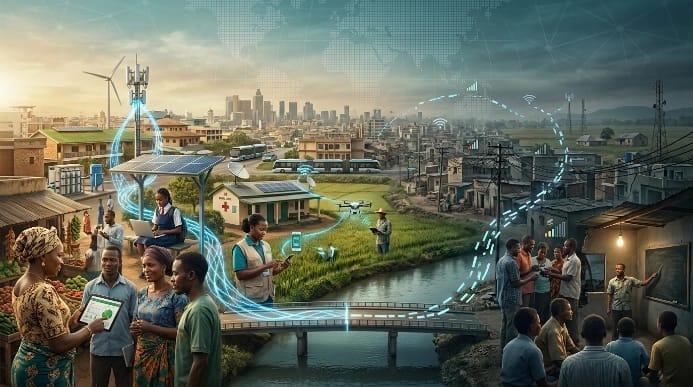
AI in developing countries could become one of the most important economic stories of the next decade. The technology may help nations expand access to expertise, improve weak public services and raise business productivity without first building the expensive systems that powered earlier industrial revolutions. But the same technology could also deepen the gap between countries that can use it well and those that remain trapped by unreliable electricity, expensive internet access and limited digital skills.
That tension is at the center of the World Development Report 2026. The World Bank argues that artificial intelligence is spreading much faster than electricity, the internet and other general-purpose technologies did. Middle-income countries accounted for half of ChatGPT’s global traffic within six months of its launch. Access to an AI tool, however, is not the same as turning it into better jobs, stronger companies or more effective government.
The real question is therefore not whether AI in developing countries will arrive. It already has. The question is whether governments and businesses can adapt affordable systems to local needs before weaknesses in infrastructure and institutions turn a historic opportunity into another dangerous economic divide.
The Short Answer: Why This Matters Now
AI in developing countries is more likely to support workers than replace them in the near term. According to the World Bank, 16.2% of jobs in developing economies could receive a meaningful productivity boost from AI, compared with 18.7% in high-income countries. Only 4.5% of jobs in low- and middle-income economies face high automation risk, versus 14.2% in richer economies.
Those figures challenge the idea that the AI race is only about giant data centers and frontier models. Many of the most valuable applications may be smaller systems that help a nurse interpret information, give a farmer a better weather warning, translate government services or help a small company handle paperwork. The opportunity for AI in developing countries is practical—but it depends on foundations that remain highly unequal.
- Opportunity: affordable AI can spread scarce expertise across health, education, agriculture and business.
- Constraint: power, connectivity, computing access and relevant data are still limited.
- Economic risk: foreign platforms could capture most of the value while local companies remain users rather than builders.
- Policy priority: countries should adopt proven tools, adapt them to local conditions and advance toward more complex systems only when the foundations are ready.
1. AI Can Expand Access to Scarce Expertise
The most powerful case for AI in developing countries begins with a shortage, not a surplus. Many communities lack enough doctors, teachers, agricultural advisers, engineers and trained public administrators. AI in developing countries cannot replace these professionals, but it can help each one serve more people and make routine knowledge easier to access.
A health worker in a rural clinic could use a carefully tested system to organize patient histories, flag warning signs or translate guidance into a local language. A teacher could adapt exercises to different learning levels. A civil servant could search regulations and records faster. The value comes from reducing the time needed to find and apply expertise—not from removing human responsibility.
This is why smaller, task-specific systems may matter more than expensive general models. Countries do not need to reproduce the enormous AI spending boom led by Big Tech. They need dependable tools that work with local institutions, low-cost devices and uneven internet connections.
2. Agriculture Could Deliver Some of the Fastest Gains
Agriculture remains a major source of employment across Africa, South Asia and parts of Latin America. Yet farmers often make decisions with limited access to accurate weather forecasts, soil analysis, crop-disease expertise, market prices or formal finance. AI in developing countries can combine these signals and deliver advice at the moment a decision is made.
The best systems will not assume every farmer owns a new smartphone or reads a major international language. Advice may need to arrive through a voice call, basic messaging service or local agricultural cooperative. A model trained on conditions in Europe or North America may produce confident but useless recommendations when crop varieties, soil, weather and farming practices differ.
Adaptation is therefore more important than simply importing a tool. Local universities, ministries, farmer groups and technology companies need to test whether the advice improves yields, reduces waste or helps producers respond to climate shocks. If the evidence is weak, a polished interface does not create development value.
3. Public Services Can Reach More People
Governments are often the largest service providers in developing economies. They operate schools, health systems, tax agencies, courts, disaster-response programs and social-protection networks. Even modest improvements in how these systems handle information can affect millions of people.
AI in developing countries could help identify areas at risk from floods, detect unusual tax patterns, translate public information, schedule scarce medical resources or reduce administrative backlogs. It may also make complicated services easier for citizens to understand. These are less dramatic than building a national supercomputer, but they can create a more direct public benefit.
Government use also creates serious risks. A flawed commercial chatbot is frustrating; a flawed eligibility system can deny a family essential support. Procurement must include testing, appeal routes, privacy protection, human review and evidence that the system works across regions and social groups. Our analysis of the hidden cost of AI governance explains why accountability must be designed before high-stakes deployment, not added after harm occurs.
4. Local Languages Could Become an Economic Asset
Most digital content and many leading AI systems remain strongest in widely used languages. That leaves hundreds of millions of people with tools that misunderstand their questions, cultural context or legal and medical vocabulary. Closing this gap is essential if AI in developing countries is supposed to broaden opportunity rather than serve only educated urban users.
Local-language development requires more than translation. Countries need usable text, speech and specialist data that represent how people communicate in real settings. Universities, broadcasters, libraries and public agencies may hold valuable material, but it must be digitized, licensed responsibly and protected against misuse. Communities should also have a voice in how their language and culture are represented.
Better language tools could expand education, make government information easier to reach and open digital markets to small businesses. They could also allow more processing to happen on ordinary devices. As our guide to on-device AI shows, local processing can improve privacy and reliability when cloud access is costly or unstable.
5. Small Businesses Can Gain Capabilities Once Reserved for Large Firms
Small and informal businesses dominate employment in many developing economies. They often lack accountants, marketing teams, legal support, software developers and sophisticated research tools. AI in developing countries can lower the cost of some of these capabilities by helping owners prepare invoices, explain regulations, translate product descriptions, analyze sales or answer routine customer questions.
AI in developing countries could also make services exports more accessible. A designer, bookkeeper, researcher or software team can use AI to handle more complex work. But this opportunity sits beside a threat: international clients may use the same tools to automate basic outsourced tasks. Businesses need to move toward work that combines technology with local knowledge, relationships and judgment.
6. The Jobs Story Is More About Transformation Than Mass Replacement
Employment structures help explain why immediate automation exposure is lower in poorer countries. A larger share of people work in agriculture, construction, transport, retail and other jobs that require physical presence. Current generative systems are much better at manipulating words, images and code than performing unpredictable manual work.
That does not mean disruption will be small. Call centers, clerical services, basic design, translation and entry-level digital work may change quickly. The ILO’s global analysis of generative AI and jobs finds that transformation is more likely than complete replacement, but exposure is uneven across occupations, income groups and gender.
The right response is not to train everyone as a machine-learning engineer. Workers need a combination of digital confidence, strong communication, problem solving and occupational knowledge. Our practical guide to skills for the AI job market focuses on capabilities that remain useful even as specific tools change. The central challenge is helping workers use AI to improve outcomes rather than merely perform the same task faster.
7. Developing Economies May Be Able to Leapfrog Older Systems
Countries sometimes move faster because they are not locked into expensive legacy infrastructure. Mobile payments spread rapidly in places where traditional banking coverage was weak. Distributed solar can serve communities that waited years for a reliable grid connection. AI in developing countries may create a similar opening by giving people access to services that were previously too costly to deliver at scale.
There is also a strategic question about dependence. Advanced chips, cloud platforms and frontier models are concentrated in a small number of companies and countries. The global competition over AI diplomacy shows how access to infrastructure and technical standards is becoming a source of geopolitical influence. Developing economies need partnerships, but they should avoid contracts that make switching providers impossible or transfer sensitive public data without clear safeguards.
The Dangerous Divide: Five Barriers That Could Stop Progress
1. Electricity and Connectivity
AI in developing countries depends on the basic systems that many communities still lack. The International Telecommunication Union estimates that 2.2 billion people remained offline in 2025. Internet use reached 94% in high-income countries but only 23% in low-income countries, while access was still unaffordable in around 60% of low- and middle-income economies.
AI in developing countries cannot become inclusive if it assumes constant broadband, modern hardware and cheap electricity. The growing power demand from AI data centers also creates a policy tradeoff: scarce electricity should not be diverted from households and productive industries simply to support speculative computing projects.
2. Computing Access and Cost
Most countries do not need to build a frontier model, but local firms still need affordable computing power to adapt and run useful systems. Cloud fees paid in foreign currency can become a serious burden. Regional computing facilities, shared research resources and competitive access to multiple providers may offer better value than expensive national prestige projects.
3. Skills and Institutional Capacity
A model cannot repair a weak process by itself. Hospitals need records, schools need trained staff and agencies need the ability to evaluate vendors. When these systems are fragile, AI in developing countries may automate confusion or hide it behind a confident answer. Investment in managers, teachers, regulators and technical staff is therefore as important as investment in software.
4. Data That Does Not Reflect Local Reality
AI in developing countries trained on foreign data may misunderstand local diseases, laws, crops, accents or social conditions. Building relevant datasets is difficult and can create privacy risks. Governments need clear rules for consent, security, access and accountability. Open public data can support innovation, but personal or sensitive information should not become a free resource for private platforms.
5. Concentration of Economic Value
The global AI industry is concentrated in the firms that control chips, cloud infrastructure, models and capital. If local companies only resell foreign services, much of the revenue may leave the country while dependence grows. UNCTAD’s work on inclusive artificial intelligence warns that technological capacity and investment remain highly uneven.
The answer is not complete technological self-sufficiency, which would be unaffordable for most nations. It is bargaining power: interoperable systems, fair contracts, local talent, support for domestic applications and the ability to change providers. Those foundations help countries capture more value without wasting resources trying to duplicate every layer of the AI supply chain.
What Governments Should Do First
The most sensible strategy for AI in developing countries follows three stages: adopt, adapt and advance. Countries should first use proven tools where the benefit can be measured. They should then adapt those systems to local languages, laws and service conditions. Only countries with the necessary capital, infrastructure and research base should prioritize building frontier models.
- Fix the foundations. Reliable electricity, affordable internet, digital identification and basic skills produce benefits far beyond AI.
- Choose real problems. Start with health, education, agriculture, disaster response and business bottlenecks where better information can change an outcome.
- Test before scaling. Measure accuracy, cost, accessibility and harm across different groups instead of counting pilots or users.
- Buy for flexibility. Require data portability, interoperability, security standards and clear exit terms in public contracts.
- Build local capacity. Support universities, entrepreneurs, civil servants and sector experts who can adapt tools to national needs.
- Protect people. Create human review, appeals and privacy safeguards for decisions involving rights or essential services.
- Cooperate regionally. Shared computing, language resources, safety expertise and procurement standards can reduce costs for smaller economies.
This approach to AI in developing countries is less glamorous than announcing a sovereign supercomputer, but it is more likely to produce durable gains. It also fits the wider reality described in our analysis of countries at risk of falling behind: technology strengthens economies when it is connected to education, infrastructure, competitive businesses and effective institutions.
What Businesses and Workers Should Do
Companies do not need to wait for a national strategy. They can begin with narrow tasks where the cost of error is manageable and the result is measurable. Examples include summarizing non-sensitive documents, preparing first drafts, translating marketing material, organizing customer requests or identifying patterns in inventory data. High-stakes decisions still need expert review.
Workers should learn how to verify outputs, protect confidential information and combine AI with industry knowledge. The goal is not to chase every new application. It is to become better at defining problems, checking evidence and making responsible decisions. As we explained in our analysis of AI and job transformation, durable value comes from judgment and outcomes rather than familiarity with one interface.
The Light Span Perspective
AI in developing countries is neither an automatic shortcut to prosperity nor a technology that only rich nations can use. It is a powerful amplifier. Where electricity, connectivity, education and institutions are improving, AI in developing countries can spread expertise and help people do more. Where those foundations remain weak, it can magnify inequality, dependence and distrust.
The countries that benefit most will not necessarily be those that spend the most money or build the largest model. They will be those that choose useful problems, adapt technology to local reality and measure whether ordinary people receive a better service or a better economic opportunity.
That is the real race. The next phase of global development will be shaped not only by who invents artificial intelligence, but by who turns it into reliable health care, stronger education, more productive businesses and work that gives people greater—not smaller—control over their future.

