


AI Spending Boom 2026: Costs and Returns for Big Tech
Artificial intelligence has moved from a software race into one of the largest infrastructure-building cycles in modern technology.
The numbers are becoming extraordinary.
Technology companies are buying advanced processors, constructing enormous data centers, securing electricity supplies, designing custom chips and financing entirely new computing campuses.
The four largest customers of Nvidia alone are expected to spend roughly $650 billion on AI infrastructure in 2026, according to figures cited by the company. Nvidia itself has become involved with financing initiatives targeting hundreds of billions of dollars of additional AI infrastructure.
And the spending race continues.
But as investment moves deeper into the hundreds of billions, a different question is becoming harder to avoid:
How much money must artificial intelligence eventually generate to justify everything being built for it?
That is the central issue behind the AI spending boom 2026.
There is little doubt that AI is useful. Businesses are adopting AI tools, cloud providers are reporting growing demand, coding assistants are changing software development and increasingly capable models are spreading into almost every major industry.
But useful technology and profitable infrastructure are not automatically the same thing.
The internet transformed the world.
Telecommunications companies still overbuilt fiber networks during the dot-com boom.
Railways transformed economies.
Investors still financed more railroads than some markets could economically support.
A technology can be revolutionary while investment around it becomes excessive.
AI could ultimately produce the same paradox.
Understanding whether that is happening requires looking beyond the excitement surrounding new models and examining the economics underneath the infrastructure boom.
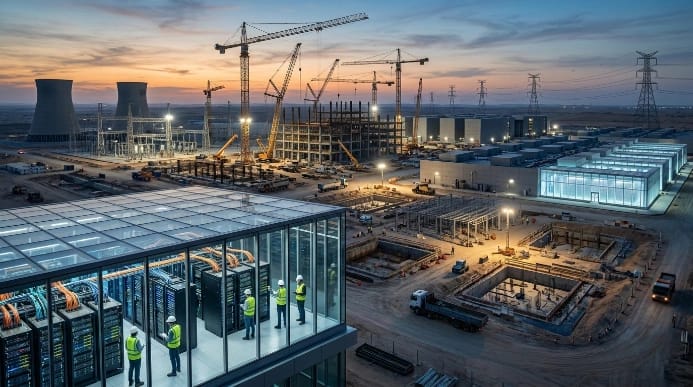
AI Is Becoming One of the World’s Largest Construction Projects
When people imagine artificial intelligence, they usually think about software.
Chatbots.
Image generators.
Coding assistants.
AI agents.
But the physical infrastructure supporting these systems increasingly resembles heavy industry.
Modern frontier AI requires enormous clusters of specialized processors connected through high-speed networking.
Those processors operate inside data centers that need:
advanced cooling,
backup power,
transformers,
high-capacity electrical connections,
fiber networks,
storage,
security,
and enormous amounts of land.
The scale becomes even larger when electricity infrastructure is included.
As we explained in our analysis of the AI power grid crisis, electricity availability is becoming one of the biggest constraints on new data-center development. Developers increasingly need not just buildings and servers but substations, transmission connections and sometimes dedicated generation.
That means an AI investment can trigger another investment behind it.
More GPUs require more servers.
More servers require more data centers.
More data centers require more electricity.
More electricity demand requires more grid infrastructure.
The AI spending boom 2026 is therefore much larger than semiconductor spending alone.
1. The Numbers Have Become Enormous
The easiest way to understand the scale is to look at Nvidia’s biggest customers.
Ahead of Nvidia’s August 26 earnings report, the company said its four largest customers are expected to spend around $650 billion on AI infrastructure this year, up from roughly $480 billion last year.
That is not the size of the entire AI industry.
It represents spending by only a small group of enormous technology companies.
And AI investment increasingly extends beyond conventional capital expenditure.
Nvidia has aligned with six major financial institutions around efforts targeting more than $500 billion in AI infrastructure financing. Investors are closely examining these financing relationships because they demonstrate just how capital-intensive the next stage of AI development has become.
This is the crucial change.
Early generative AI could be presented as a software breakthrough.
The next stage looks more like an industrial buildout.
Companies are effectively constructing the computing factories needed to manufacture intelligence at enormous scale.
That is exactly why the rise of AI factories matters.
The economic question is no longer simply whether people will use AI.
They clearly will.
The question is whether usage becomes valuable enough to support the extraordinary amount of infrastructure being constructed.
2. Nvidia’s Rubin Generation Is the Next Major Test
Few companies sit closer to the center of the AI spending cycle than Nvidia.
Its GPUs became the essential computing engines behind the generative AI boom.
Now attention is moving toward the next generation.
Nvidia’s Vera Rubin systems are expected to begin shipping this autumn, and investors will closely watch demand as the platform reaches customers. Analysts expect Nvidia’s second-quarter revenue to nearly double year over year to around $92 billion, according to estimates compiled ahead of its August 26 results.
Strong demand would reinforce the argument that the AI infrastructure cycle still has considerable room to run.
But Rubin also exposes a deeper issue.
AI hardware evolves extremely quickly.
A data center can spend billions on advanced processors only to see significantly more powerful hardware arrive a few years later.
That creates an economic problem rarely discussed outside financial statements:
depreciation.
Companies must recover the cost of AI hardware during its economically useful life.
A server does not need to physically stop working to become less valuable.
If newer chips perform AI tasks much more efficiently, older hardware may become economically obsolete long before it breaks.
This means AI companies are racing against technology itself.
The faster AI hardware improves, the faster companies need to generate returns from the infrastructure they already purchased.
3. The Cost of AI Hardware Is Still Rising
Normally, rapidly improving technology eventually becomes cheaper.
AI infrastructure is experiencing a more complicated situation.
Demand for advanced components is so strong that shortages are appearing throughout the supply chain.
Nvidia customers have reportedly been warned that prices for some AI-server configurations could increase by more than 15%, partly because of rising memory costs. The increases would affect systems using both Vera Rubin and Grace Blackwell hardware scheduled for delivery in early 2027.
This matters because the processor itself is only part of the cost.
Modern AI systems require enormous amounts of advanced memory.
They require networking equipment.
Cooling.
Power-management systems.
Storage.
Racks.
All of these components can become bottlenecks.
If demand expands faster than supply, building the next gigawatt-scale AI campus becomes more expensive even as individual chips become more powerful.
That creates pressure from both directions.
Technology companies need more computing capacity.
But the infrastructure required to provide that capacity costs more.
Eventually, AI revenue must grow fast enough to cover those costs.
4. Custom AI Chips Could Change the Economics
One of the most important responses to rising AI costs is already underway.
Big technology companies increasingly want their own processors.
Google has spent years developing Tensor Processing Units, or TPUs, designed specifically for AI workloads.
Its strategy is now expanding dramatically.
On August 19, Marvell announced an agreement to help develop Google’s custom AI chips and related infrastructure. Under the arrangement, Google received warrants that could allow it to acquire a stake in Marvell worth as much as $12.2 billion. The commercial relationship could generate up to $120 billion in revenue for Marvell through fiscal 2033 if performance conditions are met.
Google is not alone.
Meta plans to begin production of another internal AI chip in September as part of its effort to expand overall computing capacity to 14 gigawatts next year.
Why are hyperscalers doing this?
Control.
A custom chip can be optimized for a company’s specific workloads.
It can potentially reduce reliance on expensive general-purpose AI accelerators.
It can improve energy efficiency.
And it gives cloud companies more negotiating power.
This does not mean Nvidia suddenly loses its market.
Frontier GPUs remain extremely valuable because of their flexibility, performance and software ecosystem.
But the more AI spending rises, the stronger the incentive becomes for Nvidia’s biggest customers to develop alternatives.
Ironically, Nvidia’s extraordinary success may be accelerating the custom-chip industry designed to reduce dependence on Nvidia.
5. Alibaba Shows the Profitability Trade-Off
The AI investment dilemma becomes especially clear when looking at Alibaba.
The Chinese technology giant recently reported strong growth in AI and cloud services.
Its cloud and AI revenue increased 45% to 48.44 billion yuan during the latest quarter.
That sounds excellent.
But capital expenditure simultaneously surged 75% to 67.68 billion yuan, driven heavily by AI infrastructure and rising chip procurement costs.
Quarterly net profit fell approximately 75%.
Alibaba has already spent roughly half of the 380 billion yuan—about $56 billion—it planned to invest in AI through 2029.
Management argues that the investment is strategic and expects AI capital spending to reach break-even within several years. Alibaba is also deploying proprietary chips to improve margins and reduce dependence on expensive commercial processors.
This is almost a perfect case study for the broader industry.
AI demand can grow rapidly.
AI revenue can grow rapidly.
And profits can still come under pressure because the infrastructure required to support that growth is extraordinarily expensive.
Investors therefore need to look beyond revenue.
The more important question is:
How much capital does a company need to spend to generate each additional dollar of AI profit?
6. Electricity Is Becoming Part of the AI Bill
Even if chip prices stabilize, AI infrastructure faces another major expense.
Power.
Large data centers require extraordinary quantities of electricity.
And the largest projects increasingly need gigawatts rather than megawatts.
That changes where data centers can be built.
Traditional technology hubs are beginning to encounter shortages of available grid capacity, forcing developers toward locations where electricity connections can be obtained faster.
This creates costs that rarely appear when AI companies announce a new model.
A data center may require:
new transmission,
new substations,
transformers,
backup generation,
battery storage,
cooling infrastructure,
and long-term power contracts.
Our AI power grid crisis analysis showed why the electricity network itself is becoming part of the AI race.
And electricity demand does not disappear once construction finishes.
Servers consume power every hour they operate.
That makes energy a continuing operating expense rather than merely an upfront investment.
The economics of AI therefore depend partly on something technology companies cannot completely control:
future electricity prices.
7. Higher Interest Rates Make the Buildout More Difficult
The AI infrastructure race is colliding with another major development.
Capital is expensive.
Long-term U.S. Treasury yields have risen sharply, increasing borrowing costs throughout financial markets.
As we explored in our recent analysis of the U.S. bond market, higher yields can affect everything from mortgages to corporate financing.
AI infrastructure is no exception.
The scale of planned investment is becoming too large to assume that every project can simply be financed through existing corporate cash.
Private credit.
Banks.
Infrastructure funds.
Bonds.
Joint ventures.
Special financing vehicles.
All are becoming increasingly important.
That means interest rates matter.
Imagine two identical data-center projects.
One is financed when capital costs 3%.
The other is financed when capital costs 6%.
The physical data center can be exactly the same while the economics look dramatically different.
Higher financing costs increase the amount of revenue the project must generate before investors earn an acceptable return.
This is one reason Nvidia’s financing relationships are receiving increased scrutiny ahead of its earnings.
The AI boom increasingly needs Wall Street as much as Silicon Valley.
8. AI Revenue Is Growing—but Is It Growing Fast Enough?
This is where the debate becomes more complicated.
Critics sometimes frame AI infrastructure as though companies are spending hundreds of billions on technology with no revenue.
That is clearly wrong.
AI already generates substantial revenue.
Cloud providers sell AI computing capacity.
Businesses pay for AI assistants.
Developers pay for model APIs.
Consumers subscribe to premium AI products.
Companies purchase enterprise AI software.
AI advertising and recommendation systems can increase revenue indirectly.
Alibaba’s 45% cloud and AI growth demonstrates real demand.
AI-related companies have also become major contributors to corporate earnings growth. Reuters reported that AI infrastructure stocks accounted for roughly one-third of S&P 500 earnings-per-share growth during the second quarter.
The question is therefore not whether AI makes money.
It does.
The question is whether future profits become large enough to justify the rate of infrastructure investment.
Those are very different questions.
A business generating $10 billion from AI can still destroy value if it needs $30 billion of continuing investment to support that revenue.
The industry’s ultimate success will depend on operating leverage:
Can AI revenue continue growing rapidly while the cost of delivering each unit of intelligence falls?
If yes, today’s investment may eventually look visionary.
If not, the economics become much harder.
9. Efficiency Could Be the Most Important Variable
The strongest argument against assuming AI spending will increase forever is efficiency.
AI models are becoming better at doing more with less computing.
Hardware is becoming more capable.
Software optimization is improving.
Smaller models can handle tasks that once required much larger systems.
Custom silicon can reduce costs for specialized workloads.
This creates a fascinating contradiction.
The more efficient AI becomes, the cheaper individual tasks become.
Cheaper AI encourages more usage.
More usage creates more demand for computing.
Economists sometimes describe a similar effect as the Jevons paradox: improvements in efficiency can increase total consumption because using the resource becomes cheaper.
AI could experience exactly that.
Suppose the computing cost of generating a useful answer falls 90%.
Companies may not reduce total computing expenditure by 90%.
Instead, they may use AI ten, fifty or a hundred times more often.
Agents might operate continuously.
Businesses could automate workflows that are currently too expensive.
Robots could run AI models constantly.
Personal assistants could interact with users throughout the day.
Efficiency therefore does not automatically end the infrastructure boom.
It may actually expand the market.
10. AI Agents Could Become the Revenue Engine Big Tech Needs
Today’s chatbot business may not be large enough by itself to justify trillions of dollars of eventual infrastructure.
AI agents could change that.
An AI assistant answering occasional questions has limited economic value.
An AI system capable of independently completing valuable work can justify much higher spending.
Imagine agents that can:
write and test software,
manage customer support,
analyze financial data,
operate marketing campaigns,
schedule logistics,
conduct research,
process insurance claims,
or manage parts of business operations.
The value shifts from answering questions to performing work.
Our analysis of AI agents as digital employees explains why this transition could radically expand the economic opportunity.
A business may hesitate to pay $100 every month for a better chatbot.
It could willingly pay thousands for an AI agent that replaces hundreds of hours of repetitive work.
That is the revenue opportunity behind much of today’s spending.
Big Tech is not constructing giant data centers only for today’s AI usage.
It is betting on what AI could become.
11. Physical AI Could Make the Market Even Larger
Then comes robotics.
The humanoid robot race demonstrates how AI is beginning to move from digital environments into the physical world.
Humanoid robots need continuous perception.
Reasoning.
Movement planning.
Vision.
Language understanding.
Real-time decision-making.
All of that requires computing.
Autonomous vehicles create similar demand.
So do industrial robots.
If physical AI reaches mass adoption, computing demand could expand far beyond today’s chatbot market.
That is one reason companies are willing to invest so aggressively.
They are not simply forecasting more people using AI search.
They are imagining intelligence becoming an infrastructure layer across the economy.
Software.
Factories.
Vehicles.
Robots.
Healthcare.
Scientific research.
Finance.
Defense.
Education.
The addressable market becomes enormous.
But enormous potential does not guarantee that every infrastructure project being built today will earn an acceptable return.
12. What Would an AI Bubble Actually Look Like?
The phrase “AI bubble” is used too casually.
High valuations alone do not prove a bubble.
Large capital spending does not prove one either.
A better test is whether investment becomes disconnected from realistic future cash flows.
Warning signs could include:
data centers being built without committed customers,
companies repeatedly financing customers so those customers can buy their products,
rapidly rising debt tied to speculative AI demand,
persistent low utilization of expensive computing infrastructure,
AI service prices falling faster than costs,
and infrastructure becoming obsolete before earning back its investment.
Some investors are already examining circular financing relationships closely. Nvidia’s involvement in customer financing has become a particular area of scrutiny, although CEO Jensen Huang argues such support helps rapidly growing customers expand.
None of this proves a bubble today.
But it identifies what investors should watch.
The most dangerous moment would come if companies continue building infrastructure based on forecasts of demand that fails to materialize.
That is what turns ambitious investment into overcapacity.
The Dot-Com Comparison Is Useful—but Often Misunderstood
Comparisons with the dot-com bubble are inevitable.
They can also be misleading.
The internet was not a failed technology.
It transformed the global economy.
But investors still overestimated how quickly some businesses would become profitable and financed infrastructure that temporarily exceeded demand.
Many companies collapsed.
The infrastructure remained.
Fiber-optic networks built during the boom later became useful as internet demand caught up.
AI could follow a similar pattern.
Even if some AI investments eventually prove excessive, the data centers, power infrastructure and semiconductor capacity being constructed today could still become enormously valuable over the longer term.
This creates an important distinction:
An AI investment bubble would not mean AI itself is a bubble.
Technological impact and investment returns are different questions.
The internet changed everything.
Not every internet stock survived.
AI could do the same.
Who Wins If AI Spending Slows?
A slowdown would not affect every company equally.
The strongest companies would probably have several advantages.
First, enormous existing cash flows.
Companies able to finance AI investment internally are less exposed to high borrowing costs.
Second, custom silicon.
Google and other hyperscalers capable of designing processors can potentially reduce infrastructure costs.
Third, large existing customer bases.
AI can be added to cloud platforms, productivity software, advertising systems and consumer services that already generate revenue.
Fourth, high infrastructure utilization.
A data center running close to capacity is economically very different from an expensive facility sitting partly empty.
Finally, companies that own multiple layers of the AI stack may be able to capture more value.
The global race for AI leadership increasingly depends on this entire ecosystem—chips, capital, energy, infrastructure, talent and applications—not merely who builds the smartest model.
What Nvidia’s Earnings Could Tell Us
Nvidia reports second-quarter results on August 26, making the announcement one of the clearest near-term tests of AI infrastructure demand.
Analysts will watch more than headline revenue.
Rubin demand will matter.
Margins will matter.
Customer spending commentary will matter.
Financing will matter.
And management’s view of future data-center investment could influence sentiment across the entire AI ecosystem.
The options market reflects the significance of the event. Traders are pricing the possibility of roughly a $280 billion swing in Nvidia’s market capitalization following the report.
That demonstrates how much of the technology market now depends on one broader assumption:
AI infrastructure spending will remain enormous.
If Nvidia confirms that assumption, the boom can continue.
If customers begin showing signs of slowing investment, markets may start asking harder questions about the hundreds of billions already committed.
Either way, the next phase of the AI story is becoming increasingly financial.
FAQs
How much is Big Tech spending on AI in 2026?
Nvidia says its four largest customers are expected to spend approximately $650 billion on AI infrastructure this year, up from around $480 billion last year.
Why is AI infrastructure so expensive?
Advanced AI requires specialized processors, memory, networking, cooling, data-center buildings and enormous electricity supplies. Large projects may also require new grid and power infrastructure.
Is AI already profitable?
Yes, AI is generating meaningful revenue through cloud computing, subscriptions, enterprise software and other services. However, profitability varies widely, and enormous infrastructure spending means revenue alone does not prove attractive returns.
Could custom AI chips threaten Nvidia?
They could reduce some hyperscalers’ dependence on Nvidia for particular workloads. Google’s expanding custom-chip partnership with Marvell illustrates the trend, although Nvidia retains major advantages in performance, flexibility and its software ecosystem.
Is the AI boom a bubble?
There is not enough evidence to conclude that AI itself is a bubble. A more realistic risk is that some infrastructure could be overbuilt even while AI becomes an extremely important technology.
Why do interest rates matter to AI?
Data centers and energy infrastructure require enormous capital. Higher borrowing costs increase the returns projects need to generate to remain financially attractive.
When does Nvidia report earnings?
Nvidia is scheduled to report its fiscal second-quarter results on August 26, 2026.
The Light Span Perspective
The AI spending boom 2026 should not be reduced to a choice between believing AI will transform the world and believing there is an investment bubble.
Both possibilities can coexist.
Artificial intelligence can become one of the most important technologies of this century while some companies simultaneously spend too much building its infrastructure.
The critical issue is return on capital.
Hundreds of billions are flowing into chips, data centers, power grids and financing because companies expect AI usage to become vastly larger than it is today. AI agents, robotics and increasingly automated businesses could eventually justify that expectation.
But the infrastructure must earn its keep.
Expensive processors depreciate. Data centers consume electricity. Debt carries interest. New hardware can make older systems less competitive.
That means the next phase of AI competition will not be judged only by model benchmarks.
It will increasingly be judged by economics.
Which companies can deliver more intelligence using less capital? Which can keep their data centers busy? Which can convert AI usage into durable profit?
Those questions may ultimately determine the winners of the AI revolution more than who builds the largest computing cluster.
Continue reading more

