


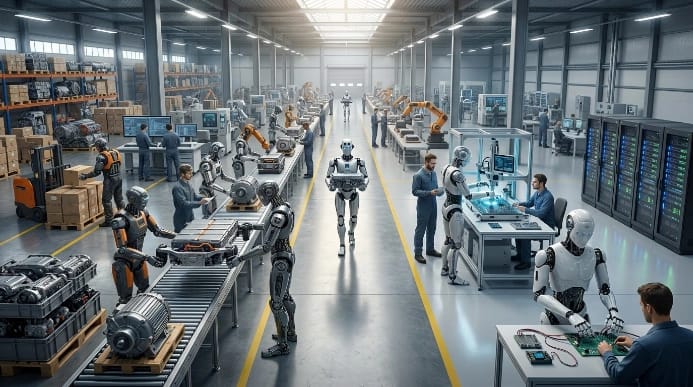
Humanoid Robot Race 2026: The Challenge of Mass Production
Artificial intelligence is beginning to leave the screen.
For the past several years, the AI race has focused on chatbots, image generators, coding assistants and increasingly capable AI agents.
The next competition could be much more physical.
Companies in China and the United States are racing to build humanoid robots capable of walking through factories, handling objects, operating equipment and eventually performing everyday tasks designed for humans.
And in 2026, that competition is accelerating dramatically.
Chinese manufacturers are already shipping thousands of humanoids. Unitree Robotics completed a blockbuster stock-market debut in August. Chinese automaker XPeng has just raised more than $900 million for its robotics business. Meanwhile, Tesla continues developing Optimus, while American challengers such as Figure AI and Boston Dynamics are pursuing their own approaches.
The numbers already show an extraordinary imbalance.
Market estimates cited in August suggest Chinese manufacturers accounted for the overwhelming majority of global humanoid shipments during the first half of 2026, with AgiBot and Unitree occupying the leading positions. TrendForce had earlier forecast that China’s humanoid robot output would grow 94% during 2026.
But shipments alone do not determine who wins the humanoid robot race 2026.
The real competition involves five separate challenges:
intelligence, dexterity, reliability, manufacturing scale and cost.
And no company has solved all five.
That is why the humanoid race may become one of the most important—and most misunderstood—technology battles of the next decade.
Why Humanoid Robots Suddenly Matter
Industrial robots are not new.
Factories have used robotic arms for decades.
Warehouses increasingly use automated systems to move products.
But most traditional robots are designed around one environment and one job.
Humanoid robots promise something different.
Human civilization has already built an enormous physical environment designed around the human body.
Doors are designed for human hands.
Stairs are designed for human legs.
Shelves are positioned for human reach.
Factory tools are designed for human workers.
Warehouses, stores, hospitals and homes follow similar assumptions.
A sufficiently capable humanoid robot could theoretically operate inside these environments without requiring every workplace to be redesigned around machines.
That is the attraction.
Combine a human-shaped machine with increasingly capable artificial intelligence, and robotics potentially moves from specialized automation toward general-purpose physical labor.
This is why humanoids deserve a place alongside the breakthrough technologies that could change everyday life by 2030.
The idea is simple.
Building it reliably is extraordinarily difficult.
1. China Has Taken an Early Manufacturing Lead
If the humanoid competition were judged purely by current shipment volume, China would already be far ahead.
Estimates from Smart Analytics Global reported that approximately 19,100 humanoid robots were shipped worldwide during the first half of 2026, nearly three times the level from a year earlier.
AgiBot reportedly shipped around 8,400 units, giving it approximately 44% of the market, while Unitree delivered about 5,900, or roughly 31%.
Chinese manufacturers collectively accounted for more than 90% of estimated shipments.
Those numbers should be treated carefully because the humanoid industry remains young and different research groups can define shipments differently.
But the direction is clear.
China has established an early advantage in actually producing robots.
This should sound familiar.
China used a similar industrial strategy in electric vehicles.
It developed large supply chains around batteries, motors, electronics, sensors and precision manufacturing. Intense domestic competition then pushed companies to improve products while lowering prices.
Humanoid robotics can benefit from many of the same capabilities.
Electric motors.
Batteries.
Cameras.
Sensors.
Power electronics.
Precision components.
Advanced manufacturing.
China already has enormous ecosystems producing them.
The global AI race therefore may be developing an interesting divide:
The United States has major strengths in frontier AI software, while China has formidable strengths in turning advanced technology into manufactured physical products.
Humanoid robots require both.
2. Unitree Has Become the Symbol of China’s Robot Boom
Few companies demonstrate China’s momentum better than Unitree.
The Hangzhou-based company originally became famous for relatively affordable quadruped robots. It later expanded aggressively into humanoids.
Then came its extraordinary stock-market debut.
Unitree’s shares closed approximately 460% above their offer price during their August 19 Shanghai debut. The company raised roughly $900 million from the listing.
The enthusiasm reflects enormous expectations surrounding physical AI.
But there is an important reality check.
A large portion of today’s humanoid demand still comes from research, education, demonstrations and early commercial trials rather than widespread replacement of human workers.
That means selling thousands of robots is impressive, but it does not prove that humanoids have reached their equivalent of the smartphone moment.
The real breakthrough comes when businesses can calculate:
This robot costs less to operate than the labor or specialized automation it replaces, performs the job reliably and provides a measurable return on investment.
Until that happens across many tasks, humanoids remain an emerging technology rather than a mature mass market.
Unitree’s advantage is that shipping hardware today gives it something extremely valuable:
real-world experience.
Every robot deployed can reveal weaknesses in motors, batteries, joints, software and control systems.
Scale creates learning.
And learning can improve the next generation.
3. AgiBot Is Quietly Winning the Shipment Race
Unitree may receive more international attention, but AgiBot has emerged as another major Chinese force.
Current industry estimates place it ahead of Unitree in 2026 humanoid shipments.
That matters because the future humanoid market may not resemble today’s AI-model industry.
Building a leading language model requires enormous computing resources, specialized researchers and access to advanced chips.
Robotics adds another layer:
manufacturing.
Companies need factories capable of repeatedly producing reliable mechanical systems.
A prototype can be assembled by engineers.
Producing tens of thousands of machines with consistent quality is a different problem.
This is where Chinese companies could have an important advantage.
AgiBot and Unitree are competing inside a domestic ecosystem filled with component suppliers, manufacturers and other robotics companies.
That competition can drive costs lower extremely quickly.
It also means the Western robotics industry may face a problem similar to the one Western automakers encountered with Chinese EVs:
By the time the technology becomes obviously commercial, Chinese manufacturers may already have significant production experience.
4. Tesla Optimus Has a Completely Different Advantage
Tesla’s position is unusual.
It is not currently the humanoid shipment leader.
But dismissing Optimus would be a mistake.
Tesla already knows how to manufacture complex machines at enormous scale.
It operates factories.
It develops batteries.
It designs power electronics.
It works extensively with computer vision and autonomous systems.
And it has access to enormous amounts of real-world AI expertise developed through its vehicle programs.
Tesla describes Optimus as a general-purpose, bipedal autonomous humanoid robot intended to perform unsafe, repetitive or boring tasks. Its official robotics program emphasizes perception, navigation, balance and physical interaction.
The company’s biggest potential advantage could be vertical integration.
If Tesla successfully combines AI software, robot hardware and mass manufacturing, Optimus could potentially move from prototype to volume production faster than a robotics startup without factories.
Tesla also has somewhere obvious to deploy robots first:
its own manufacturing facilities.
That matters enormously.
A robot company needs real environments in which to train and test machines.
Factories provide controlled settings where tasks repeat frequently.
Humanoids do not need to become general household assistants before becoming economically useful.
If Optimus can move components, handle materials or perform repetitive factory operations reliably, Tesla could generate useful deployment data before attempting harder consumer tasks.
This mirrors the transition we explored in the rise of AI factories: AI increasingly creates value when software becomes integrated with real industrial processes.
5. Figure AI Is Betting That Intelligence Matters Most
Figure AI represents another American strategy.
Instead of winning primarily through manufacturing scale, Figure has emphasized combining sophisticated AI with humanoid hardware.
That distinction could prove critical.
A humanoid robot that walks beautifully but cannot understand an unfamiliar task has limited usefulness.
The ultimate goal is not merely mechanical movement.
It is physical intelligence.
Imagine telling a robot:
“Take these boxes from the loading area, identify which shelf they belong on and ask me if anything is damaged.”
A truly useful general-purpose robot would need to interpret the instruction, perceive the environment, identify objects, plan movements, manipulate different packages and recover when something unexpected happens.
That requires something much closer to reasoning than conventional industrial automation.
This is where the humanoid race intersects with the rise of AI agents as digital employees.
AI agents are learning to perform multi-step digital tasks.
Humanoid robotics attempts to extend a similar idea into the physical world.
The challenge becomes dramatically harder.
A software agent making a mistake can sometimes retry.
A 70-kilogram machine making a mistake beside a human worker can cause physical damage.
Physical AI therefore requires intelligence and safety simultaneously.
6. Boston Dynamics Shows How Far Robot Hardware Has Come
Boston Dynamics has spent years demonstrating extraordinary robotic mobility.
Its new electric Atlas shows how advanced industrial humanoid hardware is becoming.
According to Boston Dynamics’ official 2026 specification sheet, Atlas stands about 1.9 meters tall, weighs 90 kilograms and has 56 degrees of freedom.
It includes tactile sensing in its hands, 360-degree camera coverage and an autonomous battery-swapping system. It can sustain loads of 30 kilograms and operate autonomously or through teleoperation.
Those specifications illustrate something important.
The hardware problem is increasingly solvable.
Robots can walk.
They can balance.
They can lift objects.
They can manipulate increasingly complicated environments.
But impressive mobility should not be confused with general intelligence.
A robot performing a rehearsed sequence in a controlled environment is fundamentally different from one independently handling unpredictable work for eight hours.
That gap between demonstration and dependable labor is perhaps the biggest challenge facing the entire industry.
7. XPeng Is Turning the EV Supply Chain Into a Robotics Advantage
Another serious challenger has emerged from China’s automobile industry.
XPeng announced on August 24 that its robotics unit raised more than $900 million in its first external funding round, valuing the business above $6.3 billion.
The company plans to use the money for hardware, AI models, training data, manufacturing and international expansion.
More importantly, XPeng aims to reach production of 1,000 IRON humanoids per month by the end of 2026, with initial deployments focused on industrial and retail environments.
This reinforces a major pattern.
The EV and humanoid industries are beginning to overlap.
Both need batteries.
Both require electric motors.
Both depend on sensors.
Both use AI and computer vision.
Both need sophisticated manufacturing.
Automakers therefore possess capabilities that robotics startups would otherwise need years to build.
Tesla is following this path in America.
XPeng is following it in China.
Other Chinese automakers are exploring robotics as well.
The automobile industry’s next competition may therefore extend far beyond cars.
8. The Real Battle Is Cost
A humanoid robot can be technologically astonishing and commercially irrelevant at the same time.
The difference is economics.
Businesses will eventually ask a simple question:
Does deploying this machine save enough money or create enough productivity to justify buying it?
That calculation includes much more than the purchase price.
Companies must consider:
maintenance,
electricity,
software subscriptions,
downtime,
repairs,
supervision,
training,
insurance,
and useful operating life.
Reliability may ultimately matter more than athletic ability.
A factory does not need a robot that can perform a backflip.
It needs one that can complete the same useful task thousands of times without stopping.
China’s manufacturing scale could become particularly important here.
If Chinese companies drive hardware costs down rapidly, they could accelerate adoption even if competing robots initially possess more sophisticated AI.
Cheap hardware creates more deployments.
More deployments create more data.
More data can improve software.
That can create a powerful feedback loop.
9. The First Humanoid Jobs Will Probably Be Boring
Popular culture imagines humanoid robots cooking dinner, cleaning houses and behaving like science-fiction assistants.
Those applications may eventually arrive.
They probably will not be the first large market.
Factories and warehouses are much easier.
Their environments are structured.
Tasks repeat.
Floors are predictable.
Objects can be standardized.
Workers can supervise robots.
Companies can directly calculate productivity gains.
The earliest commercially useful humanoids are therefore likely to perform jobs such as:
moving materials,
sorting products,
machine tending,
warehouse handling,
inspection,
basic assembly,
and repetitive manufacturing tasks.
Over time, robots could expand into retail, hospitality, logistics and healthcare support.
Homes are harder because they are unpredictable.
A factory can standardize where boxes appear.
A household contains children, pets, stairs, clutter, liquids, fragile objects and thousands of unusual situations.
The path to the home therefore probably runs through industry first.
10. What Happens to Human Jobs?
Humanoid robots inevitably raise concerns about employment.
If companies build machines specifically designed to perform human tasks, some jobs will eventually be automated.
But the timeline matters.
The immediate impact is likely to be much smaller than the most dramatic predictions suggest because today’s humanoids remain expensive and limited.
The larger disruption comes if robots become simultaneously:
cheap,
reliable,
intelligent,
safe,
and mass-produced.
At that point, the economics of physical labor could change significantly.
Our analysis of how AI is reshaping the global job market focused largely on knowledge work.
Humanoids extend the same technological pressure into physical work.
Warehouses, manufacturing, logistics, retail and eventually service industries could all be affected.
But new jobs will also emerge around robot deployment, maintenance, supervision, training, manufacturing and software.
The biggest challenge may therefore be transition rather than the disappearance of work itself.
The Robot Olympics Reveal Both Progress and Hype
China’s current humanoid competitions provide an almost perfect picture of where the technology stands.
More than 2,000 robots are participating in events ranging from running to soccer and martial arts at this year’s Beijing games.
The demonstrations can be impressive.
They can also be awkward.
Robots fall.
Some struggle with coordination.
Others complete remarkable athletic movements but remain far from independently handling unpredictable everyday tasks.
This distinction matters.
The robotics industry is entering a hype cycle similar to early generative AI.
Every spectacular demonstration attracts enormous attention.
But buyers ultimately care about reliability.
The winning humanoid will not necessarily be the machine producing the most viral video.
It will be the robot that shows up for work tomorrow and performs its job again.
Who Is Winning the Humanoid Robot Race in 2026?
There is no single winner yet.
But different competitors clearly lead different parts of the race.
China currently leads manufacturing volume and cost reduction.
AgiBot and Unitree demonstrate that Chinese companies can already produce humanoids in meaningful numbers.
Tesla has one of the strongest potential manufacturing platforms.
Its experience building vehicles and developing autonomous systems could become a major advantage if Optimus reaches reliable production.
Figure AI is one of the strongest bets on intelligence-first robotics.
Its challenge is turning sophisticated AI capabilities into reliable physical machines at scale.
Boston Dynamics remains a benchmark for advanced robotic hardware and mobility.
Its Atlas platform demonstrates how far industrial humanoids have progressed mechanically.
XPeng represents the rapidly emerging connection between EV manufacturing and humanoid robotics.
Its newly funded production ambitions show how quickly Chinese automakers are entering the competition.
The eventual winner may not even be one company.
Humanoid robotics could develop into competing ecosystems of AI models, chips, components, operating systems and manufacturers—much like smartphones and automobiles.
Could China Repeat Its Electric-Vehicle Success?
This may be the most important geopolitical question surrounding humanoid robotics.
China did not dominate EVs simply by inventing one superior car.
It built an ecosystem.
Battery suppliers.
Component manufacturers.
Charging infrastructure.
Factories.
Engineering talent.
Government support.
Intense domestic competition.
Those forces pushed costs lower while production increased.
Humanoid robotics could follow a similar path.
The United States retains extraordinary strengths in AI research, advanced computing and software.
But if China manufactures vastly more robots, Chinese companies gain another advantage:
physical-world data.
Every deployed robot encounters situations that can potentially improve future systems.
That could turn manufacturing scale into an AI advantage.
This is why the humanoid race belongs inside the broader global race for AI leadership.
The next stage of AI leadership may not be determined only by who builds the smartest model.
It may depend on who can put intelligence into millions of machines.
What Would a True Breakthrough Look Like?
The humanoid industry is still waiting for its equivalent of the smartphone moment.
That breakthrough will probably not be defined by running speed or dancing ability.
It will arrive when a robot can enter a new environment, receive ordinary instructions and reliably perform useful work without extensive programming.
Imagine a warehouse manager saying:
“Unload those containers, organize the packages by destination and tell me which items are damaged.”
The robot understands.
It plans.
It works.
It handles unexpected situations.
It asks for help only when necessary.
And it does this safely and economically.
That would change robotics completely.
Until then, humanoids remain somewhere between advanced industrial tools and the general-purpose machines companies ultimately want to build.
FAQs
Who is leading the humanoid robot race in 2026?
China currently appears to lead in shipment volume, with AgiBot and Unitree among the largest suppliers. American companies remain highly competitive in AI software, advanced robotics and future manufacturing potential.
How many humanoid robots are being shipped?
One industry estimate puts global shipments at approximately 19,100 units during the first half of 2026, with Chinese manufacturers accounting for the overwhelming majority. Definitions and estimates vary because the market is still emerging.
What is Tesla Optimus designed to do?
Tesla says Optimus is intended as a general-purpose autonomous humanoid capable of performing unsafe, repetitive or boring tasks.
Are humanoid robots already working in factories?
Some humanoids are being tested or deployed in controlled industrial and commercial environments, but widespread autonomous humanoid labor has not yet arrived.
Will humanoid robots replace human workers?
They could automate portions of repetitive physical work if costs fall and reliability improves. However, deployment is likely to occur gradually, while robotics could also create new maintenance, supervision, engineering and manufacturing jobs.
When will humanoid robots become common in homes?
There is no reliable date. Household environments are significantly more unpredictable than factories, making safe general-purpose home robots a much harder technical challenge.
The Light Span Perspective
The humanoid robot race 2026 may ultimately become more important than today’s competition over chatbots.
Generative AI taught machines to work with language, images and software. Humanoid robotics is attempting something harder: giving artificial intelligence a body capable of interacting with the physical world.
China currently has an important advantage in manufacturing scale, component supply chains and cost reduction. The United States retains major strengths in frontier AI, software and advanced robotics.
Neither advantage guarantees victory.
The breakthrough will come when intelligence, dexterity, reliability and economics converge in the same machine.
That is why spectacular robot demonstrations should be treated cautiously. Running, boxing and dancing demonstrate engineering progress, but businesses need machines that can perform useful work safely for thousands of hours.
The most important competition is therefore happening away from viral videos.
It is happening inside factories, supply chains, AI laboratories and production lines.
If humanoids eventually become as scalable as automobiles or smartphones, the economic consequences could be enormous.
And the country that learns how to manufacture physical intelligence at scale may gain one of the most important technological advantages of the next decade.
Continue reading more

