


The global economy isn’t collapsing.
But something more subtle is happening.
The ability of countries to generate sustained productivity, investment and rising living standards is becoming increasingly uneven.
Some economies are combining artificial intelligence, infrastructure, energy investment, skilled workers and private capital to create new sources of growth.
Others are struggling with weak productivity, expensive energy, insufficient investment, skills shortages, high debt and growing uncertainty.
That doesn’t mean there is a simple divide between “rich countries” and “poor countries.”
The picture is much more complicated.
The International Monetary Fund projected global growth at 3% in 2026 and 3.4% in 2027 in its July 2026 update, while warning that the outlook is being shaped by opposing forces including an energy shock and a technology-driven investment boom.
The World Bank’s January outlook was less optimistic, projecting global growth of 2.6% in 2026 and 2.7% in 2027, while noting that roughly one in four developing economies remained poorer on a per-capita basis than in 2019.
The exact forecasts differ because economic conditions are changing quickly.
But the broader message is consistent:
Countries that cannot improve productivity, attract investment and adapt to technological and economic change risk falling further behind.
So how can you tell when an economy is losing momentum?
Here are seven warning signs.
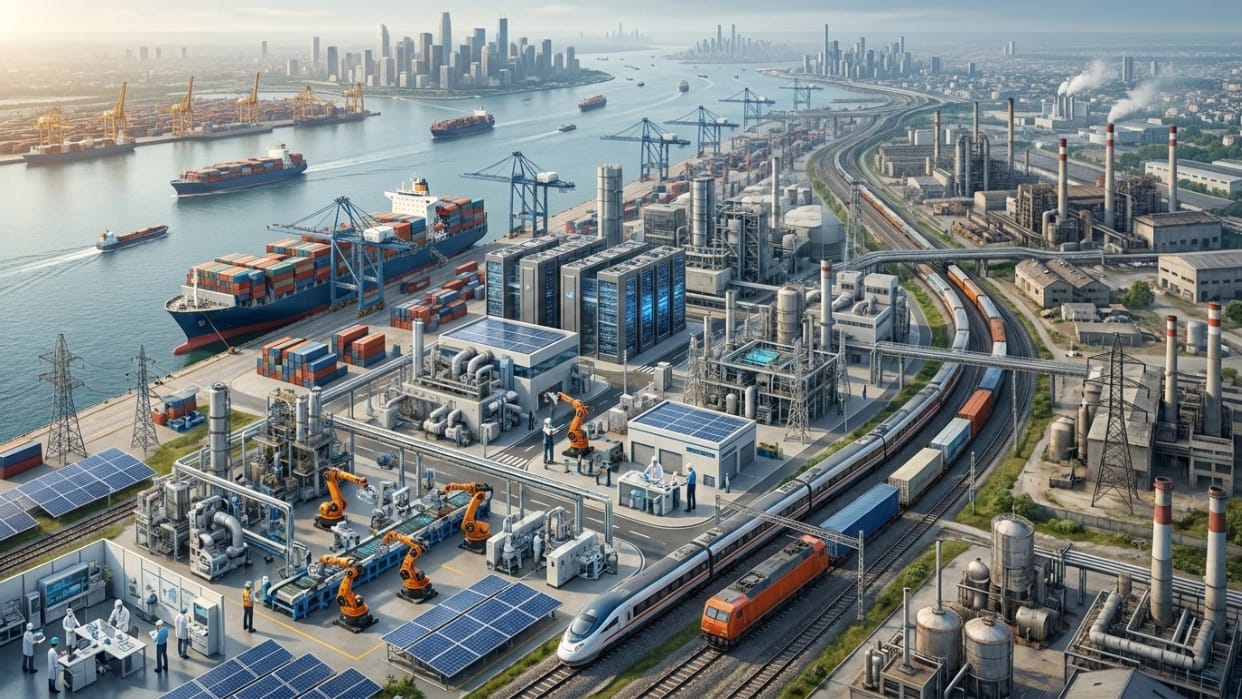
The divide is visible in rising global economic uncertainty, growing government-debt pressure, the restructuring of global supply chains, and the strategic race for critical minerals. The IMF’s July 2026 outlook projects continued but uneven global growth, while the OECD Going Digital Toolkit shows how connectivity, skills, innovation, and technology adoption increasingly shape national competitiveness.
1. Productivity Stops Improving
The most important warning sign may also be the least exciting.
Productivity.
An economy can grow temporarily because of population growth, government spending, commodity prices or borrowing.
But long-term improvements in living standards depend heavily on the ability to produce more value with the same amount of labor and capital.
When productivity stagnates, the consequences eventually spread everywhere.
Businesses struggle to raise wages.
Governments collect less revenue than they otherwise could.
Companies become less competitive internationally.
Investment becomes harder to justify.
And consumers eventually feel the effects through slower improvements in living standards.
The OECD has warned that potential GDP per capita growth in OECD economies has slowed substantially compared with the 1990s, highlighting the importance of competition, skills development, business investment and technological adoption.
Why this matters
Imagine two countries.
Country A increases productivity by continually adopting better technology, improving infrastructure and developing worker skills.
Country B continues operating with aging technology, inefficient processes and weak investment.
At first, the difference may barely be noticeable.
After 10 or 20 years, it can become enormous.
What countries should do
Governments don’t necessarily need to “pick winners.”
They need to create conditions where productive businesses can grow:
- Reliable infrastructure
- Competitive markets
- Skilled workers
- Digital adoption
- Research and development
- Efficient regulations
- Access to capital
Productivity isn’t a single government program.
It’s the cumulative result of thousands of decisions made by businesses, workers and policymakers.
2. Energy Becomes Too Expensive or Unreliable
Modern economies run on energy.
Factories need it.
Data centers need it.
Hospitals need it.
Transport systems need it.
Homes need it.
Agriculture needs it.
Even seemingly digital businesses ultimately depend on physical infrastructure powered by electricity and fuel.
That’s why energy security has become an economic competitiveness issue rather than simply an environmental or geopolitical issue.
The OECD’s June 2026 outlook highlighted how disruptions involving the Strait of Hormuz and damage to energy infrastructure pushed up energy prices and increased the cost of fertilizers and other industrial inputs.
The IMF similarly described the 2026 outlook as being pulled between an energy shock and a technology-driven investment boom.
The AI connection
AI makes this even more important.
Modern data centers require enormous quantities of electricity.
If a country wants to become a major AI and digital-economy hub, it needs more than software engineers.
It needs:
- Electricity
- Transmission networks
- Data centers
- Cooling systems
- Reliable grids
- Fiber networks
- Industrial infrastructure
This creates a powerful economic feedback loop.
Cheap, reliable energy → investment → technology → productivity → jobs → higher incomes.
The reverse can also happen.
Expensive or unreliable energy → higher costs → weaker investment → lower competitiveness.
What countries should do
Energy strategy should focus on reliability, affordability and diversification.
That can involve a combination of:
- Renewables
- Nuclear power
- Natural gas
- Grid modernization
- Battery storage
- Energy efficiency
- Cross-border electricity connections
- Domestic energy production
The exact mix will differ by country.
The economic objective is the same:
Keep productive businesses powered.
3. Infrastructure Investment Falls Behind
A country’s economy cannot become more competitive if its physical and digital foundations are deteriorating.
Look beyond highways.
Modern economic infrastructure includes:
- Ports
- Railways
- Airports
- Electricity grids
- Water systems
- Telecommunications
- Broadband
- Data centers
- Industrial zones
- Logistics networks
A company may have excellent employees and a brilliant product.
But if electricity is unreliable, ports are congested and internet infrastructure is weak, productivity suffers.
The World Bank’s January 2026 outlook specifically emphasized the need for developing economies to strengthen physical, digital and human capital to raise productivity and employability.
The hidden problem
Infrastructure deterioration often happens slowly.
A road doesn’t suddenly become “bad.”
A power grid doesn’t become obsolete overnight.
A port doesn’t suddenly become inefficient.
Instead, small problems accumulate.
Maintenance gets postponed.
Capacity becomes constrained.
Businesses spend more time and money dealing with bottlenecks.
Eventually, investors choose another location.
What countries should ask
Instead of only asking:
“How much infrastructure do we have?”
ask:
“Can our infrastructure support the economy we want 10 years from now?”
That’s a very different question.
4. Education Produces Degrees but Not Enough Useful Skills
An economy can have millions of educated people and still suffer from a skills shortage.
The problem occurs when education and the labor market move in different directions.
A modern economy increasingly needs workers who can combine:
- Technical knowledge
- Digital literacy
- Data skills
- Communication
- Problem-solving
- AI literacy
- Management
- Adaptability
This is especially important as AI changes the structure of work.
The World Bank says developing economies face a major jobs challenge, with 1.2 billion young people expected to reach working age over the next decade. It argues that strengthening physical, digital and human capital is essential for creating more productive employment.
The danger
If education systems continue preparing people for yesterday’s economy, graduates can face a strange contradiction:
High unemployment alongside employer complaints about labor shortages.
Both can exist at the same time.
Businesses may need technicians, software professionals, data specialists, healthcare workers, engineers and skilled tradespeople while graduates possess qualifications that don’t match those needs.
The solution
Education shouldn’t only prepare people to pass exams.
It should prepare them to solve real problems.
That means stronger links between:
schools → universities → employers → vocational training → technology
And because technology changes continuously, learning cannot end at graduation.
5. Businesses Stop Investing
This warning sign deserves much more attention.
An economy can have strong consumer spending today while quietly becoming weaker tomorrow if businesses stop investing.
Investment creates future productive capacity.
Companies invest in:
- Machinery
- Software
- Research
- Factories
- Employees
- Logistics
- Digital infrastructure
- New products
When investment slows for a long period, productivity growth can weaken.
The OECD has repeatedly highlighted business investment and structural reform as important drivers of longer-term economic dynamism. Its earlier outlook also noted that AI-related investment was already helping support growth, particularly in the United States.
Why businesses stop investing
There can be many reasons:
- Policy uncertainty
- High interest rates
- Weak consumer demand
- Political instability
- Poor infrastructure
- Unpredictable regulations
- Currency instability
- Trade barriers
- Lack of skilled workers
This creates a dangerous cycle.
Uncertainty → less investment → weaker productivity → slower growth → even less investment.
Breaking that cycle requires credible policies that give businesses a reason to invest for the long term.
6. An Economy Becomes Too Dependent on a Few Exports or Markets
Global trade creates enormous opportunities.
But concentration creates vulnerability.
Imagine a country whose economy depends heavily on:
- One commodity
- One major export market
- One industry
- One supply chain
- One foreign investor
A major disruption can suddenly become a national economic problem.
Trade tensions in recent years have demonstrated how quickly tariffs, supply-chain disruptions and geopolitical conflicts can change business calculations.
The IMF’s January 2026 outlook noted that global growth remained resilient despite trade disruptions, partly because companies adapted their supply chains and redirected activity.
But adaptability has limits.
The goal isn’t to stop trading.
It’s to diversify intelligently.
A resilient economy might export:
- Manufactured goods
- Services
- Technology
- Agricultural products
- Energy
- Financial services
- Digital products
That way, weakness in one sector doesn’t automatically become a nationwide crisis.
7. A Country Falls Behind in Technology Adoption
This could become the defining economic divide of the next decade.
Not:
Who invented AI?
But:
Who actually uses it productively?
The distinction matters.
A country doesn’t need to invent every important technology to benefit from it.
But it needs businesses and workers capable of adopting useful technologies.
The OECD’s 2026 research on AI and trade argues that AI’s economic benefits will depend partly on how gains are distributed across countries and how economies are connected through international trade and technology diffusion.
Meanwhile, the IMF has warned that AI investment could provide a meaningful productivity boost, but also that concentrated technology investment creates risks if expectations fail to translate into earnings and productivity.
The real opportunity
AI can potentially improve:
- Business productivity
- Customer service
- Software development
- Research
- Manufacturing
- Healthcare
- Education
- Logistics
- Financial services
- Public administration
But simply buying AI software doesn’t create productivity.
Workers need training.
Businesses need redesigned workflows.
Data needs to be accessible.
Systems need to work together.
And organizations need to measure whether AI is actually improving outcomes.
The Seven Warning Signs Are Connected
These problems shouldn’t be viewed separately.
They form a system.
Consider an economy with unreliable electricity.
That raises business costs.
Higher costs discourage investment.
Lower investment reduces productivity.
Weak productivity limits wage growth.
Lower wage growth reduces household purchasing power.
Slower growth reduces government revenue.
Lower revenue makes infrastructure investment harder.
The cycle continues.
Now reverse the direction.
Reliable energy supports investment.
Investment increases productivity.
Higher productivity supports better wages.
Better wages increase consumer demand.
Stronger businesses generate tax revenue.
Higher revenue supports infrastructure and education.
Better infrastructure attracts more investment.
That’s why economic policy can’t focus on one indicator alone.
Economic competitiveness is an ecosystem.
Why AI Could Make the Economic Divide Larger
AI creates a fascinating possibility.
It could help countries with limited traditional advantages become more productive.
A small business in a developing country can now access tools that previously required expensive software, large teams or specialized expertise.
AI can help with:
- Translation
- Customer service
- Marketing
- Software
- Research
- Accounting
- Design
- Education
That could lower barriers to entry.
But there is another possibility.
Countries that already have:
- Strong electricity systems
- Large technology companies
- Deep capital markets
- Advanced universities
- Skilled workers
- Data infrastructure
may adopt AI faster.
That could widen existing productivity differences.
The OECD’s research on AI and trade specifically examines how international linkages influence the distribution of AI-related gains.
So the AI revolution isn’t automatically equalizing.
Technology can reduce barriers—but adoption still requires infrastructure, skills and investment.
What Falling Behind Actually Looks Like
Economic decline doesn’t necessarily look like a financial crisis.
That’s an important distinction.
A country can remain politically stable and continue growing while gradually becoming less competitive.
You might see:
- Wages growing slowly
- Young people leaving for better opportunities
- Businesses moving investment elsewhere
- Imports growing faster than competitive exports
- Infrastructure deteriorating
- Electricity becoming expensive
- Productivity stagnating
- Public debt limiting investment
- Skilled workers becoming harder to find
None of these alone proves that an economy is “failing.”
But several occurring together should get policymakers’ attention.
What Countries Can Do Before the Problem Gets Worse
The good news is that economic competitiveness isn’t predetermined.
Countries can improve.
The most important priorities are surprisingly consistent.
1. Invest in productivity
Make it easier for productive companies to expand.
2. Build reliable infrastructure
Focus on electricity, transport, communications and digital systems.
3. Improve education
Align skills with the industries that are actually growing.
4. Encourage private investment
Reduce unnecessary uncertainty and regulatory friction.
5. Diversify exports
Avoid excessive dependence on one commodity or market.
6. Accelerate technology adoption
Help businesses and workers use AI and digital technologies effectively.
7. Protect macroeconomic stability
High inflation, unstable currencies and unsustainable debt make long-term planning harder.
The World Bank’s 2026 outlook similarly emphasizes private investment, trade, technology, education and improved business environments as key ingredients for stronger growth in developing economies.
The Most Important Question for the Next Decade
The global economy isn’t simply competing over who has the largest population or the most natural resources.
Increasingly, countries are competing over something more complicated:
Who can convert capital, energy, technology and human talent into productivity most effectively?
That is the race.
And it won’t have one winner.
Different countries will lead in different industries.
Some may dominate AI.
Others may lead in manufacturing.
Others may become energy hubs.
Others may specialize in digital services.
The countries that adapt fastest will have more opportunities to benefit.
Frequently Asked Questions
Is the global economy shrinking?
No. Current forecasts still show global growth, but the gains are uneven across countries depending on energy exposure, technology, investment, trade links, and policy conditions.
What is the clearest long-term warning sign?
Persistent weak productivity is the clearest signal because it limits wage growth, competitiveness, public revenue, and the ability to raise living standards.
The Light Span Perspective
The global economy doesn’t need to experience a dramatic collapse for countries to fall behind.
It can happen gradually.
A little less investment.
A little slower productivity.
A little weaker infrastructure.
A little more expensive energy.
A little bigger skills gap.
A little more trade concentration.
A little slower technology adoption.
Each problem may seem manageable on its own.
Together, they can create a powerful downward cycle.
The encouraging part is that the opposite is also true.
Productivity can improve.
Infrastructure can be upgraded.
Workers can be retrained.
Businesses can invest.
Energy systems can become more resilient.
Technology can spread.
Trade can diversify.
The global economy is therefore not splitting into two predetermined camps.
The more useful way to think about it is this:
Countries are entering a competition over adaptability.
The winners won’t necessarily be the countries with the most resources.
They’ll increasingly be the ones that can turn their resources, people, capital and technology into productive economic activity.
For businesses and workers, the lesson is equally important.
Don’t wait to see which countries win.
Position yourself around the industries, technologies and skills that are becoming more productive.
Because in the next phase of the global economy, standing still may be more dangerous than moving in the wrong direction.

