


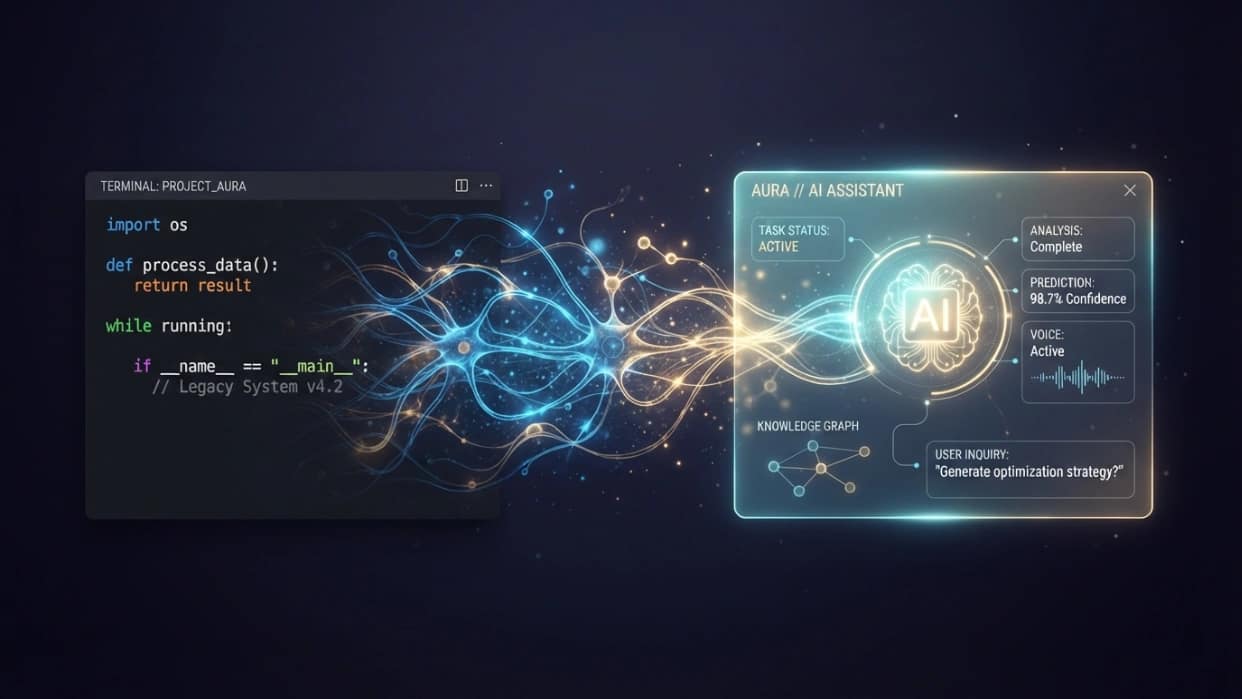
AI Replacing Traditional Software: How Computing Is Changing
For decades, using software meant learning how the software worked.
You opened an application, navigated menus, clicked buttons, filled in forms and moved information from one tool to another.
Artificial intelligence is beginning to change that model.
Instead of learning exactly how to operate each program, users can increasingly describe what they want to achieve and allow an AI system to determine how to complete the task.
That is the real story behind AI replacing traditional software.
It does not mean spreadsheets, accounting platforms, customer databases or design tools will suddenly disappear.
A more realistic change is happening underneath the surface:
AI is beginning to replace the traditional way humans interact with software.
The shift is accelerating as AI systems move beyond answering questions and start planning multi-step tasks, calling tools and taking actions across digital services.
The International Monetary Fund describes agentic AI as systems capable of interpreting objectives, planning steps and interacting with digital services with limited human intervention. In payments, the IMF says this could shift activity away from explicit human instructions toward decisions mediated by AI agents.
That same model could reshape much more than payments.
It could change how people write reports, manage customers, analyze data, build software, schedule work and operate businesses.
Here are seven major changes showing why AI replacing traditional software may become one of the defining computing trends of the next several years.
Key Takeaways
- AI is increasingly becoming an interface between users and conventional applications.
- AI agents can potentially complete multi-step workflows instead of merely answering questions.
- Traditional software is unlikely to disappear; much of it may become infrastructure operating behind AI.
- The value of software could shift from attractive interfaces toward data, APIs, workflows and trusted execution.
- Businesses may gain productivity, but giving AI permission to act introduces security and accountability risks.
- SaaS companies may need to redesign products for both human users and AI agents.
- The transition from AI that suggests actions to AI that takes actions is the most important change to watch.
What Does AI Replacing Traditional Software Actually Mean?
The phrase sounds more dramatic than the reality.
Traditional software usually depends on direct human control.
A user opens a program and tells it what to do through explicit actions.
For example:
Traditional software
Human → opens application → chooses feature → enters information → confirms action → receives result
Generative AI added another layer.
AI copilot
Human → asks AI for help → AI creates or recommends something → human reviews → human completes action
Agentic AI introduces a third model.
AI agent
Human → describes objective → AI plans steps → chooses tools → performs authorized actions → reports result
This third model is what makes AI replacing traditional software such an important possibility.
The software still exists.
The database still exists.
The payment processor still exists.
The CRM still exists.
But the user may interact with those services through an intelligent layer rather than manually opening each application.
That is a major change in computing.
1. Prompts Are Starting to Replace Menus
The first major shift is already familiar.
People increasingly tell software what they want instead of manually finding every command.
Consider a spreadsheet.
Traditionally, a user might need to understand formulas, formatting rules and data-analysis tools.
An AI-enabled system can potentially let the user say:
“Compare this year’s sales with last year’s, identify our fastest-growing products and create a summary.”
The software can then perform several operations behind the scenes.
The same idea applies to:
- image editing,
- presentations,
- email,
- coding,
- customer-service tools,
- analytics,
- document creation.
This doesn’t make graphical interfaces useless.
There will always be tasks where direct visual control is faster.
But AI replacing traditional software interfaces could dramatically reduce the amount of product-specific knowledge users need.
Instead of learning where a feature is located, users increasingly need to understand what outcome they want.
That shifts computing from commands toward intentions.
2. AI Agents Can Move Across Multiple Applications
The second change is much bigger.
An AI assistant inside one application can help with tasks in that application.
An AI agent can potentially work across several services.
Imagine asking:
“Find a suitable flight for Tuesday, compare it with my calendar, book the best option within our travel policy, reserve a hotel and send the itinerary to my team.”
Completing that task manually could require:
- a calendar,
- airline website,
- travel platform,
- payment system,
- hotel service,
- email,
- company policy database.
A capable AI agent could coordinate those services.
That moves artificial intelligence from content generation into workflow execution.
The trend also fits the broader evolution already visible in The Light Span’s coverage of the rise of AI agents and autonomous digital workers. That article focuses on how autonomous systems could become part of the workforce; this page focuses specifically on how those systems change the software layer itself.
The distinction matters.
The future may not involve one giant AI application replacing every program.
Instead, AI could become the orchestration layer connecting many specialized applications.
3. Software Is Moving From Tools Toward Outcomes
Traditional software companies sell tools.
A CRM helps manage customers.
Accounting software helps manage finances.
A design platform helps create graphics.
Project-management software helps organize work.
But what customers ultimately want is not software.
They want an outcome.
Businesses want:
- more sales,
- lower costs,
- faster reporting,
- fewer errors,
- better customer service,
- completed projects.
Agentic systems could allow software companies to move closer to delivering those outcomes directly.
Instead of selling:
“a platform for finding customer leads”
a future AI system might offer:
“identify the 50 most promising prospects, research them, draft personalized outreach and prepare everything for approval.”
That is a very different product.
This is also where businesses need to think carefully about return on investment.
The Light Span’s analysis of the costly AI ROI problem shows that adopting AI without a clearly defined business problem often produces disappointing results.
The same rule applies here.
AI replacing traditional software only creates value when the resulting workflow is actually better, cheaper or faster.
Adding an AI button to every application isn’t a strategy.
4. SaaS Business Models Could Change
Software-as-a-service transformed the technology industry.
Companies moved from selling boxed software licenses toward recurring subscriptions.
AI agents could produce another business-model shift.
Today, SaaS products often compete heavily through their user interfaces.
Businesses evaluate:
- dashboards,
- workflows,
- menus,
- ease of use,
- collaboration features.
But if an AI agent interacts with the application on the user’s behalf, the visible interface may become less important.
Other assets could become more valuable:
- proprietary data,
- APIs,
- reliability,
- permissions,
- integration quality,
- specialized workflows,
- domain expertise.
Imagine two accounting systems.
One has a beautiful dashboard.
The other has a more reliable API and cleaner financial data.
For a human, the first product might be more attractive.
For an AI agent operating the software automatically, the second could be more valuable.
That is why AI replacing traditional software interfaces could force SaaS companies to rethink what makes their product defensible.
The best software may increasingly need to serve two types of users:
Humans
and
AI agents.
5. AI Is Entering Business Operations
AI is already being integrated into many business functions.
Common examples include:
- customer support,
- software development,
- research,
- marketing,
- financial analysis,
- document processing,
- scheduling,
- data analysis.
The difference between today’s assistants and tomorrow’s agents is the level of autonomy.
An AI assistant might draft an email.
An agent might identify which customers require follow-up, draft personalized responses, schedule messages and update the CRM.
An assistant might summarize invoices.
An agent could potentially collect invoices, categorize them, flag unusual items and prepare payment instructions for human approval.
The IMF’s analysis of agentic AI in payments shows why this distinction matters. It notes that autonomous agents could increasingly make decisions about timing, routing and payment execution, fundamentally changing today’s human-directed payment model.
This is a concrete example of AI replacing traditional software workflows rather than merely making existing software easier to use.
But it also introduces a serious problem:
What happens when the AI makes the wrong decision?
6. Security Becomes More Important When AI Can Act
This may be the most important challenge.
A chatbot that gives an incorrect answer can cause problems.
An AI agent with permission to send money, delete files, change customer records or purchase products can cause much larger problems.
The risk increases as AI moves through three stages:
AI suggests
↓
AI recommends
↓
AI acts
Every increase in autonomy requires stronger controls.
The Bank for International Settlements has highlighted risks related to data quality, privacy, security, third-party dependencies, explainability and governance as AI becomes more deeply integrated into financial services. These concerns become even more important when systems can act on behalf of users rather than simply provide analysis.
Companies therefore need clear permission systems.
An agent that schedules meetings might require relatively little oversight.
An agent that can transfer money should have strict limits and human approval.
The principle should be:
The greater the possible damage from an incorrect action, the stronger the human control should be.
This is why businesses also need defenses against AI-powered cyber threats. AI systems can create new attack surfaces through prompt injection, stolen credentials, manipulated data and excessive permissions.
Giving an AI access to five business systems is useful.
Giving a compromised AI access to five business systems is dangerous.
7. Traditional Software Probably Survives—But Becomes Less Visible
Does all of this mean Microsoft Excel, Salesforce, Photoshop, accounting software and thousands of other applications will disappear?
Probably not.
The more likely outcome is that many applications remain underneath AI.
Think about the internet today.
Most people don’t manually interact with databases, web servers, content-delivery networks or payment infrastructure.
Those systems still exist.
They simply operate in the background.
Traditional software could increasingly follow the same pattern.
Users may say:
“Prepare the monthly report.”
Behind that request, an AI agent could:
- query the accounting system,
- extract sales data,
- analyze the spreadsheet,
- create charts,
- write the summary,
- build the presentation.
The user may never manually open most of those programs.
But the underlying software remains essential.
This is the most accurate way to understand AI replacing traditional software:
AI may replace the interface and workflow more quickly than it replaces the underlying application.
That is a much less sensational—but potentially much more important—change.
AI Infrastructure Still Matters
AI software can feel almost invisible to users, but it requires enormous physical infrastructure.
AI models need:
- data centers,
- processors,
- memory,
- networking,
- electricity,
- cooling,
- cloud infrastructure.
That means the transition toward AI-operated software is connected directly to the wider AI infrastructure boom.
As AI usage expands from occasional chatbot queries to agents running continuous business workflows, computing demand could increase further.
This creates a fascinating contradiction.
Software may become easier for the end user while the infrastructure underneath becomes dramatically more complex.
A simple sentence such as:
“Review our sales and prepare tomorrow’s meeting”
could trigger several models, databases, APIs and cloud services.
The user sees simplicity.
The infrastructure sees complexity.
AI Governance Will Become Part of Software Management
Traditional enterprise software already requires rules.
Businesses decide:
- who can access customer information,
- who can approve payments,
- who can edit records,
- who can install software.
AI makes those policies more complicated.
Organizations must now ask:
- Which tools may AI access?
- What data can an agent read?
- Which actions can it take automatically?
- When is human approval required?
- Who is responsible for an incorrect decision?
- How are actions logged and audited?
These are governance questions, not simply technical questions.
Our guide to building an AI governance strategy explains why companies need clear policies covering data, risk, responsibility and human oversight as AI adoption expands.
The more AI replaces manual software operation, the more important that governance becomes.
Could AI Agents Replace Entire Apps?
In some cases, perhaps.
Simple applications that mainly provide a thin interface over information or a limited workflow could face significant pressure.
If an AI system can perform the same task through another service or API, users may no longer need a separate application.
But specialized software with important underlying capabilities is harder to replace.
Examples include:
- engineering systems,
- enterprise databases,
- payment infrastructure,
- professional design tools,
- cybersecurity platforms,
- industry-specific systems.
AI agents may operate these products rather than eliminate them.
This distinction will probably define winners and losers in the next phase of software.
Companies whose main advantage is a convenient interface may face greater disruption.
Companies with valuable data, trusted infrastructure or specialized capabilities could become even more important.
What Does This Mean for Software Workers?
The software transition also affects jobs.
Developers may spend less time manually writing basic code and more time:
- defining architecture,
- checking AI-generated code,
- securing systems,
- integrating services,
- designing agent workflows.
Business users may also need fewer product-specific technical skills.
But human judgment becomes more valuable.
Someone still needs to understand whether the AI’s output makes sense.
This aligns with the broader labor-market trend covered in The Light Span’s analysis of why AI is creating new jobs instead of simply replacing everyone.
Automation usually changes tasks before it eliminates entire occupations.
Software may follow the same pattern.
What Should Businesses Do Now?
Companies do not need to replace all their software with AI.
That would be reckless.
A better strategy is to identify workflows where AI can genuinely remove unnecessary manual work.
Start with questions such as:
Which repetitive software tasks consume the most employee time?
Which workflows require copying information between several applications?
Where can AI assist without creating unacceptable financial or security risk?
Then begin with controlled automation.
Keep humans involved in high-impact decisions.
Restrict AI permissions.
Measure whether the automation actually saves time or money.
And make sure there is a way to reverse incorrect actions.
The strongest AI strategy is not maximum automation.
It is useful automation with appropriate control.
FAQs
Is AI replacing traditional software?
AI is beginning to replace some traditional software interactions and workflows, but most underlying applications are unlikely to disappear immediately. AI may increasingly become the layer through which users control multiple applications.
What is agentic AI?
Agentic AI generally refers to AI systems that can interpret an objective, plan multiple steps and interact with tools or services to complete tasks with limited human intervention. The IMF has examined how this model could reshape payment systems.
Will AI agents replace SaaS?
AI agents could disrupt some SaaS products, particularly applications whose main value is a simple interface. However, specialized SaaS platforms with valuable data, workflows, infrastructure and APIs may remain essential.
Are AI agents safe?
They can be useful, but greater autonomy creates risks involving permissions, privacy, cybersecurity and incorrect actions. High-impact actions should generally require stronger safeguards and human oversight.
Will traditional apps disappear?
Probably not completely. Many applications may continue operating underneath AI while becoming less visible to users.
Why are companies interested in AI agents?
AI agents could reduce repetitive software work and automate multi-step processes across several services. Businesses are interested because this may improve productivity, although actual return on investment depends heavily on how well the technology is implemented.
The Light Span Perspective
The most interesting thing about AI replacing traditional software is that users may barely notice the transition.
There may never be a single day when traditional software suddenly disappears.
Instead, people may gradually stop opening as many applications.
They will increasingly tell AI what they want.
The AI will decide which tools to use.
Applications will still process payments, store data, edit images, manage customers and run businesses—but much of that activity could happen behind the scenes.
That represents a fundamental shift in computing.
For decades, humans learned the language of machines.
We learned menus, commands, formulas and workflows.
AI is beginning to reverse that relationship.
Machines are increasingly learning how to interpret human intentions.
But convenience shouldn’t hide the risks.
The moment AI moves from recommending actions to taking them, businesses need stronger security, permissions and accountability.
A system that drafts an email is one thing.
A system that sends contracts, transfers money or changes business records is something else entirely.
The winners in the next software era may therefore not be the companies that simply add the most AI.
They may be the companies that combine three things:
powerful AI, valuable underlying software and trustworthy control.
Traditional software is not disappearing tomorrow.
But the traditional software experience—the world of endless menus, dashboards and manual workflows—may already be starting to fade.
Continue reading more

