


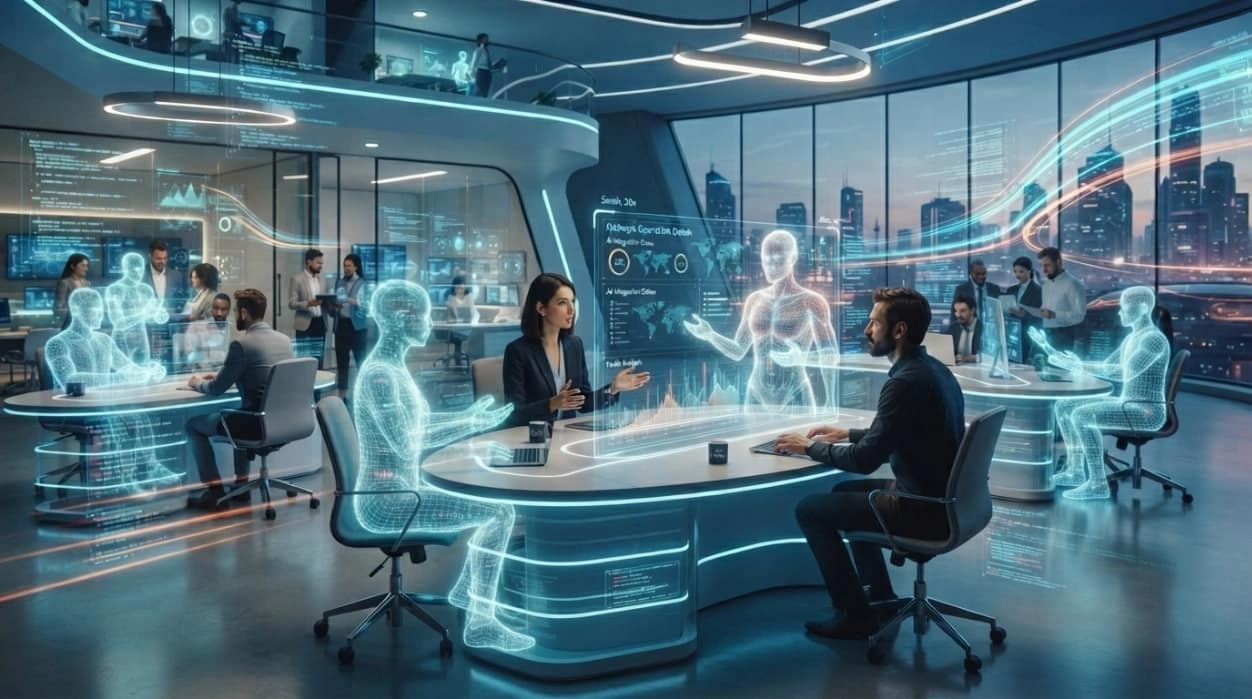
For years, the AI industry focused on teaching machines to understand information.
Models consumed enormous quantities of books, websites, code, images and other digital material. The goal was to make AI better at predicting, generating and reasoning about information.
That approach produced the generative AI revolution.
But something important is changing.
The next generation of AI systems increasingly needs to do more than know things.
It needs to do things.
That means navigating software, operating computers, making decisions, following procedures, recovering from mistakes and completing long-running workflows.
And teaching an AI to do that is considerably harder than teaching it to generate a good answer.
That’s why some of the most interesting developments in AI are now happening inside something that sounds surprisingly simple:
virtual workplaces.
Instead of training an AI agent only on text describing how people work, companies are increasingly exploring environments where agents can actually perform work, receive feedback, make mistakes and try again.
Recent reporting indicates that major technology companies are pursuing this direction aggressively. Google is reportedly discussing a deal involving AI startup Mechanize, whose technology focuses on creating virtual environments where agents can learn to perform software-based work. Meta, SpaceX and Uber are also pursuing ways to capture or simulate human workflows for AI development.
The implications could be enormous.
Because if AI learns how to perform entire workflows—not merely answer questions—the boundary between AI assistant and digital worker starts to disappear.
The AI Training Game Is Changing
The first generation of large language models relied heavily on massive datasets of human-created information.
Books.
Web pages.
Code.
Articles.
Forums.
Images.
That data taught models how humans communicate and what information looks like.
Then came reinforcement learning and human feedback, which helped models become better at following instructions and producing useful responses.
But there is a fundamental limitation.
A model can read thousands of descriptions of how an accountant uses a spreadsheet without necessarily becoming a good accountant.
It can read software documentation without reliably behaving like an experienced software engineer.
It can read customer-service conversations without understanding every operational decision involved in resolving a real customer problem.
Knowing how work is described is not the same as knowing how work is performed.
That’s the problem virtual workplaces are designed to address.
What Is a Virtual Workplace for AI?
A virtual workplace is essentially a simulated digital environment where an AI agent can perform tasks similar to those performed by a human worker.
Imagine giving an AI access to a simulated office containing:
- Spreadsheets
- Documents
- Databases
- Web browsers
- Coding environments
- Customer-management software
- Project-management tools
- Communication systems
The AI can then be assigned an objective.
For example:
“Investigate why this customer’s order was delayed and prepare a resolution.”
Instead of simply generating a hypothetical answer, the agent has to navigate the software, locate the relevant information, interpret it, make decisions and produce the appropriate outcome.
The environment can then determine whether the task was completed correctly.
That’s powerful because it creates something AI training has historically struggled to obtain:
a measurable feedback loop.
AI Can Learn Through Trial and Error
This is where reinforcement learning becomes important.
A simplified version looks like this:
Task → Action → Result → Feedback → Adjustment → Retry
Suppose an AI agent is learning how to use accounting software.
It clicks the wrong menu.
The task fails.
The system provides negative feedback.
The agent tries a different sequence.
It succeeds.
The successful behavior receives a positive signal.
Repeated across thousands or millions of simulated tasks, this process can potentially help an agent discover more reliable strategies.
That is fundamentally different from simply showing an AI thousands of examples.
The machine is learning from interaction.
Recent reporting on Mechanize describes this approach as creating increasingly realistic software environments in which agents can practice work and receive signals about whether they completed tasks correctly.
Why This Matters for AI Agents
This development connects directly to the rise of AI agents.
A conventional chatbot primarily responds to prompts.
An agent is expected to pursue a goal.
For example:
Chatbot:
“Here’s how you can analyze your sales data.”
Agent:
“I’ll analyze the sales data, identify the largest changes, prepare a report and flag the most important issues.”
That second system needs much more than language ability.
It needs:
- Planning
- Tool use
- Memory
- Computer interaction
- Error recovery
- Decision-making
- Goal management
Google Cloud defines AI agents as systems that use AI to pursue goals and complete tasks on behalf of users, incorporating capabilities such as reasoning, planning and memory.
The virtual-workplace approach attempts to train exactly those abilities.
AI Agents Are Getting Better—But They’re Not Ready for Everything
There is already evidence that computer-using AI agents are improving rapidly.
Stanford’s 2026 AI Index reports that agent performance on the OSWorld benchmark jumped from roughly 12% task success to about 66%.
OSWorld tests agents on real computer tasks across operating systems.
That’s a remarkable improvement.
But there’s an equally important number:
Agents still fail roughly one out of every three attempts.
That distinction matters enormously.
A 66% success rate sounds impressive in a research demonstration.
It is much less impressive when the task involves:
- Moving money
- Managing confidential information
- Handling a customer complaint
- Editing critical software
- Filing legal documents
- Making business decisions
A human employee who successfully completes 66% of routine tasks would not be considered reliable.
So the AI industry has made enormous progress—but there is still a significant distance between demonstration and dependable employment.
Why Virtual Workplaces Could Accelerate That Progress
The biggest advantage of a simulated environment is scale.
Imagine training a human employee to perform a complicated software workflow.
They might complete the process a few times each day.
An AI agent could potentially practice continuously.
It can:
- Attempt the task.
- Make a mistake.
- Receive feedback.
- Change its strategy.
- Try again.
- Repeat thousands of times.
The environment doesn’t need to sleep.
It doesn’t need a salary.
It doesn’t get bored.
And most importantly, mistakes can happen without damaging a real company.
That’s why virtual environments could become an important part of the next AI training cycle.
The First Target May Be Software Engineering
Software development is an obvious starting point.
Almost everything involved in software engineering happens digitally.
A simulated environment can reproduce:
- Code repositories
- Development tools
- Testing systems
- Documentation
- Issue trackers
- Version control
- Build systems
An AI agent can then receive a task:
Fix this bug.
Or:
Implement this feature.
Or:
Identify why this test is failing.
The system can evaluate whether the code works.
That creates an unusually measurable environment for reinforcement learning.
This helps explain why software engineering is reportedly one of the first areas being targeted by Mechanize’s approach.
And it could eventually extend far beyond coding.
From Coding Agents to Digital Workers
Imagine the same concept applied to customer service.
A simulated customer sends a complaint.
The agent must:
- Identify the customer.
- Examine the account.
- Understand the problem.
- Check company policy.
- Determine an appropriate resolution.
- Communicate the decision.
- Update the records.
The environment can measure whether the agent followed the correct process.
Now imagine the same approach for:
Sales
Research → qualify → contact → follow up → update CRM.
Marketing
Analyze → plan → create → publish → measure → optimize.
Finance
Collect data → reconcile → identify anomalies → report.
Human resources
Review requests → check policies → prepare documentation → route decisions.
Research
Search → compare → verify → synthesize → report.
The concept becomes much bigger than chatbot training.
It’s workforce simulation.
The Most Important Data May Become Human Workflows
This could explain why technology companies are increasingly interested in how humans actually interact with computers.
Recent reporting says Meta has explored collecting employee interaction data—including keystrokes, mouse movements, clicks and screen activity—to understand how people navigate software. SpaceX has also discussed using workplace activity data to help train Grok. Uber has reportedly embedded AI-focused teams within departments to study workflows and redesign them for automation.
The strategic logic is straightforward.
If you want an AI to perform a job, you need to understand:
How is the job actually done?
Not how a textbook says it is done.
Not how a job description describes it.
But what the employee actually does.
Which button do they press?
Which information do they check first?
What shortcut do they use?
What exception do they recognize?
When do they ask another person for help?
Those tiny behaviors can contain enormous amounts of practical knowledge.
The Hidden Value of “How Work Gets Done”
Consider an experienced employee.
A beginner might follow ten steps to complete a task.
An expert might complete it in four.
Why?
Because the expert has accumulated thousands of small decisions:
- Which information matters
- Which information can be ignored
- Which errors are dangerous
- Which shortcuts are safe
- When to escalate
- What unusual patterns mean
These aren’t always written down.
They are tacit knowledge.
AI agents need to acquire more of this knowledge if they are going to perform complex jobs reliably.
Virtual workplaces could provide a way to turn some of that tacit knowledge into training data.
But There’s a Major Catch: Simulations Aren’t Reality
This is one of the most important limitations.
A simulated workplace can be extremely realistic and still be wrong.
Real businesses are messy.
Customers behave unpredictably.
Software breaks.
Policies conflict.
Employees misunderstand each other.
Data can be incomplete.
Unexpected events happen.
A virtual environment may not capture all of those conditions.
This creates what’s often called a sim-to-real gap.
An AI might become extremely good at a simulated customer-service environment but struggle when confronted with a real customer who behaves in a way the simulation never anticipated.
The same problem applies to software engineering, finance, administration and almost every other field.
So better simulations don’t eliminate the problem.
They reduce it.
Could AI Practice Entire Careers?
This is where the concept becomes genuinely disruptive.
Today, humans learn many jobs through experience.
A junior employee might spend years progressing from simple tasks to increasingly complex responsibilities.
AI could potentially compress that process.
Instead of:
Years of experience → expertise
the system could pursue:
Millions of simulated experiences → improved agent
That doesn’t mean an AI would instantly become a perfect professional.
But it could change the economics of learning.
An AI system doesn’t need to wait for Monday morning to practice.
It can potentially run thousands of simulated workdays simultaneously.
Entry-Level Jobs Could Face the First Major Pressure
This is one of the most important implications.
Many entry-level knowledge jobs involve highly structured digital workflows.
For example:
- Data entry
- Basic research
- Customer support
- Administrative processing
- Routine reporting
- Scheduling
- Document preparation
- Basic coding
- Simple analysis
These tasks may be particularly suitable for AI agents because their environments can be modeled and their outputs can often be evaluated.
That creates a potential problem.
Traditionally, entry-level employees learn by doing these simpler tasks before moving into more complex responsibilities.
If AI automates the entry-level layer, companies could face a new question:
Where will future experienced workers get their experience?
That’s a much more complicated issue than simply asking whether AI will eliminate jobs.
AI Could Also Create a Productivity Boom
The story isn’t entirely negative.
If AI agents can reliably handle routine digital work, companies could become dramatically more productive.
A small team might be able to accomplish what previously required a much larger organization.
Consider a five-person startup with specialized AI agents handling:
- Customer support
- Market research
- Bookkeeping
- Software testing
- Content production
- Administrative work
The humans could focus on:
- Strategy
- Product decisions
- Relationships
- Creativity
- Leadership
This could lower the cost of starting businesses.
Meta CEO Mark Zuckerberg recently argued that increasingly capable personal AI systems could enable smaller teams and potentially make entrepreneurship easier by allowing individuals to accomplish work that previously required larger organizations.
If that happens, the future could contain more small companies with much greater technological leverage.
The One-Person Company Could Become More Powerful
Imagine a person with an idea for a software product.
Historically, they might need:
- Developer
- Designer
- Researcher
- Marketer
- Customer-support staff
- Operations manager
With capable AI agents, one entrepreneur could potentially coordinate many of those functions.
That doesn’t mean humans become unnecessary.
It means the minimum viable organization could become smaller.
This could lead to a fascinating economic paradox:
AI may eliminate some jobs while simultaneously making it easier for individuals to create new businesses.
The final outcome will depend on how quickly automation develops compared with the creation of new economic opportunities.
AI Agents Could Change What “Employee” Means
Today, an employee is generally a human who performs tasks for an organization.
In an agentic economy, organizations may increasingly contain a mixture of:
- Human employees
- AI agents
- Human-agent teams
- Specialized automated systems
An AI agent might have a defined role:
Research Agent
Another:
Sales Operations Agent
Another:
Coding Agent
Another:
Compliance Agent
Humans would manage the overall system.
This could create something closer to a hybrid workforce.
But Automation Creates New Risks
More autonomy means more responsibility.
A recent research study examining workplace AI-agent risks analyzed thousands of job tasks and identified numerous potential failure scenarios. It found that erroneous agent actions were among the most significant risks and warned that overreliance on agents can gradually weaken human skills and oversight.
This is an important warning.
An agent doesn’t need to be malicious to cause damage.
It simply needs to be:
confident + wrong + authorized to act.
That’s potentially enough.
The “Human in the Loop” May Become More Important
The logical response isn’t necessarily to prohibit AI agents.
It’s to determine where humans remain responsible.
For example:
Low-risk task
AI can act independently.
Medium-risk task
AI acts and records its reasoning/results for review.
High-risk task
AI prepares the action, but a human must approve it.
Critical task
AI can provide recommendations but cannot execute the decision.
This could become one of the most important design principles for workplace AI.
The Next AI Race May Be About Environments
For years, companies competed over:
Models + chips + data.
The next race may increasingly include:
Environments.
Who can build the most realistic digital workplace?
Who has the best evaluation system?
Who can generate the best training tasks?
Who can accurately measure success?
Who has access to real human workflows?
Who can turn those workflows into safe training environments?
This could become a major competitive advantage.
The AI Industry Is Moving From “Knowing” to “Doing”
That’s ultimately what makes this development so significant.
A language model is impressive because it can know and generate.
An AI agent is more valuable when it can execute.
A digital worker becomes transformative when it can execute reliably.
And that final word matters:
Reliably.
The difference between an impressive demo and a commercially useful digital worker is reliability.
If an agent succeeds 66% of the time, it may be fascinating.
If it succeeds 99.9% of the time on the tasks that matter, it becomes economically transformative.
The industry is therefore moving toward a much harder problem:
How do we make AI agents reliable enough to trust with real work?
Virtual workplaces could be part of the answer.
7 Jobs AI Agents Could Learn First
1. Software Engineering
Digital environment, measurable outputs and abundant training data make coding an obvious target.
2. Customer Support
Large volumes of structured interactions provide opportunities for training and evaluation.
3. Administrative Work
Many workflows involve predictable software interactions.
4. Data Analysis
Inputs and outputs can often be objectively evaluated.
5. Digital Marketing
Research, reporting and campaign workflows can be simulated.
6. Research Assistance
Search, comparison and synthesis are increasingly agent-friendly tasks.
7. Operations
Agents could eventually coordinate repetitive digital workflows across multiple systems.
The hardest jobs will likely be those requiring complex physical interaction, deep interpersonal judgment or unpredictable real-world conditions.
What Happens Next?
The next few years could follow a progression like this:
Stage 1 — AI assistants
Humans tell AI what to do.
Stage 2 — AI agents
AI performs multi-step tasks.
Stage 3 — AI workflows
Multiple agents coordinate tasks.
Stage 4 — Virtual workplace training
Agents practice entire workflows inside simulations.
Stage 5 — Digital workers
Reliable agents perform recurring professional tasks in real environments.
Stage 6 — Hybrid organizations
Humans and AI agents operate together as teams.
We’re already seeing pieces of these stages emerge.
But moving from Stage 2 to Stage 5 will require enormous improvements in reliability, security and governance.
What This Means for Workers
The safest response isn’t to assume that every job will disappear.
It’s to understand how your work is structured.
Ask:
Which parts of my job are repetitive?
Which parts happen entirely on a computer?
Which parts follow predictable rules?
Which parts require human judgment?
Which parts require relationships or trust?
The more predictable and digital a task is, the more likely AI can potentially assist with or automate it.
The more a task depends on:
- Judgment
- Accountability
- Creativity
- Leadership
- Human relationships
- Physical interaction
the harder it becomes to fully automate.
That doesn’t mean those jobs are immune.
It means their transformation is likely to look different.
What Businesses Should Watch
Companies considering AI agents should focus less on the question:
“Can AI do this?”
and more on:
“Can AI do this reliably, safely and economically?”
A good evaluation should consider:
Accuracy
Does the agent complete the task correctly?
Reliability
Does it work consistently?
Recovery
Can it recover from unexpected problems?
Security
Can it access only what it should?
Cost
Is automation cheaper than human labor?
Oversight
Can humans intervene when necessary?
Accountability
Who is responsible when something goes wrong?
These factors will determine whether AI agents actually create value.
Further Context and Primary Sources
Further context from The Light Span includes AI agents and the future of work, AI infrastructure build-out, pressure on AI-chip companies, energy limits on computing growth, and supply-chain exposure in advanced technology. Together, these analyses show how technology, capital markets, energy systems and supply chains increasingly shape one another.
Readers can also examine the underlying evidence through NIST AI Risk Management Framework and Stanford AI Index. These primary resources provide useful context for tracking how the issue develops beyond a single news cycle.
The Light Span Perspective
The next AI revolution may not be about teaching machines more facts.
It may be about teaching machines how work actually happens.
That’s a profound shift.
For years, AI learned from the internet.
Now companies are increasingly interested in teaching AI from:
workflows, software environments, human behavior and simulated experience.
Recent developments around Mechanize and other efforts suggest that major AI companies see virtual work environments as potentially valuable infrastructure for developing more capable agents.
At the same time, Stanford’s data provides a useful reality check. AI agents have improved dramatically on computer-use tasks, but they still fail often enough that handing them unrestricted control over important business operations would be risky.
That means the future isn’t already decided.
The technology has enormous potential, but the final outcome will depend on reliability, economics, safety and how humans choose to deploy it.
The most important transition may therefore be:
AI that knows → AI that acts → AI that works.
If the industry manages to make that final step reliable, the consequences could be much larger than another improvement in chatbot quality.
The AI race would no longer be about building the smartest assistant.
It would be about building the most capable digital worker.
And once that happens, the question facing the global economy won’t simply be:
“Can AI do the job?”
It will be:
“What should humans do when AI can?”
Frequently Asked Questions
What are AI agents?
AI agents are software systems that can pursue goals and complete tasks using capabilities such as reasoning, planning, memory and tool use.
How are AI agents learning to perform jobs?
One emerging approach is to place agents inside simulated environments where they can perform tasks, receive feedback and improve through repeated trial and error. These environments are often associated with reinforcement learning.
What is a virtual workplace?
A virtual workplace is a simulated digital environment containing software, tools and workflows that allow AI agents to practice tasks similar to those performed by human workers.
Are AI agents ready to replace workers?
Not broadly. Their capabilities are improving rapidly, but Stanford’s 2026 AI Index shows that agents still fail roughly one-third of structured computer-use tasks on OSWorld.
Which jobs could AI agents automate first?
Highly structured digital jobs are likely to be among the earliest candidates, including some software development, customer support, administrative processing, research and data-analysis tasks.
Could AI agents create new jobs?
Yes. Greater automation could create demand for AI-agent development, supervision, evaluation, governance, workflow design and entirely new products and services.
Will AI eliminate entry-level jobs?
Some entry-level tasks could face significant automation pressure because they often involve structured digital workflows. However, the overall effect will depend on how companies redesign jobs and how new roles develop.
Why do AI companies need virtual workplaces?
Virtual workplaces give agents a controlled environment where they can practice complex tasks, make mistakes and receive measurable feedback without causing damage to real businesses.
What is the biggest problem with AI digital workers?
Reliability is one of the biggest challenges. An agent that occasionally produces an incorrect answer is one thing; an agent that takes an incorrect action inside a real business system can cause much greater harm.
AI is moving from learning what humans know toward learning how humans work.
Virtual workplaces could become an important part of that transition.
If AI agents can repeatedly practice realistic tasks, learn from mistakes and eventually achieve near-human reliability, businesses may gain something much more powerful than another chatbot.
They could gain digital workers capable of operating software, completing workflows and collaborating with human teams.
But we’re not there yet.
Today’s agents remain imperfect, and the gap between impressive demonstrations and dependable autonomous work is still significant.
The companies that close that gap may define the next stage of the AI economy.
And the biggest AI breakthrough of the next few years may not be a model that can answer a harder question.
It may be an AI system that can finish the job.
Continue reading more

