


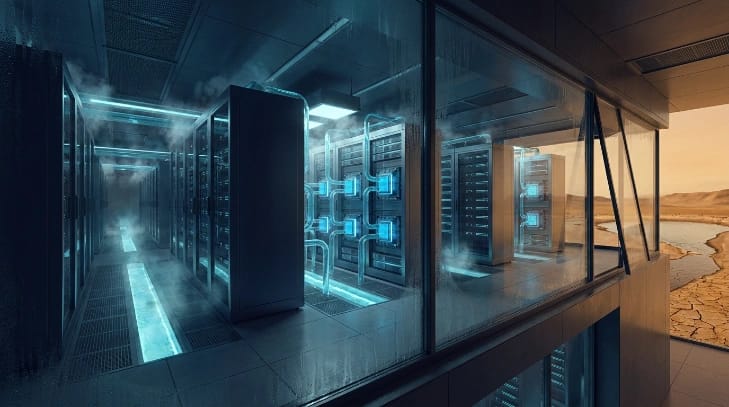
AI data center water use is becoming one of the least understood limits on artificial intelligence. The public conversation focuses heavily on chips and electricity, but powerful computing systems also generate enormous amounts of heat. Removing that heat can require water directly at the facility and indirectly through the power plants that supply its electricity.
That does not mean every AI request consumes a fixed bottle of water or that every data center uses the same amount. Those simplified claims ignore major differences in climate, cooling equipment, workload, energy source and operating time. A facility in a cool region using air-based cooling has a very different water profile from a large campus using evaporative cooling during a summer heatwave.
The real issue is local. Water may be abundant at a national level while a particular community faces drought, stressed aquifers or competing agricultural demand. As AI infrastructure expands, companies and governments must decide where facilities should be built, which cooling systems they should use and how transparently their environmental costs should be reported.
Why AI Data Centers Need Cooling
AI servers perform huge numbers of calculations and convert part of the electricity they consume into heat. Modern accelerators are densely packed, and clusters may run continuously while training models or serving millions of users. If that heat is not removed, equipment loses efficiency, reduces performance or fails.
Cooling is therefore not optional infrastructure. Traditional data centers often use fans and chilled air. Higher-density AI systems increasingly rely on liquid cooling, which moves heat more effectively from processors and racks. Liquid cooling does not always mean that water is constantly consumed. Some systems circulate fluid in a closed loop, while others reject heat through cooling towers where part of the water evaporates.
The distinction between water withdrawal and water consumption matters. Withdrawal measures water taken from a source, even if much of it is later returned. Consumption refers to water that is not immediately returned to the same local system, often because it evaporates. Discussions that mix the two measurements can make facilities look either cleaner or more damaging than they are.
1. AI Growth Is Increasing Computing Density
The first pressure comes from the speed and density of AI expansion. Conventional cloud workloads can be distributed across servers with moderate power requirements. AI training and inference often concentrate large numbers of advanced processors inside tightly connected clusters. More computing in the same physical space creates more heat per rack and makes cooling more demanding.
The site’s analysis of AI data center power demand explains how this build-out is reshaping electricity planning. Water demand follows a related but not identical path. A more efficient chip may use less energy for each calculation while total demand still rises because companies run far more calculations.
This is the rebound problem: efficiency lowers the cost of a service, which can encourage greater use. AI systems may become dramatically more efficient per task, yet aggregate electricity and cooling needs can continue climbing as models, users and applications expand.
2. Evaporative Cooling Trades Electricity for Water
The second pressure is the tradeoff between water and energy. Evaporative cooling can be highly effective because evaporation carries heat away. In many climates, it reduces the electricity needed for mechanical refrigeration. The environmental advantage is lower power demand; the cost is that water is consumed through evaporation.
Air cooling can reduce direct water consumption but may require more electricity, especially during hot weather. If the additional power comes from thermal generation, the facility may indirectly increase water use at power plants. A data center cannot be judged responsibly using a single measurement. Operators must consider direct water, indirect water, electricity, carbon emissions and reliability together.
This is why the International Energy Agency’s data-center analysis treats digital infrastructure as part of the wider energy system. Cooling choices influence grid demand, while grid conditions influence which cooling technologies are practical.
3. Water Stress Is Intensely Local
A gallon of water does not have the same environmental value everywhere. Using water in a rain-rich region with resilient infrastructure is different from using it in a drought-prone basin where households, farms and ecosystems are already competing for supply. Annual averages can also hide seasonal stress. A community may have adequate water in winter but face severe pressure during the hottest months—exactly when cooling demand is highest.
The Light Span’s broader guide to global water security shows that scarcity is shaped by climate, infrastructure, governance and unequal access. Data centers enter this existing system; they do not create water stress from nothing. But a large new industrial user can worsen tensions if local conditions are ignored.
Site selection therefore matters as much as cooling efficiency. Companies should evaluate basin-level risk, future climate conditions, municipal capacity and the needs of existing users. A facility that looks efficient on a global dashboard may still be poorly located if it adds demand where water is already scarce.
4. Communities Want Better Transparency
The fourth pressure is public trust. Residents often hear about a proposed data center only after land, tax or utility agreements are already taking shape. Technical filings may disclose peak capacity without clearly explaining expected water use, seasonal variation or the source of supply. That information gap creates suspicion even when a project uses efficient technology.
Companies increasingly publish environmental reports. Google’s sustainability reporting and Microsoft’s sustainability reporting provide examples of large technology firms disclosing water-related goals and operational impacts. Corporate totals are useful, but communities also need location-specific information because water stress is local.
Good disclosure should distinguish withdrawal from consumption, potable water from reclaimed water and direct facility use from water associated with electricity generation. It should also explain how use changes during hot periods and what happens during drought restrictions. Clear reporting allows residents and regulators to compare promised efficiency with actual performance.
5. AI Infrastructure Is Competing With Other Water Users
Data centers are not usually the largest water users in an entire country. Agriculture, municipal systems and some industrial sectors often consume much more. But national comparisons can distract from the real decision. A new facility competes within a specific watershed and utility system, not against a country’s total annual supply.
The competition can become politically sensitive when communities face restrictions while a technology company receives guaranteed access. Farmers may worry about groundwater levels. Cities may fear that rapid industrial growth will require expensive treatment and pipeline upgrades. Utilities may need to reserve capacity for a facility whose peak demand arrives during extreme heat.
Those concerns do not prove that data centers should be rejected. They show why contracts must address drought conditions, infrastructure costs and conservation responsibilities. A project is more defensible when it brings its own efficiency investments, supports recycled-water systems and accepts limits during genuine shortages.
6. Electricity Generation Adds a Hidden Water Footprint
The sixth pressure appears outside the data center fence. Many power plants use water for cooling or steam cycles. When an AI facility consumes electricity, part of its water footprint may occur at the power source rather than at the building. The amount varies substantially by generation technology and cooling design.
This link is central to the site’s coverage of AI’s electricity problem. A company can reduce on-site water use by relying more heavily on mechanical cooling, yet raise electricity demand. If the local grid depends on water-intensive generation, the total regional effect may be less impressive than the facility’s direct-water figure suggests.
Renewables can reduce some operational water use, but grid planning remains complicated. Solar and wind are variable, while data centers require reliable power. Storage, transmission, firm generation and demand flexibility all influence the final mix. The global energy transition is therefore inseparable from the challenge of sustainable AI infrastructure.
7. Climate Change Makes Cooling Harder
The seventh pressure is climate risk. Higher temperatures increase the amount of heat cooling systems must reject. Drought can reduce available supply or trigger restrictions. Extreme weather can also disrupt electricity systems just as data centers need more cooling power. Infrastructure designed around historical climate averages may perform poorly under future conditions.
Operators can respond by using climate-adjusted site planning, hybrid cooling and flexible controls. A hybrid system may use low-water cooling during periods of scarcity and more energy-efficient evaporative cooling when water is abundant. The best choice depends on local weather, water quality, grid conditions and workload requirements.
AI companies also have an incentive to schedule flexible computing. Some training or batch-processing jobs can run at times and places where electricity and cooling conditions are favorable. Real-time services have less flexibility, but better workload management can still reduce stress during peak periods.
How Much Water Does an AI Query Use?
There is no universal answer. Estimates that assign one fixed volume of water to a prompt often depend on assumptions about the model, hardware, data center, cooling system, local weather and electricity mix. Change any of those inputs and the result changes. The same AI service can have different water footprints at different times and locations.
A more useful question is how much water a service consumes per unit of useful computing under defined conditions. Even that measure should be paired with water-stress information. Consuming a certain volume in a low-stress basin is not equivalent to consuming it in a region facing scarcity.
Readers should treat viral per-query numbers as illustrations, not universal physical constants. They can help people understand that digital services have material infrastructure, but they should not be used to compare companies unless the underlying boundaries and assumptions are consistent.
The Technologies That Could Reduce Water Use
Direct-to-chip liquid cooling can remove heat efficiently from high-power processors and may operate in closed loops. Immersion cooling places components in a nonconductive fluid, potentially improving heat transfer and reducing the need for large air systems. Dry coolers reject heat without evaporating water, though their electricity demand and performance can vary with climate.
Reclaimed wastewater is another option. Using treated non-potable water can reduce pressure on drinking-water supplies, but it still requires pipelines, treatment and careful management. Some facilities may capture rainwater or reuse process water. Others can recover waste heat for nearby buildings or industrial uses, turning part of the cooling burden into a local resource.
Software matters too. Better model design, efficient inference, optimized scheduling and specialized chips can reduce the energy and heat required for each task. The site’s coverage of AI infrastructure spending highlights the scale of capital flowing into the physical stack. A growing share of that investment will need to target efficiency rather than raw computing capacity alone.
What Responsible Data-Center Planning Looks Like
Responsible planning begins before construction. Developers should compare multiple sites using basin-level water stress, future climate projections, grid conditions and municipal infrastructure. They should disclose expected annual and peak consumption using consistent definitions. Local agreements should specify drought procedures and who pays for required water-system upgrades.
Operations should prioritize the lowest-impact source suitable for the facility, including reclaimed water where practical. Cooling systems should be optimized for local conditions instead of copied from another climate. Companies should publish actual performance after opening and explain material differences from forecasts.
Governments also need consistent standards. Without common definitions, one operator may report withdrawals while another reports consumption, creating misleading comparisons. Permitting agencies should examine cumulative impacts because several individually manageable facilities can collectively strain a region.
Why Banning Data Centers Is Not a Complete Solution
AI infrastructure creates real environmental costs, but blanket opposition ignores its economic role and the possibility of better design. Data centers support cloud services, research, healthcare, communications and business systems—not only consumer chatbots. Communities may gain investment and tax revenue, although promised benefits should be evaluated realistically because highly automated facilities may not create large numbers of permanent jobs.
The better objective is disciplined development. Projects in water-stressed locations should face stricter requirements than those in resilient regions. Operators that use recycled water, fund infrastructure, disclose performance and reduce demand during emergencies should be treated differently from projects that shift costs onto residents.
This approach recognizes both sides of the issue: digital growth needs physical resources, and those resources belong to living communities and ecosystems before they appear on a corporate sustainability chart.
What Readers Should Watch Next
Watch where new AI campuses are proposed, not just which company announces them. Location reveals the connection among available land, transmission capacity, tax incentives and water supply. Pay attention to cooling technology, the source of water and whether the company reports peak summer demand.
Also watch for standardized reporting. Investors and communities need comparable measures that account for direct and indirect use. Finally, follow advances in chip efficiency and workload scheduling. The most sustainable AI system is not merely the one with an efficient building; it is the one that delivers useful computing with less energy, less heat and less water across its full supply chain.
Light Span Perspective
AI data center water use is not a simple story of technology companies draining a fixed amount of water for every prompt. It is an infrastructure problem shaped by geography, engineering and governance. The same computing workload can create very different consequences depending on where it runs and how the facility is cooled.
The industry should move beyond impressive global pledges toward transparent local accountability. Communities deserve to know how much water a project expects to consume, which source it will use, how demand changes during extreme heat and what protections apply during drought.
AI can keep expanding without turning water into its next unavoidable crisis, but only if efficiency, site selection and public trust become core design requirements. Computing power may be global. Water is always local.
Frequently Asked Questions
Do AI data centers use drinking water?
Some facilities use potable municipal water, while others use reclaimed or non-potable supplies. The source depends on local infrastructure and cooling design. Reports should clearly distinguish among these sources.
Does liquid cooling always consume water?
No. Many liquid-cooling systems circulate fluid in closed loops. Water consumption usually depends on how heat is ultimately rejected, particularly whether cooling towers rely on evaporation.
Are data centers the main cause of water shortages?
Usually not at national scale, but a large facility can add meaningful pressure within a stressed local watershed. The relevant comparison is local supply, seasonal demand and cumulative development.
Can AI become less water-intensive?
Yes. More efficient chips and models, closed-loop cooling, reclaimed water, better site selection and flexible workload scheduling can all reduce water impacts.
Why are per-query water estimates controversial?
They depend on assumptions about hardware, cooling, location, weather, electricity and the model being used. They are not universal measurements that apply equally to every AI request.

