


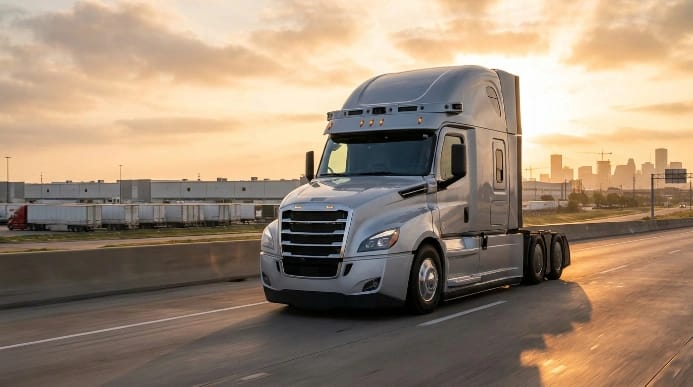
Autonomous Trucking: The Business Case for Driverless Freight
For years, autonomous trucks seemed permanently stuck in the testing stage. Technology companies demonstrated impressive vehicles, investors provided billions of dollars, and executives promised that trucks without drivers would soon transform freight. Yet commercial deployment remained limited, safety questions continued, and several developers abandoned the market.
That picture is changing in 2026.
Driverless trucks are now moving paid freight on selected routes. Autonomous trucking company Gatik has raised another $200 million after reporting more than $600 million in contracted revenue. Other operators have completed commercial deliveries without a safety driver, observer, or remote operator inside the cab.
These developments do not mean human drivers are about to disappear from every highway. Current systems operate within carefully defined routes, weather conditions, road types, and geographic areas. National regulations remain incomplete, public confidence is fragile, and unusual road situations can still challenge automated systems.
Nevertheless, autonomous trucking 2026 has crossed an important line. The central question is no longer whether a truck can drive itself during a controlled demonstration. It is whether driverless freight can operate safely, repeatedly, and profitably inside real logistics networks.
Here are seven signs the industry is moving from technological promise toward a genuine transportation business—and what that could mean for companies, workers, consumers, and roads.
Quick Takeaways
- Autonomous freight companies are attracting large investments again.
- Driverless trucks are generating revenue on carefully selected commercial routes.
- Middle-mile transport is emerging as an easier starting point than unrestricted nationwide driving.
- Retailers can use automation to increase delivery frequency and improve inventory movement.
- Safety evidence, insurance, regulation, cybersecurity, and public trust remain major barriers.
- Truck drivers are more likely to see their work change gradually than disappear overnight.
- Broad deployment will depend on proving that autonomous operations are safer and cheaper at scale.
1. Investors Are Funding Autonomous Freight Again
The first major sign is the return of substantial investment.
Gatik announced a $200 million Series D financing round in August 2026, led by the Qatar Investment Authority and Koch Disruptive Technologies. According to the company’s announcement, the funding will support driverless commercial freight networks serving large retailers, grocery businesses, and consumer-goods companies.
This financing is more meaningful because it follows evidence of commercial demand. Gatik says it has secured more than $600 million in contracted revenue and operates driverless trucks across multiple logistics networks.
That changes the investment story.
Autonomous trucking 2026 is therefore beginning to look like an infrastructure and logistics industry rather than merely an artificial-intelligence experiment. Like the wider AI infrastructure race, success will depend on converting expensive technology into dependable services customers are willing to purchase repeatedly.
2. Trucks Are Carrying Paid Loads Without Anyone in the Cab
The strongest evidence of progress is simple: some driverless trucks are now doing actual work.
In April, autonomous developer Bot Auto completed a paid freight journey of roughly 230 miles between Houston and Dallas. The truck reportedly traveled without a safety driver, onboard observer, or remote operator controlling it from elsewhere.
Gatik has concentrated on shorter middle-mile routes connecting distribution centers, warehouses, and retail locations. Its vehicles operate repeatedly within defined logistics networks instead of attempting to drive anywhere a human might go.
A public-road demonstration can be carefully staged. A commercial delivery must arrive reliably, fit a customer’s schedule, coordinate with loading facilities, and repeat the task often enough to create economic value.
Paid operations show that autonomous trucking 2026 is beginning to solve a business problem, not simply demonstrate technical capability.
The development also fits a broader shift toward physical AI systems. Artificial intelligence is moving beyond chatbots and digital software into machines that perceive their surroundings, make decisions, and perform work in factories, warehouses, and transportation networks.
3. Middle-Mile Freight Offers a Practical Starting Point
Autonomous trucking becomes easier to understand when the industry is divided into different types of driving.
Long-haul trucking moves goods over large distances between cities. Last-mile delivery brings packages from local facilities to individual homes and businesses. Middle-mile freight moves products between warehouses, distribution centers, stores, and other fixed commercial locations.
The middle mile is attractive for automation because routes can be predictable. A truck may travel between the same two facilities several times each day, using mapped roads and scheduled loading areas.
Developers can choose routes with manageable traffic patterns and suitable weather. They can position maintenance teams nearby and train facility workers around consistent procedures. If conditions move outside the system’s approved operating limits, the company can delay or redirect the journey.
This controlled approach is less dramatic than promising a vehicle capable of driving everywhere. It may also be more commercially realistic.
Modern companies are already redesigning global supply chains to become faster, more visible, and more resilient. Regular autonomous routes could help move inventory between important nodes without requiring the technology to solve every driving situation immediately.
The likely path is gradual expansion: prove reliability on one route, add similar routes, broaden operating conditions, and only then attempt more difficult environments.
4. The Business Case Is Becoming Clearer
Trucks are valuable only when they move freight. A human driver must rest, eat, sleep, and follow working-hour rules designed to prevent fatigue. An automated vehicle could potentially operate for longer periods, stopping primarily for loading, inspection, maintenance, refueling, or charging.
Higher utilization could allow one truck to complete more journeys. Retailers might replenish stores more frequently, keep less inventory sitting idle, and respond faster when demand changes.
Automation could also improve consistency. Computer-controlled driving can reduce unnecessary acceleration and braking, potentially improving fuel efficiency and lowering wear when the system operates correctly.
Autonomous vehicles require expensive sensors, computing hardware, redundant steering and braking systems, detailed maps, communication networks, specialist maintenance, cybersecurity, insurance, and operational supervision. A fleet may still need remote-support teams and workers at distribution centers.
The real calculation is therefore not “driver salary versus no driver salary.” It is total autonomous operating cost versus the cost and reliability of conventional transport.
This mirrors the broader lesson of AI spending in the global economy. Advanced technology creates value only when productivity gains eventually exceed the cost of building and operating it.
5. Safety Has Become the Deciding Issue
Commercial momentum cannot replace safety evidence.
Heavy trucks can cause catastrophic damage when something goes wrong. An autonomous system must recognize vehicles, pedestrians, motorcycles, debris, emergency responders, construction workers, unusual road markings, severe weather, and countless unpredictable situations.
It must also respond safely when a camera is blocked, a sensor fails, a tire bursts, communications disappear, or another vehicle behaves irrationally.
The National Highway Traffic Safety Administration says automated driving systems could eventually reduce crashes and react to some dangers faster than people. It also emphasizes that higher automation remains limited to restricted testing and deployment conditions and that considerable work remains.
This balanced view is essential. Human driving includes fatigue, distraction, speeding, impairment, and poor judgment. Automation may reduce those risks, but it introduces software errors, sensor limitations, system-design failures, and cybersecurity threats.
Safety cannot be established through a marketing claim or a single accident-free route. Regulators and the public need transparent measures: miles traveled, disengagements, collisions, near misses, system failures, operating conditions, and comparison with equivalent human-driven freight.
Autonomous trucking 2026 will advance only if companies show that safety improves as fleets expand. Hiding incidents or using confusing statistics would damage trust across the entire industry.
6. Regulation and Cybersecurity Are Catching Up
Road laws were written around a person sitting behind the wheel. Driverless commercial vehicles create difficult questions.
Who is responsible if the system causes a crash? Which state or federal authority should approve a route? What training should remote-support staff receive? How should police stop or communicate with an automated truck? What information must a company provide after an incident?
The U.S. Department of Transportation has developed frameworks for integrating automated vehicles, while NHTSA continues studying how safety standards should apply to vehicles that may not need traditional manual controls.
Different state rules still create complexity. A truck may be allowed to operate without a driver in one jurisdiction but face different requirements after crossing a border. That makes national freight expansion more difficult than operating inside one automation-friendly state such as Texas.
Cybersecurity creates another challenge. A connected truck exchanges information with fleet systems, maps, sensors, maintenance platforms, and logistics software. Attackers could try to steal commercial data, disrupt a fleet, alter software, or interfere with vehicle control.
The growing danger of AI-powered cyberattacks makes security a core safety requirement. Autonomous trucks need protected communications, strict access controls, secure updates, continuous monitoring, redundant systems, and tested procedures for isolating compromised vehicles.
7. Trucking Jobs Will Change More Gradually Than Headlines Suggest
Autonomous trucking could reduce demand for some driving tasks, especially repetitive routes between fixed facilities. Companies have a strong incentive to automate work that is predictable, difficult to staff, or suitable for near-continuous operation.
But trucking is not one uniform job.
Drivers inspect vehicles, secure loads, manage documents, communicate with customers, handle unexpected delays, navigate difficult facilities, and respond when equipment fails. Many routes include urban streets, severe weather, changing construction, remote areas, or complicated loading environments.
Automation may therefore divide the work rather than remove every person. Driverless systems could handle selected highway or middle-mile segments while people manage first-mile pickup, last-mile delivery, customer interaction, maintenance, and local movement.
New roles could also grow in remote assistance, fleet monitoring, sensor repair, mapping, cybersecurity, compliance, and autonomous-vehicle maintenance.
That conclusion matches The Light Span’s analysis of whether AI will replace human jobs: technology commonly automates particular tasks before it eliminates complete occupations.
The transition could still be painful for workers whose routes are easiest to automate. Governments, employers, and training institutions should prepare before displacement becomes large, not afterward.
What Must Happen Before Driverless Trucks Become Common?
First, companies need much more transparent safety evidence across varied conditions. Reliable performance in dry Texas weather does not automatically prove readiness for snow, mountain roads, heavy fog, or dense northeastern traffic.
Second, regulation must become clearer. Businesses need consistent rules, while the public needs enforceable safety standards and dependable incident reporting.
Third, autonomous operations must prove profitable after every cost is included. Hardware replacement, remote support, insurance, maintenance, mapping, and cybersecurity can change the economics significantly.
Fourth, the industry needs procedures for unusual events. Trucks must interact safely with police, emergency crews, road workers, damaged infrastructure, and members of the public.
Finally, companies must earn trust. Communities are more likely to accept driverless trucks when deployment is transparent, measurable, and gradual.
The Light Span Perspective
Autonomous trucking 2026 has not reached the point where driverless vehicles can replace conventional trucks across every road and condition.
It has reached something more important: commercial reality within limited environments.
Paid deliveries, contracted revenue, expanding fleets, and renewed investment show that autonomous freight is moving beyond demonstrations. The strongest companies are narrowing the problem instead of promising universal autonomy. They are selecting repeatable routes where the technology can create measurable value.
That disciplined strategy gives the industry a better chance of succeeding.
The future will probably not arrive as a sudden nationwide replacement of drivers. It will emerge corridor by corridor and task by task. Some journeys will become driverless, others will combine automated highway travel with human-controlled local delivery, and many difficult routes will continue requiring people for years.
The decisive measure should not be novelty. It should be whether autonomous trucks move goods more safely, reliably, and efficiently than available alternatives.
If companies can prove those benefits transparently, autonomous freight could become an important part of modern supply chains. If they rush expansion, hide failures, or underestimate cybersecurity and worker disruption, public resistance could stop progress.
Driverless trucking is no longer simply a futuristic idea. It is becoming a real business—one that must now prove it deserves a permanent place on public roads.
Continue reading more

