


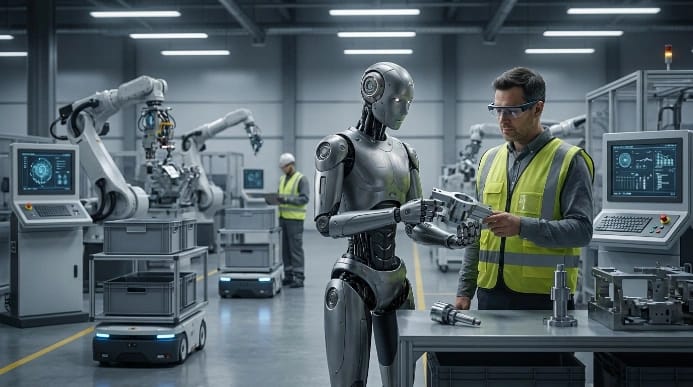
Physical AI Robots: Applications and Deployment Challenges
For most people, artificial intelligence still lives inside a screen.
You ask a chatbot a question. An AI model writes an email. A coding assistant creates software. An image generator turns words into pictures.
But AI is beginning to make a much bigger transition.
It is learning how to interact with the physical world.
Robots equipped with advanced artificial intelligence can increasingly see their surroundings, understand instructions, make decisions and perform tasks that once required carefully programmed movements.
This emerging field is often called physical AI.
And physical AI robots could become one of the most important technology shifts after generative AI.
The difference is fundamental.
Generative AI can tell you how to move a box.
Physical AI can potentially understand the box, locate it, determine how to grip it, avoid nearby people and actually move it.
That requires far more than a language model.
Robots must combine AI with cameras, sensors, motors, control systems, spatial understanding and real-time decision-making.
The technology is still developing, and many humanoid robots remain experimental.
But the industry is moving quickly.
The International Federation of Robotics says the global market value of industrial robot installations has reached a record $16.7 billion, while U.S. industrial robot installations increased 11% year over year to approximately 38,000 units in 2025.
At the same time, companies are beginning to move humanoid robots beyond demonstrations.
Schaeffler, for example, announced plans in April 2026 to deploy at least 1,000 Hexagon AEON humanoid robots across its global factory network over seven years following a pilot program.
These developments suggest the next stage of AI may not simply produce smarter software.
It could produce machines capable of doing useful physical work.
Here are seven changes driving the rise of physical AI robots—and what they could mean for businesses, workers and everyday life.
Key Takeaways
- Physical AI combines artificial intelligence with machines capable of sensing and acting in the real world.
- Industrial robot installations in the United States increased 11% in 2025, according to the International Federation of Robotics.
- AI is making robots more adaptable than conventional machines programmed for one repetitive task.
- Humanoid robots are attracting attention because they could operate in environments originally designed for humans.
- Real deployments are beginning, including plans for at least 1,000 humanoids across Schaeffler factories.
- Simulation and synthetic data are becoming important because robots need enormous amounts of training experience.
- Safety, reliability, cost and real-world usefulness remain bigger obstacles than impressive demonstrations suggest.
What Is Physical AI?
Traditional artificial intelligence primarily works with digital information.
It reads text.
It recognizes images.
It analyzes numbers.
It generates software.
Physical AI adds another requirement:
the AI must understand and interact with the real world.
Consider a robot working inside a warehouse.
It needs to identify objects, estimate distance, understand where people are standing, determine whether an obstacle is moving, choose a safe route and control its motors accurately.
And it needs to keep updating those decisions as the environment changes.
That is much harder than generating text.
The physical world is unpredictable.
Boxes can fall.
People can walk into the robot’s path.
Lighting changes.
Floors can become slippery.
Objects may be placed somewhere the robot has never seen before.
A useful physical AI system therefore needs several capabilities working together:
perception → reasoning → planning → movement → feedback.
This is why robotics has historically been difficult.
Traditional industrial robots are extremely effective when the environment is predictable.
A robotic arm can weld the same section of a car thousands of times with extraordinary precision.
But change the environment significantly, and the system may require reprogramming.
Physical AI aims to make machines more adaptable.
Instead of programming every possible movement, developers increasingly want robots that can understand a goal and determine how to accomplish it safely.
1. Robots Are Moving From Programming Toward Learning
This is perhaps the biggest change.
Traditional robots generally follow carefully defined instructions.
Move here.
Rotate this joint.
Pick up this component.
Place it there.
Repeat.
That works extremely well for structured manufacturing.
But it becomes difficult when tasks vary.
Physical AI introduces a different approach.
Robots can increasingly learn from:
- demonstrations,
- sensor data,
- simulations,
- video,
- reinforcement learning,
- human instructions.
The goal is not necessarily to eliminate conventional programming.
It is to give robots enough intelligence to adapt when the situation changes.
Imagine a warehouse containing boxes of different sizes.
A traditional automation system might need carefully engineered rules for each situation.
A more capable AI robot could identify a box, estimate how it should be lifted and adapt its grip.
That flexibility expands the number of environments where robots might become useful.
NVIDIA has been developing foundation models and simulation frameworks specifically for this purpose, working with robotics companies and industrial manufacturers on systems capable of perception, planning and action.
The same evolution already happened in software.
Developers once had to explicitly program many rules that machine-learning systems can now learn from data.
Robotics is beginning to experience a similar transition.
2. Humanoid Robots Could Solve an Infrastructure Problem
Why build robots that look like humans?
It might seem inefficient.
Wheels are often better than legs.
A specialized robotic arm can outperform a human arm at many factory tasks.
But humanoid robots have one enormous potential advantage:
our world was built for humans.
Factories have stairs.
Warehouses have shelves.
Doors have handles.
Tools are designed for human hands.
Workstations are positioned for human height.
Vehicles have controls intended for human operators.
A sufficiently capable humanoid robot could potentially operate in these environments without businesses rebuilding everything around the machine.
That is the economic argument.
Instead of redesigning the factory for robots, design robots capable of working in the existing factory.
We are beginning to see this concept move toward real deployments.
Hexagon and Schaeffler announced in April that Schaeffler intends to deploy at least 1,000 AEON humanoids across its global factory network by 2032, following a joint pilot. The companies say the robots are intended to increase flexibility and reduce dependence on manual tasks.
Hexagon and Schaeffler humanoid deployment announcement
This does not mean humanoid robots are suddenly ready for every workplace.
But it marks an important shift from:
“Look what this robot can do.”
toward:
“Can this robot perform useful work repeatedly enough to justify its cost?”
That second question will determine whether humanoids become a real industry.
3. AI Is Giving Industrial Robots More Flexibility
Humanoids receive the headlines, but conventional industrial robots may benefit from physical AI much sooner.
Factories already contain enormous numbers of robotic arms and automated systems.
Adding better perception and AI can make those machines more flexible.
For example, vision-enabled robots can potentially identify parts that are not positioned exactly the same way every time.
AI can help inspect manufactured products for defects.
Autonomous mobile robots can navigate warehouses.
Robots can assist with packaging, picking and material handling.
The International Federation of Robotics identified AI and autonomy among its major global robotics trends for 2026. It says the market value of industrial robot installations has reached an all-time high of $16.7 billion.
International Federation of Robotics — Top 5 Global Robotics Trends 2026
The United States also provides useful evidence that automation demand remains strong.
Industrial robot installations there increased 11% in 2025 to approximately 38,000 units, with particularly strong growth outside the traditional automotive sector.
That diversification matters.
Robotics is spreading beyond car factories.
Food production, logistics, electronics, pharmaceuticals and other industries can increasingly benefit from automation.
Physical AI could accelerate that expansion by making robots easier to adapt to different environments.
4. Simulation Is Becoming the Training Ground for Robots
There is a major problem with teaching robots.
Training them in the real world is expensive.
A software AI model can process enormous datasets relatively quickly.
A physical robot has to move.
Movements take time.
Hardware wears out.
Mistakes can break equipment.
Unsafe experiments can injure people.
Simulation offers another path.
Developers can create virtual environments where robots practice tasks before performing them physically.
A robot can attempt an action thousands or millions of times inside a simulated world without damaging a real machine.
Developers can change:
lighting,
object positions,
floor conditions,
obstacles,
camera angles,
and countless other variables.
This helps the system encounter situations it may eventually face outside the simulation.
NVIDIA’s physical AI tools increasingly combine simulation, synthetic data generation, reinforcement learning and model evaluation. Its 2026 Physical AI Data Factory Blueprint is designed to automate large-scale generation and evaluation of training data for robotics, autonomous vehicles and vision AI systems.
NVIDIA Physical AI Data Factory Blueprint
This connects physical AI directly with the rise of AI factories.
The same enormous computing infrastructure being built for language models can increasingly train systems designed to operate machines in the physical world.
In other words:
robots may learn much of their real-world behavior inside virtual worlds.
5. Safety Is Becoming One of the Most Important Robotics Technologies
A chatbot can generate a bad answer.
A robot can physically hit something.
That difference makes safety fundamental.
The more autonomous a robot becomes, the more situations it needs to handle correctly.
Consider a robot carrying materials through a factory.
What happens if a worker unexpectedly walks in front of it?
What happens if one sensor fails?
What happens if an object slips from its grip?
What happens if the AI misunderstands an instruction?
Physical AI cannot simply be intelligent.
It must be predictably safe.
This is why robotics companies are developing safety systems alongside more capable AI.
In June 2026, NVIDIA announced Halos for Robotics, a full-stack safety architecture covering AI compute, sensor connectivity, software and system evaluation. Agility Robotics was announced as the first humanoid robotics company working to incorporate elements of the architecture into its own safety system.
NVIDIA Halos for Robotics safety system
This part of the robotics revolution may receive less attention than robots running or performing impressive demonstrations.
But commercially, it may be more important.
Businesses will not deploy autonomous machines around employees simply because they look impressive.
They need to know:
Can the machine stop safely?
Can its behavior be audited?
What happens when hardware fails?
How are unusual situations handled?
Who is responsible when something goes wrong?
Solving those questions is essential before physical AI can operate widely around humans.
6. Physical AI Could Help Solve Labor Shortages—But Change Jobs Too
Robotics is often discussed entirely through the question:
Will robots take jobs?
The reality is more complicated.
Many industries are already struggling to fill certain positions.
Warehouses need workers.
Manufacturers need skilled operators.
Agriculture faces seasonal labor shortages.
Some countries have aging populations and shrinking working-age populations.
Robots could help businesses maintain production where labor is genuinely difficult to find.
The International Federation of Robotics identifies labor shortages as one of the forces supporting robotics adoption, alongside reshoring and demand for greater production resilience.
But automation will also change jobs.
Some repetitive physical tasks may require fewer workers.
At the same time, demand could increase for:
- robotics technicians,
- maintenance specialists,
- automation engineers,
- safety professionals,
- AI trainers,
- system integrators,
- data specialists.
This follows a pattern already visible in digital AI.
Our analysis of why AI is creating new jobs instead of simply replacing everyone explains why automation often changes the composition of work before it eliminates work entirely.
Physical AI could create the same dynamic on factory floors and inside warehouses.
The challenge is transition.
A new robotics job may require different skills from the manual position that automation changes.
Governments and businesses therefore need training programs alongside robotics investment.
7. The Biggest Test Is Economics, Not Intelligence
Robotics demonstrations can be spectacular.
A humanoid can run.
Another can dance.
A robotic hand can manipulate delicate objects.
Those achievements demonstrate technological progress.
But they do not answer the most important commercial question:
Does the robot save enough money or create enough value to justify buying it?
Businesses care about return on investment.
Suppose a humanoid robot costs significantly more than existing automation, requires frequent maintenance and can only perform useful work for a few hours before needing attention.
Its intelligence may be impressive.
Its economics may not be.
For physical AI robots to scale, companies need progress across several dimensions:
hardware cost must fall.
reliability must rise.
robots must work longer.
maintenance must become easier.
training must require less engineering.
safety must be proven.
And most importantly:
robots must perform valuable tasks consistently.
This is why factory deployments such as the Schaeffler-Hexagon project deserve attention.
Real commercial environments reveal problems that carefully controlled demonstrations can hide.
The robotics industry is approaching the point where deployment data will matter more than viral videos.
Why 2026 Could Be a Turning Point for Robotics
Several technologies are improving simultaneously.
AI models are becoming better at reasoning.
Computer vision is improving.
Simulation is becoming more realistic.
Robotics foundation models are emerging.
Sensors are improving.
Computing hardware is becoming more capable.
Manufacturers are investing in automation.
And enormous amounts of capital are flowing into AI.
This convergence makes 2026 different from previous robotics hype cycles.
The underlying industrial robotics market already exists.
The International Federation of Robotics reports record market value for industrial robot installations.
What physical AI adds is the possibility of making robots more general and adaptable.
That’s why the trend fits naturally alongside the broader global race for AI leadership.
Countries are no longer competing only over language models and data centers.
Robotics connects AI directly with manufacturing capacity.
That gives physical AI economic and geopolitical importance.
China Could Become a Major Physical AI Power
China deserves particular attention.
It already has enormous manufacturing capacity and is the world’s largest market for industrial robots.
Now AI-powered robotics is becoming part of its national technology strategy.
The International Federation of Robotics reported in May that China’s 15th Five-Year Plan for 2026–2030 places AI-powered robots at the core of the country’s industrial modernization strategy.
Meanwhile, Chinese humanoid robot manufacturer Unitree has become one of the most closely watched companies in the industry. As of July 2026, Reuters reports that the company had delivered around 18,000 bipedal humanoid robots across its product lines.
This matters because China has something particularly useful for physical AI:
manufacturing scale.
Building advanced robots requires motors, batteries, sensors, electronics, actuators, precision components and supply chains.
Countries that already manufacture these components efficiently may have an advantage as robotics production increases.
The AI race could therefore begin merging with the manufacturing race.
Physical AI Is Much Bigger Than Humanoid Robots
It would be a mistake to treat physical AI as synonymous with humanoids.
AI can enter many types of machines.
Warehouse robots
Autonomous machines can transport goods and assist with inventory management.
Industrial robotic arms
AI vision can help robots work with more varied objects.
Agricultural robots
Machines can identify crops, monitor fields and automate repetitive agricultural tasks.
Autonomous vehicles
Cars and delivery vehicles must perceive and react to complicated environments.
Drones
AI can help drones navigate, inspect infrastructure and perform specialized tasks.
Medical robots
AI could improve assistance, imaging and precision in specialized medical systems.
Construction machines
Autonomous or semi-autonomous equipment could assist in dangerous or repetitive construction work.
Humanoids receive attention because they resemble us.
But specialized physical AI systems may often make more economic sense.
A warehouse robot doesn’t need legs if wheels work better.
A farming robot doesn’t need a human-shaped body if a specialized design performs the job more efficiently.
The future of physical AI will likely involve many different forms of intelligent machines.
What Could Slow the Physical AI Revolution?
The technology still faces major barriers.
Reliability
Robots need to work consistently for long periods, not only during demonstrations.
Battery life
Mobile robots need enough energy to perform useful work without constant charging.
Dexterity
Human hands remain extraordinarily difficult to replicate.
Safety
Machines working around people need strong safeguards.
Cost
Robots need to provide a convincing financial return.
Training data
Real-world robotic data is much harder to collect than internet text.
Regulation
Governments may introduce new rules for autonomous machines.
Public acceptance
People may be uncomfortable working alongside humanoid machines.
These challenges mean predictions of millions of humanoid robots arriving immediately should be treated cautiously.
Physical AI is promising.
It is not solved.
What Businesses Should Watch
Companies considering robotics should focus less on hype and more on measurable results.
Ask:
Can this system perform a real task?
How often does it fail?
How much human supervision does it need?
What does maintenance cost?
How long can it operate?
Is it safe around workers?
How quickly does the investment pay back?
Businesses should also consider whether an existing automation system can solve the problem more cheaply.
A humanoid robot is not automatically better because it looks more advanced.
The best automation is the one that solves the business problem reliably.
That principle will become increasingly important as investment flows into robotics.
FAQs
What are physical AI robots?
Physical AI robots combine artificial intelligence with sensors, computing and mechanical systems so machines can perceive their environment, make decisions and perform actions in the physical world.
How is physical AI different from generative AI?
Generative AI primarily creates or analyzes digital information. Physical AI uses intelligence to control machines that interact with real environments.
Are humanoid robots being used in factories?
Early deployments and pilots are underway. Schaeffler plans to deploy at least 1,000 Hexagon AEON humanoid robots across its global factory network over seven years following an earlier pilot.
Is robotics growing in 2026?
Yes. The International Federation of Robotics reports record global industrial-robot market value, while U.S. industrial robot installations increased 11% in 2025.
Will physical AI robots replace workers?
Some tasks are likely to become automated, particularly repetitive or physically demanding work. However, robotics can also create demand for maintenance, engineering, safety and automation roles.
Why do humanoid robots have human-shaped bodies?
Human environments are designed around human bodies. Humanoid robots may therefore be able to use existing stairs, tools, doors and workstations without requiring facilities to be completely redesigned.
What is the biggest obstacle to humanoid robots?
Commercial reliability is arguably the biggest challenge. Robots must perform useful tasks consistently, safely and cheaply enough to justify their cost.
The Light Span Perspective
The first wave of generative AI taught machines how to work with our information.
Physical AI is attempting something more difficult.
It is teaching machines how to work with our world.
That distinction could make robotics one of the most important technology stories of the next decade.
But this industry needs to be judged differently from software AI.
A chatbot can be released to millions of users and improved rapidly.
A robot exists in physical space.
It has weight.
It uses electricity.
Its components wear out.
And its mistakes can damage objects or injure people.
That makes reliability and safety just as important as intelligence.
The most important robotics breakthrough may therefore not be a humanoid performing an impressive backflip.
It may be a robot quietly working eight hours inside a factory, completing useful tasks every day without requiring constant human intervention.
That’s the milestone that changes economics.
And signs of that transition are beginning to appear.
Industrial robot demand remains strong. AI is making machines more adaptable. Companies are starting larger humanoid deployments. Simulation is improving training. Safety systems are becoming more sophisticated.
None of this guarantees that humanoid robots will suddenly fill homes and workplaces.
But physical AI no longer looks like a distant science-fiction concept.
It is becoming an engineering and business problem.
And if companies solve that problem, the next AI revolution may not happen on our screens.
It may happen beside us.
Continue reading more

