


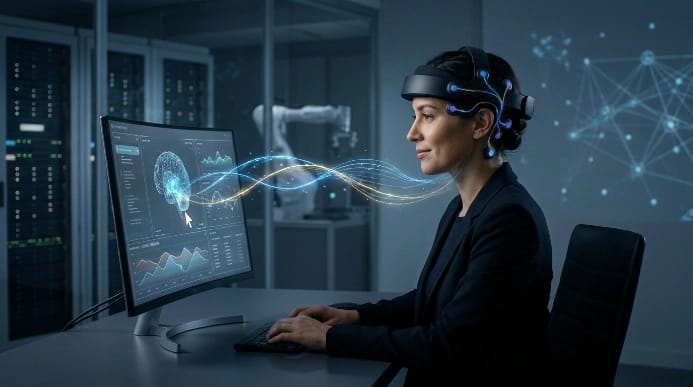
Brain Computer Interface Technology Could Change How Humans Use Computers
For decades, humans have communicated with computers through keyboards, mice, touchscreens and voice commands.
But what if we eventually didn’t need any of them?
What if a computer could respond directly to signals produced by the brain?
That is the promise behind the brain computer interface, a technology designed to create a direct communication pathway between brain activity and an external computer or machine.
The idea sounds like science fiction, but research has already moved beyond the purely theoretical stage.
In 2026, brain-computer interfaces are being investigated for medical applications, communication, rehabilitation and other forms of human-machine interaction. A 2026 clinical review describes BCIs as moving toward clinical integration while still facing important limitations involving evidence, technology and implementation.
The technology is also becoming part of national technology strategies. South Korea announced in August 2026 that it aims to commercialize brain-computer-interface products by 2035 as part of its “Seven Major SEED” initiative.
That raises an important question:
Could the brain become the next major interface between humans and computers?
What Is a Brain Computer Interface?
A brain computer interface is a system that connects brain activity with an external device.
The basic idea is relatively simple.
Your brain produces electrical activity when neurons communicate.
A BCI attempts to capture some of those signals, interpret them and translate them into commands that a computer or another device can understand.
The process can look something like this:
Brain activity → Sensors → Signal processing → AI/software → Computer action
For example, a person might imagine moving a cursor.
The BCI detects patterns associated with that intention.
Software interprets the signal.
The cursor moves.
The user doesn’t necessarily need to physically move their hand.
This could be especially valuable for people who have lost the ability to control conventional computer interfaces because of paralysis or other neurological conditions.
How Does a Brain Computer Interface Work?
There isn’t one universal type of BCI.
Some systems use sensors placed outside the skull.
Others use devices positioned closer to the brain.
Implanted systems can potentially capture more detailed neural signals, but they also involve substantially greater medical and engineering challenges.
The general process remains similar.
1. Capture
Sensors detect neural activity.
2. Process
The system removes noise and converts the signals into usable information.
3. Decode
Software attempts to identify what the user is trying to do.
4. Translate
The decoded intention becomes a computer command.
5. Feedback
The user receives some form of feedback and adjusts their behavior.
Artificial intelligence can play an increasingly important role in this process because neural signals are complex and can vary between people.
Research into BCI systems is increasingly combining neuroscience with machine learning and other computational techniques.
Can a Brain Computer Interface Actually Read Your Thoughts?
This is where science fiction often creates unrealistic expectations.
A brain computer interface isn’t a magic mind reader.
Current systems generally work by detecting specific neural patterns associated with particular tasks or intentions.
For example, a BCI might be trained to distinguish between patterns associated with imagined movements.
That is very different from opening someone’s mind and reading every private thought.
The technology is still limited.
Different people can produce different neural signals.
Signals can be noisy.
Hardware can move.
Brain activity can change over time.
And the system needs training to interpret what a particular user’s signals mean.
So the more accurate description is:
BCIs can decode certain measurable patterns of brain activity—not simply read everything a person is thinking.
That distinction is extremely important as the technology becomes more widely discussed.
The Biggest Opportunity May Be Healthcare
The strongest near-term case for a brain computer interface is not replacing smartphones.
It is helping people who have lost important physical abilities.
Researchers are investigating BCIs for people with paralysis and other neurological impairments, including systems that can help users interact with computers or other assistive technologies. The FDA has specific guidance for implanted BCIs intended for patients with paralysis or amputation.
Imagine someone who cannot move their hands.
A conventional keyboard may be impossible to use.
A voice assistant may not always work either.
A BCI could potentially allow the person to control a digital interface through neural signals.
That could provide a new pathway for communication and independence.
Recent research reviews also describe BCIs as promising tools for restoring neurological functions lost through injury or degeneration, although significant limitations remain.
BCIs Could Change How We Use Computers
The traditional computer interface has changed several times.
First came mechanical controls.
Then keyboards.
Then mice.
Then touchscreens.
Then voice assistants.
A brain computer interface represents a completely different direction.
Instead of telling a computer what to do through a physical action, the user could potentially communicate an intention directly.
That could make certain interactions much faster.
Consider a future workplace where a user can:
- Select an object
- Move a cursor
- Navigate a menu
- Control a robotic system
- Communicate basic commands
without physically touching a device.
But this doesn’t mean keyboards and phones will disappear.
For many tasks, physical interfaces are extremely efficient.
The BCI may instead become another interface that works alongside existing technology.
Artificial Intelligence Could Make BCIs More Powerful
AI could become one of the most important technologies behind the future of the brain computer interface.
Neural signals are complicated.
A person’s brain activity doesn’t always produce identical patterns.
AI models can potentially learn relationships between neural activity and intended actions.
This could allow systems to become more personalized over time.
AI may also help compensate for noisy signals and improve decoding.
Researchers are even exploring synthetic data generation because BCI development faces limited and privacy-sensitive neural recordings. A 2026 research survey examines approaches for generating synthetic but physiologically plausible brain signals to support BCI development.
This creates an interesting connection between two major technology trends:
AI learns from the brain.
And eventually:
AI could help humans communicate with machines through the brain.
Could BCIs Control Robots?
This is where BCIs could eventually connect with another emerging technology: physical AI.
Imagine someone wearing a BCI system and controlling an intelligent robot.
The human provides the intention.
AI interprets it.
The robot performs the physical action.
The combination could be particularly useful in environments that are dangerous or difficult for humans.
For example, a person could potentially direct a robotic system to perform tasks in:
- Disaster zones
- Industrial facilities
- Hazardous environments
- Remote locations
- Space exploration
This doesn’t mean today’s BCIs can seamlessly control general-purpose humanoid robots.
They cannot.
But the combination of neural interfaces, AI and robotics is an important area to watch.
Gaming Could Become Another Major Application
Gaming companies have spent decades trying to make digital interaction more immersive.
BCIs could eventually introduce a new control mechanism.
Instead of pressing buttons, players could potentially interact with games using neural signals.
However, the most realistic early applications are likely to involve relatively simple commands rather than complete thought-driven virtual worlds.
BCIs also face major challenges involving accuracy, comfort and user training.
So while brain-controlled gaming is an exciting possibility, widespread consumer adoption remains uncertain.
The Technology Is Moving Toward the Real World
One reason the BCI industry deserves attention in 2026 is that development is increasingly moving toward clinical and commercial applications.
In April 2026, Rice University reported that a BCI based on its research received FDA approval for its first clinical trial.
Another important development came in June, when Paradromics announced the first surgical implantation of its Connexus BCI in a U.S. FDA-approved clinical study.
And in July 2026, Science Corp received European CE approval for its Prima bionic-eye system, a technology that combines a retinal implant with specialized glasses to provide limited visual perception for people with age-related macular degeneration.
These developments don’t mean BCIs are ready for everyday consumers.
They show something more important:
The technology is moving from laboratory research toward regulated clinical use.
South Korea Is Betting on Brain Computer Interfaces
South Korea’s latest technology roadmap provides another signal that governments see potential in the sector.
On August 12, 2026, the country announced its Seven Major SEED initiative.
Among its goals is the commercialization of brain-computer-interface products by 2035.
The initiative also includes quantum computing, advanced biotechnology, energy, space and critical materials.
The inclusion of BCIs alongside major strategic technologies is significant.
It suggests that governments are beginning to view neurotechnology as more than a niche research field.
South Korea’s goal is ambitious, but commercialization does not necessarily mean that ordinary consumers will have affordable brain implants by 2035.
The more likely path is gradual:
Research → Clinical applications → Specialized products → Broader commercial adoption
The Biggest Problem: Accuracy
The brain is incredibly complex.
A BCI has to extract useful information from signals that can be noisy and difficult to interpret.
That creates a major challenge.
If the system misunderstands the user’s intention, the resulting action could be wrong.
This may be annoying when controlling a computer cursor.
It becomes much more serious when the system controls a medical device or physical machine.
Researchers therefore need systems that are not only accurate but also reliable over long periods.
A 2026 review of BCI rehabilitation research highlights challenges including small study populations, differences between protocols and limited long-term evidence.
This is one reason widespread adoption will take time.
The Brain Privacy Problem
Perhaps the most important issue surrounding the brain computer interface isn’t technical.
It’s privacy.
Your brain is arguably one of the most personal sources of information imaginable.
A BCI could potentially generate neural data that reveals information about a person’s behavior, preferences or neurological state.
That raises difficult questions.
Who owns neural data?
Can companies store it?
Can it be sold?
Can employers request it?
Can governments access it?
What happens if it is stolen?
Researchers have warned that neural data presents unusual privacy concerns because it can be far more intimate than many conventional categories of personal information.
This means BCI development cannot focus solely on better hardware.
Privacy and security need to be designed into the technology from the beginning.
Could BCIs Be Hacked?
Any connected technology can potentially create cybersecurity risks.
A networked BCI could introduce an entirely new category of security concerns because the device may interact directly with neural information or, in some cases, therapeutic stimulation or physical control.
Researchers studying BCI cybersecurity have identified potential risks involving unauthorized access, data confidentiality, software modification and interference with device behavior.
That doesn’t mean hackers can currently take over people’s brains through the internet.
Such claims would be misleading.
But the security problem deserves serious attention before networked BCIs become widespread.
A future BCI should ideally have strong:
- Authentication
- Encryption
- Access controls
- Software security
- Update mechanisms
- Data minimization
The more powerful the interface becomes, the more important those protections will be.
Invasive vs. Non-Invasive BCIs
Another major question is whether users will actually want an implant.
There are two broad approaches.
Non-invasive
Sensors remain outside the skull.
Advantages:
- No brain surgery
- Easier deployment
- Potentially lower medical risk
Disadvantages:
- Signals can be weaker
- More interference
- Lower precision in some applications
Invasive
Sensors are implanted inside or close to the brain.
Advantages:
- Potentially stronger and more detailed signals
- Greater precision for certain applications
Disadvantages:
- Surgery is required
- Medical risks exist
- Long-term device performance matters
- Regulatory requirements are significant
The FDA already maintains specific guidance for implanted BCI devices intended for patients with paralysis or amputation.
This means the future will probably contain multiple types of BCIs, rather than one universal design.
When Will Brain Computer Interfaces Become Mainstream?
There is no reliable date.
Medical applications are likely to develop much sooner than mass-market consumer applications.
That is because medical devices can provide significant benefits even when they are expensive and specialized.
A person who regains the ability to communicate or interact with a computer may consider the technology worthwhile even if it isn’t cheap.
A healthy consumer is likely to demand much more.
They may ask:
Why should I have a brain implant if my phone already works perfectly?
That is a much harder commercial proposition.
For consumer BCIs to succeed, they would likely need to be:
- Safe
- Comfortable
- Affordable
- Reliable
- Easy to use
- Privacy-protecting
- Clearly better than existing interfaces
That’s a high bar.
What Could BCIs Look Like by 2035?
By 2035, the most realistic scenario is not everyone walking around with brain implants.
Instead, we could see a growing ecosystem of specialized systems.
Hospitals could use advanced BCIs for neurological rehabilitation.
People with severe disabilities could use neural interfaces to communicate and control assistive technology.
Specialized workers could use non-invasive interfaces for certain tasks.
Robotic systems could incorporate neural commands in carefully controlled environments.
And researchers could continue improving the technology.
South Korea’s 2035 commercialization target demonstrates that governments are already thinking on roughly this timeline.
The consumer revolution, if it happens, may come later.
The Light Span Perspective
The most important thing about the brain computer interface isn’t whether humans will soon control everything with their thoughts.
We won’t.
At least, there is no evidence to suggest that is about to happen.
The real story is more interesting.
For the first time, technology is developing a pathway that could allow the brain to communicate directly with computers.
That could change the lives of people with severe disabilities long before it changes the lives of healthy consumers.
It could help restore communication.
It could assist rehabilitation.
It could control specialized devices.
And eventually, it could create completely new ways for humans to interact with AI and robots.
But there is another side to the story.
The closer technology gets to the brain, the more important privacy, cybersecurity, consent and safety become.
Neural data isn’t just another category of information.
It is deeply personal.
That means the future of the brain computer interface should not be measured only by how quickly developers can make these systems work.
It should also be measured by whether society can build them responsibly.
The keyboard changed computing.
The touchscreen changed it again.
The next major interface could be much closer to us.
It could begin with the brain itself.
FAQs
What is a brain computer interface?
A brain computer interface is a system that creates a communication pathway between brain activity and an external computer, machine or device.
How does a brain computer interface work?
A BCI detects neural signals using sensors, processes the signals and uses software or AI to interpret them as commands.
Can a brain computer interface read thoughts?
Not in the science-fiction sense. Current systems generally decode specific patterns of brain activity associated with trained tasks or intentions rather than reading every private thought.
Are brain computer interfaces available today?
Some BCI technologies are already being studied or used in clinical settings, but most advanced implanted systems remain specialized medical technologies rather than mainstream consumer products. The FDA has established guidance for implanted BCI devices intended for patients with paralysis or amputation.
Can BCIs help people with paralysis?
Yes. Restoring communication and computer control for people with paralysis is one of the most important areas of BCI research and clinical development.
Are brain computer interfaces safe?
Safety depends heavily on the type of system. Non-invasive systems avoid surgical risks, while implanted BCIs introduce medical and long-term device considerations. Regulatory testing is therefore an important part of development.
Could a BCI be hacked?
Connected BCIs could introduce cybersecurity risks involving neural data, software and device controls. Researchers have already identified security issues that developers and regulators will need to address.
When will brain computer interfaces become mainstream?
There is no reliable timeline. Medical applications are likely to expand before BCIs become common consumer devices.
What is the future of brain computer interfaces?
The technology could eventually connect humans with computers, AI, assistive devices and robots more directly. However, accuracy, cost, safety, privacy and regulation will determine how quickly adoption occurs.
Continue reading more

