


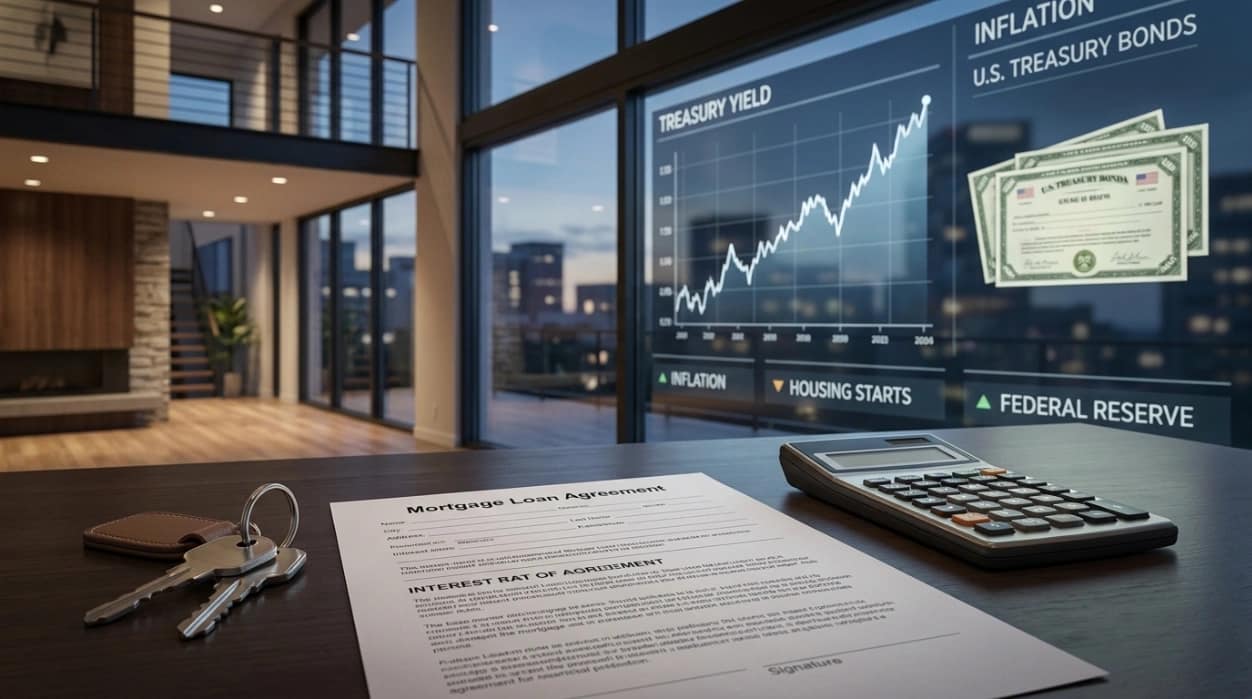
Mortgage Rates Are Still High: Why Borrowing Money Could Stay Expensive
For millions of Americans hoping to buy a home, one question matters more than almost anything else:
When will mortgage rates finally come down?
The answer has become surprisingly complicated.
The latest Freddie Mac data shows the average U.S. 30-year fixed mortgage rate at 6.67% as of August 13, 2026, down slightly from 6.69% the previous week. The 15-year fixed rate also fell to 5.96%.
That is lower than some of the recent peaks, but it is still a long way from the ultra-low rates many homeowners remember from the early 2020s.
At the same time, inflation has shown some signs of cooling. That would normally sound like good news for borrowers.
So why aren’t mortgage rates falling faster?
The answer lies in something many home buyers overlook: mortgage rates are driven by much more than the Federal Reserve’s policy rate.
Long-term Treasury yields, inflation expectations, government borrowing and investor demand all play an important role.
And right now, those forces are keeping borrowing costs elevated.
What Are Mortgage Rates Right Now?
As of August 13, Freddie Mac’s national average for a 30-year fixed mortgage was 6.67%, while the 15-year average was 5.96%. A year earlier, the comparable rates were 6.58% and 5.71%, respectively.
These numbers are useful as a market benchmark, but they are not guaranteed rates for every borrower.
The actual rate offered by a lender depends on factors such as:
- Credit score
- Down payment
- Loan type
- Property type
- Debt-to-income ratio
- Loan size
- Lender
- Market conditions
That means two people shopping for the same house can receive different offers.
Still, the national average gives us a clear picture of the broader direction.
And right now, mortgage rates remain relatively high.
Why Haven’t Mortgage Rates Fallen More?
This is where the situation gets interesting.
Many people assume that when the Federal Reserve cuts interest rates, mortgage rates immediately fall.
That’s not how it works.
The Federal Reserve directly controls the federal funds rate, which is a very short-term interest rate.
A 30-year mortgage, however, is a long-term loan.
Its pricing is heavily influenced by the bond market, especially longer-term Treasury yields.
The Federal Reserve itself has noted that higher long-term Treasury yields increase the current cost of long-term credit for households and businesses.
That’s why mortgage rates can remain elevated even when expectations for future Fed policy become more favorable.
The Hidden Role of Treasury Yields
If you want to understand mortgage rates, you need to understand Treasury bonds.
A simplified version looks like this:
Investors buy Treasury bonds
↓
Treasury yields change
↓
Long-term borrowing costs change
↓
Mortgage rates respond
Mortgage rates don’t simply equal the 10-year Treasury yield plus a fixed amount, but the two markets are closely connected.
When long-term Treasury yields rise, mortgage rates often face upward pressure.
And that’s exactly what has been happening.
Reuters reported on August 14 that the U.S. Treasury’s 30-year bond auction produced the highest borrowing cost in decades, reflecting continued investor concerns around inflation and fiscal conditions.
That is one reason the housing market hasn’t received the relief that some borrowers expected.
Why Are Long-Term Yields So High?
Several forces are working together.
Persistent inflation
Inflation has cooled from earlier peaks, but it remains above the Federal Reserve’s long-term 2% target.
That means investors still have to consider the possibility that prices will remain elevated.
Higher inflation expectations can push long-term yields higher.
Government borrowing
The U.S. government needs to issue large quantities of debt to finance spending and deficits.
When investors demand higher returns for holding long-term debt, Treasury yields rise.
Economic uncertainty
Investors also consider future economic growth, energy prices, geopolitical risks and Federal Reserve policy.
All of these can influence bond yields.
Investor demand
Treasury yields are ultimately determined by market conditions.
If investors demand more compensation for holding long-term bonds, yields can rise even when the Fed is not raising its policy rate.
That is why predicting mortgage rates is more complicated than simply predicting the next Fed decision.
What Is the Federal Reserve Doing?
The Federal Reserve held its federal funds target range at 3.5% to 3.75% on July 29, 2026.
The decision matters because expectations about future Fed policy can influence bond markets.
But there is another important complication.
The market is not convinced that the next move must be a rate cut.
Recent inflation data has been encouraging, but long-term yields remain elevated. Reuters reported that markets were still pricing uncertainty around the Federal Reserve’s next moves as investors weighed softer inflation against persistent concerns about prices and government borrowing.
That uncertainty makes it harder for mortgage rates to fall sharply.
Could Mortgage Rates Fall Soon?
Yes—but nobody can reliably predict exactly when or how far.
There are several possible paths.
Scenario 1: Rates gradually decline
If inflation continues cooling, economic growth slows and long-term Treasury yields fall, mortgage rates could gradually move lower.
This would be the most favorable scenario for prospective buyers.
Scenario 2: Rates remain around current levels
Inflation could continue improving without falling quickly enough to push long-term yields dramatically lower.
In that case, mortgage rates could remain around the mid-6% range for an extended period.
Scenario 3: Rates rise again
A renewed inflation shock, higher energy prices or another increase in Treasury yields could push mortgage rates higher.
Recent market volatility demonstrates that this possibility cannot be ignored.
The important lesson is that waiting for a dramatic rate collapse is not guaranteed to work.
What High Mortgage Rates Mean for Home Buyers
The biggest impact is simple:
Higher monthly payments.
Consider a hypothetical $350,000 30-year mortgage.
A relatively small difference in the interest rate can add up to tens of thousands of dollars in additional interest over the life of the loan. Market analysis similarly shows how even fractions of a percentage point can materially change total borrowing costs.
This affects affordability in two ways.
First, buyers may qualify for smaller loans.
Second, buyers may decide they cannot comfortably afford the monthly payment on the house they originally wanted.
That can push people toward:
- Smaller homes
- Cheaper locations
- Larger down payments
- Longer saving periods
- Delaying the purchase
This is why mortgage rates can have such a powerful effect on the housing market even when home prices themselves aren’t moving dramatically.
Why Existing Homeowners Are Staying Put
High mortgage rates create an unusual problem for the housing market.
Millions of homeowners locked in much lower rates in previous years.
If someone has a mortgage below 4%, moving into a new home with a mortgage closer to 7% can be financially painful.
That creates a powerful incentive to stay in the current home.
The result can be fewer homes coming onto the market.
This is sometimes called the lock-in effect.
It creates a strange situation:
High mortgage rates reduce buyer affordability
while simultaneously
discouraging existing homeowners from selling.
That can reduce transaction activity even if there are people on both sides of the market who would otherwise like to move.
Could High Mortgage Rates Hurt Home Sales?
Yes.
When financing becomes more expensive, some buyers leave the market.
That can reduce demand.
But the effect on home prices is not always straightforward.
If fewer people want to buy, prices could face downward pressure.
However, if existing homeowners refuse to sell because they don’t want to give up their low-rate mortgages, housing supply can also remain tight.
That means prices may not fall as much as buyers expect.
The result can be a market where:
Homes remain expensive + financing remains expensive = affordability remains difficult.
That’s one of the biggest challenges facing prospective buyers.
What About First-Time Buyers?
First-time buyers are particularly exposed.
They usually don’t have an existing home to sell and therefore don’t benefit from transferring a low mortgage rate to a new property.
They also have less accumulated home equity.
That means they may need to save longer for a down payment while simultaneously dealing with higher monthly financing costs.
For these buyers, the question isn’t simply:
“Will mortgage rates fall?”
It is:
“Can I comfortably afford this home at today’s rate?”
That’s a much healthier way to approach the decision.
What High Mortgage Rates Mean for Renters
The housing market doesn’t end with homeowners.
High mortgage rates can also influence renters.
If people who would normally buy homes remain renters for longer, rental demand can stay stronger.
At the same time, developers may face higher financing costs when constructing new housing.
That can make it harder to increase housing supply quickly.
The effects vary widely by city and region, but the basic connection is important:
Mortgage rates can influence the rental market even when renters never take out a mortgage themselves.
Should You Wait for Lower Mortgage Rates?
This is one of the most common questions buyers ask.
There isn’t a universal answer.
If buying today would leave you financially stretched, waiting may be sensible.
But trying to perfectly time the housing market is extremely difficult.
A buyer who waits for lower rates could discover that:
- Rates fall but home prices rise
- Rates stay high
- Rates rise further
- More competition returns when rates fall
The better approach is to focus on affordability and financial stability, rather than trying to predict the exact bottom in rates.
And if rates eventually fall substantially, refinancing may become an option for eligible homeowners.
That isn’t guaranteed, of course, and refinancing involves its own costs.
What Should Potential Buyers Do Now?
If you’re seriously considering buying a home while mortgage rates remain elevated, focus on the things you can control.
Compare multiple lenders
Don’t automatically accept the first rate you receive.
Different lenders can offer different rates, fees and loan terms.
Look at the total cost
A lower advertised rate isn’t necessarily the cheapest loan if it comes with significant fees or points.
Compare the annual percentage rate and total borrowing costs.
Don’t stretch your budget
A bank approving a loan doesn’t necessarily mean the payment is comfortable for your household.
Leave room for:
- Property taxes
- Insurance
- Maintenance
- Utilities
- Emergency expenses
Consider the full housing cost
Your mortgage payment is only one part of homeownership.
Don’t assume rates will fall
Build your budget around a payment you can realistically handle today.
If rates fall later, that’s a potential bonus—not something your purchase should depend on.
What Happens Next?
The next major question for mortgage rates is whether long-term bond yields begin moving lower.
If inflation continues cooling and investors become more comfortable with the economic outlook, borrowing costs could gradually decline.
But if inflation remains stubborn or investors demand higher returns on long-term government debt, mortgage rates could remain elevated.
The latest data illustrates that uncertainty.
Freddie Mac’s 30-year average fell slightly to 6.67% on August 13, but it remains above the 6.58% level recorded a year earlier.
That isn’t a dramatic change—but it tells us something important.
The housing market may have to operate in a higher-for-longer borrowing environment even if rates don’t return to their recent highs.
The Bigger Economic Picture
Mortgage rates are more than a housing story.
They affect consumer behavior throughout the economy.
When borrowing becomes expensive, households may have less money available for:
- Cars
- Furniture
- Renovations
- Travel
- Other major purchases
Businesses can also face higher financing costs.
The Federal Reserve has noted that higher long-term rates increase borrowing costs for households and businesses more broadly.
This means the housing market can become an important transmission channel between financial markets and the real economy.
That’s why economists pay so much attention to long-term yields and mortgage rates.
The Light Span Perspective
The biggest mistake when thinking about mortgage rates is assuming that the Federal Reserve controls them directly.
It doesn’t.
The Fed has enormous influence over financial conditions, but a 30-year mortgage is ultimately connected to a much broader market.
Treasury yields, inflation expectations, government borrowing, economic growth and investor demand all matter.
Right now, those forces are keeping borrowing costs relatively high.
The good news is that rates have shown some signs of easing from recent levels. The bad news is that there is no guarantee that the decline will continue.
For potential buyers, that means the smartest strategy isn’t necessarily waiting for a magical rate below a certain number.
It’s understanding what you can actually afford.
If you can comfortably buy a home at today’s rate, you don’t necessarily need to predict the future.
If the payment would put your finances under serious pressure, waiting may be more sensible.
Ultimately, the most important question isn’t:
“When will mortgage rates fall?”
It’s:
“Can I afford this home without depending on rates falling later?”
That distinction could save buyers far more money than trying to predict the next move in the market.
FAQs
Why are mortgage rates still high in 2026?
Mortgage rates remain elevated because long-term borrowing costs are influenced by Treasury yields, inflation expectations, government borrowing and financial-market conditions—not simply the Federal Reserve’s policy rate.
What is the current 30-year mortgage rate?
Freddie Mac reported an average 30-year fixed mortgage rate of 6.67% for the week ending August 13, 2026. Individual borrowers may receive different rates depending on their financial circumstances and lender.
Will mortgage rates go down in 2026?
They could, but the timing and size of any decline are uncertain. Continued improvement in inflation and lower Treasury yields could help, while renewed inflation or higher long-term yields could keep rates elevated.
Does the Federal Reserve control mortgage rates?
Not directly. The Federal Reserve controls the federal funds rate, while long-term mortgage rates are heavily influenced by the bond market and other economic factors.
Should I wait for lower mortgage rates before buying a house?
There is no universal answer. Buyers should focus on whether they can comfortably afford the home at today’s rate rather than assuming rates will definitely fall.
Why do Treasury yields affect mortgage rates?
Mortgage rates are closely connected to long-term bond-market conditions. When Treasury yields rise, lenders generally face greater pressure to charge higher rates on long-term mortgages.
Can mortgage rates rise again?
Yes. Higher inflation expectations, rising energy prices, stronger-than-expected economic conditions or higher Treasury yields could put upward pressure on mortgage rates.
Continue reading more
https://www.federalreserve.gov/econres/notes/feds-notes/2026-index.htm

