


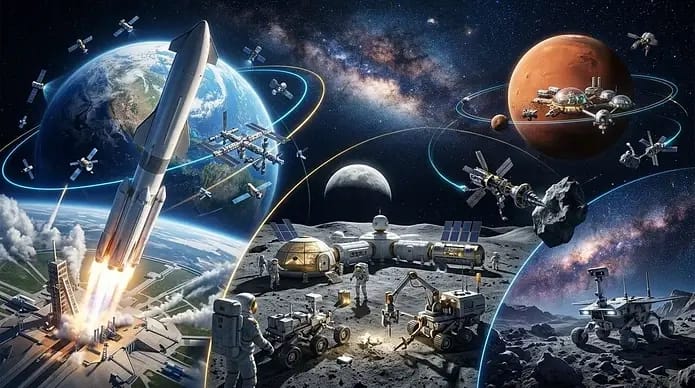
Space Technologies 2030: New Directions in Exploration
For most of human history, space was unreachable.
Then rockets made it possible to send machines beyond Earth. Humans followed. Satellites transformed communications, navigation and weather forecasting.
Now space exploration is entering another transition.
The next era may be defined less by simply reaching space and more by learning how to operate there routinely.
Rockets are becoming increasingly reusable. Robots are becoming more autonomous. Private companies are expanding satellite networks. Governments are developing technology for longer stays on the Moon, while commercial stations are being planned for low Earth orbit.
NASA’s current technology strategy reflects this shift. In 2026, the agency identified priorities including lunar infrastructure, surface mobility, advanced onboard computing, power systems and technologies capable of surviving extended operations on the Moon.
NASA also selected 41 industry proposals in June to advance technologies involving space transportation, lunar infrastructure and planetary surface operations.
This makes the years leading to 2030 particularly important.
Not every futuristic space concept will become reality by then. Mars cities and asteroid-mining empires remain much further away.
But several space technologies 2030 could bring much closer are already progressing from concepts toward practical systems.
Here are ten worth watching.
1. Reusable Rockets Could Make Access to Space More Routine
The economics of space exploration begin with one problem:
Getting there is expensive.
Traditional rockets historically discarded large portions of extremely expensive hardware after a single mission.
Reusability changes that equation.
If important rocket components can fly repeatedly, launch costs can potentially decline while launch frequency increases.
This has already changed the commercial launch industry.
The next stage is deeper reusability.
Future launch systems are being designed around recovering more hardware, reducing refurbishment requirements and increasing flight frequency.
The economic impact could extend far beyond rocket companies.
Cheaper launches can make it more practical to deploy:
satellites,
scientific instruments,
space-station equipment,
lunar cargo,
communications infrastructure,
and commercial experiments.
This creates a powerful feedback loop.
Lower launch costs encourage more missions.
More missions increase demand.
Greater demand encourages investment in additional infrastructure.
By 2030, the most important measure may therefore not be which rocket can carry the heaviest payload.
It could be how routinely and economically launch systems can operate.
Space starts becoming an economy when transportation becomes dependable enough for businesses to plan around it.
2. Lunar Infrastructure Could Turn Moon Visits Into Long-Term Operations
Apollo proved humans could reach the Moon.
The next challenge is staying there.
That requires completely different technology.
Astronauts need power.
Communications.
Mobility.
Habitats.
Thermal management.
Cargo delivery.
Protection from lunar dust.
And systems capable of surviving long periods without constant intervention from Earth.
NASA’s Lunar Surface Innovation Initiative is developing technologies in areas including power and thermal management, autonomous robotics, excavation, construction and dust mitigation.
These technologies may sound less dramatic than a rocket launch, but they are essential for sustained exploration.
The Moon’s environment is difficult.
Temperatures vary enormously.
Lunar dust is abrasive.
Some regions experience long periods without sunlight.
Transporting every kilogram of equipment from Earth is expensive.
That means future lunar missions will increasingly need infrastructure designed specifically for operating locally.
NASA’s current plans explicitly target an enduring U.S. presence on the Moon by 2030, with lunar operations also serving as a testing ground for technologies required for future Mars missions.
If that transition succeeds, the Moon could change from somewhere humans occasionally visit into somewhere humans increasingly operate.
3. Space Nuclear Power Could Solve a Critical Energy Problem
Everything in space requires energy.
Communications equipment needs electricity.
Habitats need electricity.
Scientific instruments need electricity.
Robots need electricity.
Future manufacturing and resource-processing equipment will require even more.
Solar power works extremely well in many environments, but it has limitations.
On the Moon, long periods of darkness can make continuous solar generation difficult in some locations.
Nuclear systems offer another possibility.
They can potentially provide reliable electricity regardless of sunlight.
NASA’s current strategy includes establishing a dedicated Space Reactor Office and developing nuclear power systems that could support a lunar surface station and eventually more ambitious missions.
That makes nuclear power one of the less visible but potentially most important space technologies 2030 may advance.
A permanent lunar outpost cannot depend on occasional bursts of electricity.
Reliable power is basic infrastructure.
If nuclear systems become sufficiently compact, safe and dependable, they could support communications, science, habitation and resource utilization through the lunar night.
Energy could therefore become as important to the space economy as rockets themselves.
4. Nuclear Propulsion Could Make Deep-Space Travel Faster
Nuclear technology could also change how spacecraft move.
Most spacecraft today rely on chemical propulsion for major maneuvers, while other propulsion systems are used for specialized applications.
Future crewed missions to Mars create a difficult challenge.
Mars is far away.
Long journeys expose astronauts to radiation and increase the amount of food, water and other supplies required.
Faster transportation could reduce some of those risks.
Nuclear thermal propulsion is one technology being investigated for that purpose.
Instead of burning conventional chemical propellants in the same way as today’s major rocket engines, a nuclear thermal system uses a reactor to heat propellant and generate thrust.
NASA describes advanced propulsion as one of the technologies needed for travel to the Moon, Mars and beyond. Its space-travel technology portfolio includes nuclear thermal propulsion alongside cryogenic fluid management, thermal management, navigation and landing technologies.
Nuclear propulsion is not guaranteed to become operational by 2030.
But this decade could determine whether it becomes a credible part of future Mars architectures.
If successful, it could eventually change one of deep-space exploration’s hardest variables:
travel time.
5. Autonomous Robots Could Build Before Humans Arrive
Sending humans into a dangerous environment is expensive.
Sending robots first can be much easier.
Future space robots may do considerably more than today’s planetary rovers.
They could:
survey landing areas,
move cargo,
excavate lunar material,
inspect infrastructure,
prepare construction sites,
repair equipment,
and perform scientific work.
The key improvement is autonomy.
A robot on Earth can be controlled almost instantly.
A robot operating far from Earth faces communication delays and limited connectivity.
Future systems therefore need greater ability to interpret their surroundings and make routine decisions independently.
NASA’s 2026 technology priorities specifically identify surface mobility, logistics and advanced onboard computing as major areas requiring further development.
Artificial intelligence will play an important role.
Computer vision can help robots understand terrain.
AI planning systems can help determine routes and actions.
Predictive systems can identify potential equipment problems.
This connects space exploration with the broader robotics transformation discussed in our article on breakthrough technologies approaching 2030.
The first builders of future lunar infrastructure may therefore not be astronauts.
They may be robots.
6. Commercial Space Stations Could Replace the ISS Era
For decades, the International Space Station has been humanity’s primary laboratory in low Earth orbit.
That era is approaching a transition.
NASA plans to end ISS operations around 2030 and move toward commercially owned and operated destinations in low Earth orbit. Its planning calls for commercial replacements capable of supporting research and continued human activity after the ISS.
This could fundamentally change the economics of human spaceflight.
Historically, orbital stations have primarily been government projects.
Commercial stations could host a broader mixture of:
government astronauts,
scientific researchers,
private missions,
manufacturing experiments,
technology demonstrations,
and potentially tourism.
NASA could become one customer rather than the sole operator.
That resembles changes seen elsewhere in the space industry.
Governments increasingly purchase launch services from commercial providers instead of owning every part of the transportation system themselves.
A similar model in low Earth orbit could create a more diverse marketplace.
Commercial stations still face difficult technical and financial challenges.
But if even one or two become sustainable, the 2030s could begin with something unprecedented:
multiple destinations for humans in Earth orbit.
7. Satellites Could Become More Intelligent and Autonomous
Satellites already shape everyday life.
They enable navigation.
Monitor weather.
Provide communications.
Observe agriculture.
Track disasters.
Support financial timing systems.
And increasingly deliver broadband internet.
The next transformation may involve making satellites more intelligent.
Traditionally, large amounts of satellite data are transmitted back to Earth for processing.
Advanced onboard computing could allow spacecraft to analyze more information themselves.
Imagine an Earth-observation satellite identifying a wildfire and prioritizing important imagery before sending it to the ground.
Or a satellite detecting equipment problems and adjusting operations autonomously.
AI could reduce the amount of unnecessary information transmitted while allowing spacecraft to respond more quickly.
NASA identified onboard advanced computing as one of the major technology shortfalls highlighted by industry, government and academic stakeholders in its 2026 assessment.
Satellite systems also connect directly with Earth’s digital infrastructure.
Our article on undersea internet cables explains why today’s global internet still relies overwhelmingly on physical cables rather than satellites.
Future networks are more likely to combine both.
Satellites will complement terrestrial and undersea infrastructure rather than simply replace it.
8. In-Space Manufacturing Could Create Products Impossible to Make on Earth
Gravity influences manufacturing.
Remove most of it, and materials can behave differently.
That makes microgravity potentially useful for producing or researching specialized materials, pharmaceuticals and biological products.
The International Space Station has already supported experiments in these areas.
Commercial stations could eventually expand them.
The important question is economics.
A product manufactured in orbit must provide enough value to justify launch costs, orbital operations and returning material to Earth.
That sets a very high bar.
But declining launch costs could gradually change the calculation.
In-space manufacturing may also become important for space exploration itself.
Instead of launching every replacement part from Earth, future crews could manufacture certain components in orbit or on the Moon.
That could reduce logistics requirements for long-duration missions.
NASA’s technology-transfer portfolio already includes capabilities related to materials, robotics, data systems, power and manufacturing that are intended to support both exploration and commercial activity.
By 2030, orbital factories are unlikely to rival terrestrial manufacturing.
But we could begin learning which products genuinely benefit from being made in space.
9. Using Lunar Resources Could Reduce Dependence on Earth
Every kilogram transported from Earth carries a cost.
That creates a strong incentive to use resources already available at a destination.
This concept is known as in-situ resource utilization, or ISRU.
On the Moon, future missions may attempt to use local material for construction or extract useful resources from lunar soil.
Water ice is particularly important.
If accessible deposits can eventually be extracted and processed economically, water could support crews.
Its components—hydrogen and oxygen—could potentially contribute to fuel and life-support systems.
Lunar regolith could also potentially be used for construction or shielding.
NASA’s current technology efforts include excavation and transportation of lunar regolith at scales relevant for future demonstrations.
The implications are enormous.
Imagine building a house on Earth but transporting every brick, every bottle of water and every kilogram of construction material from another planet.
That is effectively the logistics challenge of creating permanent infrastructure on the Moon.
Using local resources changes the equation.
It could turn the Moon from merely a destination into a source of materials supporting continued operations.
That would be one of the crucial steps toward a genuine lunar economy.
10. The Space Economy Could Become Much Larger
The biggest space technology breakthrough may not be one particular machine.
It could be the emergence of an increasingly interconnected space economy.
Launch companies provide transportation.
Satellite operators provide communications and data.
Manufacturers build spacecraft.
Commercial stations provide orbital infrastructure.
Robotics companies support lunar missions.
Energy systems power surface operations.
Earth-observation businesses sell information to governments and companies.
This ecosystem is already expanding.
The European Space Agency’s 2026 Space Economy Report found that global private investment in space ventures increased 60% in 2025, driven particularly by a sharp rise in U.S. investment. ESA also notes that satellite data, signals and services are increasingly integrated into the wider digital economy.
This is an important shift.
Space technology used to be dominated almost entirely by national governments because very few organizations could afford it.
Commercial companies now play increasingly important roles.
That doesn’t mean governments become irrelevant.
Quite the opposite.
NASA and other agencies remain crucial customers, regulators, research organizations and sources of early investment.
The model is becoming more collaborative.
And as our analysis of South Korea’s technology strategy shows, more countries increasingly view space capability as part of their broader economic and technological strategy.
Why the Moon Matters So Much Before 2030
Mars attracts enormous attention, but the Moon is likely to be more important to space technology development during the rest of this decade.
The reason is proximity.
Mars missions require much longer journeys and create considerably greater logistical challenges.
The Moon provides somewhere closer to test:
habitats,
power systems,
surface mobility,
resource utilization,
robotics,
communications,
and long-duration human operations.
NASA explicitly describes sustained lunar operations as preparation for eventual human exploration of Mars.
The Moon can therefore function as both destination and proving ground.
Lessons learned there could shape how humanity eventually operates much farther from Earth.
Could Space Technology Affect Everyday Life on Earth?
It already does.
Satellite navigation helps people travel.
Weather satellites improve forecasting.
Earth observation supports agriculture and disaster response.
Satellite communications connect remote locations.
But future space technologies could create additional benefits.
NASA’s 2026 Spinoff program continues documenting commercial applications of technologies originally developed for exploration. The agency describes technology transfer as a deliberate effort to move NASA innovations into products and applications useful on Earth.
Future advances in:
robotics,
materials,
energy,
communications,
water recycling,
medical systems,
and autonomous operations
could similarly find terrestrial applications.
Space exploration forces engineers to solve difficult problems under extreme constraints.
Those solutions sometimes become valuable far beyond space.
What Could Slow the Space Revolution?
Technological progress does not guarantee rapid adoption.
Space remains extraordinarily difficult.
Launch failures can destroy years of work.
Radiation threatens equipment and people.
Lunar dust damages machinery.
Extreme temperatures create engineering challenges.
Long-distance communication complicates operations.
Projects can experience delays and cost overruns.
Commercial businesses also need sustainable revenue.
A technology can work scientifically while failing economically.
Regulation creates another challenge.
More satellites and spacecraft mean greater concerns around orbital debris, spectrum allocation, traffic management and international rules.
Geopolitics matters too.
Space is becoming strategically important to communications, navigation and national security.
That can encourage investment while also increasing competition.
The future space economy will therefore depend on more than engineering.
It will require rules capable of supporting growing commercial and international activity.
Will Humans Reach Mars by 2030?
Mars remains one of humanity’s biggest exploration goals, but predicting an exact date for the first crewed landing is extremely difficult.
The technical challenges include:
long-duration transportation,
radiation exposure,
life support,
landing heavy payloads,
surface power,
and safely returning crews.
Progress on lunar technology can help solve some of these problems.
NASA’s current strategy explicitly connects long-term Moon operations with preparing technologies required for eventual crewed Mars missions.
That makes 2030 important even if humans have not yet landed on Mars.
By then, we may have a much clearer understanding of the technologies and infrastructure required to make such a mission realistic.
FAQs
What are the most important space technologies for 2030?
Key technologies include reusable launch systems, lunar infrastructure, autonomous robotics, nuclear space power, advanced propulsion, commercial space stations, intelligent satellites, in-space manufacturing and lunar resource utilization.
Will there be a Moon base by 2030?
NASA’s current strategy aims to establish an enduring U.S. lunar presence through a phased Moon Base program, although the exact scale and timing of infrastructure will depend on mission progress, budgets and technology development.
What will replace the International Space Station?
NASA is preparing to transition from ISS operations around 2030 toward commercially owned and operated destinations in low Earth orbit.
Could nuclear power be used on the Moon?
Yes. Nuclear surface power is being developed as one potential way of supplying reliable electricity for long-duration lunar operations, particularly where solar power alone may be insufficient.
Why are robots important for future Moon missions?
Robots can perform exploration, construction, logistics and maintenance while reducing the need to expose astronauts to dangerous conditions. Greater autonomy also allows them to operate with less continuous control from Earth.
Will space technology benefit people who never go to space?
Yes. Satellites already support navigation, communications, weather and Earth observation, while technologies developed for space can later find applications in industries on Earth.
The Light Span Perspective
The most important change in space exploration is not simply that rockets are improving.
It is that space is slowly becoming infrastructure.
Reusable transportation makes access more frequent. Commercial stations could create new destinations in orbit. Autonomous robots could prepare lunar sites before astronauts arrive. Local resources could reduce dependence on supplies from Earth, while new power systems could make longer missions possible.
None of this means cities on Mars are around the corner.
The more realistic transformation is quieter but potentially more important: humanity is beginning to develop the systems required to operate beyond Earth repeatedly rather than treating every mission as an isolated expedition.
The Moon will be a critical test.
If governments and companies can learn to provide reliable power, communications, transportation, robotics and logistics there, many of the same lessons could eventually support deeper exploration.
The growing commercial space economy also changes who participates. ESA’s latest report shows private investment accelerating while satellite services become increasingly embedded in the wider digital economy.
By 2030, space may still feel distant to most people.
But the infrastructure being built today could determine whether the decades after 2030 turn space from somewhere humanity visits into somewhere humanity increasingly works, builds and conducts business.
Continue reading more

