


South Korea Technology Strategy: Projects and Priorities
South Korea is already one of the world’s most important technology economies. It makes advanced memory chips, smartphones, displays, batteries, ships and other products used across the global economy.
Now Seoul wants to prepare for what comes after today’s semiconductor and artificial-intelligence boom.
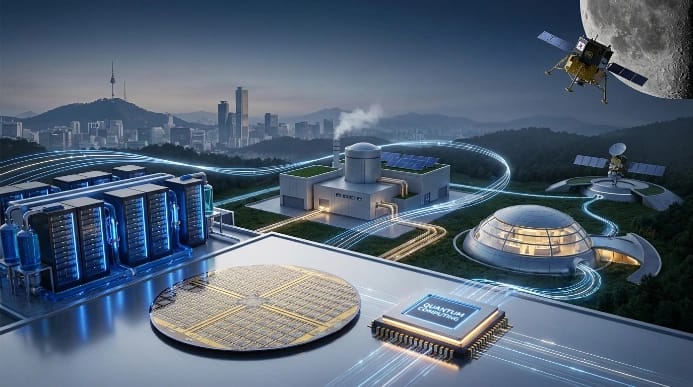
The new South Korea technology strategy, called the Seven Major SEED initiative, targets seven areas that the government believes could become major sources of economic growth and national power over the next decade.
The projects cover small modular nuclear reactors, fusion energy, next-generation renewable energy, quantum technology, space and aviation, advanced biotechnology, and critical minerals and materials.
The targets are ambitious. They include developing a domestic error-corrected 100-qubit quantum processor by 2029, landing a spacecraft on the Moon in 2030, commercializing an indigenous small modular reactor by 2035, developing brain-computer-interface products and strengthening domestic critical-mineral supply chains.
This isn’t simply another research program.
The South Korea technology strategy shows how countries increasingly view advanced technology as a combination of economic policy, energy security and national security.
And South Korea may have an advantage: it already possesses one of the world’s strongest advanced-manufacturing ecosystems.
Key Takeaways
- South Korea has introduced seven strategic technology projects intended to create new growth engines beyond today’s AI and semiconductor boom.
- The country wants a domestic 100-qubit error-corrected quantum processor by 2029 and a lunar landing in 2030.
- Energy is a major part of the plan, including SMRs, fusion and next-generation renewable technologies.
- Advanced biotechnology and brain-computer interfaces are another major target.
- South Korea plans to invest 10 trillion won ($7.1 billion) by 2030 specifically in materials, parts and equipment technologies as part of its supply-chain strategy—not as the total value of the entire SEED initiative.
- The strategy builds on South Korea’s existing strengths in semiconductors, AI infrastructure and advanced manufacturing.
- Execution will ultimately matter more than the number of ambitious targets announced.
Why Is South Korea Making This Move Now?
South Korea faces an unusual challenge.
It is technologically advanced, but many of the industries responsible for its economic success are entering periods of intense international competition.
China is strengthening domestic technology capabilities. The United States is spending heavily on AI and semiconductor infrastructure. Japan is rebuilding strategic manufacturing capacity. Governments worldwide are also competing for batteries, critical minerals, quantum technology and biotechnology.
At the same time, South Korea faces demographic pressure from a shrinking working-age population and slower potential economic growth. Those challenges make productivity and high-value technology increasingly important.
The country’s answer is essentially to begin building the industries it expects to need 10 or 20 years from now.
South Korea is already included among the leading contenders in the global race for AI leadership because of its semiconductor industry, telecommunications infrastructure and advanced manufacturing capabilities.
The new strategy attempts to extend that strength into several additional technologies.
1. Small Modular Reactors Could Become a New Export Industry
The first major area in the South Korea technology strategy is nuclear energy.
South Korea wants to commercialize an indigenous small modular reactor, or SMR, by 2035.
SMRs are smaller than conventional nuclear plants and are designed around modular construction. Supporters hope this could make nuclear capacity easier to deploy in different locations and reduce some of the challenges associated with building enormous traditional reactors.
South Korea’s Ministry of Science and ICT says the country is pursuing next-generation reactor technologies as electricity requirements increase during the AI era. Its current plans include SMRs, molten-salt reactors, micro modular reactors and even a public-private project for a nuclear-powered vessel.
South Korea Ministry of Science and ICT — 2026 science and technology work plan
This is important because South Korea isn’t approaching nuclear power only as domestic energy policy.
If it develops commercially competitive reactor technology, nuclear systems could eventually become another high-value export industry.
2. South Korea Is Betting on Fusion Energy
The second energy bet is even more ambitious: nuclear fusion.
Fusion attempts to produce energy through processes similar to those that power the Sun.
Scientists have worked on fusion for decades, but turning experimental breakthroughs into commercially useful electricity remains extremely difficult.
South Korea nevertheless wants to move aggressively.
Its government says it is designing a fusion demonstration reactor with the aim of generating electricity in the 2030s and plans to develop public-private cooperation models to support the program.
Why invest in something so uncertain?
Because the potential reward is enormous.
The AI economy is increasing electricity requirements from data centers, semiconductor factories and advanced computing infrastructure. Our previous analysis of the AI infrastructure race explains why electricity is becoming one of the hidden constraints behind the AI boom.
If South Korea can combine advanced computing with abundant reliable energy, it could strengthen several industries simultaneously.
Fusion is far from guaranteed to deliver that future. But this is exactly the type of long-term technology the SEED initiative is designed to pursue.
3. Next-Generation Renewable Energy Completes the Energy Strategy
The South Korea technology strategy doesn’t depend entirely on nuclear power.
The third SEED area focuses on next-generation renewable technologies.
Plans include advanced solar cells, offshore wind, hydrogen-production technologies and AI-based power-grid systems.
This matters because tomorrow’s technology competition could increasingly become an energy competition.
AI data centers need electricity.
Semiconductor fabrication plants need enormous amounts of reliable electricity and water.
Battery factories and advanced manufacturing facilities also require large energy supplies.
South Korea therefore needs to expand technology industries without creating an energy bottleneck.
The combination of nuclear, fusion and renewables suggests that Seoul isn’t betting on a single source.
It is trying to build a broader energy system capable of supporting a much larger technology economy.
4. Quantum Computing Is One of the Boldest Bets
Quantum computing is perhaps the most futuristic part of the South Korea technology strategy.
The government wants a domestically developed 100-qubit error-corrected quantum processor by 2029 and ultimately aims to become a leading quantum-chip manufacturing nation.
That is a serious ambition.
Traditional computers process information using bits represented as zeros and ones. Quantum computers use quantum bits, or qubits, which behave differently and could eventually make certain types of calculations dramatically more powerful.
Potential applications include:
- Drug discovery
- Materials science
- Cryptography
- Logistics
- Financial modeling
- Scientific simulations
- Advanced manufacturing
But quantum computing still faces major technical challenges, especially error correction and scaling.
That is why South Korea’s target matters.
Rather than treating quantum computing purely as scientific research, the country wants to connect quantum development with its existing semiconductor manufacturing capabilities.
For readers unfamiliar with the technology, our guide to why quantum computing could become the biggest technology revolution after AI explains how the technology works and why governments are investing in it.
If quantum processors eventually become commercially important, South Korea wants to manufacture part of the hardware powering that revolution.
5. South Korea Wants to Land on the Moon in 2030
Perhaps the most visually dramatic goal is a South Korean Moon landing in 2030.
The country’s plans go much further than a symbolic lunar mission.
The Ministry of Science and ICT and Korea AeroSpace Administration say South Korea plans a lunar communications satellite in 2029, a small lunar lander in 2030, and a Korean low-Earth-orbit satellite communications network by 2035.
The government also wants South Korea to become one of the world’s top five aerospace powers and increase its share of the global aerospace market.
Official South Korean aerospace and lunar roadmap
Why does this matter economically?
Space is gradually becoming an industry rather than simply a government science program.
Commercial opportunities include:
- Satellite communications
- Earth observation
- Navigation
- Launch services
- Space-based data
- Advanced materials
- Defense systems
- Lunar exploration
South Korea also plans to participate more deeply in next-generation commercial aircraft development and localize advanced aircraft engines.
So the Moon mission should be viewed as one part of a much broader aerospace strategy.
6. Biotechnology Could Become Another Korean Technology Strength
Another pillar of the South Korea technology strategy combines artificial intelligence with biotechnology.
The government wants to establish AI-bio infrastructure by 2030 and pursue AI-assisted drug discovery, autonomous laboratories, gene and cell therapies, and brain-computer interfaces.
South Korea’s science ministry says it has already been building autonomous experimentation infrastructure in which AI and robotics can help test drug candidates designed by AI. The government also plans to begin developing a cancer-specialized AI model in 2027.
Brain-computer interfaces are particularly ambitious.
These systems attempt to translate signals between the human brain and computers.
South Korea wants to demonstrate a BCI product for people with paralysis affecting all four limbs by 2030, with broader commercialization goals extending into the following years.
This illustrates a broader feature of the strategy.
AI isn’t really a separate project.
It acts as a layer running through many of the seven projects—from biotechnology and energy grids to manufacturing and scientific research.
7. Critical Minerals May Be the Least Glamorous—but Most Important—Project
Quantum computers and Moon landings attract attention.
Critical minerals usually don’t.
But the seventh part of the South Korea technology strategy may be among the most strategically important.
Modern technologies depend on specialized materials used in:
- Semiconductors
- Batteries
- Electric vehicles
- Electronics
- Renewable energy
- Aerospace
- Defense systems
A country can design world-class technology and still face problems if it cannot reliably obtain the materials required to manufacture it.
South Korea therefore wants to increase domestic processing and recycling, diversify international sourcing and expand strategic stockpiles.
The government also plans 10 trillion won ($7.1 billion) of investment in materials, parts and equipment technologies through 2030.
This fits a much larger global trend.
Our analysis of how global supply chains are being reshaped by reshoring and diversification explains why governments increasingly value resilience alongside efficiency.
For South Korea, supply-chain security is especially important because so much of its economy depends on advanced manufacturing.
Semiconductors Remain the Foundation
Interestingly, semiconductors are not one of the seven SEED fields announced this week.
That’s because chips are already a central pillar of South Korea’s industrial strategy.
Just two days before the SEED announcement, Seoul unveiled a 5 trillion won ($3.52 billion) semiconductor fund targeting materials, components, equipment and fabless companies, alongside another 5 trillion won in trade finance for suppliers.
The broader semiconductor megaproject involves more than $576 billion in expected investment from Samsung Electronics, SK Hynix, suppliers and local governments.
South Korea’s official technology plan also calls for a domestic AI-semiconductor ecosystem and future work on 1-nanometer-class devices and next-generation stacked HBM memory.
This is where South Korea has an unusual advantage.
It doesn’t need to build an advanced technology manufacturing ecosystem entirely from scratch.
It already has one.
The challenge is transferring that industrial strength into quantum chips, AI hardware, aerospace, biotechnology and energy technology.
AI Is the Technology Connecting Everything
The same is true for artificial intelligence.
AI isn’t merely one project inside the South Korea technology strategy.
It connects many of them.
South Korea wants AI for:
- Scientific research
- Biotechnology
- Drug discovery
- Power grids
- Manufacturing
- Physical robotics
- Semiconductor development
- Government services
The government says it wants to become a top-three global AI power and is supporting gigawatt-scale AI data centers through major private investment.
This matters because future technological leadership may depend less on dominating one individual field and more on connecting several.
AI can accelerate biotechnology.
Semiconductors power AI.
Energy powers data centers.
Quantum computing may transform scientific research.
Critical minerals support manufacturing.
Satellite networks provide communications infrastructure.
The individual projects therefore reinforce one another.
Why South Korea Could Actually Compete
Many countries publish ambitious technology strategies.
Far fewer have the industrial base required to execute them.
South Korea already possesses globally competitive companies in:
- Memory semiconductors
- Consumer electronics
- Batteries
- Displays
- Shipbuilding
- Automotive manufacturing
- Telecommunications
It also has a strong research and engineering base.
That gives the South Korea technology strategy more credibility than a plan built entirely around future industries that do not yet have domestic foundations.
The country’s role in the global economy outlook for 2026 also reflects a wider shift: advanced technologies, resilient supply chains and strategic manufacturing are becoming increasingly important sources of economic power.
South Korea already participates in all three.
But the Strategy Faces Serious Challenges
Ambitious targets don’t guarantee technological leadership.
South Korea still faces several obstacles.
Talent
Quantum computing, fusion, advanced biotechnology and AI all require highly specialized researchers.
Every major technology economy is competing for the same talent.
Energy and infrastructure
South Korea’s semiconductor and AI ambitions require enormous amounts of electricity and water.
Reuters reported that the planned Yongin semiconductor cluster alone is expected to require 14.7 gigawatts of electricity by 2041.
Demographics
A shrinking working-age population could make talent shortages more difficult over time.
Competition
The United States, China, Japan and European countries are investing in many of the same technologies.
South Korea doesn’t need to dominate every field, but it must establish areas where it has a genuine competitive advantage.
Commercialization
A successful laboratory prototype is not the same as a successful industry.
The country will need companies capable of turning publicly supported research into products customers actually buy.
Could South Korea Become a Bigger Technology Superpower?
Potentially.
But the answer depends on execution.
The strongest part of the South Korea technology strategy isn’t any single Moon mission or quantum target.
It’s the attempt to create an interconnected system.
South Korea already manufactures advanced chips.
Those chips support AI.
AI can improve scientific research and manufacturing.
Future nuclear and renewable technologies could provide energy.
Quantum computing could create another advanced-chip market.
Critical-mineral security could protect manufacturing.
Space infrastructure could create new communications and aerospace industries.
If those pieces develop together, South Korea could become much more than a semiconductor powerhouse.
It could become one of the countries providing the physical infrastructure behind several of the world’s most important emerging technologies.
FAQs
What is the South Korea technology strategy?
The South Korea technology strategy includes the new Seven Major SEED initiative covering SMRs, fusion, next-generation renewable energy, quantum technology, space and aviation, advanced biotechnology, and critical minerals and materials.
What is South Korea’s quantum computing goal?
South Korea aims to develop a domestic error-corrected 100-qubit quantum processor by 2029 and strengthen its position in quantum-chip manufacturing.
Is South Korea going to the Moon?
The government plans a lunar communications satellite in 2029 and a small lunar lander mission in 2030, followed by further lunar ambitions.
Why is South Korea investing in nuclear technology?
Growing electricity demand from AI, semiconductors and other industries makes reliable power increasingly important. South Korea is developing SMRs and pursuing fusion technology as part of its long-term energy strategy.
Is AI part of the Seven Major SEED projects?
AI is not simply one of the seven newly announced SEED fields. Instead, it acts as an enabling technology across several areas while South Korea simultaneously pursues a broader national AI strategy.
The Light Span Perspective
The most important part of the South Korea technology strategy isn’t the Moon landing or even the quantum computer.
It is the timing.
South Korea is benefiting from extraordinary demand for semiconductors and AI infrastructure today, but its government is already asking what industries will matter after the current boom.
That is smart long-term thinking.
Some SEED projects will almost certainly progress more slowly than planned. Fusion energy remains extremely difficult. Useful fault-tolerant quantum computing is still developing. Space programs can face delays, and biotechnology must navigate technical and regulatory barriers.
But South Korea doesn’t need every project to succeed equally.
If even several become internationally competitive industries, the economic impact could be significant.
The broader lesson extends beyond South Korea.
The global technology race is changing.
Countries are no longer competing only over software or individual products. They are competing over chips, energy, materials, scientific research, manufacturing capacity, talent and infrastructure.
South Korea already has many of those pieces.
The Seven Major SEED initiative is an attempt to connect them—and turn today’s semiconductor strength into tomorrow’s technological power.
Continue reading more

