


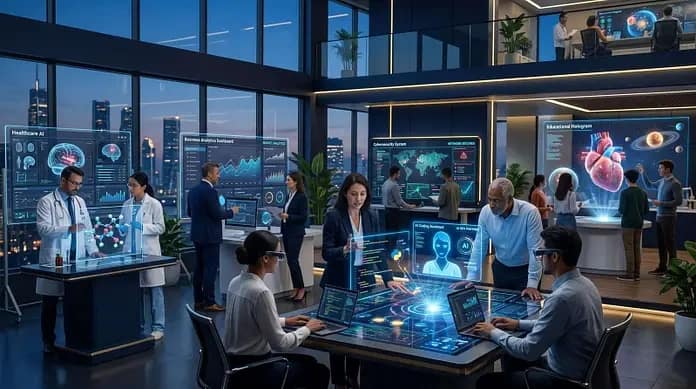
AI Tools 2027: Technologies That Could Change How We Work
The artificial intelligence industry is moving beyond the chatbot.
That may be the most important technology trend to understand before 2027.
The first wave of generative AI taught millions of people to open a chatbot, enter a prompt and wait for an answer.
The next wave looks very different.
AI systems are beginning to perform work rather than simply discuss it.
They can operate tools, write and test software, analyze large collections of information, interact with applications, work on tasks for extended periods and coordinate multiple steps toward a goal.
This transition from AI assistants to AI agents could reshape what we consider an AI tool.
OpenAI described the change in June 2026 as a shift in the unit of knowledge work from individual interactions toward delegated, longer-horizon tasks. Its research found users increasingly assigning Codex work estimated to take humans more than an hour, with some tasks extending much longer.
Google is moving in the same direction. At I/O 2026, it described the emergence of an “agentic Gemini era,” introducing systems designed not only to generate information but to take actions across workflows.
This makes predicting the best AI tools of 2027 very different from creating another list of today’s popular apps.
Several products dominating 2027 may not even exist yet.
Others will evolve so quickly that their current capabilities will look basic a year from now.
Instead, the most useful approach is to examine the tools and technology categories already showing where AI is heading.
These are not guaranteed winners.
They are ten technologies that could define how people actually use artificial intelligence in 2027.
1. Autonomous AI Work Agents
The biggest shift may come from AI systems capable of working independently for extended periods.
Traditional chatbots operate through a simple cycle:
You ask.
AI answers.
You ask again.
Agents can potentially operate very differently.
Give an agent a goal such as:
“Research our competitors and prepare a strategy report.”
Instead of simply explaining how to perform the task, an advanced agent can potentially break the goal into steps, gather information, analyze it, organize the findings and produce finished materials.
This concept is already moving into mainstream AI products.
OpenAI introduced ChatGPT Work in July 2026 as an agent capable of taking actions across apps and files, breaking complicated goals into smaller steps and staying with projects for hours when necessary.
Meanwhile, Google has introduced Gemini Spark, designed to provide proactive, around-the-clock assistance, alongside broader agent capabilities throughout its ecosystem.
By 2027, this could change how businesses think about software.
Instead of employees manually switching between ten applications, they may increasingly supervise agents that operate those applications for them.
The human role moves from performing every step toward setting objectives, reviewing work and making important decisions.
That could make general-purpose work agents one of the most important AI tools of 2027.
2. AI Coding Agents That Build Complete Software
Programming was one of the first professions to experience serious AI assistance.
Initially, AI coding tools mostly suggested individual lines of code.
Then they began generating functions.
Then entire files.
The next stage is dramatically more ambitious.
Modern coding agents can work across software repositories, investigate bugs, modify multiple files, run tests and prepare code for human review.
OpenAI’s Codex, for example, is designed to handle end-to-end engineering work ranging from routine pull requests to complex refactoring and migrations. It can also coordinate multiple agents working in parallel.
This changes the economics of software creation.
A developer may increasingly act as an architect and reviewer while several AI agents perform implementation work simultaneously.
But an even more interesting effect could appear outside professional programming.
Entrepreneurs who understand a business problem but cannot write sophisticated software may increasingly be able to describe what they want and collaborate with AI to build it.
A restaurant owner could create a specialized booking tool.
A marketer could develop a custom analytics dashboard.
A small company could automate an internal workflow without hiring a large development team.
That does not eliminate software engineers.
Complicated software still requires architecture, security, judgment, testing and maintenance.
But AI could dramatically reduce the cost of turning an idea into working software.
This is one reason our analysis of why AI is creating new jobs emphasizes hybrid expertise. People who combine domain knowledge with powerful AI tools may become increasingly valuable.
3. Deep Research Agents
Search engines changed how humans find information.
AI could change how we process it.
A conventional search engine returns links.
The user then opens those links, evaluates sources, extracts useful information, compares claims and creates a conclusion.
Research agents attempt to automate parts of that process.
A sophisticated system can potentially search across many sources, examine documents, identify relevant evidence, compare conflicting information and prepare a structured report.
By 2027, these systems could become particularly useful for:
market research,
investment analysis,
academic research,
competitive intelligence,
legal preparation,
policy research,
and product development.
The real breakthrough will not be producing longer reports.
AI can already produce enormous amounts of text.
The breakthrough will be trustworthy research.
That requires systems capable of distinguishing primary sources from commentary, showing citations clearly, recognizing uncertainty and avoiding fabricated evidence.
Research agents will therefore compete on something different from ordinary chatbots.
Not simply intelligence.
Reliability.
The strongest tools may be those that allow humans to inspect exactly where claims came from.
4. Multimodal AI Assistants
Most human communication is not text.
We speak.
We listen.
We see.
We watch.
We draw.
We interact with physical environments.
AI systems are increasingly capable of working across all of these formats.
Google’s Gemini 3.5, introduced in May 2026, was designed around complex agentic workflows, while Google’s wider 2026 AI push increasingly combines text, images, video, audio and action.
This means the future AI assistant may not feel like a chatbot at all.
Imagine showing an AI your screen and saying:
“Why isn’t this working?”
The system can inspect what you see.
Or pointing your camera toward a machine and asking:
“Which component should I check?”
Or uploading a video of a production line and asking the AI to identify potential bottlenecks.
A multimodal AI could combine:
text,
voice,
images,
video,
documents,
screen activity,
and contextual information.
That is why the biggest AI breakthroughs of 2026 increasingly involve convergence rather than isolated technologies.
AI becomes far more useful when it understands information in the same mixed formats humans encounter every day.
5. Personal AI That Understands Your Context
Today’s AI assistants often know very little about what you are actually trying to accomplish.
You provide context.
The AI responds.
Then you provide more context.
Future assistants could become much more personalized.
With user permission, an AI system might understand:
your projects,
preferred working style,
important documents,
calendar,
communication patterns,
frequently used applications,
and recurring tasks.
That could transform AI from a generic chatbot into something closer to a personalized operating layer.
Instead of asking:
“What meetings do I have tomorrow?”
you might ask:
“Prepare me for tomorrow.”
The AI could potentially examine your schedule, identify important meetings, retrieve relevant materials and prepare short briefings.
Or instead of asking:
“Write a reply to this email,”
you could say:
“Handle the routine messages and show me anything requiring a decision.”
This level of personalization would make AI dramatically more useful.
It also creates major privacy and security questions.
An assistant cannot deeply understand your work without access to information about your work.
That makes permission systems essential.
Users need to understand what information an AI can access, what actions it can perform and when approval is required.
OpenAI’s approach to coding agents illustrates the importance of these controls: Codex is designed around boundaries, permissions and auditability as agents gain the ability to perform increasingly consequential actions.
The best personal AI of 2027 may therefore not be the system that knows the most.
It may be the system that gives users the best control over what it knows.
6. AI Video Production Systems
Generative AI has already transformed image creation.
Video is likely to become one of the next major battlegrounds.
Early AI video tools were impressive but inconsistent.
Characters changed appearance.
Objects behaved strangely.
Physics broke.
Camera movements felt artificial.
Long sequences were difficult to maintain.
Those limitations are gradually improving.
Future AI video systems could combine several tasks that currently require separate software:
storyboarding,
visual generation,
animation,
editing,
voice,
sound effects,
music,
motion graphics,
and localization.
Instead of generating one short clip, users may eventually describe an entire production.
For example:
“Create a 60-second product advertisement using these product images, follow our visual style, produce three opening hooks, add voiceover and create vertical and horizontal versions.”
The AI could potentially coordinate much of the workflow.
That would be particularly powerful for small businesses and independent creators.
Professional filmmaking would still require human creative direction.
But routine commercial video production could become dramatically faster.
This is another example of why the future gadgets and technology ecosystem is increasingly being shaped by AI. Content creation, personal devices and intelligent software are converging into the same technological environment.
7. AI Business Automation Agents
Many companies do not need a smarter chatbot.
They need fewer repetitive processes.
Consider the amount of work inside a normal business that involves moving information from one place to another:
reading incoming requests,
updating spreadsheets,
preparing reports,
categorizing documents,
following up with customers,
checking inventory,
processing forms,
creating invoices,
and monitoring performance.
Traditional automation can handle predictable workflows.
But it struggles when the information is unstructured.
AI changes that.
A future business agent might read an email, understand what the customer wants, retrieve relevant information, update internal systems, prepare a response and escalate the case only when human judgment is required.
That could make automation accessible to far more businesses.
The biggest change may be that companies stop automating individual tasks and begin automating entire workflows.
This is where AI’s economic impact could become much larger.
As explained in The Light Span’s analysis of the AI productivity paradox, simply giving employees AI software does not automatically transform productivity.
Businesses must redesign how work happens.
Agentic automation could provide the missing bridge.
8. AI Cybersecurity Agents
As AI becomes more capable, cybersecurity becomes simultaneously more difficult and more important.
Organizations already generate enormous volumes of security data.
Logs.
Network events.
Alerts.
Login activity.
Software vulnerabilities.
Suspicious behavior.
Human security teams cannot manually investigate every signal.
AI agents could help prioritize and investigate threats.
A cybersecurity agent might:
monitor activity,
identify suspicious patterns,
investigate related events,
summarize evidence,
recommend actions,
and automatically handle low-risk defensive tasks.
By 2027, specialized cybersecurity agents could become increasingly important because offensive actors can also use AI.
That creates an AI-versus-AI dynamic.
Attackers automate reconnaissance.
Defenders automate detection.
Attackers generate more convincing social engineering.
Defenders use AI to identify anomalies.
The security challenge becomes particularly important as agents gain permissions to perform real actions.
A chatbot producing a bad answer is inconvenient.
An autonomous system with access to company infrastructure can create far greater consequences.
Google’s July 2026 Gemini updates already include a dedicated 3.5 Flash Cyber model alongside models optimized for scalable agentic workflows, showing how specialized AI systems are emerging around security use cases.
AI security may therefore become one of the most important enterprise technology categories of 2027.
9. AI Tools That Run More Work in the Background
Most software waits for you.
You open it.
You perform a task.
You close it.
Agentic software can operate differently.
An AI might continuously monitor a situation and act when necessary.
Imagine an agent that checks your company’s analytics every morning and alerts you only when something unusual happens.
Another could monitor inventory and prepare purchase recommendations.
A coding agent could continuously review incoming software issues.
A research agent could track regulatory changes relevant to your business.
A sales agent could prepare daily account briefings.
This represents a shift from on-demand AI toward persistent AI.
OpenAI’s current Codex direction already includes scheduled background work such as issue triage, monitoring and other recurring engineering tasks.
Google’s Managed Agents similarly added background execution in July 2026, allowing agents to continue asynchronous work and connect with external systems.
By 2027, this could become normal.
We may stop thinking of AI as something we explicitly “use.”
Some AI systems will simply remain active in the background, waiting for conditions that require attention.
That makes automation more powerful.
It also makes transparency essential.
Users need clear records showing what an agent did and why.
10. AI Robotics and Physical Agents
The most ambitious AI tools of 2027 may not live inside computers at all.
They may have bodies.
Modern AI is increasingly being connected with robots capable of seeing, understanding instructions, reasoning about their surroundings and manipulating physical objects.
This is sometimes called physical AI.
The concept is enormously important because most economic activity does not happen exclusively on computer screens.
Factories need workers.
Warehouses move products.
Construction involves physical materials.
Hospitals contain equipment.
Agriculture requires physical operations.
Homes require endless physical tasks.
Software agents can automate digital work.
Robotics could extend AI automation into the physical economy.
The technology remains far from solved.
Real-world environments are unpredictable.
A robot needs to recognize objects, understand spatial relationships, plan movements and react safely when something unexpected happens.
Reliability requirements are also much higher.
A text-generation error can be corrected.
A physical robot making the wrong movement can damage property or injure someone.
That means robotics will probably progress more slowly than software agents.
But its long-term economic potential is enormous.
And the computing required to support increasingly capable AI systems helps explain why AI data centers use so much electricity. The intelligence appearing in software and machines ultimately depends on a rapidly expanding physical computing infrastructure.
The Bigger Shift: From AI Tools to AI Coworkers
All ten categories point toward the same transformation.
AI tools are becoming less passive.
The old model looked like this:
Human → request → AI → response
The emerging model looks more like:
Human → goal → AI agent → plan → tools → actions → review
That is a much bigger change than simply making language models smarter.
It changes the relationship between humans and software.
OpenAI’s 2026 research provides an early indication of this shift. By May 2026, more than 70% of sampled individual Codex users had made at least one request estimated to represent over an hour of human work.
People are beginning to delegate rather than merely prompt.
That could become the defining AI behavior of 2027.
Will We Still Need Hundreds of Separate AI Apps?
Possibly not.
Today’s AI market contains thousands of specialized applications.
One summarizes PDFs.
Another writes emails.
Another creates presentations.
Another analyzes data.
Another generates images.
Another produces video.
That fragmentation may not last.
General-purpose agents are becoming capable of using multiple tools and working across applications.
Instead of purchasing ten AI tools, users may increasingly rely on one intelligent agent connected to ten specialized capabilities.
This does not mean specialized software disappears.
It means the interface layer changes.
The agent becomes the interface.
The specialized tools operate underneath it.
This could eventually create a technology environment where users spend less time learning software menus and more time describing desired outcomes.
What Will Separate Great AI Tools From Bad Ones?
Raw intelligence will not be enough.
Five characteristics could matter increasingly in 2027.
Reliability will determine whether businesses trust agents with meaningful work.
Integration will determine whether AI can actually interact with the software and information people already use.
Security will become critical as agents gain permissions.
Transparency will help users understand what AI systems did and why.
And cost efficiency will matter because continuously running agents can consume substantial computing resources.
Google’s 2026 Gemini Flash development illustrates this growing focus on efficiency. Its newer Flash models specifically target lower latency, reduced token usage and more reliable performance for production-scale AI agents.
The winning AI tool may therefore not always be the model that scores highest on a benchmark.
It may be the system that completes useful work most reliably for the lowest total cost.
Three Risks Users Should Understand
The more capable AI tools become, the more carefully they need to be used.
AI can still be wrong
An agent capable of performing ten steps autonomously can also compound an error across ten steps.
Important work still requires verification.
Permissions create security risks
Giving AI access to files, email, financial information or company software increases the consequences of mistakes or attacks.
Access should be limited to what the system actually needs.
Automation can create dependence
Businesses should understand critical workflows rather than blindly delegating them.
Human oversight remains particularly important where decisions involve money, safety, employment, legal consequences or sensitive information.
The future of AI is therefore not simply about maximum autonomy.
It is about useful autonomy with appropriate control.
What Should Businesses Do Before 2027?
Businesses do not need to adopt every new AI product.
They should begin with problems.
Identify repetitive processes that consume significant employee time.
Determine which steps require judgment and which can be automated.
Test AI on low-risk workflows.
Measure whether it actually saves time or improves outcomes.
Train employees.
Then expand gradually.
This approach is more valuable than buying software simply because it contains AI.
The companies that benefit most from artificial intelligence will probably not be those using the greatest number of AI tools.
They will be those that redesign work most intelligently around them.
FAQs
What will be the best AI tools in 2027?
The strongest categories are likely to include autonomous work agents, AI coding systems, research agents, multimodal assistants, personalized AI, generative video platforms, business automation, cybersecurity agents and robotics.
Will AI agents replace chatbots?
Not completely. Simple questions still benefit from conversational interfaces. Agents become more valuable when users want AI to complete multi-step tasks rather than simply provide an answer.
What is agentic AI?
Agentic AI refers to systems capable of pursuing goals through multiple steps, using tools, interacting with environments and taking actions with varying levels of autonomy.
Are AI coding agents already available?
Yes. Current systems such as OpenAI Codex can work across repositories, write and modify code, run tests and handle longer engineering tasks.
Will AI tools become cheaper?
Many capabilities should become cheaper as models and computing infrastructure become more efficient, although advanced agents performing long-running tasks can still require substantial computing resources.
Will businesses need fewer software applications?
Possibly. General-purpose AI agents may increasingly become interfaces that operate multiple specialized applications behind the scenes rather than requiring users to interact manually with each application.
Should businesses wait until 2027 before adopting AI?
No. Organizations can begin experimenting with practical, low-risk workflows today. The important goal is developing experience with AI integration rather than attempting to predict exactly which product will dominate next year.
The Light Span Perspective
The most revolutionary AI tools of 2027 may not look revolutionary.
They may simply remove steps.
Instead of searching for information, opening a spreadsheet, organizing data, creating a presentation and writing an email, you may describe the outcome you want.
The AI handles much of what happens between intention and result.
That is the deeper transformation behind agentic AI.
For decades, humans learned how computers wanted us to work.
We learned file systems.
Menus.
Applications.
Commands.
Search engines.
Spreadsheets.
Programming languages.
AI begins reversing that relationship.
Increasingly, the computer learns what the human is trying to accomplish.
That does not eliminate the need for human skill.
In many situations it increases the importance of judgment.
When generating work becomes cheap, deciding what work should be done becomes more valuable.
When software becomes easier to build, understanding which problems deserve solutions becomes more valuable.
When research becomes faster, evaluating evidence becomes more important.
And when AI agents can act autonomously, deciding what they should be allowed to do becomes critical.
This is why 2027 may not be remembered as the year of one extraordinary AI application.
It could instead become the year when the idea of an “AI tool” itself begins to disappear.
AI will increasingly become embedded inside software, operating systems, devices, businesses and eventually physical machines.
We will still use applications.
But more of the work between those applications may be coordinated by intelligent agents.
The shift has already started.
OpenAI is pushing AI toward longer-running delegated work. Google is building agents throughout Gemini and its wider ecosystem. Coding agents are taking on increasingly complicated engineering projects. Background agents are becoming persistent. Multimodal models are learning to work across more types of information.
The technology still has serious weaknesses.
Agents make mistakes.
Security becomes harder as autonomy increases.
Businesses need measurable returns rather than impressive demonstrations.
And many tasks will continue to require human expertise.
But the direction is increasingly clear.
The AI revolution began by giving us machines that could answer questions.
The next phase is giving us machines that can complete tasks.
By 2027, the most important AI tools may be the ones we stop thinking of as tools—and start treating as digital collaborators.
Continue reading more

