


Panama Canal Drought 2026: 7 Alarming Global Trade Risks
The Panama Canal drought 2026 is becoming a serious test for global trade just as businesses are already managing expensive energy, geopolitical conflict and fragile supply chains.
The Panama Canal Authority plans to reduce the number of vessels allowed to cross the waterway each day as strengthening El Niño conditions reduce rainfall across the canal’s watershed. From early September, daily capacity is scheduled to fall from 36 ships to 34, followed by a further reduction to 32 ships from September 15.
That may sound like a small adjustment. In a tightly scheduled global shipping system, however, removing several daily transit slots can create queues, increase reservation prices and force companies to choose longer routes.
The canal connects the Atlantic and Pacific oceans without requiring ships to sail around South America. It is particularly important for trade between Asia and the eastern United States, energy shipments, agricultural exports and containerized consumer goods.
The official Panama Canal Authority shipping advisory links the restrictions to lower water availability and the expected effects of El Niño. The warning is reinforced by the World Meteorological Organization, which says a strong El Niño is developing and is expected to intensify during August–October 2026.
The Panama Canal drought 2026 will not stop global trade. Shipping companies can adapt by reserving passages earlier, changing vessels or rerouting cargo. But every adjustment adds time, cost or uncertainty somewhere else in the system.
Here are seven alarming risks businesses, consumers and policymakers should watch.
Key Takeaways
- Daily Panama Canal transits are scheduled to fall to 34 and then 32 vessels in September.
- Rainfall in the canal watershed has been well below historical averages.
- El Niño is expected to strengthen and could extend water stress into 2027.
- Fewer transit slots can produce queues, higher booking costs and longer delivery times.
- U.S.–Asia trade, agricultural exports and energy shipments are particularly exposed.
- Rerouting ships can increase fuel use, freight costs and emissions.
- The disruption shows why climate resilience has become essential economic infrastructure.
Why the Panama Canal Depends on Rainfall
Understanding the Panama Canal drought 2026 begins with the waterway’s unusual design.
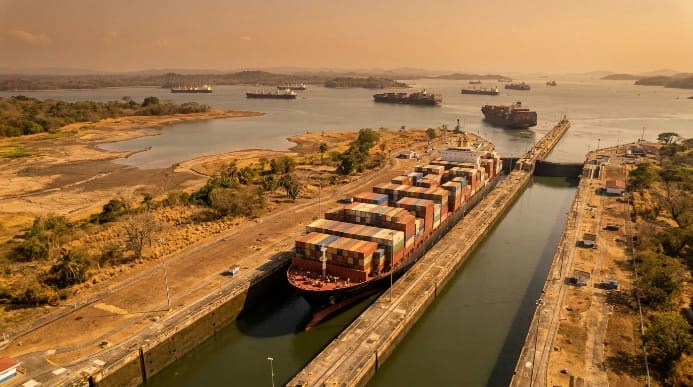
The Panama Canal is not a sea-level channel. Ships are lifted and lowered through locks as they cross the isthmus. This process depends on freshwater stored in artificial lakes, especially Gatún Lake.
Each transit releases freshwater toward the ocean. Rainfall must replenish the watershed while the same water system also supports communities and economic activity in Panama.
When rainfall drops for an extended period, canal managers face a difficult balance. They must protect drinking-water supplies and preserve lake levels while continuing to move international shipping.
The Panama Canal drought 2026 is therefore not simply a problem of ships waiting for rain. It is a resource-allocation challenge involving trade, public water security and the long-term operation of one of the world’s most important transport corridors.
Officials have already introduced water-saving measures and improved how lock operations use available supplies. Those changes provide more resilience than the canal had during earlier droughts, but they cannot eliminate the physical need for freshwater.
1. Shipping Queues Could Grow Quickly
The first risk is congestion.
A reduction of four daily passages removes more than 100 potential transit opportunities over a month. If vessel demand remains above the new limit, ships without secure reservations may have to wait.
Queues can grow quickly because international shipping operates through carefully coordinated schedules. A vessel delayed at the canal may arrive late at several ports, disrupting the next voyages in its rotation.
The Panama Canal drought 2026 could therefore create effects far beyond Panama. Containers may reach warehouses later. Manufacturers could wait longer for parts. Exporters may miss delivery windows, while ports receive cargo in less predictable waves.
The Light Span’s analysis of global shipping routes and geopolitical risk showed how a disruption at one maritime chokepoint can redirect pressure toward other routes. When several trade corridors face problems simultaneously, the global system has less spare capacity to absorb another shock.
Reserved vessels may continue moving with limited delay, but smaller companies and irregular shippers often have less flexibility. Congestion can therefore affect businesses unevenly.
2. Transit and Freight Costs May Rise
The second Panama Canal drought 2026 risk is higher cost.
Scarce transit slots become more valuable when demand exceeds supply. Shipping companies may pay higher reservation or auction prices to protect delivery schedules. Those costs can be passed to cargo owners through higher freight rates and surcharges.
Rerouting is not free either. Sailing around Cape Horn or using another route adds distance, fuel, crew time and insurance exposure. Moving cargo through ports, railways or roads may work for some products but requires additional handling.
The Panama Canal drought 2026 does not guarantee a large global inflation shock. Freight costs are only one part of a product’s final price, and major shipping companies have learned how to respond to disruptions.
However, the impact can become more visible for goods with low profit margins, urgent delivery requirements or limited alternative routes. Smaller importers may also lack the bargaining power of large retailers.
This risk arrives during a period of wider global trade uncertainty, when tariffs, energy costs and geopolitical tensions are already making long-term planning more difficult.
3. U.S.–Asia Supply Chains Face Greater Pressure
The third Panama Canal drought 2026 risk involves one of the canal’s most important trade relationships.
The Panama Canal offers a practical route for goods moving between Asia and ports on the eastern and Gulf coasts of the United States. Container ships can avoid unloading on the U.S. West Coast or sailing around South America.
If passage becomes slower or more expensive, companies may reconsider how they divide cargo between American ports. Some shipments could move through Los Angeles, Long Beach or other western gateways before continuing east by rail. Others may remain on all-water services and accept higher canal costs.
The Panama Canal drought 2026 could expose weaknesses in businesses that rely too heavily on one route, port or logistics partner. Companies with multiple suppliers and transport options will generally be better positioned.
This supports the broader shift described in The Light Span’s report on global trade and changing supply chains. Efficiency remains important, but resilience increasingly requires alternative routes, additional inventory and better visibility across suppliers.
Diversification carries a cost. Yet it can prevent one bottleneck from stopping an entire production or retail operation.
4. Agricultural and Energy Trade Could Be Disrupted
The fourth Panama Canal drought 2026 risk extends beyond container ships.
The canal is used by vessels carrying grain, liquefied petroleum gas, liquefied natural gas, chemicals and other bulk commodities. These cargoes support food systems, electricity generation, manufacturing and household energy use.
Some commodity ships are highly sensitive to timing. Agricultural products may be linked to harvest schedules and contractual delivery periods. Energy cargoes may be needed when seasonal demand rises or another supply route is disrupted.
The Panama Canal drought 2026 could make those movements more expensive or less predictable. Buyers may need to source cargo from a different region, use an alternative route or hold more inventory.
The risk becomes more serious when it overlaps with geopolitical pressure on other energy corridors. The recent oil prices update showed how uncertainty around strategic shipping routes can influence prices even before a complete physical disruption occurs.
Not every commodity will experience the same effect. Vessel size, destination, contract terms and available routes all matter. The key warning is that water scarcity in Panama can influence markets far beyond Central America.
5. Consumers Could Face Delays and Selective Price Increases
The fifth risk is the effect on households.
Consumers are unlikely to see every product become more expensive because the canal reduces daily passages. Large retailers can adjust shipping schedules, use alternative ports and draw from existing inventory.
The Panama Canal drought 2026 may instead produce selective pressure. Seasonal products, time-sensitive goods, medicines, electronics and merchandise with limited inventory could be more exposed to delays.
Businesses must decide whether to absorb higher logistics costs or pass them to customers. Competitive markets may prevent full pass-through, but repeated disruptions can gradually raise the cost of maintaining reliable supply.
Delivery reliability also matters. A product that arrives after a holiday, promotional campaign or manufacturing deadline can lose much of its value even if its transport cost changed only slightly.
This is why the canal disruption should not be measured only through consumer inflation. Lost sales, delayed production and additional inventory all create economic costs that may not appear immediately in headline price data.
6. Rerouting Could Increase Fuel Use and Emissions
The sixth risk is environmental.
The Panama Canal shortens many voyages. When ships take longer routes, they usually consume more fuel and produce more emissions. Faster sailing to recover lost time can increase fuel use further.
This creates a difficult contradiction. The Panama Canal drought 2026 is linked to climate variability and water stress, yet one response to the disruption may be longer, more carbon-intensive shipping journeys.
Shipping companies can reduce part of the impact through slower speeds, efficient vessels, cleaner fuels and better route planning. Those measures may conflict with customers’ demands for rapid delivery.
Climate pressure is therefore becoming an operational issue rather than a distant environmental concern. The Light Span’s report on extreme weather and the global economy explained how droughts, floods and storms can damage infrastructure, transport and food production at the same time.
The canal demonstrates that climate resilience must include trade infrastructure. A route can remain physically intact while becoming less productive because the water system supporting it is under pressure.
7. The Canal Faces a Long-Term Water-Security Challenge
The seventh Panama Canal drought 2026 risk is larger than the September transit reductions.
El Niño is expected to strengthen during the second half of 2026. NOAA’s latest ENSO assessment indicates a greater than 90% probability of a very strong event during the Northern Hemisphere fall and winter of 2026–27.
El Niño does not produce identical weather in every event, but it is commonly associated with drier conditions in Central America. If reduced rainfall continues, canal managers may need to preserve water through additional operating restrictions.
The Panama Canal drought 2026 is also happening alongside population growth and rising demand for freshwater. The same watershed must support ships and people, making water management a strategic national issue.
Long-term solutions could include expanded reservoirs, watershed restoration, improved lock efficiency, stronger forecasting and alternative water projects. These options require investment, environmental review and public support.
The world cannot assume that historic shipping capacity will always remain available. Climate patterns, infrastructure age and competing water needs are changing the operating environment.
What Businesses Should Do Now
Businesses do not need to abandon the canal, but they should prepare for variability.
The most useful actions include:
- Confirming whether important shipments have reserved transit slots.
- Comparing canal routes with West Coast, rail and alternative maritime options.
- Identifying products whose value depends on a specific delivery date.
- Holding additional inventory for genuinely critical components.
- Avoiding excessive dependence on one supplier, carrier or port.
- Reviewing freight contracts for delay and surcharge provisions.
- Monitoring Panama Canal Authority advisories instead of relying only on headlines.
The Panama Canal drought 2026 should encourage targeted resilience rather than panic buying. Carrying too much inventory creates its own costs. The objective is to understand which products can tolerate delay and which cannot.
Large organizations may use supply-chain software to model route changes. Smaller businesses can still build resilience by maintaining regular contact with freight forwarders and identifying one realistic backup plan.
What Governments and Ports Should Prioritize
Governments should treat maritime resilience as economic security.
Ports that receive diverted cargo may need additional labor, storage and rail capacity. Customs agencies must be prepared for changing import patterns, while regulators should monitor whether congestion creates unfair pricing or threatens critical supplies.
The Panama Canal drought 2026 also strengthens the case for better international coordination. Shipping networks cross borders, but disruptions are often managed through separate national systems.
Panama’s priority is more complex. The government and canal authority must protect a major source of national revenue while preserving water for communities and ecosystems. Maximizing ship movements today cannot come at the expense of the canal’s long-term operation.
Frequently Asked Questions
Why is the Panama Canal reducing ship transits?
The canal depends on freshwater to operate its locks. Below-average rainfall and the expected strengthening of El Niño are reducing water availability, leading authorities to preserve lake levels by limiting daily passages.
How many ships will be allowed through the canal?
The Panama Canal Authority plans to reduce daily capacity from 36 vessels to 34 in early September and then to 32 vessels from September 15, 2026.
Will the Panama Canal drought 2026 stop global trade?
No. Ships can reserve passages, wait or use alternative routes. The likely effects are higher costs, longer delivery times and greater uncertainty rather than a complete halt to trade.
Which industries are most exposed?
Container shipping, agriculture, energy, chemicals, retail and manufacturers dependent on time-sensitive components may face the greatest pressure. Actual exposure depends on route, cargo and available alternatives.
Could the drought increase consumer prices?
It could raise prices for selected goods if higher freight costs are passed to consumers. However, the effect is unlikely to be uniform because large businesses can adjust routes and use inventory.
How long could the restrictions last?
That depends on rainfall, lake levels, vessel demand and El Niño’s strength. Conditions may remain difficult into 2027 if the current climate pattern produces prolonged water stress.
The Light Span Perspective
The Panama Canal drought 2026 is a reminder that the global economy depends on physical systems that are more fragile than they appear.
A modern container ship may carry advanced electronics, medicines and thousands of consumer products. Yet its journey through one of the world’s most sophisticated trade corridors still depends on rainfall entering a freshwater watershed.
That connection between climate and commerce is becoming increasingly important.
Businesses spent decades optimizing supply chains for speed and cost. The next era will require them to value flexibility, water security, infrastructure resilience and alternative routes as well.
The canal is not closing, and the September restrictions do not automatically create a global crisis. The danger lies in accumulation. A drought in Panama becomes more disruptive when energy routes, ports or other canals are already under pressure.
Resilience does not mean trying to eliminate every risk. That would be impossible and enormously expensive.
It means recognizing critical dependencies before a disruption exposes them.
The countries and companies that learn that lesson will be better prepared for a world in which climate, geopolitics and trade infrastructure are becoming impossible to separate.

