


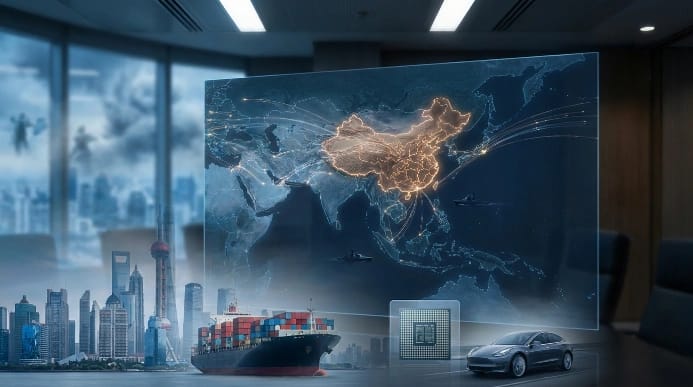
China Global Influence: Trade, Diplomacy and Strategic Reach
The balance of global power is changing, and China global influence is becoming increasingly difficult to ignore.
While the United States and its allies remain focused on conflicts and security challenges in the Middle East and Ukraine, Beijing is continuing to strengthen its position across the Asia-Pacific.
Recent developments have included Chinese maritime activity near Southeast Asian countries, military exercises around disputed areas, a submarine-launched missile test and cyber operations targeting Taiwan, according to Reuters.
At the same time, China is expanding its economic reach.
Chinese exports jumped almost 24% year over year in July, while the country recorded a trade surplus of about $113 billion, according to Reuters reporting. Much of the growth is increasingly connected to electric vehicles, batteries, technology and other advanced products.
This creates an important question:
Is China simply responding to a changing world, or is Beijing actively using global uncertainty to accelerate its rise?
The answer is probably a combination of both.
China isn’t creating every crisis distracting the world’s major powers. But Beijing can use periods of international uncertainty to strengthen relationships, expand economic influence and improve its strategic position.
And that could have consequences far beyond Asia.
What Is Driving China’s Global Influence?
China global influence is built on several different forms of power.
Military strength is one part.
Economic size is another.
Technology, trade, diplomacy and supply chains are also becoming increasingly important.
This matters because modern geopolitical competition isn’t decided only by armies.
A country that controls important manufacturing capacity, technology supply chains and strategic industries can influence other countries without deploying troops.
China has spent years building exactly this kind of influence.
Its manufacturing base gives it an enormous role in global trade, while its growing capabilities in electric vehicles, batteries, renewable-energy equipment and technology give Beijing additional economic leverage.
At the same time, China is expanding diplomatic and security relationships throughout the developing world.
The result is a more complicated form of global power.
Why the Asia-Pacific Is the Main Battleground
The Asia-Pacific sits at the center of China global influence because it combines economic importance with major security disputes.
China has territorial disputes or strategic tensions involving several countries in the region.
These include:
- Taiwan
- Philippines
- Japan
- Vietnam
- India
- Other South China Sea states
China’s military modernization has made the regional balance more complicated.
But military power isn’t the only factor.
Many Asian countries have deep economic relationships with China while maintaining security relationships with the United States.
That creates a difficult balancing act.
Countries don’t necessarily want to choose completely between Washington and Beijing.
They often want trade with China while relying on American or regional partnerships for security.
That gives China considerable room to expand its influence without every neighboring country becoming a formal ally.
China Is Increasing Its Maritime Activity
One of the clearest signs of changing regional dynamics is China’s expanding maritime activity.
Reuters reported that Chinese underwater drones were found near Indonesia and the Philippines, while Beijing has continued military drills and maritime operations around disputed areas.
China has also carried out military activities involving Japan and other parts of the region.
For Beijing, maritime power serves several purposes.
It protects trade routes.
It strengthens China’s military position.
It demonstrates technological capabilities.
And it gives China greater influence over waters that are strategically important to the global economy.
But neighboring countries view some of these actions very differently.
For them, increased Chinese activity can create uncertainty about future security.
That is why the Asia-Pacific is becoming one of the most important areas of global geopolitical competition.
The U.S. Has a Difficult Strategic Problem
The expansion of China global influence creates a major challenge for Washington.
The United States has strategic commitments across several regions simultaneously.
It must consider:
- Europe and Ukraine
- The Middle East
- Taiwan
- Japan
- South Korea
- The Philippines
- Trade relations with China
- Technology competition
That creates a problem of limited resources.
Military resources are limited.
Diplomatic attention is limited.
Political attention is limited.
And government budgets are limited.
China doesn’t necessarily need the United States to completely leave the region.
It may simply benefit when Washington has fewer resources available for Asia.
Reuters recently described China’s current strategy as increasingly assertive while the world focuses heavily on conflicts elsewhere.
That doesn’t mean a major confrontation is inevitable.
In fact, both Washington and Beijing have strong reasons to avoid a direct conflict.
But competition can intensify even without war.
China’s Economic Power Is Becoming a Geopolitical Tool
Perhaps the most important part of China global influence is economic.
China remains deeply connected to global manufacturing.
But the nature of that manufacturing is changing.
China is increasingly competing in advanced industries such as:
- Electric vehicles
- Batteries
- Solar technology
- Industrial equipment
- Artificial intelligence
- Semiconductors
- Robotics
- Renewable-energy technology
This matters because advanced manufacturing creates influence.
Countries that depend on another country for critical technologies or products have fewer strategic options.
China’s export numbers demonstrate how powerful this economic engine remains.
Reuters reported that Chinese exports rose roughly 24% year over year in July, while the country generated a trade surplus of around $113 billion.
That is particularly notable because China’s domestic economy continues to face challenges.
Instead of relying entirely on domestic consumers, Chinese manufacturers are increasingly looking toward international markets.
China’s New Export Push Could Change Global Competition
The latest export boom has been described by some economists as “China Shock 2.0.”
The first China shock was associated with China’s enormous manufacturing expansion following its integration into the global trading system.
The new phase looks different.
Instead of focusing primarily on basic manufactured goods, Chinese companies are increasingly competing in sophisticated products.
Electric vehicles are one example.
Batteries are another.
AI-related equipment and advanced technology are increasingly important as well.
Reuters reported that Chinese exports in July were supported by strong demand for high-tech products linked to the global AI infrastructure boom.
This could create opportunities for consumers around the world.
But it could also create serious political tension.
American and European manufacturers may struggle to compete with China’s combination of manufacturing scale, supply-chain depth and aggressive pricing.
That is where economics and geopolitics begin to merge.
Southeast Asia Doesn’t Want to Pick One Side
One of the most interesting aspects of China global influence is that Beijing doesn’t necessarily need Southeast Asian countries to become formal allies.
Many governments in the region prefer a balancing strategy.
They may want:
Chinese trade + American security + regional independence.
This approach allows countries to benefit from China’s enormous economy while maintaining relationships with the United States and other powers.
Indonesia provides an interesting example.
Reuters reported that despite concerns about Chinese activity, Indonesia has also engaged in joint military exercises with China.
This doesn’t mean Indonesia has chosen Beijing.
It demonstrates something more important:
Regional countries are trying to keep their options open.
That makes Southeast Asia one of the most important arenas in the competition between China and the United States.
Taiwan Remains the Biggest Flashpoint
Any discussion of China global influence eventually leads to Taiwan.
Beijing considers Taiwan part of China and has repeatedly rejected the idea of permanent Taiwanese independence.
Taiwan, meanwhile, operates as a self-governing democracy.
The United States maintains an important but complicated relationship with Taiwan.
That creates one of the world’s most dangerous geopolitical flashpoints.
China’s military pressure around Taiwan has increased over recent years, including military exercises and other forms of pressure.
But there is a major difference between applying pressure and launching a war.
A conflict over Taiwan would carry enormous economic consequences.
It could disrupt semiconductor production.
It could affect shipping routes.
It could damage global financial markets.
And it could create a much wider confrontation between major powers.
For that reason, Taiwan will remain one of the most important issues shaping the future of China global influence.
Technology Is Becoming Part of China’s Power Strategy
Military and economic power are no longer separate from technology.
Artificial intelligence, semiconductors, robotics, telecommunications and advanced computing are becoming strategic assets.
China understands this.
Beijing has been investing heavily in domestic technology capabilities while attempting to reduce dependence on foreign suppliers.
At the same time, Chinese technology companies are becoming more competitive globally.
Recent reporting shows China’s AI industry continuing to advance, including domestic AI companies reporting increasingly competitive performance in specialized areas.
This matters because technological dependence can become geopolitical dependence.
If a country controls an important technology, it gains influence over the countries and businesses that rely on it.
That’s why the U.S.-China technology competition is likely to continue even if trade relations temporarily improve.
The Global Economy Is Becoming More Fragmented
The rise of China global influence is happening at the same time as globalization itself is changing.
For decades, companies largely focused on producing goods where costs were lowest.
Now governments increasingly ask different questions:
Where are our critical products manufactured?
Who controls our supply chains?
Can we access essential technology during a crisis?
Are we too dependent on one country?
That is leading companies and governments to diversify production.
The Light Span has already covered this broader shift toward strategic economic competition, where supply chains and trade relationships increasingly reflect national-security considerations rather than cost alone.
China is adapting to this new environment by expanding production overseas and developing stronger relationships with emerging markets.
Could China’s Influence Continue Growing?
There are strong reasons to believe it could.
China has:
- A huge manufacturing base
- A massive domestic market
- Advanced industrial capabilities
- Growing military power
- Strong trade relationships
- Expanding technology capabilities
- Increasing diplomatic reach
But China’s rise isn’t guaranteed to continue without obstacles.
The country also faces significant challenges.
Its domestic economy has been weaker than policymakers would like.
Consumer demand remains a concern.
The property sector has experienced serious problems.
Trade restrictions from major economies could increase.
And other countries are increasingly trying to reduce strategic dependence on China.
That means China global influence is likely to expand unevenly rather than in a straight line.
Three Possible Futures
1. China becomes even more influential
If Chinese technology and manufacturing continue advancing while the U.S. remains strategically stretched, Beijing could gain additional influence across Asia, Africa, Latin America and other emerging markets.
2. The world becomes divided into competing blocs
The United States, China and their partners could increasingly build separate technology, trade and security networks.
This would make global commerce more expensive and complicated.
3. Competition stabilizes
Washington and Beijing could decide that cooperation in selected areas is more beneficial than constant confrontation.
Trade and technology competition would continue, but both sides could establish limits that reduce the risk of direct conflict.
The third scenario would probably be the most beneficial for the global economy.
But it may also be the most difficult to achieve.
What Businesses Should Watch
The changing balance of China global influence isn’t only important for governments.
Businesses should pay attention too.
Companies with significant exposure to China should monitor:
Trade restrictions
New tariffs and export controls could change supply-chain economics.
Technology rules
Semiconductor and AI restrictions can affect entire industries.
Shipping
Tensions in the Asia-Pacific could increase transportation costs and uncertainty.
Chinese competition
Manufacturers in Europe and North America may face increasing competition from Chinese companies.
Supply-chain diversification
Companies may increasingly adopt “China plus one” or multi-country manufacturing strategies.
The companies that understand these geopolitical changes early could have an advantage.
What This Means for the Rest of the World
The rise of China global influence doesn’t necessarily mean the United States is losing its global position.
The reality is more complicated.
The world may be moving toward a system where several major powers have significant influence at the same time.
The United States remains a dominant military, financial and technological power.
China has enormous manufacturing capacity and a rapidly developing technology ecosystem.
India is becoming increasingly important.
Europe remains a major economic bloc.
Middle powers are gaining more freedom to negotiate between competing powers.
This could produce a more fragmented world—but also a more competitive one.
The Light Span Perspective
The biggest mistake would be to view China’s rise as simply a story about military strength.
China global influence is much broader than that.
It is built through factories, ports, technology, trade, investment, diplomacy and military power.
And that makes China’s strategy particularly difficult to counter.
A country doesn’t need to control every institution to become influential.
It can become essential to the global economy.
It can build relationships with countries that don’t want to choose between Washington and Beijing.
It can dominate important supply chains.
It can invest in technologies that other countries need.
And it can expand its military capabilities at the same time.
That appears to be the direction China is pursuing.
The current global environment may give Beijing additional opportunities, particularly while other major powers are dealing with conflicts and competing priorities. Recent Reuters reporting highlights exactly this dynamic across the Asia-Pacific.
But China’s growing influence also creates a difficult balancing act.
If Beijing becomes too aggressive, neighboring countries may strengthen their security relationships with the United States and each other.
If China combines economic opportunity with predictable diplomacy, however, its influence could expand much further.
That is why the next phase of global competition won’t be decided by military power alone.
It will be decided by who can build the strongest combination of technology, trade, alliances and economic resilience.
And China is clearly trying to compete on all four fronts.
FAQs
What is China global influence?
China global influence refers to Beijing’s growing ability to affect international politics, trade, technology, security and economic relationships through its military, economic, diplomatic and technological power.
Why is China’s influence increasing?
China has a large manufacturing base, extensive trade relationships, growing technological capabilities and an increasingly capable military. These different forms of power reinforce one another.
Is China becoming more powerful than the United States?
China is becoming more influential in several areas, particularly manufacturing and trade, but the United States remains a major global power with significant advantages in finance, technology, military capabilities and alliances. The competition is multidimensional rather than a simple ranking.
Why is Southeast Asia important to China?
Southeast Asia is geographically close to China, contains strategically important shipping routes and includes rapidly growing economies. Many countries in the region also have strong economic ties with both China and the United States.
Why is Taiwan important?
Taiwan is strategically important because of its location, semiconductor industry and relationship with both China and the United States. A conflict could have major consequences for global trade and technology.
Is China using economic power to gain political influence?
Economic relationships can create diplomatic influence, although the strength of that influence varies by country. China’s trade, investment and manufacturing relationships give Beijing important connections across many regions.
Could China global influence continue growing?
Yes, but its future growth will depend on economic performance, technological progress, relations with neighboring countries, trade restrictions and competition with the United States and other major powers.
Continue reading more

