


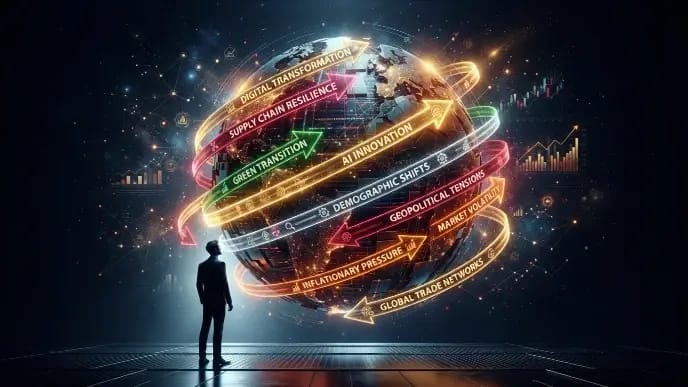
Global Economic Risks 2026: What Could Weaken Growth
The global economy has survived years of extraordinary disruption. A pandemic, inflation shock, wars, higher interest rates, trade tensions and rapid technological change have all tested businesses and households.
Yet the world economy has kept growing.
That resilience is encouraging—but it should not hide the global economic risks 2026 has brought into focus.
The International Monetary Fund expects the world economy to expand by about 3.0% in 2026 and 3.4% in 2027. However, the IMF also warns that global progress on reducing inflation has stalled and that growth remains uneven.
The OECD similarly sees modest global growth while highlighting risks from energy prices, geopolitical conflict and trade uncertainty.
At the same time, artificial intelligence is creating enormous investment opportunities, international investment is becoming more concentrated, and companies are redesigning supply chains around resilience rather than simply finding the lowest costs.
The result is not necessarily a global recession.
Instead, the world is entering a period in which economic growth could continue while risks become more complicated.
Here are seven global economic risks 2026 that businesses, investors and consumers should understand.
Key Takeaways
- The global economy is still expanding, but growth remains relatively weak and uneven.
- Inflation has proven harder to eliminate than many expected.
- Energy and geopolitical shocks can quickly create new inflation pressure.
- Global trade growth is expected to slow significantly in 2026.
- High debt and borrowing costs leave some governments with less room to respond to future crises.
- AI is supporting investment and growth, but the benefits are highly concentrated.
- Global investment is increasingly flowing toward a smaller group of economies and strategic industries.
- Supply-chain resilience is becoming as important as cost efficiency.
1. Global Growth Is Resilient—but Not Particularly Strong
The first of the major global economic risks 2026 is straightforward: the world economy is growing, but not quickly enough to make all of its underlying problems disappear.
The IMF’s July World Economic Outlook Update projects 3.0% global growth in 2026, followed by 3.4% in 2027.
IMF — July 2026 World Economic Outlook Update
The IMF describes the outlook as uneven. Energy-importing and vulnerable economies are feeling pressure from geopolitical shocks, while economies connected to the AI technology supply chain are receiving a boost from investment and demand.
The OECD has a similarly cautious view. Its March interim outlook projected global growth of about 2.9% in 2026, with higher energy costs and conflict weighing against strong technology investment.
Different organizations use somewhat different assumptions and methodologies, so their numbers shouldn’t be treated as direct contradictions.
The bigger message is more important:
The global economy continues growing, but there is little room for complacency.
A major energy shock, financial-market correction or escalation in geopolitical conflict could weaken that growth.
For a broader look at the positive and negative forces shaping the year, our global economy outlook for 2026 examines the trends businesses should watch beyond the immediate risks.
2. Inflation Has Not Been Defeated
Inflation is another of the biggest global economic risks 2026.
The problem has changed.
Several countries are no longer experiencing the extreme inflation rates seen during earlier shocks, but getting inflation consistently back toward central-bank targets is proving difficult.
The IMF’s July assessment says that global disinflation has stalled.
That matters because inflation affects almost every part of the economy.
When prices remain elevated, households have less purchasing power.
Businesses face higher costs.
Central banks have less freedom to reduce interest rates.
Governments also pay more to finance debt when borrowing costs remain elevated.
Energy makes the situation particularly unpredictable.
Oil and natural gas affect transportation, manufacturing, agriculture, electricity and supply chains. A geopolitical shock that pushes energy prices higher can therefore spread into many other prices.
The relationship is not always immediate, but it can create a difficult cycle:
Energy shock → higher business costs → consumer-price pressure → cautious central banks → higher borrowing costs.
That makes inflation one of the most important risks to monitor through the rest of 2026.
3. Energy Shocks Can Spread Through the Entire Economy
Energy deserves its own place among the global economic risks 2026 because its impact extends far beyond oil companies.
When crude oil rises sharply, transportation becomes more expensive.
Airlines pay more for jet fuel.
Trucking companies pay more for diesel.
Shipping companies face higher operating costs.
Farmers can experience higher fuel and fertilizer expenses.
Manufacturers may face more expensive energy and transportation.
Those costs can eventually reach consumers.
The OECD specifically identifies higher energy prices and supply-chain disruption as forces that can raise costs and weaken demand. It also argues that improving energy efficiency and reducing dependence on imported fossil fuels can make economies less vulnerable to future geopolitical shocks.
This is why the global economy can be affected by events occurring thousands of miles from consumers.
A disruption to a strategically important energy route can influence inflation expectations, central-bank decisions and financial markets around the world.
Our Weekly Brief on AI, oil, markets and global power shifts explains how closely energy security, geopolitics and markets have become connected in 2026.
For businesses, energy resilience is becoming an economic strategy rather than simply an environmental issue.
4. Global Trade Is Losing Momentum
Trade is another important warning sign.
The OECD projects that global trade growth will slow from 5.0% in 2025 to 3.1% in 2026, before easing further to 2.9% in 2027.
Several forces are contributing.
Higher transportation and energy costs can reduce trade.
Tariffs can make imports more expensive.
Geopolitical tensions can push businesses away from certain suppliers.
Governments are also becoming more protective of industries they consider strategically important.
Semiconductors, critical minerals, batteries, artificial intelligence and energy infrastructure are increasingly treated as national-security concerns rather than ordinary traded products.
That doesn’t mean globalization is ending.
It means globalization is changing.
Businesses are increasingly using:
- reshoring,
- nearshoring,
- friend-shoring,
- multiple suppliers,
- regional manufacturing,
- and larger strategic inventories.
These strategies can make supply chains safer, but sometimes at a higher cost.
The shift is explored in more detail in our analysis of why global supply chains are moving closer to home, where we examine how companies are balancing resilience against efficiency.
For the global economy, this creates a difficult trade-off.
More resilient supply chains may reduce the damage from future disruptions.
But duplicating production and moving manufacturing to more expensive locations can also raise costs.
5. Debt and High Borrowing Costs Reduce the World’s Safety Margin
Debt is less dramatic than a market crash or oil shock, but it may be one of the most important long-term global economic risks 2026.
Governments often respond to economic crises by borrowing.
That can be extremely useful.
During recessions or emergencies, government spending can support households, protect businesses and stabilize financial systems.
But debt becomes harder to manage when interest rates remain high.
A larger share of government revenue may need to go toward interest payments.
That leaves less money available for:
- infrastructure,
- education,
- healthcare,
- defense,
- technology investment,
- and future economic support.
The IMF’s current policy recommendation reflects this concern: governments should rebuild fiscal space while maintaining price stability and improving their ability to respond to future shocks.
The danger isn’t that every highly indebted country will suddenly experience a crisis.
The more subtle problem is reduced flexibility.
Imagine another global downturn occurs.
Countries with strong public finances may have significant room to support their economies.
Highly indebted countries with expensive borrowing costs may have fewer options.
Debt therefore acts like a vulnerability that becomes most visible when another problem arrives.
6. AI Is Creating Growth—but It Is Also Creating a New Divide
Artificial intelligence is one of the most unusual parts of the global economic risks 2026 story because it is simultaneously an opportunity and a risk.
AI investment is helping support economic activity.
Companies are spending heavily on:
- data centers,
- semiconductor manufacturing,
- networking equipment,
- electricity generation,
- cooling infrastructure,
- cloud computing,
- and AI software.
The IMF explicitly notes that AI-related demand is helping economies integrated into the global technology value chain.
This could eventually produce major productivity gains.
But those benefits are not evenly distributed.
Countries with advanced semiconductor industries, reliable electricity, capital markets, skilled workers and large technology companies are better positioned to capture AI investment.
Other countries risk falling behind.
This is why our analysis of the global race for AI leadership focuses not only on AI models but also chips, infrastructure, talent and investment.
There is another risk.
The amount of capital flowing into AI infrastructure is enormous.
Our analysis of the AI infrastructure boom examines the central question facing the sector: whether future AI revenue will justify today’s extraordinary infrastructure spending.
If productivity and revenue rise as expected, the investment could help drive a powerful new economic cycle.
If expectations run far ahead of actual returns, financial markets could eventually reprice AI-related assets.
That makes AI both a major source of economic optimism and an emerging source of concentration risk.
7. Global Investment Is Becoming More Uneven
The final warning sign among the global economic risks 2026 is not a collapse in investment.
It is the concentration of investment.
UN Trade and Development’s World Investment Report 2026 shows that global foreign direct investment rose 6% to $1.6 trillion in 2025, ending two years of decline.
At first glance, that sounds strongly positive.
Look deeper, however, and the picture changes.
The world’s top 20 destination economies captured more than 80% of global FDI, while developed-economy inflows increased 11% and developing economies saw only 2% growth. Much of the overall increase was also linked to a relatively small number of large projects, particularly AI-related digital infrastructure.
UNCTAD — World Investment Report 2026
This tells us something important about the modern economy.
Capital is available.
But it isn’t being distributed evenly.
Countries with attractive technology ecosystems, reliable infrastructure, skilled workers and relatively stable business environments may receive increasingly large investments.
Countries lacking those advantages risk falling further behind.
UNCTAD also says the outlook for 2026 remains affected by trade-policy uncertainty, geopolitical tensions, conflict, financing costs and economic fragmentation.
That makes investment concentration both a symptom and a cause of the widening differences between economies.
Are We Heading Toward a Global Recession?
Not necessarily.
This distinction is important.
The global economic risks 2026 do not automatically mean the world is heading toward recession.
The IMF still expects positive global growth this year and an acceleration in 2027.
Technology investment remains strong.
Consumers continue spending in many economies.
International investment is still flowing.
And many supply chains have become more adaptable after years of disruption.
The problem is vulnerability.
Several risks could interact.
For example:
Geopolitical conflict
could push up
energy prices
which could increase
inflation
which could keep
interest rates higher
which could increase
debt pressure
and weaken
business investment and consumer spending.
No individual risk needs to trigger a crisis by itself.
The concern is what happens when several occur together.
What Could Improve the Global Economic Outlook?
There are also meaningful upside possibilities.
The global economy could perform better than expected if geopolitical tensions decline, energy prices stabilize and inflation resumes falling.
Lower inflation could give central banks more flexibility.
Lower borrowing costs could support housing, investment and consumer demand.
AI could begin delivering stronger productivity improvements outside the technology industry.
Trade agreements could reduce uncertainty.
And supply-chain diversification could make businesses less vulnerable to sudden disruptions.
The IMF describes risks as more balanced than earlier in the year, even though conflict and financial-market repricing remain important downside threats.
That is why describing 2026 as simply a “bad economy” would be misleading.
It is better described as a resilient but unusually uneven economy.
What Should Businesses Do About These Risks?
Businesses cannot predict wars, central-bank decisions or commodity prices perfectly.
Trying to do so isn’t the best strategy.
Resilience is.
Companies can reduce exposure by diversifying suppliers rather than relying heavily on one region.
They can examine how higher energy prices would affect margins.
Businesses carrying significant debt should understand what happens if borrowing costs stay elevated longer than expected.
Companies should also distinguish useful AI adoption from AI spending driven only by hype.
And international businesses should monitor currency risk because exchange-rate changes can quickly affect the cost of imported products, overseas revenue and international investments.
Most importantly, companies should build plans around several possible economic scenarios rather than relying on one forecast.
The organizations best prepared for uncertainty are rarely those that predict every event correctly.
They are those capable of adapting when the forecast turns out to be wrong.
What Do These Economic Risks Mean for Consumers?
Consumers don’t need to become economists to understand the effects.
Several indicators matter directly to household finances.
Inflation
Persistent inflation reduces purchasing power.
Interest rates
Higher rates can make mortgages, auto loans, business loans and other forms of credit more expensive.
Energy prices
Higher oil and gas prices can affect transportation, electricity and the cost of goods.
Employment
Slower economic growth can make businesses more cautious about hiring.
Financial markets
Economic uncertainty can create volatility in retirement accounts and investments.
The most useful response is usually not attempting to predict the next recession.
It is maintaining financial flexibility.
Emergency savings, manageable debt and diversified long-term investments can make households less vulnerable to economic shocks.
FAQs
What are the biggest global economic risks in 2026?
The biggest global economic risks 2026 include persistent inflation, geopolitical and energy shocks, slower trade growth, high debt and borrowing costs, uneven AI-driven growth, concentrated investment and supply-chain fragmentation.
Is the global economy in recession in 2026?
No. The IMF currently projects global economic growth of approximately 3.0% in 2026, meaning the world economy as a whole is still expanding.
Why is inflation still a risk?
Inflation has fallen from previous peaks in many economies, but the IMF says global disinflation has stalled. Energy shocks and supply disruptions could also create renewed price pressure.
Is global trade declining?
Not overall. Trade is still growing, but the OECD expects the growth rate to slow from 5.0% in 2025 to approximately 3.1% in 2026.
Is AI helping the global economy?
Yes. AI-related investment is supporting technology industries, infrastructure construction and economies connected to the technology supply chain. However, the benefits are uneven and heavy investment also creates financial risks if future returns disappoint.
Could there still be a global recession?
It remains possible, particularly if several shocks occur simultaneously. Current major forecasts, however, continue to project positive global growth rather than a worldwide recession.
The Light Span Perspective
The most important thing about the global economic risks 2026 is not any single warning sign.
It is how connected they have become.
A geopolitical conflict can become an energy shock.
An energy shock can become an inflation problem.
Inflation can change interest-rate policy.
Higher interest rates can make government and corporate debt more expensive.
At the same time, AI can create extraordinary investment opportunities—but also concentrate capital, electricity demand and technological power in a relatively small number of countries and companies.
Meanwhile, businesses are redesigning supply chains to survive a world in which geopolitics matters almost as much as production costs.
That makes the global economy difficult to describe with a single word such as strong, weak, bullish or recessionary.
A better description is:
Resilient, but increasingly divided and interconnected.
The world economy has repeatedly demonstrated an ability to absorb shocks.
That resilience should not be underestimated.
But resilience is not immunity.
The countries, businesses and households best positioned for the remainder of 2026 will likely be those that recognize the risks without becoming paralyzed by them.
Economic uncertainty doesn’t eliminate opportunity.
It simply makes adaptability more valuable.
Continue reading

