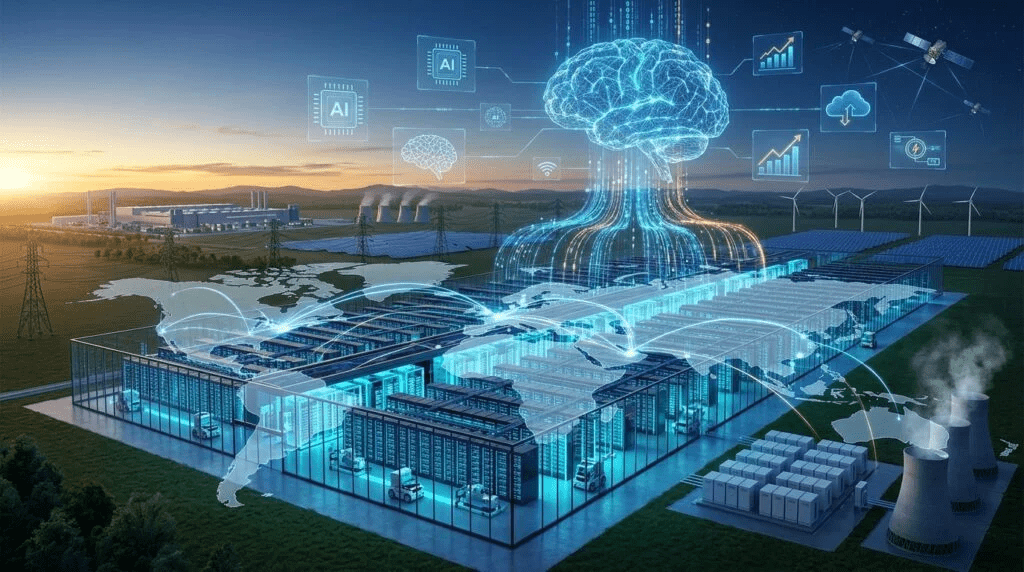



AI data centers have become strategic real estate because their value comes from far more than the buildings. A viable site needs large and dependable electricity connections, advanced cooling, fiber routes, water or alternative heat-management systems, secure land, specialist labor and access to thousands of high-performance chips.
Those requirements make suitable locations scarce. Technology companies can buy servers, but they cannot instantly create a new transmission line, substation or planning approval. The AI infrastructure race is therefore becoming a contest for physical capacity—and the bottlenecks around power and construction may determine which companies and regions can scale fastest.
Quick Take
- Artificial intelligence is driving one of the largest infrastructure investment cycles since the rise of the internet and cloud computing.
- AI data centers have become strategic assets, requiring billions of dollars in investment, advanced semiconductors, high-speed networking, and enormous amounts of electricity.
- Governments and technology companies are competing to secure computing capacity, energy resources, and semiconductor supply chains that will power the next generation of AI.
- The AI infrastructure boom is creating opportunities across industries—from utilities and construction to real estate, cooling technologies, and fiber-optic networks.
- The countries that build the strongest AI infrastructure today may gain a lasting competitive advantage in tomorrow’s digital economy.
The Real AI Race Is Happening Behind Closed Doors
Artificial intelligence is often discussed through the lens of chatbots, image generators, and digital assistants.
These applications capture public attention, but they represent only the visible layer of a much larger transformation.
Behind every AI model capable of answering questions, generating code, or analyzing massive datasets lies an enormous physical infrastructure built to process staggering amounts of information. Hidden inside highly secure facilities are thousands of advanced processors connected through ultra-fast networks, consuming vast quantities of electricity while operating around the clock.
This infrastructure has become the foundation of the AI economy.
As demand for artificial intelligence accelerates, governments, technology companies, and investors are committing hundreds of billions of dollars to expand the computing capacity needed to support future innovation.
The global competition is no longer just about building better AI models.
It is increasingly about building the digital factories where those models are created and operated.
AI Is Triggering a New Infrastructure Supercycle
Every major technological revolution has required a massive investment in physical infrastructure.
The industrial age depended on railways, ports, and factories.
The internet era required fiber-optic cables, mobile networks, and cloud computing.
Artificial intelligence is now creating the next infrastructure supercycle.
Training modern AI models requires specialized hardware, advanced networking, sophisticated cooling systems, reliable electricity, and highly secure facilities capable of operating continuously.
Unlike traditional software, AI cannot scale without equally significant investment in the physical systems that support it.
Industry analysts increasingly view AI infrastructure as one of the defining long-term investment themes of the decade.
Why It Matters
History shows that breakthrough technologies create lasting economic value only when supported by the infrastructure capable of delivering them at scale.
Data Centers Have Become the Factories of the Digital Economy
Modern AI data centers bear little resemblance to the server rooms that powered the early internet.
Today’s facilities are purpose-built computing campuses designed to handle workloads that require extraordinary processing power.
A single AI-focused data center may contain:
- Tens of thousands of AI accelerators and GPUs
- High-bandwidth networking equipment
- Specialized liquid cooling systems
- Massive battery backup installations
- Advanced cybersecurity infrastructure
- Redundant power systems operating 24/7
These facilities can cost several billion dollars to construct and require years of planning, permitting, and engineering.
As a result, data centers have become some of the world’s most valuable forms of commercial infrastructure.
Why It Matters
The ability to deploy AI increasingly depends on access to computing capacity, making data centers strategic assets rather than ordinary real estate.
Computing Power Is Becoming a Strategic Resource
Throughout history, nations competed for access to oil, steel, shipping lanes, and industrial capacity.
Today, computing power is emerging as another strategic resource.
Advanced AI systems require specialized processors capable of performing trillions of calculations every second.
Demand for these chips has accelerated investment across the semiconductor industry, including:
- Chip design
- Wafer fabrication
- Advanced packaging
- Memory technologies
- High-speed networking
- Semiconductor manufacturing equipment
Governments around the world have introduced industrial policies to strengthen domestic semiconductor production, recognizing that future economic competitiveness increasingly depends on computing infrastructure.
Why It Matters
Access to advanced computing is becoming as strategically important as access to energy or transportation infrastructure.
Electricity Has Become the New Competitive Advantage
One of the least discussed aspects of artificial intelligence is its extraordinary appetite for electricity.
Training frontier AI models and operating large-scale inference systems requires enormous amounts of energy.
As new data centers are built, electricity demand is increasing rapidly, forcing utilities, governments, and technology companies to rethink long-term energy planning.
Investment is accelerating across:
- Renewable energy
- Natural gas generation
- Nuclear power
- Battery storage
- High-voltage transmission
- Smart electricity grids
Regions capable of providing abundant, reliable, and affordable electricity are becoming increasingly attractive destinations for AI infrastructure investment.
Energy policy and technology policy are now more interconnected than at any point in recent history.
Why It Matters
The future leaders of artificial intelligence may be determined not only by software innovation but also by access to dependable energy.
AI Infrastructure Is Reshaping Real Estate Markets
The AI boom is also transforming commercial real estate.
Locations once selected primarily for office developments are now competing to attract hyperscale data centers.
Developers increasingly evaluate sites based on factors including:
- Access to high-capacity electrical grids
- Fiber-optic connectivity
- Land availability
- Water resources for cooling
- Regulatory certainty
- Climate conditions
- Skilled technical workforce
Entire regions are positioning themselves as future AI infrastructure hubs by investing in utilities, transportation, and digital connectivity.
This has elevated certain industrial properties into some of the most strategically valuable real estate assets in the world.
Why It Matters
The definition of prime real estate is expanding beyond city centers to include locations capable of supporting the digital economy.
An Entire Industrial Ecosystem Is Benefiting
Artificial intelligence is not creating a single winning industry.
Instead, it is generating demand across a broad industrial ecosystem.
Companies positioned to benefit include:
- Semiconductor manufacturers
- Cloud computing providers
- Data center developers
- Networking equipment suppliers
- Construction firms
- Industrial cooling specialists
- Power utilities
- Renewable energy developers
- Fiber-optic infrastructure companies
- Engineering and automation firms
This interconnected ecosystem demonstrates that AI is driving growth far beyond software development alone.
Why It Matters
The economic impact of artificial intelligence extends across manufacturing, infrastructure, energy, construction, and industrial technology.
Challenges Could Shape the Next Phase of Growth
Despite extraordinary investment, important challenges remain.
Organizations must address issues such as:
- Rising electricity demand
- Grid capacity constraints
- Semiconductor supply risks
- Water consumption for cooling
- Cybersecurity threats
- Skilled labor shortages
- Environmental sustainability
- Long project development timelines
Investors are also asking whether today’s pace of spending will generate sufficient long-term returns as AI adoption continues to mature.
Managing these challenges will require close cooperation between governments, utilities, technology companies, and infrastructure developers.
Why It Matters
Building the AI economy requires solving physical infrastructure challenges as well as technological ones.
Looking Ahead: The Infrastructure Economy of AI
Artificial intelligence is entering a phase where infrastructure may matter just as much as algorithms.
Future competitiveness will depend on the ability to build integrated ecosystems combining:
- Advanced computing
- Reliable electricity
- High-speed connectivity
- Semiconductor manufacturing
- Cloud platforms
- Skilled engineering talent
Rather than slowing, infrastructure investment is expected to remain a defining feature of AI development throughout the remainder of the decade.
As enterprises adopt AI more broadly, demand for secure, scalable computing resources is likely to continue expanding across nearly every major industry.
What the Infrastructure Race Means Now
Artificial intelligence is no longer simply transforming software.
It is reshaping the physical foundations of the global economy.
Data centers have become the factories of the digital age, computing power has emerged as a strategic resource, and electricity has become a critical driver of technological competitiveness.
The race now extends far beyond AI models themselves.
It encompasses semiconductors, energy systems, industrial construction, cloud infrastructure, telecommunications, and global supply chains.
Just as railroads powered the Industrial Revolution and broadband enabled the internet economy, AI infrastructure is laying the foundation for the next era of global growth.
The organizations—and nations—that invest wisely today are helping build the digital backbone of tomorrow’s economy.
What Makes an AI Data-Center Site Valuable?
Traditional property is usually judged by location, tenants and expected rent. AI data-center property adds a different set of questions: how many megawatts can the grid deliver, how quickly can capacity be expanded, how resilient are the fiber connections, and can the site remove heat from increasingly dense computing racks? A warehouse with no near-term power allocation may be far less useful than a smaller parcel beside a suitable substation.
The power requirement is growing quickly. The International Energy Agency projects global data-center electricity consumption to reach roughly 945 terawatt-hours by 2030 in its base case, around double the 2024 level. It also estimates that consumption grew 17% in 2025, with AI-focused facilities growing faster than the overall data-center market.
Power availability can outrank geography
Low latency still matters for many applications, but the largest training jobs can sometimes be placed farther from major cities if electricity and networks are available. This gives energy-rich regions a new economic opportunity. Hydropower, nuclear generation, natural gas and rapidly expanding renewable systems can all attract computing investment, depending on cost, reliability and corporate climate targets.
At the same time, the AI power-grid bottleneck can delay projects for years. Grid connections require transformers, switchgear, transmission upgrades and regulatory approval. That is why technology groups are signing long-term power agreements and exploring on-site generation rather than treating electricity as a routine utility expense.
The investment reaches far beyond servers
Every new cluster creates demand for construction, electrical equipment, cooling systems, backup power, network hardware, security and maintenance. The chips receive most of the attention, but the surrounding infrastructure can be just as decisive. Alphabet, for example, said through its 2026 disclosures that it expected technical-infrastructure investment to rise significantly from 2025, reinforcing how the AI spending cycle reaches across the physical economy.
Materials matter too. Servers, power electronics and grid equipment depend on complex supply chains. Pressure on copper, transformers and critical minerals can increase costs even if semiconductor supply improves. A data center is therefore not one product; it is a coordinated industrial project.
Why overbuilding remains a risk
Scarcity does not guarantee that every project will succeed. AI models may become more efficient, customers may concentrate workloads with a few providers, and capital costs can rise before facilities begin earning revenue. Local opposition can also grow when residents believe data centers are competing for electricity or water without creating enough jobs.
Investors should distinguish between announced capacity and energized capacity. A press release does not mean a site has permits, grid access, customers or financing. The strongest assets will combine contracted demand with credible construction schedules and power arrangements.
The long-term direction remains clear: computing is becoming a form of industrial infrastructure. But the winners will not necessarily be the owners of the largest land portfolios. They will be the companies and regions able to coordinate chips, capital, energy and community support. That connection between digital demand and physical limits also explains why AI data centers use so much electricity and why energy policy is now part of technology strategy.
The Light Span Perspective
History often remembers breakthrough technologies, but it is infrastructure that determines whether those breakthroughs transform society. The steam engine required railways. The automobile required highways. The internet required fiber-optic networks and cloud computing. Artificial intelligence is following the same pattern. At The Light Span, we believe the defining story of the AI era is not simply smarter algorithms—it is the unprecedented race to build the computing power, energy systems, and digital infrastructure that will support the world’s next generation of innovation. Those who understand this shift aren’t just watching technology evolve; they’re watching the foundations of a new economic era being built.
Continue reading more