


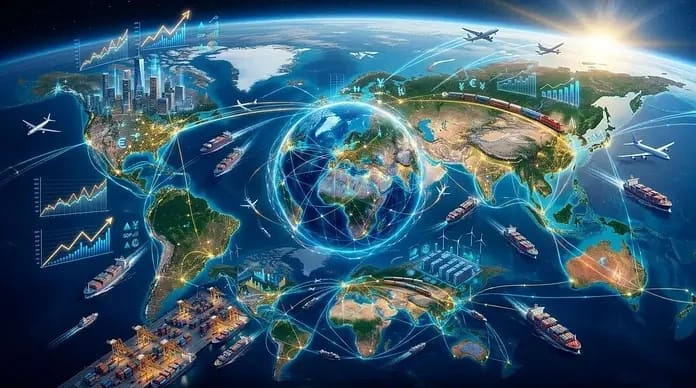
Global Economy Outlook 2026: Growth and Trade Trends
The global economy entered 2026 hoping for greater stability.
Instead, the year has delivered two powerful forces moving in opposite directions.
On one side, conflict in the Middle East has pushed energy prices higher, complicated trade and increased inflationary pressure.
On the other, enormous investment in artificial intelligence, data centers, semiconductors and related infrastructure is supporting economic activity in countries connected to the technology boom.
The result is an unusually divided global economy outlook for 2026.
The International Monetary Fund’s latest World Economic Outlook Update projects global economic growth of 3.0% in 2026, followed by 3.4% in 2027. The IMF describes the outlook as a struggle between the drag from war and the support provided by technology investment.
The World Bank is more cautious. Its June 2026 Global Economic Prospects report projects global growth of 2.5% in 2026, down from 2.9% in 2025, largely because of the energy shock associated with the Middle East conflict.
Different forecasting methodologies produce different numbers, but the message is similar:
The world economy is still growing, but growth is fragile, uneven and unusually dependent on geopolitics, energy and technology.
Here are seven trends defining the global economic outlook in 2026.
1. Global Growth Is Slowing—but the World Is Not in Recession
The first important distinction is between slow growth and recession.
The global economy is not currently forecast to contract in 2026.
But growth is weak compared with many previous periods of expansion.
The World Bank expects growth to slow from 2.9% in 2025 to 2.5% this year before improving to 2.8% in 2027. It says forecasts for roughly two-thirds of economies were downgraded compared with its January projections.
The IMF is somewhat more optimistic, projecting 3.0% growth this year.
Why the difference?
Economic institutions use different methodologies, country weights and assumptions. What matters more than the exact decimal is the direction.
Growth has weakened.
Higher energy costs reduce household purchasing power.
Businesses face greater uncertainty.
Some governments have limited room to stimulate their economies because debt levels are already high.
Interest rates remain restrictive in many places.
And geopolitical tensions are making investment decisions more complicated.
Yet the world economy has shown surprising resilience.
The IMF says the economic shock from the Middle East conflict has so far been less severe than initially feared. Oil inventories, production outside the Gulf, renewable energy and lower energy intensity have helped economies absorb part of the shock.
This means the most realistic description of 2026 is not a global recession.
It is uneven resilience under pressure.
Some economies are benefiting from technology investment or commodity exports.
Others are being hit much harder by expensive energy and weak external demand.
That divergence is one of the defining features of the year.
2. Inflation Has Become a Problem Again
At the beginning of 2026, many policymakers hoped the inflation crisis was moving decisively into the past.
That assumption has become less certain.
The IMF’s July update says global disinflation has stalled and forecasts global headline inflation at approximately 4.7% in 2026.
Energy is an important reason.
Oil and natural gas affect far more than what consumers pay directly for fuel.
Energy costs influence:
transportation,
manufacturing,
agriculture,
chemicals,
electricity,
air travel,
shipping,
and eventually consumer prices.
When energy becomes more expensive, companies often absorb some of the increase initially.
If high prices persist, however, those costs can gradually reach consumers.
This creates a difficult situation for central banks.
If policymakers cut interest rates too aggressively, inflation could accelerate again.
If they keep rates high for too long, borrowing becomes expensive and economic growth weakens.
The problem becomes particularly difficult when inflation comes from a geopolitical energy shock rather than excessive domestic demand.
Higher interest rates cannot produce more oil.
They can only reduce demand elsewhere in the economy.
The result is a delicate policy balancing act.
The risk also connects directly with why oil prices are rising again, because sustained energy disruption can influence inflation, interest rates and consumer confidence simultaneously.
For households, this means the cost-of-living crisis may improve more slowly than hoped.
Inflation falling from its previous peaks does not mean prices return to where they were.
It simply means they rise more slowly.
3. AI Investment Is Becoming a Real Macroeconomic Force
Artificial intelligence is normally discussed as a technology story.
In 2026, it is increasingly an economic growth story.
Building modern AI systems requires enormous investment.
Companies need:
advanced processors,
data centers,
electricity generation,
transmission infrastructure,
networking equipment,
cooling systems,
software,
construction,
and specialized workers.
This creates economic activity far beyond the technology companies developing AI models.
The IMF explicitly identifies AI-related investment as one of the forces supporting global growth in 2026. Its July outlook says technology momentum is partly offsetting the economic drag created by war and the energy shock.
That is significant.
AI investment has become large enough to appear directly in the global macroeconomic outlook.
This creates clear winners.
Countries producing advanced semiconductors benefit.
Regions attracting data-center construction gain investment.
Electricity suppliers see new demand.
Engineering and construction companies gain projects.
Technology firms increase capital spending.
Countries positioned inside this value chain can therefore grow faster than economies with limited exposure to the AI boom.
But there is an important warning.
Investment is not the same as productivity.
Companies can spend enormous amounts building AI infrastructure before the technology produces equally large improvements in economy-wide output.
The long-term economic payoff will depend on whether businesses successfully integrate AI into real workflows.
Still, 2026 has established something important:
AI is no longer economically significant only because technology stocks are valuable.
The infrastructure required to build and operate AI is becoming a major source of physical investment.
4. Global Trade Is Becoming More Regional and Strategic
Globalization is not disappearing.
But its structure is changing.
For decades, businesses primarily optimized international supply chains around efficiency.
Produce a component wherever it is cheapest.
Ship it to another country for assembly.
Move the finished product to the consumer.
Recent disruptions exposed the weakness of that approach.
Pandemic shortages were followed by geopolitical tensions, semiconductor restrictions, shipping disruptions and energy shocks.
Businesses have responded by placing greater value on resilience.
That is why nearshoring, friendshoring and supply-chain diversification are becoming more common.
Our deeper analysis of how the global supply chain is changing explains why companies are increasingly spreading production across countries such as India, Vietnam, Mexico, Indonesia and other manufacturing alternatives rather than relying excessively on one location.
This does not mean factories are simply leaving China.
A more common strategy is China Plus One.
Companies maintain existing Chinese production while building additional capacity somewhere else.
The objective is not necessarily lower costs.
It is insurance.
That marks a profound change in business thinking.
A supply chain that costs 3% more but survives a geopolitical disruption may ultimately be more valuable than the cheapest possible network.
The broader new era of global trade is therefore increasingly defined by a balance between efficiency and resilience.
This transformation could continue well beyond 2026.
5. Geopolitics Is Becoming an Economic Variable
Economists traditionally focus on indicators such as inflation, employment, productivity and interest rates.
Businesses now need another variable:
geopolitics.
Conflict can disrupt energy.
Sanctions can redirect trade.
Tariffs can change manufacturing decisions.
Technology restrictions can reshape semiconductor supply chains.
Maritime disruption can increase shipping costs.
Political tensions can change where companies invest billions of dollars.
The World Bank identifies escalating hostilities, further commodity-market disruptions and additional geopolitical strains among the major downside risks facing its 2026 outlook.
This is why global businesses increasingly need geopolitical risk analysis alongside conventional economic forecasting.
A factory may be highly efficient but strategically vulnerable.
A shipping route may be cheap but exposed to conflict.
A supplier may offer excellent prices but operate in a country facing possible sanctions.
The relationship between geopolitics and economics is becoming particularly visible in strategic industries such as:
semiconductors,
energy,
critical minerals,
defense,
pharmaceuticals,
telecommunications,
and artificial intelligence.
Governments increasingly treat these industries differently from ordinary commerce.
Security is becoming part of economic policy.
That creates costs.
Duplicating supply chains is expensive.
Subsidizing domestic factories is expensive.
Holding strategic reserves is expensive.
But governments increasingly view those costs as insurance against dependence on geopolitical rivals.
6. High Debt and Bond Yields Are Limiting Governments
Another major risk receives less attention than AI or oil:
debt.
Governments borrowed heavily during the pandemic.
Many entered 2026 with substantially larger debt burdens than they had a decade ago.
That would be easier to manage if interest rates were extremely low.
They are not.
When governments refinance debt at higher interest rates, more public money must be spent simply servicing existing obligations.
That can leave less money available for:
infrastructure,
healthcare,
education,
defense,
social programs,
and economic stimulus.
The problem becomes particularly serious for countries that need to borrow heavily while investors demand higher yields.
Our analysis of why bond yields are surging in 2026 examines how higher borrowing costs can move through governments, businesses, mortgages and financial markets.
This limits policymakers’ ability to respond to future shocks.
During a recession, governments often borrow and spend to support demand.
But countries already carrying high debt at expensive interest rates have less flexibility.
Developing economies can be especially vulnerable.
Higher U.S. and global interest rates can attract capital toward safer assets, weaken emerging-market currencies and make foreign-currency debt more difficult to service.
The World Bank warns that developing economies are facing particularly weak progress in per-capita income growth, with the Middle East shock adding further pressure.
Debt may therefore become one of the constraints determining which governments can respond effectively if another economic shock arrives.
7. Emerging Markets Face Both Opportunity and Risk
The global economy outlook 2026 looks very different depending on where you live.
Some emerging economies are benefiting from supply-chain diversification.
India and Southeast Asian economies can attract manufacturing investment.
Commodity exporters may benefit when energy or mineral prices rise.
Gulf economies are investing heavily in infrastructure and technology.
Countries connected to AI supply chains may benefit from the technology investment boom.
But emerging economies also face serious vulnerabilities.
Energy importers can be hit hard by higher oil prices.
Countries with dollar-denominated debt can struggle when currencies weaken.
Governments with limited fiscal capacity cannot easily protect households from price shocks.
Weak global demand can reduce exports.
The World Bank expects emerging-market and developing economies to face their weakest per-capita income growth since the pandemic.
This creates an unusually uneven picture.
A country gaining semiconductor factories or data centers may experience strong investment.
Another economy dependent on imported energy and external borrowing may face inflation, currency pressure and weaker growth.
This is why describing the global economy with a single growth number can be misleading.
The world economy may grow 2.5% or 3%.
But very few countries will experience exactly that outcome.
The Biggest Difference Between the IMF and World Bank Forecasts
Readers may reasonably wonder why two major international institutions produce different global growth forecasts.
The IMF expects 3.0% global growth in 2026.
The World Bank expects 2.5%.
This does not necessarily mean one is right and the other is wrong.
Their methodologies and country weighting differ.
Forecasts also change as new information becomes available.
The IMF’s update was released in July, while the World Bank’s major outlook was prepared earlier in June.
More importantly, both organizations identify similar forces.
Negative pressures:
Middle East conflict and energy disruption, persistent inflation, geopolitical uncertainty, high borrowing costs and vulnerability in developing economies.
Positive forces:
AI-related investment, resilient financial conditions in some economies, diversified energy supplies and the potential for stronger growth once current shocks fade.
The direction of the analysis therefore matters more than arguing over half a percentage point.
Both forecasts describe a world economy that is growing—but operating under considerable strain.
Is a Global Recession Still Possible?
Yes.
But it is not the baseline forecast.
A deeper Middle East conflict could create another energy shock.
A major disruption to global shipping could increase transportation costs.
Inflation could remain stubborn enough to prevent interest-rate cuts.
Financial markets could reprice risk sharply.
Debt problems could emerge in vulnerable economies.
Trade tensions could intensify.
The IMF says risks are more balanced than they were earlier in the year, but renewed conflict and financial-market repricing remain important downside possibilities.
Businesses therefore face a difficult planning environment.
They cannot assume recession.
But they cannot assume stability either.
This explains why global trade uncertainty has become such an important business issue. Companies increasingly need plans that remain workable across several economic scenarios rather than depending on one forecast.
Resilience is becoming an economic advantage.
What Could Make the Global Economy Stronger?
The outlook is not entirely negative.
Several developments could improve growth.
A reduction in geopolitical conflict could lower energy prices and restore business confidence.
Lower inflation could give central banks greater room to reduce interest rates.
Cheaper borrowing could revive housing, investment and consumer spending.
AI could begin producing broader productivity improvements.
Supply-chain diversification could reduce the economic impact of future disruptions.
Infrastructure investment could improve long-term growth.
The IMF expects growth to strengthen to 3.4% in 2027, while the World Bank expects its measure of global growth to recover to 2.8%.
That suggests current weakness does not necessarily represent the beginning of a prolonged global downturn.
Much depends on whether today’s shocks fade—or intensify.
What the 2026 Economy Means for Businesses
Businesses should resist planning around one economic scenario.
The current environment rewards flexibility.
Companies exposed to global trade can diversify suppliers.
Businesses with significant borrowing requirements can prepare for interest rates remaining higher than previously expected.
Energy-intensive companies can examine efficiency and alternative supplies.
Companies investing in AI should focus on measurable productivity rather than adopting technology simply because competitors are doing so.
International businesses also need to understand political risk.
Our existing coverage of the global trade transformation shows how manufacturing decisions increasingly depend on infrastructure, energy availability, political stability and trade relationships—not simply labor costs.
The companies best positioned for 2026 are therefore not necessarily those making the most optimistic forecasts.
They are those capable of adapting when forecasts are wrong.
What the Global Economy Means for Workers
Economic transitions eventually reach labor markets.
Slow growth can reduce hiring.
High interest rates can weaken investment.
Supply-chain relocation can create manufacturing jobs in some countries while reducing them elsewhere.
AI creates another layer.
Automation can reduce demand for some tasks while creating new occupations and increasing productivity elsewhere.
Our analysis of AI jobs in 2026 shows why the employment effects of technological change are much more complicated than simply counting jobs that can theoretically be automated.
Workers therefore face two simultaneous economic transitions:
a cyclical slowdown influenced by energy, inflation and interest rates, and a structural transformation driven by AI and automation.
Skills that complement technology may become increasingly valuable.
FAQs
What is the global economy outlook for 2026?
The global economy is expected to continue growing, although forecasts differ. The IMF projects 3.0% global growth in 2026, while the World Bank projects 2.5%. Both identify geopolitical and energy risks as significant challenges.
Is the global economy in recession in 2026?
No. Major international institutions currently expect positive global economic growth. However, growth is weak and uneven, and significant downside risks remain.
What is the biggest risk to the global economy?
A further escalation of geopolitical conflict that disrupts energy or commodity markets is among the most serious near-term risks. Debt, persistent inflation, high borrowing costs and trade fragmentation are also important.
Why is AI affecting global economic growth?
AI is generating enormous investment in data centers, semiconductors, electricity infrastructure, networking and software. The IMF says technology-driven investment is helping offset some of the economic drag from the Middle East energy shock.
Will inflation fall in 2026?
Inflation has declined from previous peaks in many economies, but the IMF says global disinflation has stalled following renewed energy pressures. Its July forecast puts global headline inflation at 4.7% for 2026.
Will global growth improve in 2027?
Both the IMF and World Bank expect improvement. The IMF forecasts 3.4% growth in 2027, while the World Bank projects 2.8% using its methodology.
The Light Span Perspective
The most important lesson from the global economy outlook 2026 is that the world is not experiencing one economic story.
It is experiencing several at once.
Energy-importing economies are absorbing another geopolitical shock. Technology-heavy economies are benefiting from an extraordinary AI investment boom. Some emerging markets are gaining factories as supply chains diversify, while others are struggling with expensive energy, debt and weaker currencies.
That explains why global economic data can sometimes appear contradictory.
Growth can slow while technology investment accelerates.
Inflation can decline in some categories while energy prices rise.
Globalization can weaken in one sense while international trade continues expanding in another.
The world economy is not simply shrinking or expanding.
It is being reorganized.
Supply chains are becoming more resilient. Technology infrastructure is becoming strategically important. Governments are paying more attention to energy security, industrial capacity and geopolitical dependence.
The IMF and World Bank disagree on the exact 2026 growth number, but their outlooks point toward the same reality: resilience remains surprisingly strong, yet risks remain unusually high.
The countries and businesses that navigate this period best may be those that prepare not for one predictable future, but for several possible ones.
Continue reading more

