


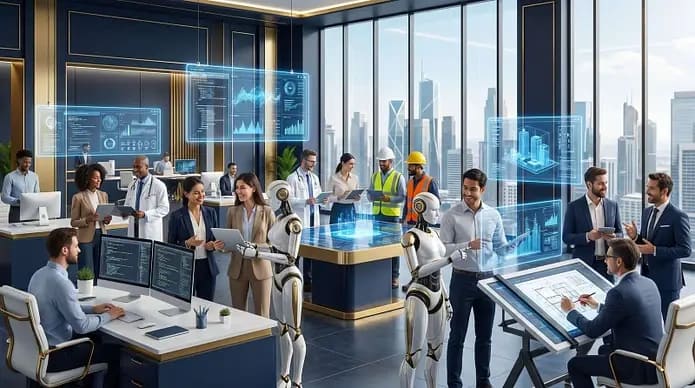
AI Jobs 2026: Where New Career Opportunities Are Emerging
Artificial intelligence is often presented as a threat to workers.
AI can write.
It can generate images.
It can analyze documents.
It can create software.
It can automate customer service.
And increasingly capable AI agents can complete multi-step tasks that previously required human workers.
That naturally creates an uncomfortable question:
What happens to jobs when machines can perform more of the work humans currently do?
But the employment story unfolding in 2026 is more complicated than a simple battle between humans and machines.
AI is eliminating or reducing demand for some tasks. It is putting particular pressure on routine digital work and could make entry-level career paths more difficult in certain industries.
At the same time, AI investment is creating entirely new roles, increasing demand for workers with complementary skills and generating enormous investment in data centers, semiconductors, electricity infrastructure, cybersecurity, software and robotics.
The World Economic Forum’s Future of Jobs Report estimates that broad economic and technological changes could create 170 million jobs globally by 2030 while displacing 92 million, resulting in a net increase of 78 million jobs. AI and information-processing technologies specifically are expected to contribute to both creation and displacement: employers surveyed expect them to create around 11 million jobs while displacing around 9 million.
That distinction is essential.
It would be misleading to say AI is simply “creating millions of jobs” without acknowledging that it is also disrupting existing ones.
The more accurate story is this:
AI is reorganizing the labor market.
Some occupations will grow.
Some will shrink.
Many will change.
And the workers who learn how to combine human expertise with artificial intelligence could have an important advantage.
Here are seven ways AI jobs in 2026 are changing the future of work—and what workers should do about it.
1. Entirely New AI Careers Are Emerging
Every major technological revolution creates jobs that previously did not exist.
Thirty years ago, careers such as social media manager, cloud architect, mobile app developer and search-engine optimization specialist either did not exist or were extremely uncommon.
Artificial intelligence is producing a similar effect.
Companies now need people who can:
build AI systems,
integrate AI into existing software,
evaluate model performance,
manage AI infrastructure,
secure AI systems,
prepare and govern data,
deploy AI applications,
and redesign business processes around automation.
Roles such as AI and machine-learning specialist are already among the occupations employers expect to grow fastest through 2030. Big-data specialists, software developers, FinTech engineers and security-related technology roles also rank highly.
The opportunity extends beyond engineers.
As companies deploy AI, they need people who understand both the technology and the business problem.
A hospital does not simply need an AI model.
It needs professionals who understand how that model fits into clinical workflows.
A bank needs people who understand financial regulations and AI.
A manufacturer needs people who understand production processes and intelligent automation.
A marketing company needs workers who understand customers, strategy and AI tools.
That creates demand for hybrid skills.
The valuable worker may increasingly be someone who understands a traditional profession and knows how to use AI effectively within it.
This is one reason the AI employment story cannot be measured simply by counting people with “AI” in their job title.
AI could transform millions of existing occupations without renaming them.
2. AI Is Creating a Massive Physical Infrastructure Economy
Chatbots feel like software.
Behind them sits an enormous physical industry.
Advanced AI requires:
semiconductor factories,
data centers,
high-speed networking,
memory,
electrical equipment,
cooling systems,
construction,
power generation,
and transmission infrastructure.
That creates jobs far beyond Silicon Valley.
The enormous AI infrastructure spending boom is turning artificial intelligence into a major capital-investment cycle. The Light Span has previously examined how hundreds of billions of dollars are flowing into the physical systems required to train and operate increasingly powerful models.
A new AI data center does not require only machine-learning engineers.
It may require:
electricians,
construction workers,
electrical engineers,
network technicians,
cooling specialists,
security personnel,
maintenance teams,
power-system engineers,
and equipment manufacturers.
Semiconductor expansion creates another employment ecosystem involving chip design, fabrication equipment, advanced materials, packaging and logistics.
Electricity demand creates yet another.
This is one of the least appreciated parts of AI job creation.
Artificial intelligence may be digital, but the infrastructure supporting it is intensely physical.
And as AI investment expands, part of its employment impact could increasingly appear in construction, energy, manufacturing and skilled trades rather than only software.
3. Existing Jobs Are Being Redesigned Rather Than Simply Eliminated
One of the strongest findings from labor-market research is that job exposure does not equal job elimination.
The International Labour Organization estimates that around one in four workers worldwide is employed in an occupation with some degree of exposure to generative AI.
But the ILO concludes that transformation is more likely than complete replacement for most occupations because human input remains necessary.
ILO — Generative AI and Jobs research
This distinction matters enormously.
A job consists of many tasks.
Consider a marketing professional.
Part of the job may involve writing first drafts.
AI can automate some of that.
But the same worker may also:
develop strategy,
speak with clients,
interpret market conditions,
approve creative decisions,
manage budgets,
coordinate teams,
and make judgment calls.
AI may change the percentage of time spent on each activity without eliminating the occupation.
The same pattern applies to accountants, lawyers, programmers, researchers, designers, teachers and many other professions.
AI can take over pieces of the workflow.
The human role then shifts toward the tasks where judgment, accountability, communication or specialized expertise matter more.
This is why “Will AI replace this job?” is often the wrong question.
A better question is:
“Which parts of this job will AI perform, and what becomes more valuable after those tasks are automated?”
Workers who answer that question early can position themselves much more effectively.
4. Human Skills May Become More Valuable, Not Less
It sounds contradictory.
If AI becomes more intelligent, shouldn’t human skills become less important?
Not necessarily.
When machines make routine technical work cheaper, the parts of work that machines struggle to perform reliably can become more valuable.
The OECD’s 2026 research on AI and skills finds that AI adoption is increasing demand for highly skilled workers and making abilities such as analyzing and interpreting data increasingly important. It also identifies skills shortages as an important barrier preventing companies from adopting AI effectively.
OECD — AI and Skills: What We Know So Far
Earlier OECD research also found that AI-related job postings increasingly value complementary abilities such as communication, creativity, teamwork and problem solving alongside technical competencies.
Consider what happens when AI can generate ten possible business plans in seconds.
Generating possibilities becomes cheap.
Determining which plan is actually sensible becomes more valuable.
If AI produces software rapidly, understanding what customers genuinely need becomes more important.
If AI generates marketing content instantly, brand judgment and original strategy matter more.
If AI summarizes thousands of pages, deciding which information deserves attention becomes critical.
The future workforce may therefore reward a combination of:
AI literacy + domain expertise + human judgment.
This is a much more realistic career strategy than attempting to compete directly against AI at tasks it performs extremely cheaply.
5. AI Could Help Small Businesses Create More Jobs
Large technology companies receive most of the attention surrounding artificial intelligence.
But small businesses could ultimately produce a significant part of AI’s employment impact.
Starting and operating a business requires many capabilities.
A small entrepreneur may need:
marketing,
customer support,
accounting,
research,
design,
sales,
administration,
and technical support.
Historically, accessing all of these capabilities required either hiring employees or purchasing expensive services.
AI can lower some of those barriers.
A small business can use AI to prepare first drafts of marketing material.
Analyze customer feedback.
Research competitors.
Organize information.
Automate repetitive administration.
Assist with customer support.
Help write simple software.
The entrepreneur still needs to make decisions and verify important work, but the cost of accessing basic business capabilities can decline.
That matters because productivity improvements can allow small companies to expand with fewer initial resources.
If those companies grow, they may eventually hire people for areas where human expertise provides the greatest value.
This illustrates an important economic point.
Automation does not only remove labor.
It can also lower the cost of creating new products and businesses.
The internet automated many activities while simultaneously enabling millions of online businesses, creators, software companies and digital services.
AI could create a similar entrepreneurial effect.
The scale remains uncertain, but focusing only on direct job displacement misses this second-order impact.
6. AI Productivity Could Eventually Create Demand Elsewhere
Suppose AI allows a company to produce the same amount of work with fewer hours.
At first glance, that sounds negative for employment.
But what happens next depends on what the company does with the productivity gain.
It might reduce its workforce.
But it might also lower prices.
Serve more customers.
Launch new products.
Enter new markets.
Increase investment.
Or redirect employees toward work that previously could not be justified economically.
Technology therefore affects employment through multiple channels.
This helps explain the AI productivity paradox we previously examined on The Light Span.
AI capabilities are improving rapidly, but economy-wide productivity has not increased at the same speed. Many companies are still experimenting, redesigning workflows and learning how to integrate the technology effectively.
The ILO’s June 2026 review of empirical evidence reaches a similarly nuanced conclusion.
It finds genuine productivity improvements from generative AI, but those benefits remain uneven. Worker-reported time savings have not yet consistently translated into higher measured output, earnings or employment, while large-scale job displacement remains limited so far.
This is important because we are still early in the economic transition.
Companies have bought AI tools.
That does not mean they have fully redesigned themselves around AI.
Historically, transformative technologies often require complementary investments before their largest productivity effects appear.
Electricity became much more economically valuable when factories were redesigned around electric machinery.
Computers became more valuable when businesses digitized entire workflows.
The internet became more valuable when companies created completely new business models around connectivity.
AI may follow the same pattern.
And if productivity eventually accelerates, new economic demand could create employment in areas that are difficult to predict today.
7. The Biggest Opportunity May Be Workers Who Learn to Work With AI
There is a tempting way to think about the future of work:
Humans versus AI.
That framing is probably too simplistic.
A more realistic competition may increasingly be:
workers using AI versus workers performing the same tasks without it.
Consider two analysts with similar experience.
One manually searches through dozens of documents.
The other uses AI to organize the documents, identify relevant passages and create a preliminary comparison before personally verifying the results.
The second analyst can potentially spend more time on interpretation and decision-making.
The same pattern can apply to programmers, marketers, researchers, designers, accountants and entrepreneurs.
AI does not need to replace a profession to change what good performance looks like inside that profession.
This is why training matters.
The OECD reports that training is the dominant employer response to changing AI skill requirements and that workers who receive AI-related training are more likely to report positive effects on performance and working conditions.
The implication is practical.
Workers do not necessarily need to become machine-learning engineers.
They need to understand how AI affects their field.
A lawyer needs legal expertise plus AI literacy.
A marketer needs marketing expertise plus AI literacy.
An engineer needs engineering expertise plus AI literacy.
A small-business owner needs commercial judgment plus AI literacy.
That combination may become one of the defining workforce advantages of the next decade.
But AI Is Also Destroying Some Opportunities
A credible discussion of AI jobs in 2026 cannot ignore the negative side.
Some work is genuinely vulnerable.
The ILO identifies clerical occupations as having the highest exposure to generative AI. Highly digitized professional and technical roles have also become more exposed as models improve at writing, image creation, voice generation and other digital tasks.
Entry-level work deserves particular attention.
Junior employees have traditionally performed tasks such as:
basic research,
first drafts,
routine coding,
document preparation,
data entry,
administrative work,
and simple analysis.
Those are precisely the types of tasks increasingly affected by generative AI.
That creates a difficult problem.
Senior workers developed expertise partly by doing junior work.
If companies automate too much entry-level activity, where will the next generation of experienced professionals come from?
The ILO’s June 2026 evidence review identifies the erosion of opportunities for younger workers as one of the more significant emerging risks even though broad job displacement remains limited.
This means the AI transition needs to be judged not only by total employment.
Job quality and career pathways matter too.
The “Millions of Jobs” Claim Needs Important Context
This is where the original headline behind this article needs refinement.
Yes, major forecasts expect millions of new jobs.
But it would be inaccurate to attribute every one of those jobs directly to artificial intelligence.
The World Economic Forum estimates 170 million new jobs and 92 million displaced jobs by 2030, for a net increase of 78 million.
Those changes result from multiple forces, including digitalization, AI, the green transition, demographic changes and economic trends—not AI alone.
For AI and information-processing technologies specifically, surveyed employers expect approximately 11 million jobs created and 9 million displaced.
That is still significant.
But it tells a much more useful story than saying AI simply creates millions of jobs.
AI is both a creator and disruptor.
And the effects will not be distributed equally.
Developing Economies Face a Different AI Jobs Challenge
The employment impact will also vary dramatically by country.
A joint ILO–World Bank analysis published in March 2026 examined exposure across 135 countries covering roughly two-thirds of global employment.
Its conclusion is particularly important for developing economies.
Some countries could experience disruption from generative AI before receiving equivalent productivity benefits because of digital infrastructure gaps and differences in the types of work people perform.
This creates a risk of an uneven AI economy.
Countries with abundant computing infrastructure, skilled workers, capital and digital businesses may capture more of the upside.
Countries lacking those resources may experience competition and automation without generating enough new high-value employment.
That makes the global race for AI leadership an employment issue as well as a technology issue.
AI leadership is not simply about producing the smartest model.
It is about building an economy capable of turning the technology into productive businesses and quality jobs.
Which AI Jobs Could Grow the Fastest?
No forecast can predict the exact labor market of 2030.
But several categories have strong structural reasons to grow.
AI and machine-learning specialists
Companies need people capable of building, evaluating and deploying intelligent systems.
Data specialists
AI depends heavily on high-quality data, creating demand around data engineering, analysis, governance and infrastructure.
Cybersecurity professionals
More AI systems and connected infrastructure create larger security challenges.
Software developers
AI can generate code, but software demand may simultaneously increase as creating applications becomes cheaper.
AI infrastructure workers
Data-center technicians, electrical engineers, network specialists, chip-industry workers and related skilled trades could benefit from the physical AI buildout.
AI governance and risk professionals
Organizations need people capable of evaluating reliability, security, compliance and responsible deployment.
Domain experts who use AI
Some of the largest opportunities may never carry an “AI” title.
Doctors, engineers, financial analysts, researchers, marketers and other professionals who become highly effective AI users may capture much of the technology’s economic value.
What Skills Should Workers Learn Now?
Trying to predict one perfect “AI-proof job” is probably a mistake.
Technology will continue changing.
A better strategy is building a combination of durable skills.
First, learn AI literacy.
Understand what modern AI can and cannot do.
Learn how to use relevant tools effectively.
Learn how to verify outputs.
Second, develop domain expertise.
Generic AI knowledge becomes far more useful when combined with deep understanding of a valuable field.
Third, strengthen judgment and problem solving.
AI can generate options extremely quickly.
Humans still need to determine which options make sense.
Fourth, develop communication skills.
Organizations need people capable of turning complex information into decisions and coordinating with other humans.
Finally, keep learning.
The ILO emphasized in July 2026 that foundational, digital and socio-emotional skills remain central to helping workers adapt to AI-driven technological change.
The safest career may not be one AI cannot touch.
It may be a career where the worker can continuously adapt as the tools improve.
Will AI Cause Mass Unemployment?
Current evidence does not support confidently claiming that mass unemployment is inevitable.
But it also does not justify dismissing disruption.
The ILO expects global unemployment to remain around 4.9% in 2026, although it warns that labor-market stability remains fragile and the broader global jobs gap is approximately 408 million people.
AI is only one factor affecting employment.
Economic growth matters.
Interest rates matter.
Trade matters.
Demographics matter.
Education matters.
Government policy matters.
The eventual employment effect of AI will depend partly on decisions businesses and governments make.
If productivity gains primarily reduce labor costs, disruption could be substantial.
If AI enables companies to expand output, create businesses and develop new industries, job creation could offset much of that displacement.
Most likely, both will happen simultaneously.
FAQs
Is AI really creating new jobs?
Yes. AI is creating direct jobs in machine learning, data, cybersecurity and AI infrastructure while also increasing demand for complementary skills in existing professions. However, AI is simultaneously reducing demand for some tasks and occupations.
How many jobs will AI create?
The World Economic Forum estimates AI and information-processing technologies could contribute to around 11 million jobs being created and 9 million displaced by 2030, based on employer expectations. Its broader 170-million-job creation forecast includes many economic trends beyond AI.
Which jobs are most exposed to generative AI?
The ILO finds clerical occupations have the highest exposure, although exposure increasingly extends into highly digitized professional and technical work.
Will AI replace most workers?
Current evidence does not support that conclusion. The ILO expects transformation rather than complete replacement to be the more common outcome because most occupations contain tasks that still require human input.
What are the best skills for the AI era?
AI literacy, domain expertise, data interpretation, problem solving, communication, adaptability and sound judgment are increasingly valuable.
Do I need to learn programming to benefit from AI?
No. Technical AI skills are valuable for certain careers, but workers across many occupations can benefit by learning how to use AI effectively within their existing profession.
The Light Span Perspective
The debate over AI and employment is often presented as a choice between two extreme futures.
In one, artificial intelligence eliminates millions of jobs and leaves humans unable to compete.
In the other, AI creates unlimited prosperity and everyone becomes dramatically more productive.
The reality is likely to be much messier.
Artificial intelligence is a labor-saving technology.
Pretending otherwise would be misleading.
Companies will automate tasks when doing so saves money, increases speed or improves quality. Some occupations will shrink. Some entry-level career paths may become harder to enter. And workers whose skills are concentrated in highly automatable tasks face genuine pressure.
But labor-saving technologies can also be opportunity-creating technologies.
AI makes certain capabilities cheaper.
It lowers the cost of software development, analysis, research and administration.
It is driving enormous investment in semiconductors, data centers and electricity infrastructure.
It can allow small companies to perform work that once required much larger organizations.
And it creates demand for people capable of building, supervising, securing and effectively using intelligent systems.
The important question is therefore not whether AI creates jobs or destroys jobs.
It will do both.
The question is whether economies can create new opportunities quickly enough—and prepare workers to move toward them.
That will depend on education, training, investment and business innovation as much as on AI itself.
For workers, the practical lesson is simpler.
Trying to become completely immune to artificial intelligence may be impossible.
A better strategy is to become more valuable because AI exists.
Learn what the technology does well.
Understand where it fails.
Develop expertise that gives its outputs meaning.
Strengthen the human abilities that turn information into judgment and action.
The future of work is unlikely to belong entirely to humans or entirely to machines.
It will belong increasingly to people who know how to make the two work together.
Continue reading more

