


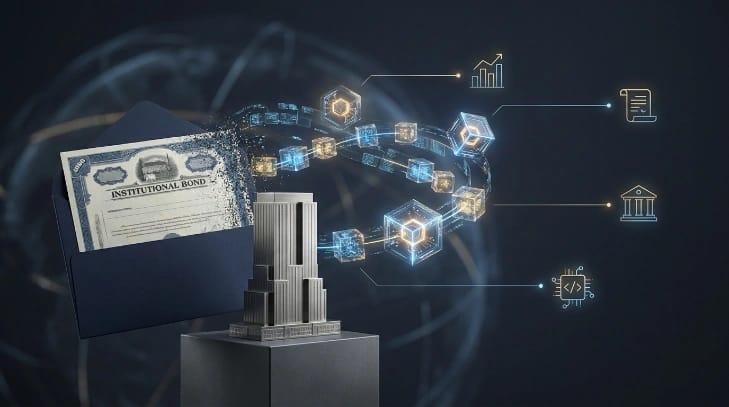
Asset tokenization is moving from a crypto-sector experiment toward a serious redesign of financial infrastructure. The basic idea is simple: represent ownership of a real or financial asset on a programmable digital ledger. The token might represent a government bond, a share in a fund, a bank deposit, a property interest or another legally recognized claim. What matters is not the digital symbol itself, but the rights, records and settlement process behind it.
This shift deserves attention because today’s markets are digital but still fragmented. Trading, ownership records, payments, compliance checks and settlement often pass through separate systems operated by different institutions. Tokenization attempts to place more of those functions on connected infrastructure where transactions can be executed and verified together. If it works, finance may become faster, more programmable and more accessible. If it is poorly designed, however, it could simply move old risks onto newer technology.
The distinction is important. Asset tokenization is not the same as turning every asset into an unregulated cryptocurrency. A tokenized bond remains a bond. A tokenized share remains a security. The technology can change how ownership is recorded and transferred, but it does not erase the issuer’s obligations, securities laws or investor protections.
What Is Asset Tokenization?
Asset tokenization is the process of creating a digital representation of an asset or claim on a programmable ledger. The underlying asset can already be digital, such as a security recorded in an electronic database, or physical, such as real estate. A valid structure must connect the token to enforceable ownership rights. Without that legal connection, a token may be little more than a digital receipt whose value depends on promises that could be difficult to enforce.
The International Monetary Fund describes tokenization as issuing assets, recording ownership and enabling transactions on blockchain-based infrastructure. That definition highlights three separate jobs. The system must create the claim, maintain an accurate ownership record and support reliable transfers. The quality of all three determines whether tokenization improves a market or introduces new points of failure.
A useful way to understand the concept is to compare it with an airline ticket. The ticket is not the aircraft seat itself; it is a recognized claim that gives the holder specific rights. A financial token works similarly. Its usefulness depends on who issued it, what it legally represents, where ownership is recorded and whether the holder can redeem or exercise the promised rights.
1. Settlement Could Become Faster and Simpler
The first powerful shift is the possibility of near-instant settlement. In traditional markets, a trade can happen in seconds while the final exchange of cash and ownership takes longer. During that period, brokers, clearing houses, custodians and banks reconcile records and manage the risk that one side may fail. Those institutions perform essential functions, but the process consumes capital and creates operational complexity.
On a programmable platform, an asset and its payment could move at the same time. This is called atomic settlement: either both sides of the transaction complete or neither does. The Bank for International Settlements’ work on tokenized finance explains how combining tokenized money and assets may integrate messaging, reconciliation and transfer into one operation.
Faster is not automatically better in every circumstance. Current settlement cycles give institutions time to arrange funding, correct mistakes and net thousands of obligations against one another. Instant settlement may reduce counterparty risk while increasing the need for participants to hold cash or liquidity at exactly the right moment. The future system may therefore combine real-time capability with flexible settlement choices rather than forcing every transaction to settle immediately.
2. Financial Assets Could Become Programmable
The second shift is programmability. Smart contracts can apply predefined rules when specified conditions are met. A tokenized bond could distribute interest automatically. A fund could restrict transfers to verified investors. Collateral could be released after a loan is repaid. A cross-border transaction could complete only after compliance checks and payment conditions are satisfied.
This is where tokenization goes beyond ordinary digitization. A scanned document is digital, but it cannot independently coordinate a transaction. A programmable asset can interact with payments, identity systems and other contracts. That opens the possibility of financial products that operate continuously with fewer manual handoffs.
Programmability also creates a new form of operational risk. Financial rules are often full of exceptions, judgment calls and legal interpretation. Code that works perfectly in normal conditions can behave badly during market stress or when data is wrong. Smart contracts therefore require audits, governance, emergency controls and clearly identified responsibility. “The code executed as written” is not a sufficient answer when clients lose money because the rules were flawed.
3. Fractional Ownership Could Expand Access
Tokenization can divide an asset into smaller units. In theory, that could let investors buy a modest interest in an asset that normally requires substantial capital, such as commercial property, private credit or infrastructure. Fractional ownership may broaden participation and help issuers reach new pools of investors.
This connects directly with the expansion of the private credit market, where investments have traditionally been available mainly to institutions and wealthy clients. Tokenized structures could lower administrative barriers, but they cannot make an illiquid or risky asset safe. A smaller investment size reduces the amount an individual must commit; it does not eliminate credit risk, valuation uncertainty or the difficulty of finding a buyer.
Real-estate tokens illustrate the problem. A token may represent a share in a company that owns a building rather than a direct claim on the property. Investors must still understand management fees, debt, voting rights, rental assumptions and legal priority. The risks described in the site’s analysis of commercial real estate debt do not disappear because ownership is recorded on a blockchain.
4. Markets Could Operate for Longer Hours
Many blockchain networks operate continuously, encouraging expectations that tokenized markets could trade around the clock. Longer access may be useful for global investors and for assets connected to fast-moving events. It may also reduce the artificial division between financial centers in different time zones.
Yet a market is more than an open computer network. Reliable trading needs market makers, banking access, customer support, surveillance and mechanisms for dealing with errors. If an asset trades at 3 a.m. while its issuer, transfer agent and banking partners are unavailable, continuous access may produce thin liquidity and unstable prices rather than a better market.
5. Tokenized Money Could Connect Directly With Tokenized Assets
Asset tokenization becomes much more useful when the payment side is also programmable. A tokenized security that still depends on slow, disconnected payment rails cannot deliver the full efficiency promised by the technology. That is why stablecoins, tokenized bank deposits and central-bank settlement assets are central to the debate.
The site’s guide to stablecoin payments explains why digitally transferable money can reduce friction, especially across borders. Stablecoins are only one option, however. Banks are experimenting with tokenized deposits, while central banks and international institutions are studying shared platforms anchored in regulated money.
The BIS’s Project Agorá explores how tokenized commercial-bank deposits and central-bank reserves could support wholesale cross-border payments. The larger objective is not merely to move crypto assets faster. It is to create an environment where trusted money and regulated assets can exchange simultaneously while preserving settlement finality, compliance and monetary integrity.
6. Bonds May Become the First Large Mainstream Market
Government and corporate bonds are strong candidates for large-scale tokenization. Their cash flows are defined, institutions already handle them electronically and settlement efficiency has direct economic value. Tokenized bonds could automate interest payments, ownership records, collateral movements and parts of issuance.
This matters because bond markets influence borrowing costs across the economy. The Light Span’s analysis of the U.S. bond market shows how yields shape mortgages, corporate finance, currencies and equity valuations. Tokenization will not determine interest rates, but it could change the plumbing through which bonds are issued, traded and used as collateral.
The biggest gains may initially appear behind the scenes. Retail investors may not notice whether a bank settles a bond trade on a traditional database or a permissioned ledger. They may notice lower costs, quicker access to funds or new products. Successful infrastructure often becomes important precisely because users no longer need to think about it.
7. Finance Could Become More Connected—and More Concentrated
The seventh shift is structural. Tokenization can connect markets that currently operate in separate silos. A single platform might combine assets, money, identity, compliance and collateral management. That could eliminate duplicated recordkeeping and make capital move more efficiently.
But shared platforms can also concentrate power. If a small number of networks become essential, their operators may control access, data standards and fees. A technical failure, cyberattack or governance dispute could affect many institutions simultaneously. Interoperability is therefore one of the decisive questions. Tokenized markets need ways to communicate without forcing the entire financial system onto one private platform.
This reflects a wider lesson from the data economy: infrastructure owners can capture enormous value when other businesses depend on their standards. Regulators will need to consider competition, operational resilience and whether market participants can move assets and records between platforms without losing legal certainty.
What Can Be Tokenized?
The potential universe is broad. Government bonds, corporate debt, money-market funds, private loans, real estate, commodities, investment funds and company shares can all be represented digitally. Even invoices, intellectual-property royalties and carbon-related instruments may be structured as tokens. The important question is not whether an asset can technically be tokenized. Almost any claim can be represented in software. The real question is whether doing so creates enough economic value to justify the legal, operational and compliance work.
Liquid public securities already benefit from efficient markets, so the improvement may be incremental. Less standardized assets could gain more from better records and fractional access, but they also have harder valuation and legal problems. The most attractive opportunities may be assets with costly reconciliation, fragmented ownership records or slow settlement—not necessarily the assets that generate the loudest marketing.
The Biggest Risks Investors Should Understand
The first risk is legal ambiguity. Investors need to know whether the token itself represents ownership, whether it is merely a contractual claim against an intermediary and what happens if the platform or issuer fails. Jurisdiction matters because property, insolvency and securities rules differ across countries.
The second risk is fragmentation. If the same asset exists across several networks without reliable synchronization, liquidity may split and prices may diverge. Bridges between networks introduce additional technical exposure. The third risk is cybersecurity. Private keys can be stolen, smart contracts can contain vulnerabilities and administrative controls can be abused.
The fourth risk is misleading liquidity. A platform may advertise continuous trading, but a market with few buyers can still be difficult to exit. The fifth is counterparty exposure. Some tokens rely on custodians, special-purpose companies or issuers to hold the underlying asset. Investors are trusting those entities even when the interface appears decentralized.
The U.S. Securities and Exchange Commission emphasized in its statement on tokenized securities that the method used to record a security does not remove applicable securities-law obligations. That is the essential safeguard: technological novelty should not obscure who owes what to whom.
How to Evaluate a Tokenized Asset
Start with the underlying asset. If you would not buy the bond, property interest or fund in conventional form, a token does not improve its economics. Then identify the legal issuer and determine exactly what rights the holder receives. Review redemption terms, fees, transfer restrictions, custody arrangements and the process used to resolve disputes.
Next, examine the market. Who provides liquidity? Where can the token be sold? Is pricing transparent? Does ownership transfer on the ledger also update the legally recognized record? Finally, evaluate the technology and governance. Strong projects disclose audits, administrative powers, outage procedures and how they respond when a smart contract behaves unexpectedly.
Investors should be particularly cautious when marketing focuses on “real-world assets” but provides little information about the real-world legal structure. A polished dashboard cannot substitute for enforceable ownership, audited reserves and clear financial reporting.
What Asset Tokenization Means for Banks and Markets
Banks may initially appear threatened because tokenization promises fewer intermediaries. In practice, regulated institutions may remain central as custodians, issuers, payment providers, identity verifiers and operators of permissioned platforms. Their role may change from manually reconciling disconnected systems to governing shared digital infrastructure.
Stock exchanges, transfer agents and clearing organizations face a similar transition. Some functions could be automated, but trusted institutions will still be needed to manage listings, corporate actions, surveillance and legal finality. The likely outcome is not the overnight replacement of Wall Street by decentralized software. It is a gradual hybrid system in which established markets adopt useful parts of programmable finance.
Light Span Perspective
Asset tokenization matters because it changes the architecture of finance, not because it gives old assets fashionable digital labels. The strongest use cases solve specific problems: slow settlement, duplicated records, limited market access, expensive compliance and disconnected payment systems. The weakest use cases tokenize an asset without improving its economics or legal protections.
The long-term opportunity is substantial. Stocks, bonds, funds and money could eventually interact on programmable platforms that operate with less friction. But the winning systems will not be those that simply move fastest. They will be the ones that combine efficiency with enforceable rights, strong governance, secure settlement and interoperability.
For investors, the practical rule is simple: understand the asset before admiring the token. For financial institutions, the challenge is harder: modernize the infrastructure without weakening the trust that makes markets function. If that balance is achieved, asset tokenization could become one of the most important—yet least visible—financial transformations of the coming decade.
Frequently Asked Questions
Is asset tokenization the same as cryptocurrency?
No. Cryptocurrency is one category of digital asset. Tokenization can represent conventional securities, deposits or physical assets on programmable infrastructure. The underlying legal and economic claim remains the most important feature.
Can tokenized assets lose value?
Yes. Tokenization does not protect an investor from falling asset prices, defaults, fraud, illiquidity or platform failure. A tokenized bond can default, and a tokenized property interest can decline just like its conventional counterpart.
Are tokenized securities regulated?
Securities laws generally continue to apply when a security is tokenized. The precise requirements depend on the jurisdiction, issuer, platform and structure. Investors should verify registration, exemptions and the legal rights attached to the token.
What is the biggest benefit of asset tokenization?
The largest potential benefit is integrating ownership records, transaction rules and settlement on connected programmable infrastructure. That could reduce reconciliation work, shorten settlement and enable new forms of automation.
What is the biggest risk?
The biggest risk is a gap between the digital token and the legally enforceable asset claim. If ownership, custody or redemption rights are unclear, technical efficiency offers little protection.

