


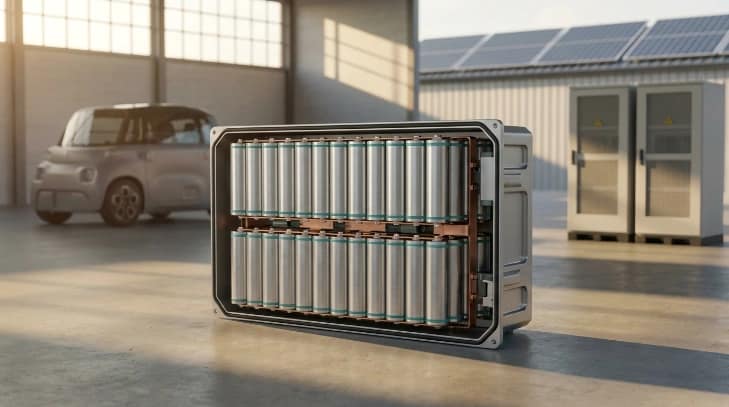
Sodium-ion batteries are becoming a serious option for storing electricity without lithium. The appeal is easy to understand: manufacturers want more choices, electricity systems need flexible storage, and buyers want dependable products that do not become dramatically more expensive whenever one raw material jumps in price. But a plentiful ingredient is not the same thing as an affordable finished battery.
The important question is therefore not whether sodium will replace lithium everywhere. It is where sodium-ion batteries can deliver a useful combination of cost, performance and reliability. A compact city car, a warehouse vehicle and a stationary energy-storage installation have very different requirements. A technology that is unsuitable for one can still make economic sense for another.
This explainer examines the evidence available as of September 8, 2026. It separates independent industry analysis from manufacturer announcements and explains the questions buyers should ask before treating a promising chemistry as a proven commercial solution. The opportunity is real, but so are the engineering and supply-chain limits.
What are sodium-ion batteries?
Sodium-ion batteries are rechargeable batteries that move sodium ions between two electrodes during charging and discharging. The operating idea resembles lithium-ion technology, but the materials and engineering requirements differ. They are not ordinary batteries filled with table salt, nor are they interchangeable replacements that can be connected to any existing lithium battery system.
Different sodium chemistries also behave differently. Cathode materials, electrolytes, anodes and pack designs determine practical performance. It is misleading to attach a single safety rating, lifespan or charging speed to the entire category. A claim demonstrated for one carefully designed cell does not automatically apply to every sodium-based product.
Hard carbon is an important anode material in this field. Research catalogued by Argonne National Laboratory identifies its promise for sodium storage. The practical lesson is that replacing lithium still requires specialist battery materials: access to sodium alone does not establish a competitive manufacturing industry.
1. The biggest benefit is another supply option
For manufacturers, sodium-ion batteries offer a way to reduce dependence on lithium. That matters even if lithium is affordable today. Automotive and energy projects run on development cycles that outlast individual commodity-price swings. A company designing production around one chemistry accepts exposure to that chemistry’s future material costs and supplier constraints.
The International Energy Agency’s February assessment describes sodium technology as a potential hedge against lithium price increases, while noting that it does not yet beat established lithium iron phosphate costs in most applications. This is a more useful starting point than assuming cheaper raw ingredients guarantee cheaper batteries.
An alternative can create negotiating power before it dominates sales. Consider a fictional fleet buyer that can qualify two battery technologies for the same delivery route. If one supply chain experiences disruption, the buyer has an additional procurement option. The value lies partly in avoiding delays, not just in obtaining the lowest initial price.
That is also why the competition over critical minerals will not disappear with a chemistry change. Industrial resilience depends on the whole production system, including processing, equipment, skilled labor and components. Sodium diversifies one part of that system; it does not remove every dependency.
2. Energy density remains a meaningful limitation
Energy density describes how much energy a battery stores relative to its weight or volume. A higher number can help a vehicle carry more energy without becoming heavier or sacrificing as much interior space. This matters particularly when a product has strict limits on size, weight or payload.
The IEA’s Global EV Outlook 2026 battery assessment puts leading sodium-ion cells at around 175 watt-hours per kilogram, compared with about 205 for leading lithium iron phosphate cells and 265 for nickel manganese cobalt cells. Those are cell-level comparisons, not guaranteed specifications for finished vehicles.
A pack adds its own structure, wiring, controls and thermal equipment. Vehicle range also depends on aerodynamics, speed, weather, tires and driving patterns. Buyers should therefore avoid comparing a laboratory cell figure with a complete vehicle’s road-test result. Both can be accurate while answering different questions.
Imagine two hypothetical delivery vehicles that must complete a predictable urban route. If both comfortably finish the route with reserve capacity, extra range may bring little value. For a vehicle that regularly travels long distances without reliable charging stops, the same energy-density difference could matter greatly. Sodium-ion batteries should be judged against the work required.
3. Cold-weather capability could be a useful advantage
Low temperatures make battery performance particularly important for transport operators. A vehicle is not useful merely because it stores substantial energy under comfortable laboratory conditions. It must provide dependable power after sitting outside, support the required route and recharge within the available operating window.
In its February 2026 announcement with Changan, CATL presented a sodium-ion passenger-vehicle application and highlighted low-temperature performance alongside a claimed cell energy density of up to 175 watt-hours per kilogram. These are manufacturer statements, not an independent guarantee that every owner will obtain the advertised results.
The right comparison needs matching conditions. Ask about starting temperature, charging temperature, usable capacity, heating energy and the duty cycle. A battery that discharges effectively in cold weather does not necessarily charge at its maximum advertised speed in the same conditions. These are separate operating questions.
For cold-climate buyers, sodium-ion batteries deserve attention when a supplier can document relevant performance and offer a credible warranty. For buyers in mild climates, that advantage may be less valuable than service coverage or purchase price. Technology benefits are strongest when they solve a problem the customer actually has.
4. Stationary storage changes the trade-off
A stationary battery does not carry passengers or repeatedly accelerate its own weight. That can make lower energy density more acceptable than it would be in a tightly packaged car. However, storage sites still pay for land, transport, foundations, electrical equipment and installation. Weight and space do not suddenly become free.
CATL’s June 22 TENER Sodium announcement described a commercial storage system and planned initial Chinese customer deliveries for September 2026, with international deliveries scheduled for June 2027. A delivery schedule is not proof that those deliveries have already occurred. Customers should verify current availability directly rather than interpreting a launch announcement as local stock.
For a storage operator, the key calculation is the cost of delivering useful electricity over the project’s life. That includes purchase price, conversion losses, maintenance, replacement needs and financing. A cheaper battery can become an expensive project if it wastes more energy or spends too much time unavailable.
Consider a fictional warehouse storing daytime solar power for evening operations. Its team should compare complete proposals with the same usable capacity, output requirement and service obligations. Comparing one supplier’s cell price with another supplier’s installed system price would produce a misleading answer before the equipment even arrives.
This is where sodium-ion batteries connect with the wider shift toward flexible electricity systems. Storage becomes valuable through useful dispatch and reliable integration, not through a chemistry label alone. Better procurement often starts with defining the service before selecting the battery.
5. AI-related electricity demand is not a shortcut to adoption
The growth of AI data-center electricity demand creates interest in many forms of energy infrastructure. But it would be a mistake to assume every new battery is immediately suitable for critical computing facilities. Backup power and daily energy shifting are different jobs with different failure consequences.
An operator protecting sensitive equipment may prioritize response behavior, proven controls, redundancy and service support over modest material savings. Another operator may evaluate storage primarily for managing an electricity bill. Sodium-ion batteries could be relevant to either discussion, but the evaluation must start with the actual operating requirements.
Storage also cannot generate the energy it later delivers. A battery helps move electricity through time; it does not eliminate the need for sufficient generation and grid access. That distinction matters in the AI power-grid bottleneck, where connection delays and infrastructure constraints cannot be solved simply by ordering more cells.
6. Manufacturing geography still matters
A country may have access to raw materials without having competitive battery factories. Production requires repeatable quality, suitable machinery, component suppliers and customers willing to qualify the output. Those relationships take time to build, and early plants must compete with established manufacturers that are improving their own products.
The IEA’s manufacturing-capacity analysis shows the importance of China in the sodium-ion project pipeline. Announced capacity should not be confused with operating output: plans can be delayed, changed or cancelled. Nevertheless, the location of those plans helps identify where expertise and investment are accumulating.
For policymakers, the conclusion is not that domestic production is impossible. It is that a new chemistry does not erase the work required to create an industrial ecosystem. Research partnerships, customer qualification and reliable manufacturing can be more decisive than a headline about local mineral abundance.
For buyers, a practical response is to map the supplier chain. Ask where cells are made, where replacement modules come from and which organization handles warranty claims. These questions apply to sodium-ion batteries just as they apply to existing technologies. The broader reorganization of global supply chains is ultimately about dependable delivery, not geographical slogans.
7. Safety and lifespan require product-level evidence
Battery marketing frequently combines impressive safety language with very large cycle counts. Both deserve careful interpretation. Passing a particular test is useful evidence, but it does not mean a system is incapable of failure under every installation, operating or maintenance condition.
Likewise, a cycle-life figure depends on how the test was performed. Depth of discharge, temperature, charging rate and the remaining-capacity threshold can change the meaning dramatically. Calendar aging also matters for equipment that spends years installed but cycles infrequently. Buyers need the conditions behind the number, not just the largest number on the brochure.
For sodium-ion batteries, request product-specific test documentation, installation requirements and applicable certification evidence. Check who accepts responsibility for integrating the battery with the inverter and management system. A promising cell paired with unsuitable controls is not a dependable finished product.
Environmental claims need similar discipline. Avoid assuming that eliminating lithium automatically eliminates environmental impacts. Manufacturing energy, material processing, service life and end-of-life handling remain relevant. A responsible comparison considers the whole system over its useful life instead of declaring one ingredient universally sustainable.
A practical checklist before buying or specifying a system
Begin with the job: required energy, peak power, operating temperature, available space and expected usage. Write those requirements down before comparing technologies. Otherwise, a sales presentation can steer the discussion toward whichever specification happens to look strongest.
Next, ask for a complete installed price and a clearly stated usable capacity. Confirm what is included in the warranty, whether transport or labor is excluded, and how a failure is diagnosed. An unfamiliar supplier should explain how it will support the equipment years after the initial sale.
Then compare like with like. Use the same operating assumptions for sodium-ion batteries and the lithium-based alternatives. Include expected losses and maintenance rather than treating nameplate capacity as delivered electricity. Where public long-term data are limited, acknowledge that uncertainty instead of filling the gap with optimistic estimates.
Finally, distinguish a pilot from a fleet-wide commitment. A limited trial with measurable success criteria can produce useful evidence without making every operation dependent on a new supplier. That is an editorial decision framework, not a recommendation to purchase any particular product.
Common questions about sodium-ion batteries
Will they replace lithium-ion batteries? There is no reason to assume a complete replacement. Different requirements favor different technologies, and lithium-based products continue to improve. Sodium’s commercial opportunity can be meaningful even if it remains one part of a much larger battery market.
Are they already cheaper? Not universally. Material-cost potential and the price of a delivered, supported system are different things. Compare actual quotations for equivalent performance rather than relying on a projected future manufacturing cost.
Should an EV buyer wait? A chemistry announcement alone is not a strong reason to delay a necessary purchase. Local availability, total vehicle cost, charging access, warranty and independent testing are more relevant. A product announced abroad may not be sold or supported in your market.
Light Span Perspective
Sodium-ion batteries represent a useful expansion of the energy-storage toolkit. Their significance is not that they make every existing battery obsolete. It is that they could give manufacturers and customers another credible way to balance materials exposure, operating conditions and total cost.
The most convincing progress will appear in delivered systems, repeat orders, dependable service and transparent performance data. Factory announcements and attractive laboratory results matter, but they are steps toward those outcomes rather than substitutes for them.
Our view is to take the technology seriously without treating it as a universal solution. Ask what problem a product solves, which compromises it introduces and what evidence supports the claim. If sodium-ion batteries can answer those questions well in particular applications, they will not need to win every market to make a meaningful difference.

