


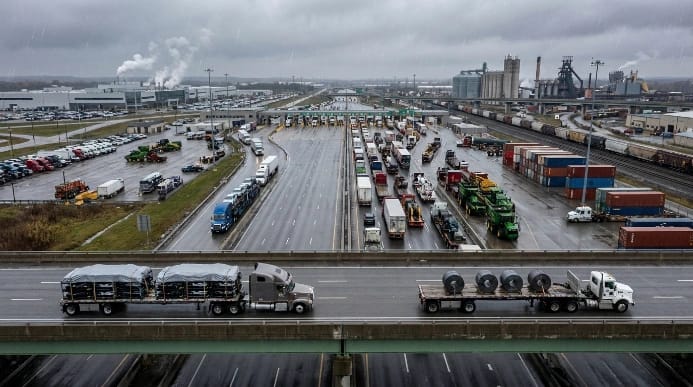
U.S.-Canada Trade War 2026: Tariff Risks for North America
For decades, the United States and Canada built one of the deepest economic relationships in the world.
Cars cross the border during production. Canadian energy powers American homes and factories. U.S. agricultural products fill Canadian stores. Steel, machinery, food, electronics and industrial components move between the two economies every day.
That integration is now facing one of its biggest tests.
On August 22, the United States imposed additional 50% tariffs on roughly $20 billion of Canadian goods after last-minute negotiations failed to produce a trade agreement. Canada responded by announcing dollar-for-dollar retaliatory tariffs on American products beginning September 8.
The dispute matters far beyond the products immediately affected.
It raises questions about manufacturing, consumer prices, investment and the future of North American economic integration.
The White House says its measures respond to what it considers discriminatory Canadian treatment of U.S. commerce in areas including dairy and motor vehicles. The administration used Section 338 of the Tariff Act of 1930 to authorize additional duties of up to 50%.
Canada strongly disputes Washington’s approach and says the new demands went too far.
The result is the U.S.-Canada trade war of 2026—and its biggest consequences may emerge not at customs checkpoints, but inside factories, stores and corporate investment decisions across North America.
Here are seven ways the dispute could reshape the economic relationship.
1. The Collapse of Negotiations Shows How Quickly Trade Policy Can Change
Perhaps the most surprising part of the dispute is how close the two countries appeared to reaching an agreement.
Only days before the tariffs took effect, Washington temporarily delayed additional duties while negotiations continued.
The White House’s August 18 proclamation moved the effective date for measures involving Canadian alcoholic beverages, dairy and motor vehicles to August 22.
That created a narrow window for an agreement.
Instead, negotiations collapsed.
Canada said Washington changed its position and introduced demands it could not accept. The U.S. side argued that Canada rejected a favorable proposal. No immediate new negotiations were announced following the breakdown.
This is important because tariffs themselves are only part of the economic problem.
Businesses can often adapt to a known tariff.
They can change suppliers, adjust prices, renegotiate contracts or relocate production.
What is much harder to manage is uncertainty.
A manufacturer considering a new North American factory needs to estimate costs for years, not days.
Will components continue crossing the border tariff-free?
Could another product category suddenly face duties?
Will today’s tariff still exist next year?
Will Canada retaliate against the products the factory needs?
This is exactly why global trade uncertainty has become such an important economic issue.
When trade rules change quickly, businesses may delay investment even before tariffs directly affect them.
2. The 50% Tariff Is Huge—but It Does Not Apply to All Canadian Trade
The headline number needs context.
The United States has not imposed a new 50% tariff on every Canadian product entering the country.
The new measures apply to roughly $20 billion worth of Canadian goods, representing around 5% of Canada’s annual exports to the United States.
The affected products span multiple categories, including consumer and manufactured goods.
At the same time, some strategically important sectors already face other U.S. trade measures.
The legal mechanism is also unusual.
Washington has relied on Section 338 of the Tariff Act of 1930, a rarely used authority that allows the president to respond when another country is determined to discriminate against U.S. commerce.
The White House’s official dairy proclamation says the administration believes Canada’s tariff-rate quota system disadvantages U.S. dairy exports. It therefore authorized an additional 50% duty on specified Canadian products.
A separate White House motor-vehicle proclamation makes a similar argument regarding Canada’s treatment of U.S. vehicles and parts.
The distinction matters.
Calling this a blanket 50% tariff would exaggerate its immediate scope.
But dismissing it because most Canadian exports are not covered would underestimate the broader risk.
Trade disputes frequently expand through retaliation.
And that process has already begun.
3. Canada’s Retaliation Could Spread the Economic Cost
Canada is not absorbing the new tariffs without responding.
Prime Minister Mark Carney announced that Canada will impose matching tariffs on U.S. products beginning September 8.
The planned measures include goods such as steel, dairy products, electronics, appliances and agricultural equipment. Ottawa has described the response as dollar-for-dollar retaliation.
This is how a tariff dispute can become a trade war.
One government imposes duties.
The other retaliates.
The first government can then expand its measures.
Businesses on both sides begin adjusting.
The economic impact spreads beyond the industries originally targeted.
Retaliatory tariffs are often designed politically as well as economically.
Governments can select products produced in strategically important regions or industries, increasing domestic pressure on the opposing government.
But retaliation also creates costs at home.
A Canadian company importing U.S. machinery may suddenly face a higher bill.
A U.S. company using Canadian materials can experience the same problem in reverse.
Businesses then have several options:
absorb the cost,
raise prices,
find another supplier,
reduce imports,
or redesign production.
None is completely painless.
That is why trade wars can hurt companies that have nothing to do with the political dispute that created them.
4. North America’s Integrated Supply Chains Make This Trade War Different
Tariffs between two distant economies are complicated.
Tariffs between the United States and Canada can be even more disruptive because the two economies manufacture many products together.
Consider a vehicle.
Raw materials may originate in Canada.
A component can be manufactured in Ontario.
Another part may come from Michigan.
The vehicle could be assembled on one side of the border while additional components arrive from the other.
North American manufacturing was built around the assumption that these networks would remain deeply integrated.
That is why tariffs can create unexpected costs.
A trade barrier does not necessarily hit a completely finished Canadian product competing against a completely finished American product.
It can affect an input used by an American factory.
The White House’s motor-vehicle proclamation itself highlights the depth of the dispute over autos and parts, while Canada has made automotive treatment a major issue in negotiations.
This fits a larger global transformation.
As we explained in our analysis of how the global supply chain is changing, companies increasingly value resilience alongside the lowest possible production cost.
The irony is that North America previously represented one of the world’s strongest examples of nearshoring.
Factories were already located close to their customers.
The U.S.-Canada dispute demonstrates that geographical proximity does not eliminate political risk.
5. American Consumers Could Pay Part of the Tariff
One of the biggest misconceptions about tariffs is that the exporting country simply writes a check to the government imposing them.
That is not how the system normally works.
A tariff is generally collected from the importer when goods enter the country.
Suppose a U.S. company imports a Canadian product worth $1,000 and that product faces an additional 50% tariff.
The additional tariff could add $500 at the border.
The importer then decides what to do.
It might negotiate a lower price with its Canadian supplier.
It might absorb part of the cost through lower profit margins.
It could switch suppliers.
Or it could pass some of the additional expense to customers.
The final burden can therefore be shared across exporters, importers, retailers and consumers.
How much reaches shoppers depends on the product.
If an American substitute is easily available, Canadian exporters may need to cut prices to remain competitive.
If the Canadian product is difficult to replace, U.S. buyers may have little choice but to pay more.
This is why the consumer effect will vary widely.
Some products may see little noticeable change.
Others could become substantially more expensive.
The broader danger is cumulative.
Tariffs on one category may have limited impact on overall inflation. But multiple tariffs affecting industrial inputs, food, metals and consumer products can gradually increase costs throughout the economy.
6. The Auto Industry Faces a Particularly Difficult Problem
Automobiles deserve special attention because North American vehicle manufacturing is extraordinarily integrated.
Modern vehicles contain thousands of parts sourced through complicated supplier networks.
Manufacturers have spent decades optimizing those networks around trade agreements between the United States, Canada and Mexico.
Changing that system is not simple.
A carmaker cannot instantly replace a specialized component supplier because a tariff appears.
New suppliers need testing.
Factories need tooling.
Contracts must be renegotiated.
Quality standards need approval.
Production schedules must be protected.
This creates a major difference between political and industrial timelines.
A government can announce a tariff quickly.
A manufacturer may need years to redesign a supply chain.
The automotive dispute was reportedly one of the important sticking points in the failed negotiations. Canada objected to the terms Washington offered for Canadian-made heavy-duty vehicles, while the broader motor-vehicle trade relationship remains contentious.
The consequences could eventually reach workers.
If producing a vehicle becomes more expensive, companies may reduce margins, raise prices or change where future models are built.
That does not mean factories immediately close.
But long-term investment decisions could shift.
And those decisions determine where future manufacturing jobs are created.
7. Steel, Agriculture and Manufacturing Could Produce Winners and Losers
Trade wars rarely hurt everyone equally.
Some businesses can benefit.
American steel producers, for example, may face less competition from tariff-affected Canadian imports.
Domestic manufacturers competing directly against Canadian products may gain pricing power or market share.
That is one reason tariffs can receive strong support from protected industries.
But downstream companies can experience the opposite effect.
A manufacturer that uses steel does not necessarily benefit when imported steel becomes more expensive.
Construction firms, machinery manufacturers and other industrial businesses may face higher input costs.
Agriculture presents another complicated picture.
Canadian retaliation targeting U.S. dairy and agricultural equipment can hurt exporters that previously relied on Canadian customers.
This creates one of the central trade-policy trade-offs.
Protecting one domestic industry can increase costs for another.
The final economic impact therefore cannot be measured simply by counting factories protected from foreign competition.
Policymakers also need to consider businesses buying those products and exporters hit by retaliation.
The same applies to consumers.
A tariff can support domestic production while simultaneously increasing prices.
Both outcomes can happen at once.
8. USMCA Is Now Facing a Much Bigger Test
The U.S.-Canada dispute raises a larger question:
What happens to the North American trade system itself?
The United States-Mexico-Canada Agreement, or USMCA, replaced NAFTA and established the framework governing much of the continent’s commerce.
Companies have made investment decisions based on that framework.
Factories have been located according to it.
Supplier relationships have developed around it.
A sustained tariff conflict between two of the agreement’s three members weakens confidence in that system even if much trade remains protected.
This matters because trade agreements provide more than lower tariffs.
They provide predictability.
Businesses need confidence that products manufactured under agreed rules can continue crossing borders under those rules.
When political disputes repeatedly override that assumption, companies may begin treating trade-policy risk as a permanent business expense.
That connects directly with the broader trend we examined in Is the Global Economy Splitting Into Two Blocs?. Governments increasingly place economic security and strategic interests alongside traditional free-trade objectives.
The surprising part is that this fragmentation is now affecting some of the world’s closest economic partners.
What Does This Mean for Mexico?
Mexico has an enormous stake in what happens next.
North American manufacturing is a three-country system.
A vehicle assembled in Mexico can contain U.S. and Canadian components.
American factories use Mexican parts.
Canadian businesses depend on suppliers throughout the continent.
A major change in U.S.-Canada trade therefore affects the assumptions behind the entire regional manufacturing model.
Mexico could benefit in some areas.
If companies seek alternatives to Canadian suppliers, Mexican manufacturers may gain orders.
Businesses worried about bilateral tariffs may also diversify production.
But Mexico cannot simply assume the dispute is an opportunity.
If confidence in North American trade rules deteriorates broadly, investment throughout the region could become more cautious.
Companies may hesitate before committing billions of dollars to factories whose economics depend on cross-border trade.
That makes the future of USMCA more important than any single tariff announcement.
Could Canada Reduce Its Dependence on the United States?
The dispute is likely to accelerate an economic debate already underway in Canada.
Should the country diversify more aggressively?
The United States is Canada’s natural trading partner because of geography, infrastructure and the enormous size of the American economy.
Replacing that relationship is unrealistic.
But reducing excessive dependence is possible.
Canada can deepen trade with Europe and Asia.
It can expand infrastructure connecting resources to overseas markets.
Companies can develop customers outside North America.
The government can encourage greater domestic processing and manufacturing.
This is part of the larger shift toward a more strategic form of globalization.
Our coverage of the global economy splitting into competing blocs explains why governments increasingly view trade relationships through the lens of security and resilience rather than efficiency alone.
Diversification, however, takes time.
A Canadian factory cannot replace American customers overnight.
Geography will continue making the U.S. market extraordinarily important.
The likely outcome is therefore not economic separation.
It is a gradual attempt to create more options.
Could Tariffs Bring Manufacturing Back to the United States?
This is one of the strongest arguments made in favor of tariffs.
If imported products become more expensive, domestic production becomes relatively more competitive.
Companies may decide it is safer to manufacture inside the United States rather than risk future tariffs.
That can happen.
But the outcome depends on the industry.
Businesses consider far more than tariffs when choosing factory locations.
They evaluate:
labor costs,
energy,
taxes,
infrastructure,
supplier networks,
skills,
regulations,
and access to customers.
A tariff may change the calculation without determining it completely.
There is also an important distinction between replacing a finished import and replacing an imported input.
If an American factory depends on Canadian materials, tariffs can make U.S. manufacturing more expensive rather than more competitive.
This is why the current dispute cannot be reduced to “America wins” or “Canada wins.”
Modern manufacturing is too interconnected.
The outcome will vary by company, product and region.
What Happens Next?
September 8 is now the immediate date to watch.
That is when Canada’s announced retaliatory tariffs are scheduled to begin.
Before then, diplomacy could resume.
The two governments have powerful incentives to find a compromise.
Businesses on both sides benefit from predictable trade.
Consumers benefit from efficient supply chains.
Manufacturers benefit from access to continental suppliers.
But the political gap is currently substantial, and no immediate new talks were planned after the negotiations collapsed.
If retaliation takes effect, the next question will be whether Washington responds again.
Another round of tariffs could turn a targeted dispute into something broader.
Businesses will also begin revealing how they plan to adapt.
Watch for changes in:
supplier contracts,
factory investment,
automotive production,
agricultural exports,
consumer prices,
and corporate guidance.
The longer the dispute lasts, the more likely temporary adaptations become permanent investment decisions.
FAQs
What is the U.S.-Canada trade war in 2026?
The dispute escalated after the United States imposed additional 50% tariffs on roughly $20 billion of Canadian goods on August 22 following failed negotiations. Canada has announced retaliatory tariffs beginning September 8.
Does the 50% tariff apply to everything Canada exports to America?
No. The new 50% measures cover roughly $20 billion of goods, equivalent to about 5% of Canada’s annual exports to the United States.
When will Canada’s retaliatory tariffs begin?
Canada says its new dollar-for-dollar retaliatory tariffs will take effect on September 8, 2026.
Will tariffs increase prices?
They can. Importers may absorb some costs, negotiate lower supplier prices or switch sources, but some tariff costs can ultimately be passed to consumers.
Which industries are most exposed?
The dispute touches manufacturing and consumer goods, while autos, metals, dairy, agriculture and other integrated industries are particularly important to the broader U.S.-Canada trade relationship.
Could the United States and Canada still reach a deal?
Yes. Both economies have strong incentives to restore predictable trade, but as of August 23 no immediate new negotiations had been announced following the collapse of talks.
The Light Span Perspective
The most important lesson from the U.S.-Canada trade war 2026 is not simply that tariffs are increasing.
It is that even one of the world’s deepest economic relationships can no longer take trade stability for granted.
The United States and Canada spent decades building factories and supply chains around integration. That system made economic sense because businesses assumed components could move across the border under relatively predictable rules.
The current dispute challenges that assumption.
A 50% tariff can hurt individual products immediately. But uncertainty can have a longer-lasting effect because companies make factories, supplier contracts and investment decisions years in advance.
There is also unlikely to be one clear winner.
Some U.S. producers may gain protection from Canadian competition. Other American manufacturers may pay more for inputs. Canadian exporters may lose sales while some domestic businesses gain opportunities. Consumers on both sides can face higher costs.
The bigger question is what happens afterward.
If the dispute is resolved quickly, the economic damage may remain manageable.
If repeated tariff battles become normal, businesses could gradually redesign North American production around political risk.
That would represent something much larger than a temporary trade disagreement.
It would mark a fundamental change in how North America’s integrated economy works.
Continue reading more

