


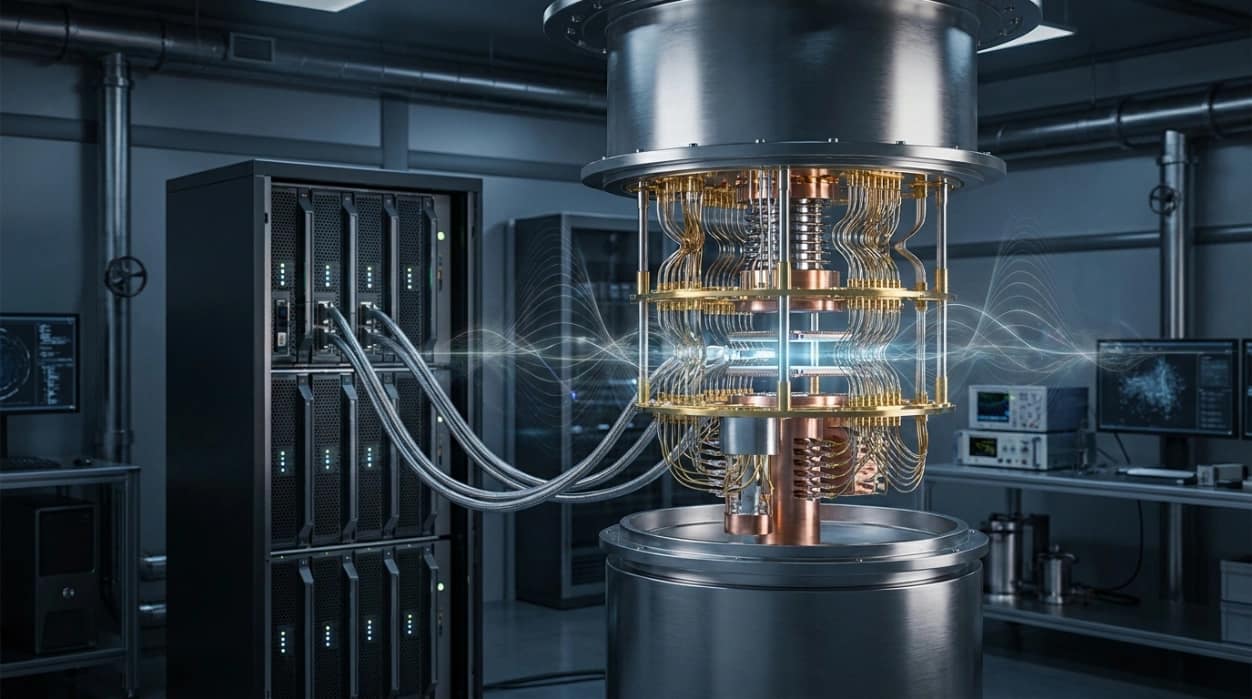
Quantum Computing Breakthrough 2026: Progress and Limits
For decades, quantum computing has existed somewhere between revolutionary science and futuristic promise.
Researchers knew quantum mechanics could potentially allow computers to tackle certain problems in completely different ways. Technology companies invested heavily. Governments launched national quantum programs. Scientists steadily improved processors.
But one question remained difficult to answer:
When will quantum computers become genuinely useful?
A major quantum computing breakthrough in 2026 is making that question more interesting.
On July 30, IBM and researchers from the University of Chicago announced an experiment involving 70 logical qubits. The researchers said their system completed a quantum computation in approximately 15 minutes that would require infeasible resources using leading classical simulation methods. More importantly, they demonstrated a way to establish confidence that the quantum result was accurate.
That combination matters.
Making a quantum computer perform something difficult is one challenge. Proving that the result can be trusted when a conventional computer cannot efficiently reproduce the calculation is another.
This does not mean quantum computers are ready to replace conventional machines.
They aren’t.
Your laptop, smartphone and the servers powering most businesses will remain classical computers.
Instead, the emerging future looks increasingly hybrid: classical supercomputers handling the work they do best while quantum processors tackle specialized calculations that become extraordinarily difficult using conventional methods.
At the same time, quantum computing is already changing cybersecurity. NIST has finalized three primary post-quantum cryptography standards and says organizations should begin migrating toward them now.
Quantum technology therefore finds itself at an important turning point.
Here are seven reasons 2026 may be remembered as a year when quantum computing began moving from impressive experiments toward practical computing.
1. Quantum Computing Is Moving Beyond the Qubit Race
For years, quantum-computing announcements focused heavily on one number:
qubits.
A conventional computer stores information in bits representing either 0 or 1.
Quantum computers use quantum bits, or qubits, which exploit properties such as superposition and entanglement.
The simplified explanation is that quantum systems can manipulate information in ways classical bits cannot easily reproduce.
But more qubits do not automatically create a better quantum computer.
Quantum states are extremely fragile.
Heat, electromagnetic interference, imperfect control and interactions with the environment can introduce errors. A machine containing thousands of unreliable physical qubits may therefore be less useful than a smaller system capable of protecting quantum information more effectively.
That is why the industry is increasingly focusing on logical qubits.
A logical qubit uses error-correction techniques to encode and protect quantum information rather than relying on a single vulnerable physical component.
IBM and University of Chicago researchers used a new error-correction method to encode 70 logical qubits in their July experiment. IBM says the resulting circuits reached a level of complexity beyond practical leading classical simulation while still allowing researchers to establish confidence in the result.
This represents an important shift.
The quantum race is moving from:
How many qubits can we build?
toward:
How much reliable computation can those qubits actually perform?
That is a much more meaningful measure.
A similar transition has happened in artificial intelligence. Counting chips tells us little if we do not understand how effectively the infrastructure converts those chips into useful output.
Our analysis of the rise of AI factories shows how AI infrastructure is increasingly judged through productivity and efficiency rather than hardware numbers alone.
Quantum computing is beginning to face the same test.
2. Quantum Advantage Is Becoming More Meaningful
One of the most important phrases in the industry is quantum advantage.
It generally describes a situation where a quantum computer performs a meaningful calculation beyond what the best practical classical methods can efficiently accomplish.
Researchers have demonstrated forms of quantum computational superiority before.
The problem is that some demonstrations involved highly specialized benchmark tasks without obvious commercial usefulness.
There is another challenge.
Imagine a quantum computer solves a calculation because the problem is too difficult for conventional computers.
How do you verify the answer?
If the classical computer could easily calculate the same result, the quantum advantage would be less impressive.
This creates a strange verification problem.
The July IBM-University of Chicago experiment is significant partly because researchers focused on trusted quantum computation.
Their goal was not simply to produce something difficult for a classical computer. They also developed a way of checking the fidelity of the quantum calculation.
That is crucial for practical applications.
A pharmaceutical company cannot rely on a molecular calculation simply because a quantum processor produced it.
A materials company cannot redesign a product around an answer nobody can trust.
Useful quantum advantage therefore needs two things:
computational advantage and confidence in the result.
The latest experiment does not prove that quantum computers are now broadly commercially useful. It tackles a specific class of circuits.
But it moves the industry toward a stronger standard.
Future quantum claims will increasingly need to answer:
What useful problem was solved?
How does performance compare with the best classical methods?
Can researchers verify the result?
Can the experiment be reproduced?
That shift from impressive demonstrations toward measurable advantage is healthy for the industry.
3. Quantum Computers Will Work With Classical Supercomputers
A common misconception is that quantum computers will eventually replace ordinary computers.
That is unlikely.
Quantum computers are not simply faster versions of conventional machines.
They process information differently and are expected to provide advantages for particular classes of problems.
Classical computers remain extraordinarily efficient at most everyday computing.
Your phone does not need quantum mechanics to display a video.
A bank does not need a quantum processor to record every transaction.
A company does not need one to run a spreadsheet.
The more realistic future combines different processors.
A classical computer could manage the overall application, while a quantum processor handles a specialized calculation.
The quantum result could then return to the classical system for further processing.
This is often described as quantum-centric supercomputing.
The idea resembles the relationship between CPUs and GPUs.
GPUs became essential to modern artificial intelligence, but they did not eliminate CPUs. Different processors perform different types of work.
Quantum processors could eventually become another specialized computing resource.
That possibility is especially interesting because companies are already investing enormous amounts in advanced computing infrastructure.
Our analysis of the AI infrastructure spending boom shows how data centers are evolving around specialized processors, high-speed networks and enormous computing workloads.
Future supercomputing environments could contain CPUs, GPUs, AI accelerators and quantum processors working together.
The next computing revolution may therefore not be:
classical versus quantum.
It may be:
classical plus quantum.
4. Error Correction Could Decide Whether Quantum Computing Succeeds
The biggest obstacle facing quantum computing is not a lack of interesting ideas.
It is reliability.
Qubits are extremely sensitive to their environment.
Quantum information can degrade through a process known as decoherence, while imperfect operations introduce additional errors.
For short experiments, researchers can sometimes manage this noise.
For complicated calculations involving enormous numbers of operations, errors can accumulate until the result becomes useless.
This is why quantum error correction is so important.
Researchers encode useful quantum information across multiple physical resources so errors can be detected and corrected without destroying the computation.
The long-term goal is fault-tolerant quantum computing.
A fault-tolerant machine should be capable of running large calculations while continuously controlling errors well enough to preserve reliable logical information.
That remains extraordinarily difficult.
But progress in logical qubits suggests researchers are moving closer.
This also explains why headline qubit counts can be misleading.
Imagine two quantum computers.
One has many physical qubits but experiences substantial noise.
Another has fewer logical qubits but can perform much longer reliable computations.
The second machine could ultimately be more useful.
The next major quantum race will therefore be about several metrics simultaneously:
logical qubits,
error rates,
circuit depth,
gate fidelity,
and useful workload performance.
Quantum computers need to become not only larger but more dependable.
That may determine whether the technology remains primarily scientific or becomes commercially transformative.
5. Chemistry and Materials Could Become Major Applications
If quantum computers become sufficiently reliable, what would we actually use them for?
One of the strongest possibilities is chemistry and materials science.
Nature itself follows quantum mechanics.
Electrons, molecules and chemical bonds involve quantum interactions.
Classical computers can model many of these systems, often extremely effectively.
But the computational difficulty can increase dramatically as researchers try to simulate more complicated quantum behavior accurately.
Quantum computers could eventually provide new tools for studying those systems.
Potential applications include research into:
- battery chemistry,
- new medicines,
- industrial catalysts,
- fertilizers,
- superconductors,
- advanced materials,
- carbon-capture technologies.
Consider battery development.
Researchers often need to understand complicated interactions between materials at microscopic scales.
Better simulation could help narrow the enormous number of possible material combinations before expensive laboratory experiments begin.
Drug discovery offers another example.
Quantum computing will not magically produce new medicines, but improved molecular calculations could eventually complement artificial intelligence and conventional high-performance computing.
This creates an especially interesting combination:
AI proposes possibilities.
Quantum computing investigates certain underlying quantum interactions.
Classical supercomputers perform additional simulation and analysis.
Scientists test promising candidates in the real world.
The technologies could reinforce each other rather than compete.
That matters because AI is already transforming scientific research.
Quantum computing could eventually become another specialized tool inside increasingly automated research pipelines.
But expectations need to remain realistic.
Most commercially important chemistry problems still exceed the capabilities of today’s quantum hardware.
The opportunity is substantial precisely because the remaining technical challenge is substantial.
6. Quantum Computing Is Becoming a Strategic Technology Race
Quantum computing is no longer simply an academic research field.
Governments and companies increasingly view it as strategic infrastructure.
The reasons are straightforward.
A country that develops advanced quantum capabilities could gain advantages in:
scientific research,
materials,
medicine,
industrial optimization,
cybersecurity,
and potentially national security.
This makes quantum technology part of a much broader competition over advanced computing.
The same pattern is already visible with artificial intelligence and semiconductors.
Our coverage of the global race for AI leadership explains how computing capacity, talent, energy and semiconductor access are becoming strategic national resources.
Quantum adds another layer.
But building a competitive quantum ecosystem requires more than processors.
Countries need physicists.
They need engineers.
They need specialized manufacturing.
They need cryogenic technology and control electronics.
They need software developers capable of creating quantum algorithms.
They need universities training the next generation of researchers.
They also need businesses willing to experiment with potential applications before the technology reaches maturity.
That creates a long-term ecosystem race.
The winners may not necessarily be the countries that produce the first spectacular demonstration.
They could be those capable of turning quantum research into reliable hardware, software, talent and commercial applications.
This is also why businesses should follow the field before quantum computing becomes mainstream.
The transition could resemble earlier technology waves.
Companies that develop expertise early may be better positioned to identify useful applications once the hardware improves.
7. Quantum Computing Is Already Changing Cybersecurity
The most important real-world effect of quantum computing may currently have little to do with running quantum applications.
It involves encryption.
Much of the modern internet depends on public-key cryptography.
It protects secure communications, software updates, digital identities, financial systems and confidential business information.
Some widely used cryptographic algorithms could eventually become vulnerable to sufficiently powerful quantum computers.
Today’s quantum computers cannot simply break modern internet encryption at scale.
The concern is what future machines might do.
This has created the idea of “harvest now, decrypt later.”
An attacker could collect encrypted information today and keep it for years.
If sufficiently powerful quantum computers eventually become available, the attacker could attempt to decrypt information that still has value.
That matters for governments, healthcare systems, financial institutions and businesses protecting long-lived confidential information.
The cybersecurity transition has therefore already started.
NIST finalized its first three principal post-quantum cryptography standards in 2024. They include ML-KEM for key establishment and ML-DSA and SLH-DSA for digital signatures. NIST says organizations should begin applying the standards now rather than waiting for cryptographically relevant quantum computers.
NIST’s post-quantum cryptography program
The transition is continuing in 2026. NIST advanced nine additional digital-signature candidates to another evaluation round in May.
This is perhaps the strongest evidence that quantum computing is no longer purely theoretical.
The technology does not need to break today’s encryption before organizations begin preparing.
Cybersecurity migrations can take years.
Large companies must identify where vulnerable algorithms are used, update software and hardware, coordinate with vendors and test new systems.
NIST’s current transition planning anticipates quantum-vulnerable algorithms being deprecated and ultimately removed from its standards by 2035, with high-risk systems expected to transition earlier.
Quantum computing is therefore influencing technology decisions before large-scale fault-tolerant quantum computers arrive.
What Could Stop the Quantum Revolution?
Despite the progress, enormous problems remain.
Error rates remain much higher than in classical computers.
Scaling from experimental systems to large fault-tolerant machines is extraordinarily difficult.
Hardware requirements can be extreme, with some technologies requiring sophisticated cryogenic systems.
Algorithms remain another limitation. Researchers still need more commercially meaningful problems where quantum machines deliver clear advantages.
Cost matters too.
Even if a quantum computer can solve a problem, the advantage must eventually justify the infrastructure required to run it.
And classical computing is not standing still.
Every time researchers demonstrate a quantum result, classical computer scientists look for better simulation methods.
That competition is beneficial.
A legitimate quantum advantage should outperform the best available classical alternative, not an outdated benchmark.
The useful quantum era will therefore arrive only when hardware, error correction, algorithms and economics improve together.
What Should Businesses Do Now?
Most companies do not need a quantum computer today.
But some should begin preparing.
Organizations handling sensitive information should evaluate their cryptographic exposure and understand post-quantum migration.
Companies working in pharmaceuticals, chemistry, materials, finance or advanced optimization should follow developments in quantum algorithms.
Large enterprises can also begin developing basic internal expertise.
The goal is not to make speculative investments based on hype.
It is to understand which business problems might eventually benefit.
This is similar to the early stages of artificial intelligence.
Organizations that experimented early developed knowledge before adoption accelerated.
Quantum computing may follow a slower path, but preparation can still create an advantage.
The important thing is to separate learning from hype.
Businesses do not need to predict the exact year useful fault-tolerant machines arrive.
They need enough understanding to recognize meaningful progress when it happens.
FAQs
What is the quantum computing breakthrough in 2026?
IBM and University of Chicago researchers announced a July experiment using 70 logical qubits that they say performed computation beyond practical leading classical simulation while allowing the result’s fidelity to be checked.
What is quantum advantage?
Quantum advantage occurs when a quantum computer provides a meaningful computational advantage over the best practical classical methods for a particular problem.
Are quantum computers useful today?
They are valuable research platforms, but broad commercial quantum advantage remains limited. Recent experiments suggest the technology is moving toward more useful workloads.
Will quantum computers replace ordinary computers?
Probably not. Quantum processors are more likely to work alongside classical computers as specialized accelerators.
What are logical qubits?
Logical qubits use error-correction techniques to protect quantum information across multiple physical resources, making computations more reliable.
Can quantum computers break encryption today?
No. Current quantum computers cannot break the major cryptographic systems protecting the internet at practical scale. The concern involves sufficiently powerful future machines.
Why is post-quantum cryptography being adopted already?
Cybersecurity migrations take years, and encrypted information captured today could remain sensitive in the future. NIST therefore recommends beginning migration now.
The Light Span Perspective
The biggest change in quantum computing is not that scientists suddenly solved every technical problem.
They haven’t.
The change is that the industry’s questions are becoming more practical.
Instead of asking only:
How many qubits can we build?
Researchers increasingly ask:
How many reliable logical qubits can we use?
Instead of simply claiming that a quantum computation is difficult:
Can we prove the result is trustworthy?
Instead of asking whether quantum computers will replace conventional machines:
Where can quantum processors make existing supercomputers more powerful?
Those are signs of a technology beginning to mature.
There will still be setbacks.
Timelines will change.
Some promised applications will prove unrealistic.
Classical computing will continue improving.
But quantum technology does not need to replace today’s computers to become transformative.
It only needs to solve certain valuable problems substantially better.
If reliable logical qubits continue scaling, chemistry and materials simulations improve, hybrid quantum-classical computing becomes practical and businesses discover workloads with genuine economic value, quantum processors could become a new layer of advanced computing.
Cybersecurity shows why preparation matters.
Powerful quantum computers capable of threatening today’s encryption do not yet exist, but organizations are already moving toward quantum-resistant standards.
Technology can change decisions long before it becomes mainstream.
That is why the quantum computing breakthrough in 2026 deserves attention.
The useful quantum era has not fully arrived.
But for the first time, we are seeing stronger evidence that the transition from quantum experiments toward trusted, specialized computing may genuinely be underway.
Continue reading more

