


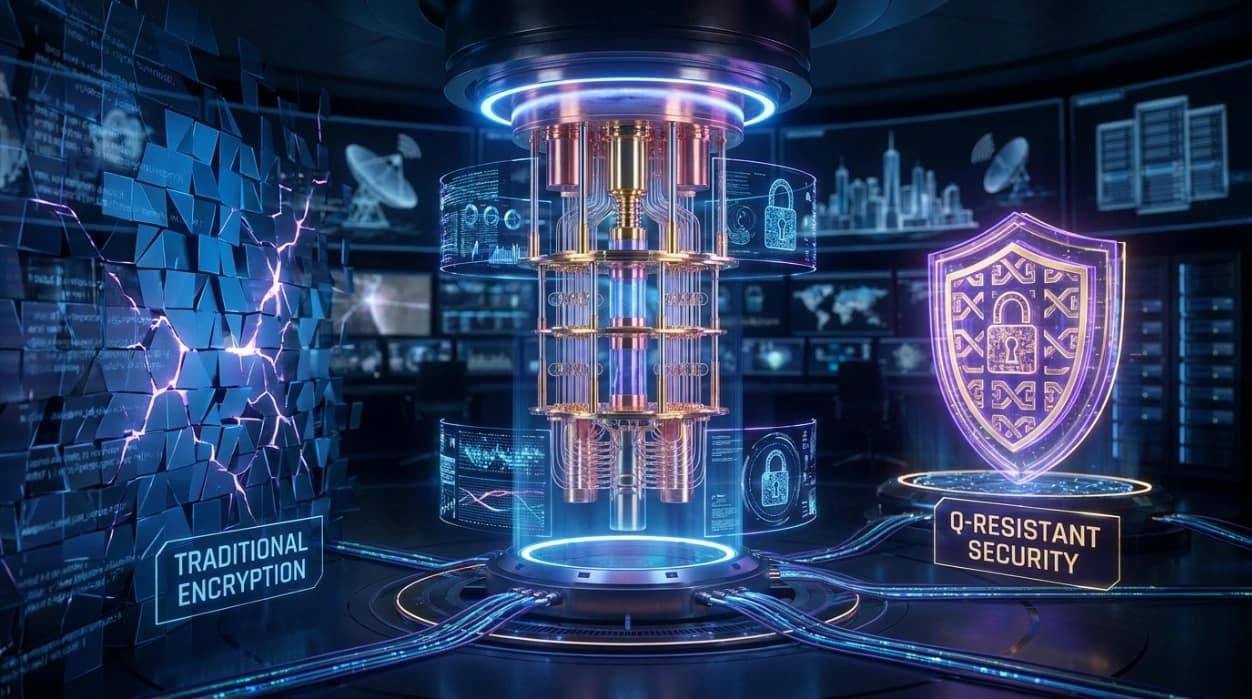
Quantum Cybersecurity: Preparing for Risks to Encryption
For decades, the internet has depended on a hidden layer of mathematics that most people never think about.
It protects online banking.
It secures messages.
It protects business information.
It helps websites verify that they are communicating with the right users.
That protection is encryption.
But a new technology could eventually challenge some of the mathematical systems the internet currently relies on.
That technology is quantum computing.
The threat isn’t immediate. Today’s quantum computers are still far too limited and unstable to break the encryption protecting modern internet traffic at scale. The National Institute of Standards and Technology (NIST) says the exact timeline for a cryptographically powerful quantum computer remains unknown.
But the cybersecurity industry isn’t waiting.
NIST finalized its first three post-quantum cryptography standards in 2024, and in 2026 it continues working on additional algorithms and migration guidance. NIST now explicitly encourages organizations to begin applying its post-quantum standards.
That creates an important question:
What happens when quantum computers become powerful enough to attack today’s encryption?
The answer explains why quantum cybersecurity is becoming an increasingly important part of technology planning.
What Is Quantum Cybersecurity?
Quantum cybersecurity is the broader effort to protect digital systems from threats created by quantum computing.
It includes technologies, encryption methods, standards and strategies designed to keep information secure in a future where powerful quantum computers exist.
The most important part of this transition is called post-quantum cryptography, or PQC.
The basic idea is simple:
Build encryption that remains secure even when attackers have access to powerful quantum computers.
This doesn’t necessarily mean replacing the internet with quantum computers.
In fact, most post-quantum cryptography works on conventional computers.
It is primarily about changing the mathematical tools used to protect digital information.
Why Quantum Computers Are Different
Today’s computers process information using bits.
A bit can represent either:
0 or 1.
Quantum computers use qubits, which can exploit quantum mechanical effects such as superposition and entanglement.
That doesn’t mean a quantum computer is simply a faster version of a normal computer.
It is a fundamentally different computing model designed to solve certain types of problems in very different ways.
For cybersecurity, one capability matters particularly.
A sufficiently powerful, fault-tolerant quantum computer could run algorithms capable of attacking some public-key cryptographic systems that are widely used today.
That is why quantum cybersecurity has become a long-term priority.
How Today’s Encryption Protects the Internet
Encryption is not one single technology.
Different systems protect different parts of digital communication.
Public-key cryptography is especially important because it helps devices establish secure communications and verify identities.
Algorithms such as RSA and elliptic-curve cryptography have become fundamental components of modern digital infrastructure.
The problem is that some of these systems rely on mathematical problems that are believed to be extremely difficult for classical computers.
A sufficiently capable quantum computer could change that calculation.
NIST warns that future quantum computers could threaten sensitive information including financial records, medical data, government information and business secrets.
That’s why the transition needs to happen before the machine capable of causing the problem actually exists.
How Quantum Computing Could Break Encryption
The biggest concern involves Shor’s algorithm.
In simplified terms, Shor’s algorithm could allow a sufficiently powerful quantum computer to solve certain mathematical problems much more efficiently than classical computers.
That could undermine widely used public-key cryptography.
This is where quantum cybersecurity becomes important.
The goal isn’t to wait for a quantum attack and then respond.
Organizations need to migrate vulnerable systems beforehand.
NIST finalized three major post-quantum standards in 2024:
- FIPS 203 — ML-KEM
- FIPS 204 — ML-DSA
- FIPS 205 — SLH-DSA
These are designed for key establishment and digital signatures that can resist attacks from future quantum computers.
NIST also selected HQC for standardization in 2025 as another post-quantum encryption approach.
The transition is therefore already underway.
The “Harvest Now, Decrypt Later” Problem
One of the most important reasons organizations shouldn’t wait is a strategy sometimes called:
Harvest now, decrypt later.
Imagine an attacker intercepts encrypted information today.
They can’t decrypt it with current technology.
So they simply store it.
Years later, if quantum computers become powerful enough to break the encryption, the attacker could potentially return to that stored information.
This creates a special problem for data that needs to remain confidential for decades.
Examples include:
- Government intelligence
- Medical records
- Defense information
- Intellectual property
- Long-term financial information
- Sensitive business communications
For this type of information, the quantum threat doesn’t begin when a powerful quantum computer appears.
It can begin when vulnerable data is collected today.
That is one reason quantum cybersecurity planning has moved from theoretical research into practical security strategy.
Could Quantum Computing Threaten Online Banking?
Financial institutions are among the organizations that have the most to lose from cryptographic disruption.
Banks depend on encryption and digital signatures to protect transactions, communications and customer information.
A future quantum attack against vulnerable cryptographic systems could create serious risks.
But that doesn’t mean quantum computers will suddenly allow someone to empty every bank account.
Modern financial security uses multiple layers of protection.
Banks can also migrate cryptographic systems before quantum computers become powerful enough to create the threat.
The challenge is scale.
Large financial institutions operate enormous technology environments containing thousands of applications, devices and connections.
Finding every cryptographic dependency can take years.
That’s why financial institutions are already examining post-quantum migration.
Recent industry reporting also shows growing commercial spending on quantum technology and quantum-related security preparation.
What Happens to Passwords?
Most people hear “quantum encryption” and immediately think about passwords.
But passwords themselves aren’t the biggest issue.
A password is usually protected through hashing, authentication systems and other security controls.
The more important concern is the cryptography used to establish secure connections, authenticate systems and protect information in transit or at rest.
That means ordinary users probably won’t wake up one morning and discover that their passwords have suddenly become useless.
Instead, the underlying technology used by websites, apps, banks and cloud services will gradually change.
For consumers, much of this transition should eventually happen behind the scenes.
Governments Are Preparing Now
Governments have a particularly strong reason to prepare early.
Government information can remain sensitive for decades.
Military plans, diplomatic communications, intelligence information and critical infrastructure data may still have value long after they were originally created.
NIST has already developed standards and transition guidance specifically to help organizations move away from quantum-vulnerable cryptography.
In June 2026, NIST also released working drafts for updating personal identity verification standards to support post-quantum algorithms including ML-DSA and ML-KEM.
That shows something important:
The quantum-security transition is no longer just a research project.
It is becoming an infrastructure project.
What Is Post-Quantum Cryptography?
Post-quantum cryptography is one of the most important technologies in quantum cybersecurity.
It aims to create cryptographic algorithms that are resistant to attacks from quantum computers while still running on conventional hardware.
That makes PQC very different from quantum key distribution.
You don’t necessarily need a quantum computer to use post-quantum cryptography.
Instead, organizations can update software, protocols and systems to use quantum-resistant algorithms.
NIST’s finalized standards include ML-KEM for key establishment and ML-DSA and SLH-DSA for digital signatures.
The objective is to make the transition as practical as possible.
Why Migration Could Take Years
Replacing an encryption algorithm sounds simple.
In reality, it can be extremely complicated.
Large companies may have cryptography hidden inside:
- Mobile applications
- Cloud systems
- Databases
- VPNs
- Websites
- Operating systems
- Payment systems
- IoT devices
- Internal software
- Hardware
Some organizations don’t even have a complete inventory of where cryptography is being used.
That creates a major problem.
You can’t easily replace something you haven’t identified.
NIST’s 2026 work on crypto agility reflects this broader challenge: organizations need systems that can adapt their cryptographic components rather than being permanently tied to one algorithm.
This concept could become central to quantum cybersecurity.
What Businesses Should Do Now
Businesses don’t need to build a quantum computer.
But they should start preparing.
1. Inventory cryptography
Find out where encryption and digital signatures are being used.
2. Identify sensitive data
Determine which information needs to remain confidential for many years.
3. Check vendor roadmaps
Cloud providers, software companies and hardware manufacturers should explain their post-quantum plans.
4. Prioritize long-lived systems
Systems that will remain operational for a decade or more deserve particular attention.
5. Build crypto agility
Companies should make it easier to replace cryptographic algorithms when standards change.
6. Test post-quantum systems
Organizations should begin experimenting with NIST’s finalized standards rather than waiting until migration becomes urgent.
The important point is that preparation is gradual.
There is no reason for most companies to panic.
But there is a good reason to start planning.
What About Quantum Key Distribution?
Quantum Key Distribution, or QKD, is another technology often discussed alongside quantum cybersecurity.
QKD uses quantum properties to establish or distribute cryptographic keys.
It is different from post-quantum cryptography.
PQC attempts to protect conventional digital systems using mathematical algorithms designed to resist quantum attacks.
QKD uses quantum communication principles.
Both approaches have potential roles, but they solve different problems.
Recent research also highlights that QKD systems themselves require careful security analysis because their classical control components can introduce vulnerabilities.
So “quantum” doesn’t automatically mean “secure.”
Implementation matters.
Quantum Cybersecurity and AI
The quantum transition could also intersect with artificial intelligence.
AI systems depend on enormous amounts of data and increasingly important computing infrastructure.
That makes the security of AI platforms another potential area where post-quantum protection could become important.
At the same time, researchers are exploring whether quantum machine learning could eventually be used to analyze or test cryptographic systems.
One 2026 research project explored quantum machine-learning approaches for assessing the resilience of post-quantum cryptographic primitives.
This doesn’t mean today’s AI or quantum computers can break modern encryption.
It demonstrates something more important:
The security race will continue evolving on both sides.
Defenders will develop stronger cryptography.
Attackers will look for weaknesses.
When Will the Quantum Threat Become Real?
This is probably the biggest unanswered question.
Nobody can confidently give an exact year.
NIST says current quantum computers are far too small and unstable to threaten modern cryptography at scale, but significant research and engineering progress is continuing.
Google has also emphasized that estimates of the resources needed to attack RSA encryption have fallen significantly as quantum research progresses.
That doesn’t mean a cryptographically relevant quantum computer is around the corner.
It means the technological trajectory is uncertain enough that organizations shouldn’t base security planning on a single predicted date.
The better strategy is simple:
Prepare before the threat becomes practical.
What Consumers Should Know
For ordinary internet users, there is no need to panic.
You don’t need to replace every password because of quantum computing.
You don’t need a quantum computer in your home.
And today’s mainstream encryption is not suddenly broken.
Instead, watch for the gradual transition.
Major technology companies, banks, cloud providers and governments will increasingly update their security systems to support post-quantum standards.
Consumers will likely benefit from these changes without having to understand the underlying mathematics.
The most important thing users can do is continue following basic cybersecurity practices:
- Use strong unique passwords
- Enable multi-factor authentication
- Keep devices updated
- Avoid suspicious links
- Use reputable services
- Protect sensitive information
Quantum computing doesn’t eliminate today’s cybersecurity risks.
It adds a future category of risk that the industry is preparing for now.
The Light Span Perspective
The biggest misconception about quantum cybersecurity is that the problem starts when someone builds a machine powerful enough to break encryption.
It doesn’t.
The real challenge is migration.
The internet has accumulated decades of software, hardware, and infrastructure.
Replacing cryptographic foundations across that ecosystem will take time.
That is why NIST has already finalized post-quantum standards and is continuing to develop additional algorithms and migration guidance.
The good news is that the cybersecurity industry has a significant advantage:
The threat is visible before it becomes practical.
We know which cryptographic systems are potentially vulnerable.
We know that migration takes time.
And we already have standardized alternatives.
That gives governments and businesses an opportunity to prepare.
The quantum era may still be years away.
But quantum cybersecurity is already here.
The organizations that treat it as a long-term infrastructure upgrade rather than a last-minute emergency will be in a much stronger position when quantum computing eventually reaches the level where today’s encryption faces a genuine threat.
The quantum revolution may transform computing.
But before that happens, it could transform cybersecurity.
FAQs
What is quantum cybersecurity?
Quantum cybersecurity is the field of protecting digital systems against threats associated with quantum computing, particularly attacks against cryptographic systems that could become vulnerable to powerful quantum computers.
Can quantum computers break today’s encryption?
Powerful, fault-tolerant quantum computers could potentially break some widely used public-key cryptographic systems. Today’s quantum computers are not yet capable of doing this at practical scale.
What is post-quantum cryptography?
Post-quantum cryptography uses cryptographic algorithms designed to remain secure against attacks from future quantum computers while operating on conventional computing systems.
What are NIST’s post-quantum standards?
NIST finalized FIPS 203, FIPS 204 and FIPS 205 in 2024. They cover ML-KEM, ML-DSA and SLH-DSA for key establishment and digital signatures.
Should consumers worry about quantum computing today?
There is no reason for ordinary users to panic. Current quantum computers cannot break mainstream internet encryption at practical scale. The larger concern is ensuring that companies and governments migrate vulnerable systems before powerful quantum computers arrive.
What is “harvest now, decrypt later”?
It describes an attack strategy where encrypted information is collected today and stored until future technology may make it possible to decrypt that information.
When will quantum computers break encryption?
There is no reliable date. Researchers are making progress, but current machines remain far from the capabilities needed to threaten modern cryptography at scale.
How can businesses prepare for quantum cybersecurity?
Businesses should inventory their cryptographic systems, identify sensitive long-lived data, assess vendor readiness, test post-quantum standards and build crypto-agile systems that can adapt as standards evolve.
Continue reading more

