


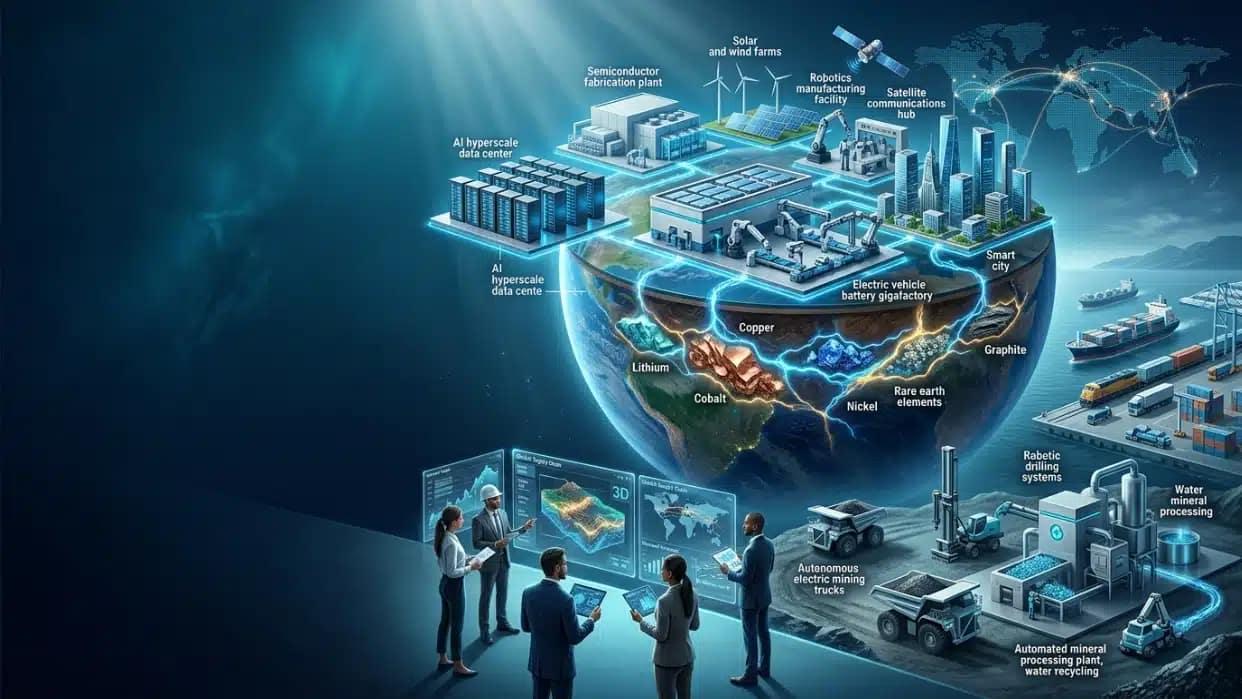
For more than a century, oil shaped the global economy.
It fueled transportation, powered industries, and influenced international politics.
Today, another resource race is quietly unfolding.
This time, the world’s attention is turning toward critical minerals—the raw materials essential for artificial intelligence, electric vehicles, renewable energy, semiconductors, defense technologies, and modern manufacturing.
Unlike oil, these resources rarely dominate daily headlines.
Yet they have become indispensable to the technologies driving the global economy.
As demand accelerates, governments and businesses are competing to secure reliable supplies, invest in new mining projects, and strengthen domestic production.
The result is one of the most significant economic transformations of the decade.
What Are Critical Minerals?
Critical minerals are natural resources considered essential for economic growth, national security, and advanced industries.
Governments classify certain minerals as “critical” because they are difficult to replace and are often produced in limited regions.
Some of the most important include:
- Lithium
- Copper
- Rare earth elements
- Nickel
- Cobalt
- Graphite
- Manganese
- Gallium
- Germanium
Without these materials, many modern technologies simply would not exist.
Why Demand Is Growing So Quickly
Several global trends are driving unprecedented demand.
Artificial Intelligence
Building AI requires enormous amounts of computing infrastructure.
Data centers, servers, networking equipment, and advanced semiconductor manufacturing all depend on large quantities of copper, rare earth elements, and specialty metals.
As AI adoption expands, demand for these materials is expected to grow alongside it.
Electric Vehicles
Electric vehicles require significantly more minerals than conventional gasoline-powered cars.
Lithium powers batteries.
Nickel improves energy density.
Cobalt enhances battery stability.
Copper is used extensively in motors, wiring, and charging infrastructure.
As EV production increases worldwide, so does competition for these resources.
Renewable Energy
Solar panels, wind turbines, battery storage systems, and modern electrical grids all require substantial quantities of critical minerals.
Transitioning toward cleaner energy depends not only on technological innovation but also on reliable access to raw materials.
Modern Electronics
Smartphones, laptops, medical equipment, satellites, robotics, and telecommunications infrastructure all rely on specialized minerals.
Even everyday consumer electronics contain materials sourced from multiple continents.
Why Countries Are Competing for Supply
Unlike many common industrial materials, critical mineral production is often concentrated in a relatively small number of countries.
This creates several challenges.
Supply Security
If production is interrupted because of political instability, trade restrictions, or natural disasters, global industries may struggle to obtain essential materials.
Economic Security
Many governments now view reliable mineral supplies as a strategic priority comparable to energy security.
Industrial Competitiveness
Countries investing in battery manufacturing, semiconductor production, and advanced technologies need dependable access to raw materials.
Securing these resources has become part of long-term industrial strategy.
The Rise of Resource Nationalism
Many resource-rich countries are placing greater emphasis on developing domestic industries instead of exporting raw materials alone.
Rather than simply mining minerals, governments increasingly want to process, refine, and manufacture higher-value products within their own borders.
This approach can create:
- More skilled jobs
- Greater economic value
- Stronger industrial development
- Increased export revenues
As a result, international competition is shifting from mining alone to the entire supply chain.
The Environmental Challenge
Mining remains essential.
However, expanding production also raises environmental concerns.
Large mining projects can affect:
- Water resources
- Local ecosystems
- Biodiversity
- Land use
- Nearby communities
Governments and companies are increasingly investing in cleaner mining technologies, recycling programs, and more sustainable extraction methods.
Balancing economic growth with environmental responsibility will remain one of the industry’s biggest challenges.
Recycling Is Becoming More Important
Mining is only part of the solution.
Recovering valuable minerals from used batteries, electronics, and industrial equipment is becoming increasingly important.
Advanced recycling can:
- Reduce dependence on new mining.
- Improve resource efficiency.
- Lower environmental impacts.
- Strengthen long-term supply resilience.
As battery use grows worldwide, recycling industries are expected to expand significantly.
How This Affects Consumers
Most people never purchase lithium or rare earth elements directly.
Yet these materials influence the products they use every day.
Critical minerals affect the cost and availability of:
- Smartphones
- Electric vehicles
- Computers
- Home appliances
- Solar panels
- Batteries
- Consumer electronics
Supply disruptions can contribute to higher manufacturing costs, which may eventually influence retail prices.
What This Means for Businesses
Manufacturers are increasingly redesigning supply chains to reduce dependence on single suppliers.
Many companies are:
- Diversifying sourcing.
- Investing directly in mining projects.
- Signing long-term supply agreements.
- Supporting recycling initiatives.
- Building regional processing facilities.
Supply chain resilience has become as important as production efficiency.
Why Investors Are Paying Attention
Critical minerals are no longer viewed simply as commodities.
They have become strategic assets tied to long-term global trends.
Industries expected to benefit include:
- Mining companies
- Battery manufacturers
- Semiconductor suppliers
- Renewable energy firms
- Industrial automation
- Recycling technologies
- Electric vehicle supply chains
Rather than representing a temporary market trend, many analysts believe demand will continue growing throughout the coming decades.
Looking Ahead
Demand for critical minerals is expected to increase as economies become more digital and electrified.
Artificial intelligence will require larger data centers.
Electric vehicles will continue expanding.
Power grids will need modernization.
Renewable energy capacity will grow.
Advanced manufacturing will become increasingly automated.
Meeting these needs will require reliable, diversified, and sustainable mineral supply chains.
The countries and companies that secure those supplies may gain significant economic advantages in the years ahead.
The Bottom Line
The global economy is entering a new era where access to critical minerals is becoming just as important as access to energy.
Lithium, copper, rare earth elements, and other strategic resources now sit at the center of technological innovation, industrial competitiveness, and economic security.
While the transition presents environmental and geopolitical challenges, it also creates opportunities for innovation, investment, and international cooperation.
Understanding the critical minerals race helps explain many of today’s developments in AI, clean energy, manufacturing, and global trade.
The Real Bottleneck Is the Entire Mineral Chain
Critical minerals are often discussed as if finding a deposit solves the supply problem. In reality, a mine is only the first stage. Ore must be financed, permitted, extracted, processed, refined, transported and converted into components that meet strict technical standards. A country can possess large reserves yet remain dependent on another country for refining or manufacturing.
That distinction explains why supply concentration matters. The International Energy Agency’s critical-minerals work tracks the connection between mineral supply and clean-energy technologies, while the OECD notes that mineral supply for clean-energy technologies may need to multiply substantially by 2040. These pressures link directly to the site’s analysis of rare-earth minerals and the global economy. Rare earths are only one group inside a much larger competition involving lithium, copper, nickel, cobalt and graphite.
Governments are responding with public finance, strategic partnerships and faster permitting. In May 2026, the Quad countries outlined a critical-minerals initiative intended to mobilize government and private support for diversified mining, processing and recycling. Such cooperation can reduce concentration, but new projects still face long development timelines, price volatility and community concerns.
Demand is also coming from several industries simultaneously. Electric grids need copper, batteries need lithium and graphite, wind turbines use specialized metals, and advanced electronics rely on high-purity inputs. The global energy transition therefore competes with the AI infrastructure boom for parts of the same material base. The recent copper-shortage analysis illustrates how slow mine development can collide with rapidly expanding demand.
Businesses should map minerals below the first tier of suppliers, because the most important dependence may be hidden inside a battery, magnet or semiconductor tool. Recycling, material efficiency and product redesign can reduce exposure, but none removes the need for responsible new production. The broader critical-minerals race will be decided by who can build complete, trusted supply chains—not simply who has the largest geological reserve.
Price cycles create another obstacle. High prices encourage investment, but mines often take many years to reach production. If prices fall before construction begins, financing can disappear even when long-term demand remains strong. Governments can improve predictability through transparent permitting, geological data and carefully designed offtake support, while companies should test projects against both high- and low-price scenarios. Communities must receive credible environmental safeguards and economic benefits, because projects without local trust face delay regardless of national strategy. A resilient mineral system therefore needs patient capital, responsible development and demand signals strong enough to survive the commodity cycle.
What a Resilient Critical-Minerals Strategy Requires
Diversification begins with better information. Governments and manufacturers need to know where minerals are mined, refined and incorporated into components. National reserve estimates alone do not reveal whether a battery maker can obtain qualified material next year. Shared standards and traceability can identify concentration before it becomes a shortage.
Investment policy must address the middle of the chain. Political announcements often focus on new mines, but processing plants, chemical conversion, specialized equipment and technical expertise may remain concentrated. Financing these stages can be difficult because they require scale and must compete with established suppliers. Long-term purchasing agreements can give investors confidence without guaranteeing profits regardless of performance.
Recycling is essential but develops gradually. Products must first reach the end of their useful lives, be collected and processed economically. Recovery rates vary by mineral and product design. Governments can support collection and common standards, while manufacturers can design batteries and electronics for easier disassembly. Recycling can reduce import dependence and environmental pressure, but it will complement primary mining for years rather than replace it.
Substitution provides another form of resilience. Engineers can sometimes redesign a product to use less of a constrained material or switch chemistry. The tradeoff may involve weight, range, durability or efficiency. Companies should fund this work before prices spike, because emergency redesign is slow when products require safety certification.
Responsible production is not a secondary concern. Poor labor practices, water damage or community displacement can close projects and undermine public support for the entire transition. Due diligence must extend through traders and refiners, not stop at the direct supplier. Local communities need transparent consultation, environmental monitoring and a fair share of economic benefits.
Stockpiles can protect essential industries during a short disruption, but they are not a complete strategy. Materials degrade at different rates, inventories cost money and government buying can distort an already tight market. Reserves should be limited to clearly defined security needs and combined with diversified supply.
Finally, policymakers should avoid treating every mineral identically. Copper is traded in deep global markets, while some rare-earth products have highly specialized supply chains. Risk assessments should consider concentration, substitutability, recycling potential and the economic importance of the end use. A targeted strategy will generally create more resilience than a broad race to subsidize every project carrying the label “critical.”
What Investors and Businesses Should Watch
Headline mineral prices are only one signal. Investors should examine project quality, ore grade, infrastructure, permitting, financing and the experience of management. A valuable deposit can remain uneconomic if it is remote, technically difficult or dependent on unrealistic price assumptions. Commodity cycles punish projects built only for the most optimistic scenario.
Manufacturers should watch refining concentration, inventory levels, trade restrictions and qualification time. Switching suppliers is not always immediate because battery, aerospace and semiconductor components may require extensive testing. A backup contract has little value if the material has never been qualified for production.
Governments should publish clear priorities and avoid changing royalty, tax or permitting rules after capital has been committed. Stability does not mean weak environmental standards; it means predictable standards applied consistently. Critical minerals will influence industrial power, but durable advantage will come from institutions capable of turning geology into responsible, competitive production. Countries that combine resources with skills, infrastructure and trust will capture more value than those exporting unprocessed material alone.
The Light Span Perspective
The technologies shaping our future all have one thing in common—they depend on materials that most people rarely think about. Behind every AI data center, electric vehicle, wind turbine, and advanced semiconductor lies a complex supply chain built on critical minerals.
At The Light Span, we believe understanding these hidden foundations is essential for making sense of today’s economic headlines. The race for critical minerals isn’t simply about mining; it’s about securing the building blocks of tomorrow’s industries. As the world accelerates toward a more digital and electrified future, these resources will increasingly influence economic growth, investment opportunities, and geopolitical strategy.

