


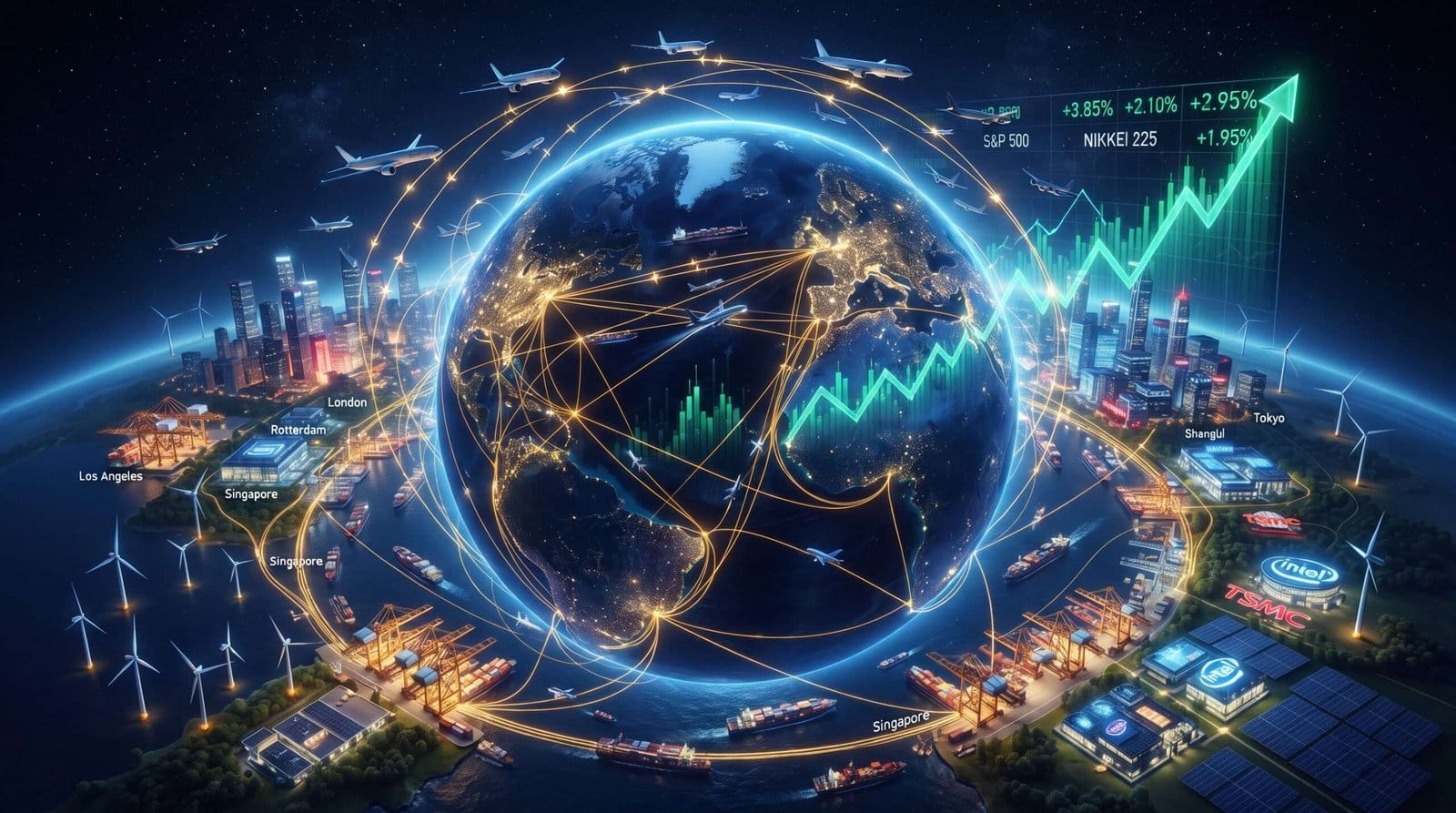
Global Economy Resilience 2026: Why Growth Is Holding Up
The global economy has been given plenty of reasons to slow down.
Geopolitical conflict has disrupted energy markets. Inflation has proven harder to defeat than expected. Governments are carrying heavy debt burdens. Trade relationships are changing, businesses face tariff uncertainty, and borrowing costs remain uncomfortable in many economies.
Yet the world economy continues to grow.
That is the central story behind global economy resilience in 2026.
The latest International Monetary Fund outlook projects global economic growth of 3.0% in 2026, followed by an acceleration to 3.4% in 2027.
The number itself may not look extraordinary.
What is extraordinary is what the economy has absorbed while continuing to expand.
The IMF describes two powerful forces pulling the world economy in opposite directions: the economic drag created by war and energy disruption, and a technology-driven investment boom that is supporting countries connected to the AI value chain.
The result is a global economy that is neither booming nor collapsing.
It is adapting.
And understanding why it is adapting matters because the answer tells businesses, investors and households where the economy’s underlying strength is coming from—and where its weaknesses remain.
Here are seven forces helping explain global economy resilience in 2026.
Key Takeaways
- The IMF expects the world economy to grow 3.0% in 2026 and 3.4% in 2027.
- Growth is uneven, with energy importers facing greater pressure while technology-linked economies receive support from AI investment.
- Inflation remains a serious problem: the IMF expects global headline inflation to rise from 4.1% in 2025 to 4.7% in 2026.
- AI investment is creating demand well beyond technology companies, reaching data centers, semiconductors, construction, electricity and networking.
- Businesses have redesigned supply chains after years of disruption, making some parts of the economy more adaptable.
- World trade is slowing rather than collapsing; the OECD projects trade growth of 3.1% in 2026.
- Economic resilience should not be confused with economic safety. Energy, debt, trade fragmentation and financial-market risks remain significant.
What Does Global Economic Resilience Actually Mean?
Economic resilience does not mean everything is going well.
It means an economy can absorb shocks without experiencing the level of damage that might otherwise have been expected.
Think about a business.
A resilient company does not avoid every problem.
Its suppliers can fail.
Costs can rise.
Customers can change.
Technology can disrupt its industry.
But the company has enough flexibility to adjust.
The same principle applies to the global economy.
Over the past several years, governments, businesses, consumers and financial institutions have repeatedly adapted to conditions that changed much faster than expected.
Supply chains were redesigned.
Businesses automated more work.
Energy supplies diversified.
Central banks responded aggressively to inflation.
Technology investment accelerated.
Companies built larger financial and operational buffers.
Not every country benefited equally from these changes.
But collectively, they help explain why global economy resilience 2026 has been stronger than a simple list of global risks might suggest.
1. Global Growth Is Still Positive Despite Major Shocks
The most obvious evidence of resilience is that the world economy continues expanding.
According to the IMF July 2026 World Economic Outlook Update, global growth is projected at 3.0% in 2026 and 3.4% in 2027.
That forecast comes despite significant disruption.
The IMF says the global outlook is being shaped by the lingering economic effects of conflict in the Middle East and a technology-driven investment boom.
Those forces do not affect every country equally.
Energy-importing economies are more vulnerable to higher oil and gas costs.
Countries connected to the global technology supply chain can benefit from demand for semiconductors, computing equipment and AI infrastructure.
This is why the global growth number alone doesn’t tell the whole story.
Some economies may struggle while others expand quickly enough to support the overall world economy.
The important point is that a synchronized global recession has not become the baseline.
That gives businesses a very different environment from one in which demand is contracting almost everywhere simultaneously.
For readers who want the broader forecast rather than the resilience question explored here, our global economy outlook for 2026 examines the major trends businesses should watch across the year.
2. AI Has Become a Real Economic Investment Cycle
Artificial intelligence is one of the clearest reasons the global economy of 2026 looks different from previous periods of slow growth.
AI is no longer simply a chatbot story.
It requires physical infrastructure.
Technology companies are investing enormous sums in:
- data centers,
- semiconductor chips,
- high-speed networking,
- cloud infrastructure,
- cooling systems,
- electricity generation,
- transmission infrastructure,
- and specialized computing equipment.
That spending creates economic activity beyond the technology industry.
A new AI data center may require construction workers, electrical equipment, engineers, land, cooling systems and grid connections.
Semiconductor expansion requires advanced manufacturing equipment, materials, logistics and highly skilled workers.
Electricity demand can encourage investment in power generation and transmission.
This is why AI can support economic activity even before the full productivity benefits of artificial intelligence appear.
Our updated analysis of AI infrastructure spending in 2026 shows how the AI boom is developing into an industrial-scale investment cycle rather than remaining a software-only phenomenon.
The IMF also identifies technology investment as an important counterweight to the negative economic effects of geopolitical disruption.
That makes AI one of the most unusual features of global economy resilience in 2026.
A technology transition is helping offset weakness coming from completely different parts of the world economy.
3. Businesses Learned From Earlier Supply-Chain Shocks
The global economy was once optimized heavily around efficiency.
Companies looked for the cheapest supplier, lowest manufacturing cost and smallest possible inventory.
That system worked extremely well when trade routes were predictable.
Then businesses experienced repeated disruptions.
The pandemic exposed dependence on concentrated suppliers.
Shipping bottlenecks created shortages.
Geopolitical tensions increased uncertainty.
Semiconductor shortages disrupted manufacturing.
Energy shocks changed production costs.
Companies responded.
Many began using multiple suppliers instead of relying on one.
Others moved production closer to their customers.
Businesses increased inventories of critical components.
Governments encouraged domestic manufacturing in strategically important industries.
This is the logic behind nearshoring, reshoring and friend-shoring.
These strategies can cost more than a supply chain designed purely for maximum efficiency.
But they may reduce the damage caused by disruption.
That distinction matters.
A company paying slightly more for components may still be better off if it can continue operating when a competitor’s cheaper supply chain stops working.
The OECD expects global trade growth to moderate from 5.0% in 2025 to 3.1% in 2026, rather than collapse altogether.
This suggests the global trading system is changing more than it is disappearing.
The shift toward resilience is also one of the central themes in our coverage of how global supply chains are moving closer to home.
4. The Economy Is Becoming Better at Redirecting Trade
Another reason for global economy resilience 2026 is that trade flows can adapt.
When tariffs rise or geopolitical relationships change, trade does not necessarily stop.
It can move.
A company that once sourced a product primarily from one country may expand sourcing elsewhere.
A manufacturer may build a regional production hub.
Exporters can look for different customers.
Businesses can redesign products around alternative components.
None of this happens without cost.
Changing suppliers takes time.
New factories require investment.
Regional production may be more expensive.
But flexibility reduces the chance that one disruption shuts down an entire business.
The OECD’s 2026 outlook illustrates this uneven trade environment. While overall global trade growth is expected to slow, parts of Asia are projected to maintain considerably stronger export growth, supported partly by electronics and AI-related trade.
This is an important feature of modern globalization.
Trade is becoming more strategic and regional, but global economic connections remain extremely deep.
The more useful question is therefore not:
“Is globalization ending?”
It is:
“How is globalization being reorganized?”
Our analysis of global trade uncertainty in 2026 explores how tariffs and policy uncertainty are changing investment and supply-chain decisions.
5. Inflation Is a Problem—but Economies Have Learned to Operate Around It
This section requires an important correction to the original article.
Earlier in 2026, it was tempting to describe inflation as steadily returning toward normal.
The latest evidence is less reassuring.
The IMF says global disinflation has stalled.
Global headline inflation is projected to increase from 4.1% in 2025 to 4.7% in 2026, before declining to 3.9% in 2027. Higher energy and food prices are major contributors.
That is not good news.
But it reveals something interesting about economic resilience.
The global economy is continuing to grow even while inflation remains difficult.
Businesses have adjusted prices and costs.
Consumers have become more selective.
Central banks have adapted their policy expectations.
Companies are prioritizing productivity.
Households are changing spending patterns.
None of this means inflation is harmless.
Higher prices reduce purchasing power.
Persistent inflation can keep borrowing costs elevated.
Higher interest payments can pressure governments and businesses.
But the world economy is no longer reacting to inflation as if it were an entirely unfamiliar shock.
That adaptability is helping prevent a difficult inflation environment from automatically becoming a global recession.
6. Emerging and Technology-Linked Economies Are Providing New Growth Engines
Another reason the world economy can remain resilient is diversification.
Global growth does not depend entirely on one country or region.
The World Bank’s June 2026 outlook shows significant differences across emerging and developing economies, while electronics exports and technology demand continue supporting parts of Asia.
The IMF similarly emphasizes that countries integrated into the global technology value chain are benefiting from AI-driven demand.
This creates a different world economy from one in which all major regions rise and fall together.
Countries can benefit from different economic engines:
Technology exporters can gain from AI demand.
Commodity producers can benefit when energy or raw-material prices rise.
Manufacturing hubs can gain when companies diversify supply chains.
Fast-growing consumer markets can attract businesses looking for new customers.
Countries investing in digital infrastructure can create new service industries.
This diversification does not eliminate global shocks.
But it can distribute economic growth across more sources.
It also helps explain why the global race for AI leadership matters economically, not just technologically. Countries with chips, computing infrastructure, energy, capital and talent may capture a larger share of the next investment cycle.
7. Governments and Central Banks Still Have Tools—But Less Room for Error
The global economy has another source of resilience: institutions have experience responding to crises.
Central banks have spent years dealing with inflation and financial stress.
Governments developed new ways to support households and businesses during extreme disruptions.
Financial regulators monitor banking vulnerabilities.
Strategic reserves can sometimes reduce short-term commodity shortages.
International institutions provide financing and coordination.
These tools matter.
But the available safety margin is not unlimited.
The IMF is now explicitly urging governments to rebuild fiscal space while maintaining price stability.
Why?
Because future shocks become harder to manage when governments already have high debt and central banks are still fighting inflation.
Imagine another major downturn.
A government with healthy finances may be able to increase spending or support vulnerable households.
A highly indebted government paying large amounts of interest has less flexibility.
Similarly, a central bank facing low inflation can cut rates more easily than one already worried about renewed price pressure.
That is why resilience today does not guarantee resilience tomorrow.
The world has developed better shock absorbers.
It also needs to maintain them.
Why the Global Economy Doesn’t Feel Strong to Everyone
There is an important difference between economic resilience and household experience.
GDP can grow while people still feel financially pressured.
Inflation illustrates why.
If prices rise rapidly for several years and then inflation slows, prices usually do not return to where they started.
They simply rise more slowly.
A household may therefore hear that economic conditions are improving while still paying substantially more for food, housing, transportation or services.
Borrowing costs create another gap.
High mortgage and loan rates can make households feel squeezed even when employment remains relatively stable.
Economic growth can also be uneven.
A worker in an expanding AI-related industry may experience the economy very differently from someone employed in a sector struggling with higher energy costs or weak demand.
This is why global economy resilience 2026 should never be interpreted as:
“Everyone is doing well.”
It means:
“The overall system is absorbing shocks better than might have been expected.”
Those are very different statements.
The Biggest Risks to Economic Resilience
The current strength is real, but several developments could weaken it quickly.
Another major energy shock
Higher oil and gas prices can raise transportation, manufacturing and household costs.
Persistent inflation
If inflation remains elevated, central banks may have less room to support weakening economies.
Trade fragmentation
The IMF warns that accelerating fragmentation could reduce output and increase prices.
Excessive debt
High debt can reduce governments’ ability to respond to future crises.
AI investment disappointment
Technology investment is supporting growth, but a sharp correction in AI expectations could affect financial markets and business investment.
Financial-market repricing
The IMF specifically identifies a correction in technology-driven expectations as a downside risk.
Geopolitical escalation
Conflict can simultaneously affect energy, trade, financial markets and business confidence.
The danger is not necessarily one risk occurring independently.
The bigger concern is several risks reinforcing each other.
For example:
Conflict → energy shock → inflation → higher rates → weaker investment → slower growth.
That is how an economy that appears resilient can suddenly become more vulnerable.
Could AI Become the Biggest Source of Economic Growth?
Possibly—but it is too early to assume that outcome.
The current AI boom affects the economy in two different ways.
The first is investment.
Companies are spending enormous amounts on infrastructure today.
That immediately creates demand.
The second is productivity.
If AI eventually allows workers and companies to produce more value with the same amount of labor and capital, the long-term economic effect could be much larger.
Productivity is crucial because sustainable improvements in living standards ultimately depend heavily on producing more efficiently.
AI could help workers:
- analyze information faster,
- automate repetitive tasks,
- write software,
- optimize logistics,
- improve manufacturing,
- accelerate scientific research,
- and make better use of large datasets.
But productivity gains are not automatic.
Companies need to redesign workflows.
Employees need training.
AI systems need to become reliable.
Businesses need to identify applications that actually create value.
The infrastructure boom is happening now.
The full productivity payoff may take much longer.
What Global Economy Resilience Means for Businesses
Businesses should not interpret resilience as a reason to ignore risk.
The opposite lesson is more useful.
Companies have survived recent shocks partly because they became more adaptable.
That means businesses should continue:
- diversifying critical suppliers,
- investing in productivity,
- monitoring energy exposure,
- controlling excessive debt,
- strengthening cybersecurity,
- developing AI skills,
- and planning for multiple economic scenarios.
Companies should also distinguish between efficiency and fragility.
The absolute cheapest supplier is not always the best supplier.
The highest possible leverage is not always the best financing strategy.
The fastest AI deployment is not always the most useful deployment.
Resilience often involves paying a small cost today to avoid a much larger cost tomorrow.
What It Means for Households and Investors
For households, the strongest lesson is not to assume that positive global growth means inflation or borrowing pressures will disappear quickly.
The IMF’s latest outlook makes clear that inflation remains a challenge.
Consumers should therefore pay attention to:
Inflation: Does price growth begin falling again?
Interest rates: Are central banks gaining room to reduce borrowing costs?
Employment: Are companies continuing to hire?
Energy prices: Are geopolitical events increasing household and transportation costs?
For long-term investors, diversification remains important.
AI may be one of the strongest investment themes of the decade, but technology-driven expectations can also become excessive.
Economic resilience can support markets without guaranteeing that every high-growth asset is fairly priced.
What Happens Next?
The remainder of 2026 is likely to be shaped by a tug-of-war between powerful positive and negative forces.
On one side:
- AI investment,
- technology demand,
- adaptable businesses,
- diversified supply chains,
- positive global growth.
On the other:
- inflation,
- energy uncertainty,
- trade fragmentation,
- geopolitical conflict,
- debt,
- and financial-market risk.
The IMF’s forecast of stronger growth in 2027 suggests the global economy could improve if current shocks fade.
But that outcome is not guaranteed.
The next phase will depend heavily on whether energy markets normalize, inflation resumes declining and technology investment produces sustainable economic value.
FAQs
Why is the global economy resilient in 2026?
The world economy is benefiting from technology investment, more adaptable businesses, diversified supply chains and growth across different regions. The IMF still projects global GDP to expand by 3.0% in 2026 despite significant economic shocks.
Is the global economy strong in 2026?
It is better described as resilient rather than strong. Growth remains positive, but inflation, geopolitical conflict, debt and trade uncertainty continue creating significant risks.
What is the global growth forecast for 2026?
The IMF’s July 2026 World Economic Outlook Update projects global growth of 3.0% in 2026 and 3.4% in 2027.
Is inflation falling in 2026?
Not consistently worldwide. The IMF says global disinflation has stalled and projects headline inflation to rise from 4.1% in 2025 to 4.7% in 2026 before declining in 2027.
Is global trade still growing?
Yes, although more slowly. The OECD projects global trade growth to moderate from 5.0% in 2025 to 3.1% in 2026.
How is AI supporting the global economy?
AI is encouraging investment in semiconductors, data centers, cloud computing, networking and electricity infrastructure. It could also produce longer-term productivity gains if businesses successfully integrate AI into real workflows.
Could the world still enter a recession?
Yes, a major downturn remains possible if several risks intensify simultaneously. Current major forecasts, however, continue to project positive global growth rather than a worldwide recession.
The Light Span Perspective
The most important lesson from global economy resilience 2026 is that resilience rarely looks dramatic.
It is built through thousands of adjustments.
A manufacturer finds another supplier.
A company automates an inefficient process.
A country diversifies its energy imports.
A technology company builds new computing infrastructure.
A central bank adjusts policy.
A household changes spending.
Individually, these actions rarely dominate headlines.
Collectively, they can change the trajectory of the global economy.
That is what appears to be happening in 2026.
The world economy is not unusually calm.
Quite the opposite.
It is operating through war, inflation, energy uncertainty, trade fragmentation and rapid technological change.
Yet it continues expanding.
That should give us confidence in the ability of economies to adapt—but not confidence that nothing can go wrong.
The IMF’s latest outlook contains both sides of that story: positive growth supported partly by technology investment, alongside stalled disinflation and continuing geopolitical and financial risks.
Perhaps the biggest mistake would therefore be to describe the global economy as either strong or weak.
A better description is:
Resilient, uneven and changing faster than before.
And that distinction matters.
The next winners in the global economy may not simply be the countries and companies with the lowest costs or largest balance sheets.
They may be the ones capable of adapting fastest when the assumptions change.
Continue reading more
https://www.imf.org/en/publications/weo/issues/2026/07/08/world-economic-outlook-update-july-2026

