


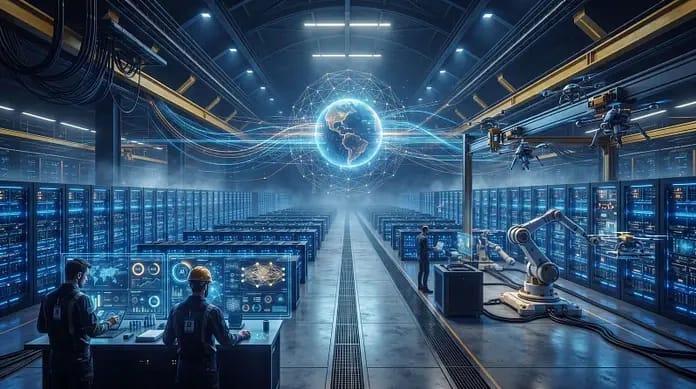
AI Industrial Revolution: How AI Factories Affect the Economy
Artificial intelligence began as a software revolution.
Today, it increasingly looks like an industrial revolution.
Behind every AI assistant, coding agent, image generator and intelligent business application is a physical system containing advanced processors, high-speed networking, memory, cooling equipment and enormous amounts of electrical infrastructure.
The buildings housing these systems are increasingly described as AI factories.
But focusing only on the buildings misses the larger story.
The emerging AI industrial revolution in 2026 is connecting artificial intelligence with manufacturing, energy, construction, semiconductors, finance and national economic strategy.
AI is no longer simply changing what software can do.
It is changing what countries build.
NVIDIA describes an AI factory as infrastructure designed to convert energy and computing capacity into AI output, with efficiency increasingly measured through metrics such as tokens per second, tokens per watt, utilization and cost per token. Its current architecture treats energy, chips, computing infrastructure, models and applications as one connected production system.
That model is important because it resembles an industrial production process.
Traditional factories take materials and energy and convert them into products.
AI factories take data, processors and electricity and convert them into digital intelligence.
And increasingly, that intelligence powers other factories, robots, research laboratories, offices and logistics systems.
The result is a technology cycle that looks less like another software upgrade and more like the creation of a new layer of economic infrastructure.
Here are seven ways the AI industrial revolution is reshaping the physical economy.
1. AI Factories Are Becoming Real Production Infrastructure
The term AI factory can sound like marketing language.
But the underlying idea describes a meaningful change in computing.
Traditional data centers were built primarily to support websites, databases, cloud applications, storage and general computing.
AI workloads place very different demands on infrastructure.
Reasoning systems and AI agents can require large numbers of accelerators working together continuously.
Processors need extremely fast access to memory.
Servers need high-speed networking.
Heat must be removed efficiently.
Power has to remain stable.
And expensive hardware needs to stay highly utilized for the economics to make sense.
This is why AI infrastructure is increasingly designed as one coordinated system.
NVIDIA’s 2026 DSX architecture, for example, connects chips, networking, cooling, facilities, software and operations with the aim of maximizing AI output per megawatt and reducing the cost of producing tokens.
NVIDIA’s AI factory architecture
The language may be new, but the economic logic is familiar.
A steel plant cares about output per unit of energy and capital.
A semiconductor factory cares about throughput, yield and utilization.
An AI factory increasingly cares about how efficiently it converts expensive computing infrastructure into useful AI output.
This means the AI business is becoming more capital intensive.
A brilliant model matters.
But a company also needs enough capacity to serve customers economically.
That makes infrastructure itself a competitive advantage.
Our separate analysis of the rise of AI factories should continue to explain the technical architecture of these facilities.
This page has a different purpose.
It explains what happens when AI factories become large enough to reshape the wider economy.
2. The Semiconductor Industry Is Becoming Part of Industrial Policy
AI factories begin with chips.
Advanced AI processors perform the calculations behind training, reasoning and inference.
But producing those processors requires one of the most sophisticated manufacturing systems in existence.
The supply chain includes:
chip designers,
semiconductor fabrication plants,
advanced packaging,
high-bandwidth memory,
optical networking,
specialized materials,
and manufacturing equipment.
The AI boom has therefore transformed semiconductors from a technology-industry concern into a strategic economic issue.
Governments increasingly care about where AI systems are designed and where the hardware underneath them is manufactured.
That explains the push toward domestic semiconductor capacity and broader efforts to strengthen technology supply chains.
NVIDIA says its Vera Rubin platform entered full production in 2026 through a manufacturing network spanning hundreds of factories and dozens of countries.
The company has also highlighted new U.S. manufacturing activity involving chip systems, optics, packaging and infrastructure suppliers.
This does not mean AI manufacturing will suddenly become completely local.
Semiconductor supply chains are too complex for that.
But countries increasingly want enough domestic capacity to reduce vulnerability.
That turns the global race for AI leadership into a manufacturing competition as well as a software competition.
The country with the best AI researchers has an advantage.
The country capable of producing chips, servers, energy infrastructure and advanced industrial equipment has another.
The strongest AI economies may increasingly need both.
3. Electricity Is Becoming a Raw Material for the AI Economy
Every industrial revolution has depended on energy.
Steam powered early factories.
Electricity transformed twentieth-century manufacturing.
Oil became central to transportation and global industry.
The AI era has its own relationship with energy.
Artificial intelligence converts electricity into computation.
That makes power availability a direct limit on how much AI infrastructure can operate.
The more AI usage expands, the more important this becomes.
Training frontier systems consumes substantial computing power, but inference may ultimately create even larger continuing demand because deployed AI operates every time users or agents request work.
Agentic AI intensifies the challenge.
An ordinary chatbot may generate one response and stop.
A sophisticated AI agent could spend minutes or hours reasoning, retrieving information, using tools and checking results.
That means one user request can trigger a much longer computing process.
The economics increasingly come down to how much useful intelligence can be generated from each unit of energy.
This is why the electricity demands of AI data centers have become central to the infrastructure debate.
NVIDIA now explicitly describes energy as one of the five fundamental layers of an AI factory.
The result is a new connection between technology companies and:
utilities,
nuclear power,
renewables,
battery storage,
natural gas generation,
transmission infrastructure,
and grid modernization.
A technology company may have enough money to buy processors.
That does not guarantee a region can provide enough electricity to operate them.
In the AI industrial revolution of 2026, megawatts are becoming almost as strategically important as GPUs.
4. AI Investment Is Creating a New Heavy-Infrastructure Financing Market
Large AI factories are extraordinarily expensive.
Their costs extend far beyond processors.
Developers need land.
Buildings.
Power connections.
Transformers.
Networking.
Cooling.
Construction.
Electrical equipment.
Storage.
And long-term access to computing hardware.
This is pushing AI infrastructure toward a financial model that looks increasingly similar to traditional infrastructure.
An important development arrived in August 2026.
NVIDIA announced partnerships involving Apollo, BlackRock, Blackstone, Brookfield, Goldman Sachs and KKR aimed at developing financing platforms capable of mobilizing more than $500 billion of third-party capital for AI infrastructure over time.
That number does not mean $500 billion has already been spent.
It represents intended financing capacity.
But the development shows how the market is evolving.
AI infrastructure is moving from individual technology companies financing individual data centers toward institutional investors treating computing capacity as an infrastructure asset.
That resembles earlier economic transformations.
Railroads required huge financing markets.
Power grids required long-term capital.
Telecommunications networks depended on enormous infrastructure investment.
AI factories may increasingly be financed through similar structures.
This also changes the risk.
The AI infrastructure spending boom will eventually need to generate enough revenue to justify the capital behind it.
A data center can be technologically impressive and still become a poor financial investment if customers do not use enough capacity.
The most important measure may therefore become utilization.
Expensive infrastructure is valuable when customers continuously use it.
Empty computing capacity is simply expensive hardware.
5. AI Factories Are Beginning to Rebuild Manufacturing
The phrase AI industrial revolution becomes much more meaningful when artificial intelligence starts influencing physical production.
AI factories generate intelligence.
That intelligence can then improve conventional factories.
Manufacturers increasingly use AI for:
predictive maintenance,
quality inspection,
production scheduling,
supply-chain optimization,
robotics,
digital twins,
and engineering.
This creates a feedback loop.
AI infrastructure supports smarter manufacturing.
Smarter manufacturing helps produce more AI infrastructure.
NVIDIA’s DSX ecosystem illustrates the connection particularly clearly because the company now uses digital twins to simulate AI factory design before construction.
Facilities can be modeled virtually to examine power, cooling, networking and hardware layouts before physical equipment is installed.
That can reduce deployment risk and speed infrastructure planning.
The same principle applies outside data centers.
A manufacturer can create a virtual model of a production line and test changes before modifying the actual facility.
AI can analyze operational data and identify inefficiencies.
Robots can increasingly use computer vision and AI models to operate in more flexible environments.
This is where AI moves from the digital economy into the industrial economy.
A model can help design a better product.
A digital twin can help design a better factory.
A robot can help manufacture the product.
And an AI agent can coordinate parts of the production workflow.
That convergence could become much more economically important than another generation of consumer chatbots.
6. Nations Are Beginning to Treat AI Compute Like Strategic Infrastructure
Governments once treated data centers primarily as commercial investments.
That view is changing.
AI compute increasingly affects:
scientific research,
manufacturing,
healthcare,
defense,
robotics,
government services,
and economic competitiveness.
That makes access to advanced computing strategically important.
Japan offers a clear recent example.
In July 2026, NVIDIA announced a project with Noetra backed by Japan’s Ministry of Economy, Trade and Industry to build a national AI infrastructure platform with 27,500 Rubin GPUs, 13,750 Vera CPUs and 140 megawatts of data-center capacity.
The project is intended to support manufacturing, logistics, healthcare and physical AI development.
That is a significant shift.
AI compute is no longer being built only because a cloud company wants more customers.
Governments increasingly see it as part of national industrial capacity.
The logic resembles earlier strategic industries.
Countries cared about steel because industrial economies required steel.
They cared about oil because transportation required oil.
They cared about semiconductor manufacturing because the digital economy required chips.
Now some governments increasingly care about AI computing capacity because future industries may depend on access to intelligence produced at scale.
This does not mean every country needs its own frontier AI model.
But it does mean countries may increasingly ask:
Where is our computing capacity?
Who controls it?
Where are the chips manufactured?
Where does the electricity come from?
Could our businesses access enough AI infrastructure during a geopolitical crisis?
Those are industrial-policy questions, not simply software questions.
7. The Real Test Is Whether AI Factories Raise Productivity
Large investments can create economic activity immediately.
Construction workers build facilities.
Equipment companies receive orders.
Utilities expand infrastructure.
Semiconductor manufacturers increase production.
But long-term economic success requires something more.
The AI created by those factories needs to make other parts of the economy more productive.
This remains an unresolved issue.
Companies are adopting AI rapidly, but many organizations are still experimenting with workflows rather than transforming entire business models.
That helps explain the AI productivity paradox.
The infrastructure is arriving faster than the full productivity payoff.
This is not unusual.
Previous industrial revolutions also required long installation periods.
Electricity became transformative when factories stopped simply replacing steam engines with electric motors and redesigned production around electric power.
Computers delivered greater value once companies reorganized information and business processes.
The internet created far more value after entire industries changed around connectivity.
AI may follow the same pattern.
The factory is only the first step.
Companies then need to determine how to use the intelligence it produces.
If AI allows workers to create more value, accelerates scientific research, improves manufacturing and enables entirely new businesses, today’s enormous infrastructure investment could look justified.
If companies struggle to turn AI capabilities into sustainable revenue and productivity, parts of the infrastructure boom could become overbuilt.
The true output of the AI industrial revolution therefore is not tokens.
It is economic value created using those tokens.
Why AI Factories Are Not Just Bigger Data Centers
This distinction deserves emphasis because the terms are often used interchangeably.
A conventional data center is mainly a place where computing infrastructure operates.
An AI factory is better understood as a production system optimized specifically for artificial intelligence.
It combines:
compute,
memory,
networking,
power,
cooling,
software,
models,
and operations
with the objective of producing useful AI output as efficiently as possible.
NVIDIA’s current AI factory framework describes five connected layers running from energy through applications.
That systems approach matters.
Installing thousands of GPUs does not automatically create an efficient AI factory.
If networking is too slow, the processors wait.
If cooling is inadequate, performance suffers.
If electricity is unavailable, hardware sits idle.
If software utilization is poor, expensive infrastructure produces too little revenue.
The AI factory therefore behaves more like one enormous industrial machine than a collection of individual servers.
Agentic AI Could Make the Industrial Model Even More Important
The economics of AI infrastructure were originally dominated by model training.
The future may be dominated increasingly by inference.
AI agents could accelerate that transition.
A conventional AI interaction may involve one prompt and one response.
An agent may perform dozens or hundreds of actions internally.
It can reason.
Retrieve information.
Use software tools.
Check its progress.
Create additional tasks.
Continue operating until the goal is completed.
NVIDIA describes modern agentic workloads as long-running processes capable of producing thousands of reasoning and tool-use steps from a single prompt. Its Vera Rubin systems are explicitly designed around these heavier inference workloads.
This means the rise of agents could significantly increase the amount of computing required per user.
The more work businesses delegate to AI, the more continuously AI factories may operate.
That gives infrastructure owners a large opportunity.
It also raises the stakes around energy efficiency and cost.
If every useful agent task is too expensive to run, adoption slows.
The next competition may therefore revolve around lowering the cost of useful intelligence.
The Jobs Created by the AI Industrial Revolution
AI is often discussed mainly as a threat to employment.
But the infrastructure buildout itself requires workers.
The employment ecosystem includes:
electricians,
engineers,
construction workers,
network technicians,
semiconductor workers,
cooling specialists,
data-center operators,
AI engineers,
robotics technicians,
and cybersecurity professionals.
NVIDIA’s own U.S. economic-impact estimates claim its partner infrastructure activity supported roughly 100,000 direct and indirect U.S. jobs in 2026, though this is a company-commissioned economic estimate rather than a government employment count.
The broader lesson is more important than the exact number.
AI jobs are not limited to people training machine-learning models.
The industrial side of AI requires workers across energy, construction, manufacturing and engineering.
Our updated guide to AI jobs in 2026 explores this wider employment shift.
That is another reason the industrial framing matters.
AI increasingly affects both digital labor and physical industry.
Could the AI Industrial Revolution Become a Bubble?
Yes—parts of it could.
A technology can be transformative while investors still build too much capacity.
History provides many examples.
Railways changed economies while many railway companies failed.
The internet transformed civilization while the dot-com bubble destroyed enormous amounts of investment capital.
AI could produce a similar outcome.
The technology may succeed while certain data-center projects, chip companies or infrastructure investments fail financially.
The warning signs would include:
capacity growing much faster than usage,
rapid declines in AI pricing,
weak infrastructure utilization,
heavy borrowing based on optimistic forecasts,
and disappointing business productivity.
At the moment, the industry is still expanding aggressively.
But investors are increasingly asking whether AI infrastructure can become a durable, revenue-producing asset rather than simply an expensive race for computing capacity.
That question will become more important as institutional capital enters the market.
What the Next AI Factories Could Look Like
Future AI factories are likely to become more automated and integrated.
Digital twins can simulate infrastructure before construction.
AI can optimize cooling.
Workloads can be scheduled around power availability.
New processors can improve performance per watt.
Optical networking can move more data efficiently.
Robots may eventually help maintain facilities.
Energy storage could help smooth electricity demand.
And more sites may be designed around specific workloads such as robotics, scientific AI or sovereign national computing.
The facility itself may increasingly become software-defined.
Instead of treating power, hardware and applications as separate systems, operators will optimize them together.
That is the deeper meaning of the AI factory.
It is not merely a larger data center.
It is a new industrial architecture built around producing intelligence.
FAQs
What is the AI industrial revolution?
The AI industrial revolution describes the shift of artificial intelligence from software into physical economic infrastructure, including data centers, semiconductor factories, power systems, robotics and advanced manufacturing.
What is an AI factory?
An AI factory is computing infrastructure purpose-built for large-scale AI training, reasoning and inference. It integrates processors, networking, power, cooling and software to produce AI outputs efficiently.
Why are AI factories so expensive?
They require advanced processors, high-bandwidth memory, networking, specialized cooling, reliable electricity, buildings and supporting infrastructure.
Why does AI need so much electricity?
AI models use large clusters of processors. Training and running those models continuously consumes substantial electrical power, especially as reasoning and agentic workloads expand.
Are governments building AI factories?
Yes. National governments increasingly support AI computing infrastructure. Japan’s 2026 national physical-AI project is one example of state-supported AI capacity.
Will AI factories create jobs?
They can create demand in construction, electrical engineering, semiconductor manufacturing, data-center operations, networking, energy and AI software, while AI adoption may simultaneously automate some existing tasks.
Could AI infrastructure be overbuilt?
Yes. If computing capacity expands significantly faster than profitable AI usage, some infrastructure investments could struggle to generate adequate returns.
The Light Span Perspective
The original Industrial Revolution changed the world because machines allowed humans to produce physical goods on a previously unimaginable scale.
The AI industrial revolution may do something similar with intelligence.
That does not mean intelligence literally becomes another commodity like steel.
It means reasoning, analysis, prediction and automated decision support can increasingly be generated using industrial-scale computing systems.
The implications extend far beyond technology companies.
Electric utilities need to respond.
Semiconductor manufacturers need to expand.
Construction firms build facilities.
Governments develop industrial strategies.
Investors finance computing infrastructure.
Factories use AI to become more efficient.
Robots use AI to become more flexible.
And businesses reorganize work around increasingly capable intelligent systems.
That is why the AI story of 2026 looks so different from the chatbot boom that initially captured public attention.
AI is developing a physical footprint.
The key resource is no longer only data.
It is also chips.
Electricity.
Land.
Cooling.
Factories.
Capital.
And highly skilled workers.
But the industrial analogy also carries a warning.
Building infrastructure is not the same thing as creating value.
The world can build millions of processors and enormous AI campuses.
Those investments will ultimately be judged by what the resulting intelligence allows the economy to accomplish.
If AI helps scientists discover faster, manufacturers produce more efficiently, workers perform higher-value tasks and businesses create entirely new products, the infrastructure being built today could become foundational to future economic growth.
If AI usage grows more slowly than expected, some of today’s investments may become painful reminders that revolutionary technologies can still attract excessive capital.
That is why the AI industrial revolution of 2026 should neither be dismissed as hype nor accepted uncritically.
Something real is clearly being built.
The factories exist.
The chips exist.
The energy demand is real.
Institutional capital is moving in.
Governments are treating compute as strategic infrastructure.
The unanswered question is what all that infrastructure will eventually produce.
The first Industrial Revolution turned energy into physical work.
The AI revolution is attempting to turn energy into scalable intelligence.
Whether that becomes the next great productivity engine—or one of history’s most expensive technology buildouts—will depend on what the world does with the intelligence those factories create.
Continue reading more

