


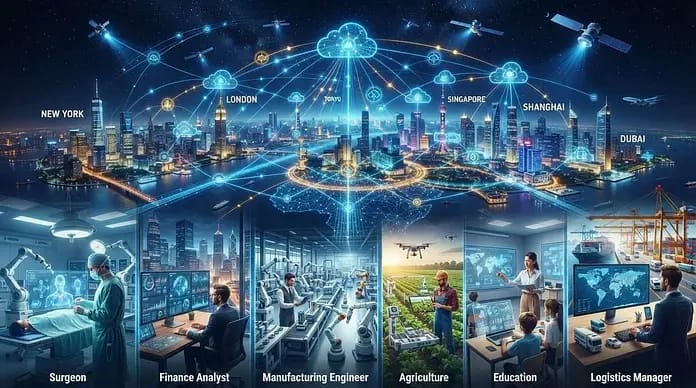
AI Economy 2026: Investment, Adoption and Growth
Artificial intelligence is no longer just a technology story.
It is becoming an economic story.
Billions of people encounter AI through chatbots, search engines, smartphones, workplace software and increasingly intelligent digital services. But behind those visible applications sits something much larger.
Companies are building data centers.
Semiconductor manufacturers are expanding production.
Utilities are preparing for enormous electricity demand.
Businesses are investing in automation.
Governments are developing national AI strategies.
Investors are pouring capital into AI startups and infrastructure.
And workers are beginning to rethink which skills will remain valuable as intelligent systems become more capable.
The scale is now large enough that the AI economy in 2026 is influencing broader economic growth.
The International Monetary Fund’s July 2026 World Economic Outlook says accelerating demand connected with artificial intelligence is helping offset some of the economic damage created by geopolitical conflict. The IMF now projects global growth of 3.0% in 2026 and 3.4% in 2027, noting that economies integrated into the global technology value chain are benefiting from AI-driven momentum.
That is a significant change.
AI is no longer simply a promising future technology.
It is already affecting investment, trade, employment, electricity demand and financial markets.
Stanford University’s 2026 AI Index provides another indication of the scale. Global corporate AI investment more than doubled in 2025, while private investment grew 127.5%. Generative AI investment increased by more than 200%, and the number of newly funded AI companies rose 71%.
But calling this a “trillion-dollar AI economy” requires an important distinction.
There is no single official statistic showing that AI itself has suddenly added exactly $1 trillion to global GDP.
Instead, the trillion-dollar story describes the enormous ecosystem of capital expenditure, company valuations, infrastructure construction, private investment, revenues, consumer value and economic activity forming around artificial intelligence.
Understanding that distinction gives us a much clearer picture of what is actually happening.
Here are seven forces driving the AI economy—and why they could reshape global growth for years.
1. AI Has Triggered One of the Largest Technology Investment Cycles in History
Every technological revolution requires investment before it produces widespread economic benefits.
Railways needed tracks.
Electricity needed power stations and transmission networks.
Automobiles needed factories, roads and fuel infrastructure.
The internet needed fiber networks, servers and data centers.
Artificial intelligence is following the same pattern.
Except the scale is extraordinary.
AI systems require specialized processors, high-bandwidth memory, networking equipment, cloud infrastructure, enormous data centers, cooling systems and increasingly large quantities of electricity.
That has created a huge capital-spending cycle.
Stanford’s 2026 AI Index reports that corporate AI investment more than doubled during 2025. Private AI investment alone increased 127.5%, while generative AI captured nearly half of all private AI funding.
This investment does more than benefit AI laboratories.
Money spreads through an enormous supply chain.
Chip manufacturers need semiconductor equipment.
Data centers need electrical equipment.
Electrical systems need transformers.
Servers need memory.
Buildings need construction workers.
Cooling systems need industrial equipment.
Cloud platforms need networking infrastructure.
Power demand creates opportunities for utilities and energy developers.
That means the AI investment boom increasingly touches parts of the physical economy that previously seemed far removed from software.
We explored this issue in our analysis of the AI infrastructure spending boom, where the key question is whether enormous capital expenditures will ultimately generate equally enormous economic returns.
That remains one of the defining questions surrounding the AI economy in 2026.
The spending is real.
The eventual returns are less certain.
2. AI Data Centers Are Turning Software Into Heavy Infrastructure
Artificial intelligence is often described as existing “in the cloud.”
Economically, that description can be misleading.
AI increasingly resembles heavy infrastructure.
Every sophisticated model operates on physical processors housed inside physical buildings connected to physical electricity grids.
As AI becomes more capable and more widely used, those computing requirements increase.
The result is a global data-center construction boom.
This creates a remarkable shift in the technology industry.
Historically, a successful software company could scale relatively efficiently. Create the software once, distribute it digitally and serve more customers without constructing an enormous physical facility for each new group of users.
Frontier AI changes that equation.
Serving hundreds of millions of AI interactions requires substantial computing resources.
Training increasingly sophisticated systems can require enormous clusters of advanced processors.
And those processors generate heat and consume electricity continuously.
Our analysis of why AI data centers use so much electricity explains how electricity availability is becoming one of the largest physical constraints on AI expansion.
That makes the AI economy partly an energy economy.
Technology companies increasingly need to think about:
power generation,
transmission,
grid connections,
energy storage,
cooling,
and long-term electricity supply.
The next generation of AI competition may therefore be decided not only by who has the smartest algorithms.
It may also depend on who can build computing and energy infrastructure fastest.
3. Semiconductors Have Become Strategic Economic Assets
Few industries demonstrate the economic impact of AI more clearly than semiconductors.
AI models require specialized chips capable of performing enormous numbers of calculations simultaneously.
That has increased demand for:
GPUs and AI accelerators,
advanced memory,
semiconductor manufacturing equipment,
high-speed networking,
advanced packaging,
and leading-edge fabrication capacity.
This creates both an economic opportunity and a strategic vulnerability.
The most advanced semiconductor supply chains are geographically concentrated.
Chip design may happen in one country.
Fabrication in another.
Manufacturing equipment may come from several others.
Advanced packaging may occur elsewhere.
Critical materials can travel through yet another supply chain.
AI therefore depends on one of the most complicated industrial networks ever created.
Governments increasingly recognize this.
Semiconductors are no longer treated simply as consumer-electronics components.
They are becoming strategic infrastructure.
Countries want domestic chip production because advanced processors affect AI leadership, military capability, industrial competitiveness and economic resilience.
This helps explain why the global race for AI leadership extends far beyond AI laboratories. The United States leads in private AI investment, while countries across Asia, Europe and the Middle East are investing in semiconductors, computing infrastructure, robotics and AI deployment.
Stanford’s 2026 AI Index shows how large the U.S. investment advantage remains: U.S. private AI investment reached $285.9 billion in 2025, more than 23 times China’s reported private investment. Stanford cautions, however, that private-investment comparisons likely understate China’s broader state-supported AI spending.
The global AI race is therefore becoming an industrial-policy race.
4. Businesses Are Moving From AI Experimentation Toward Deployment
Infrastructure explains where enormous amounts of money are being spent.
But infrastructure alone does not create a sustainable AI economy.
Businesses need to use AI productively.
That transition is underway.
Stanford reports that 88% of surveyed organizations used AI in at least one business function in 2025, while generative AI was being used in at least one function at 70% of organizations.
Those numbers matter because economic transformation occurs when technology moves beyond specialists.
Consider the internet.
Its biggest impact did not come simply from companies building internet infrastructure.
It came when ordinary businesses redesigned themselves around connectivity.
Retail became e-commerce.
Advertising became digital.
Banking moved online.
Media became streaming.
Software moved to the cloud.
AI could follow a similar pattern.
Companies are already experimenting with artificial intelligence in:
software development,
customer service,
marketing,
financial analysis,
fraud detection,
research,
manufacturing,
logistics,
healthcare administration,
and internal knowledge management.
The next stage is integrating those capabilities into workflows.
Instead of an employee manually performing every step, AI may increasingly prepare information, automate routine work and allow the employee to concentrate on judgment.
This connects directly with our analysis of AI jobs and the future of work.
The employment story is not simply “AI replaces workers.”
Some tasks will be automated.
Some occupations will face pressure.
But new AI-related jobs and complementary roles are also emerging.
The larger change is that millions of existing jobs may gradually become AI-assisted jobs.
5. The Productivity Payoff Has Not Fully Arrived Yet
Here lies one of the biggest contradictions of the AI boom.
Companies are spending enormous amounts on artificial intelligence.
AI systems are becoming dramatically more capable.
Businesses are adopting the technology quickly.
Yet economy-wide productivity has not suddenly exploded.
This is the AI productivity paradox.
The explanation may be historical.
Transformative technologies often require years of complementary investment before their full economic benefits appear.
Installing electric motors did not instantly transform factories.
Managers eventually redesigned factories around electricity.
Computers existed for decades before businesses fully reorganized around digital information.
The internet required companies to develop entirely new workflows and business models.
AI may be going through the same process.
Organizations must:
train workers,
reorganize workflows,
connect AI with existing systems,
improve data,
develop governance,
strengthen cybersecurity,
and determine where automation actually creates value.
Those changes take time.
The OECD’s 2026 productivity research emphasizes that investment plays a central role in technology adoption and productivity growth, with AI increasing the importance of both digital infrastructure and knowledge-intensive investment.
This suggests the current infrastructure boom could represent the installation phase of the AI economy.
The productivity phase may follow later.
But there is no guarantee.
Businesses still need to prove that the economic value created by AI exceeds the enormous cost of building and operating it.
6. Consumers Are Receiving Enormous AI Value—Much of It Almost Free
One of the most unusual aspects of the AI economy is that traditional revenue numbers may underestimate how much value consumers already receive.
Millions of people use AI to:
write,
study,
translate,
research,
program,
brainstorm,
analyze documents,
generate images,
and solve everyday problems.
Many of those tools are free or inexpensive.
Stanford’s 2026 AI Index estimates that U.S. consumer surplus from generative AI reached approximately $172 billion annually by early 2026, up from $112 billion one year earlier.
Consumer surplus is not the same thing as company revenue.
It attempts to estimate the value consumers receive above what they actually pay.
That distinction matters.
Imagine an AI tool saves a worker two hours.
The user may pay nothing.
The AI company’s revenue from that interaction may therefore be zero.
But the user still received economic value.
This creates a measurement problem.
Some of AI’s benefits may appear slowly—or incompletely—in conventional economic statistics.
Free digital services created similar challenges during the internet era.
AI could magnify them.
If an AI assistant helps millions of people perform tasks faster without charging them much, society may receive substantial value even before company revenues or GDP fully capture it.
That does not solve the business-model problem.
Someone still needs to pay for the computing infrastructure.
But it helps explain why the economic significance of AI may be larger than direct revenue statistics suggest.
7. AI Could Reshape Which Countries Benefit From Global Growth
Perhaps the most important economic question is not how large the AI economy becomes.
It is who benefits.
The IMF’s July 2026 outlook provides an early warning.
It says economies connected to the technology-led investment cycle are receiving stronger activity from AI demand, while many energy-importing countries with limited participation in the technology value chain face weaker conditions.
That could create a new global economic divide.
Countries with:
advanced semiconductor industries,
large data-center capacity,
reliable electricity,
skilled technical workers,
strong universities,
capital markets,
and successful technology companies
may capture disproportionate benefits.
Countries lacking those advantages risk becoming primarily consumers of foreign AI technology.
That does not mean every country needs to build frontier AI models.
Different economies can specialize.
India may expand AI services.
South Korea can benefit through semiconductors.
Japan has strengths in robotics.
Gulf economies can invest in data centers and energy-intensive computing.
European economies have advanced industrial and scientific capabilities.
Developing economies can use AI to improve services and create digital businesses.
But access alone does not guarantee equal benefits.
An IMF working paper published in July 2026 using observed AI usage data found that in developing economies, the economic value associated with AI use can be highly concentrated among relatively small groups of professionals.
This highlights a major policy challenge.
If AI benefits only highly educated workers and technology-rich regions, it could widen inequality even while increasing overall productivity.
The AI economy therefore needs more than computing infrastructure.
It needs human infrastructure.
Education.
Training.
Connectivity.
Entrepreneurship.
Access to capital.
And institutions capable of helping businesses adopt new technology.
Is the AI Economy Really Worth $1 Trillion?
This needs to be answered carefully.
There is no single universally accepted measurement called the “$1 trillion AI economy.”
Different forecasts measure different things.
Some estimate AI market revenue.
Others measure capital expenditure.
Some measure company valuations.
Others estimate productivity gains or future GDP impact.
Adding those numbers together would produce a misleading result because they represent different economic concepts.
A better interpretation is that AI has entered a trillion-dollar economic ecosystem.
Consider the scale surrounding it.
U.S. private AI investment alone reached $285.9 billion in 2025.
Global corporate AI investment more than doubled.
Generative AI investment increased more than 200%.
Technology companies are spending extraordinary sums on data centers and computing infrastructure.
And by mid-August 2026, Reuters reported that capital expenditure among major technology companies had pushed broader U.S. corporate spending to extraordinary levels, while investor concerns about the eventual return on AI infrastructure remained unresolved.
The trillion-dollar description therefore makes sense as a way of understanding the scale of the wider investment and economic transformation.
But it should not be confused with claiming AI already contributes exactly $1 trillion annually to global GDP.
That distinction makes this article more accurate—and more credible.
The Great AI Investment Question
Every boom eventually faces the same test:
Do the returns justify the investment?
This is particularly important for AI because infrastructure is extraordinarily expensive.
Companies are building facilities before they know exactly how much future demand will exist.
That is normal during technological revolutions.
Railway companies built enormous networks during the railway boom.
Telecommunications companies laid huge amounts of fiber during the internet boom.
Some investments became essential infrastructure.
Others destroyed investor capital.
AI could follow the same pattern.
The technology itself can transform the economy while individual investors still lose money.
That distinction is frequently forgotten.
A technology can be revolutionary and overinvested at the same time.
The internet changed civilization.
Many dot-com companies still failed.
Railroads transformed transportation.
Many railway investors still suffered enormous losses.
The question is therefore not:
“Is AI real?”
It clearly is.
The question is:
“Which AI investments will create enough economic value to justify their cost?”
That is much harder to answer.
What Could Make the AI Boom Sustainable?
Three developments would make today’s spending easier to justify.
Higher productivity
Businesses need measurable improvements in output, costs or revenue.
Falling computing costs
AI becomes economically more powerful when the cost of intelligence declines.
More efficient models, chips and infrastructure can help.
Wider adoption
AI infrastructure becomes more valuable when useful applications spread beyond technology companies into healthcare, manufacturing, finance, education, logistics and small businesses.
If those three forces reinforce one another, the AI economy could continue expanding rapidly.
If they do not, investment could slow.
Could the AI Economy Become a Bubble?
Parts of it certainly could.
High valuations, enormous capital spending and aggressive expectations always create bubble risk.
That does not mean AI itself is a bubble.
It means financial markets can overestimate how quickly real economic returns will appear.
The distinction is important.
Investors should separate:
technological potential from investment price.
A company can operate in a revolutionary industry and still be overpriced.
A data center can be strategically important and still produce disappointing returns.
An AI startup can build useful technology and still fail commercially.
The sustainability of the boom will therefore depend increasingly on revenues and productivity rather than announcements.
Why Energy Could Become the Hidden Limit
There is another constraint that financial models cannot easily solve.
Electricity.
AI infrastructure is expanding so quickly that power availability is becoming a strategic issue.
A company can raise money.
It can purchase processors.
It can acquire land.
But a large computing campus cannot operate without reliable electricity.
That creates opportunities for:
utilities,
renewable-energy developers,
nuclear power,
natural gas,
battery storage,
grid equipment,
and transmission infrastructure.
It also creates political questions.
Who pays for grid upgrades?
Should data centers receive priority access to electricity?
How should regions balance AI demand with household and industrial consumption?
The AI economy is therefore colliding directly with energy policy.
This is one reason its economic impact extends far beyond technology.
What Should Investors and Businesses Watch?
Ignore some of the daily AI hype.
Instead, watch five structural indicators.
AI revenue growth: Are customers actually paying for AI?
Productivity: Are businesses producing more with the technology?
Infrastructure utilization: Are expensive AI data centers being used efficiently?
Computing costs: Is AI becoming cheaper to deliver?
Adoption: Is AI spreading beyond technology companies?
These indicators will reveal much more about the durability of the AI economy than another model benchmark.
FAQs
What is the AI economy?
The AI economy includes economic activity created or transformed by artificial intelligence, including software, semiconductors, data centers, cloud computing, energy infrastructure, automation, investment and AI-enabled business activity.
Is AI really a trillion-dollar industry?
AI is increasingly part of a trillion-dollar investment and economic ecosystem, but there is no single official measure proving AI itself currently contributes exactly $1 trillion annually to global GDP.
How much is being invested in AI?
Stanford’s 2026 AI Index reports that U.S. private AI investment reached $285.9 billion in 2025 and that global corporate AI investment more than doubled during the year.
Is AI helping the global economy in 2026?
Yes, in some regions. The IMF says AI-driven technology demand is supporting economies integrated into the global technology value chain, partially offsetting other economic headwinds.
Why does AI require so much infrastructure?
Advanced AI requires specialized processors, networking, data centers, cooling and substantial electricity. Training and operating increasingly sophisticated models makes AI unusually infrastructure-intensive.
Will AI increase productivity?
AI has the potential to increase productivity significantly, but economy-wide gains take time because businesses must redesign workflows, train workers and integrate AI into existing operations.
Could the AI boom crash?
Some AI investments could lose value if expectations exceed real economic returns. That would not necessarily mean the technology itself has failed. Historically, transformative technologies have often experienced investment booms and corrections.
The Light Span Perspective
The most important thing about the AI economy in 2026 is that artificial intelligence is escaping the technology sector.
AI started as a research breakthrough.
Then it became a software product.
Now it is becoming physical infrastructure.
Semiconductor factories are being expanded because of AI.
Data centers are being built because of AI.
Electricity networks are being upgraded because of AI.
Businesses are redesigning workflows because of AI.
Workers are learning new skills because of AI.
Governments are changing industrial policy because of AI.
And financial markets are increasingly influenced by expectations surrounding AI investment.
That is what makes the current moment different.
The economic significance of artificial intelligence no longer depends entirely on what the next model can do.
It increasingly depends on whether the enormous ecosystem being constructed around those models produces sustainable value.
There are reasons for optimism.
Corporate AI adoption is expanding rapidly. AI companies are generating revenue faster. Consumers are receiving substantial value from generative AI. And the IMF is already identifying AI-driven technology demand as a meaningful support for parts of the global economy.
But there are equally important reasons for caution.
Infrastructure costs are enormous.
Electricity demand is rising.
Investment is concentrated.
Productivity gains remain uneven.
And investors increasingly want evidence that hundreds of billions of dollars in capital expenditure will eventually generate attractive returns.
Both things can be true.
AI can become one of the most important technologies in modern economic history while parts of the investment boom surrounding it become excessive.
The internet demonstrated exactly that.
The companies and countries that succeed will therefore need more than enthusiasm.
They will need infrastructure.
Talent.
Energy.
Capital.
Useful applications.
And above all, productivity.
The trillion-dollar AI economy is being built now.
The question is no longer whether enormous amounts of money will flow into artificial intelligence. They already are. The question is whether AI can create enough real economic value to justify them.
Continue reading more
https://hai.stanford.edu/ai-index/2026-ai-index-report/economy

