

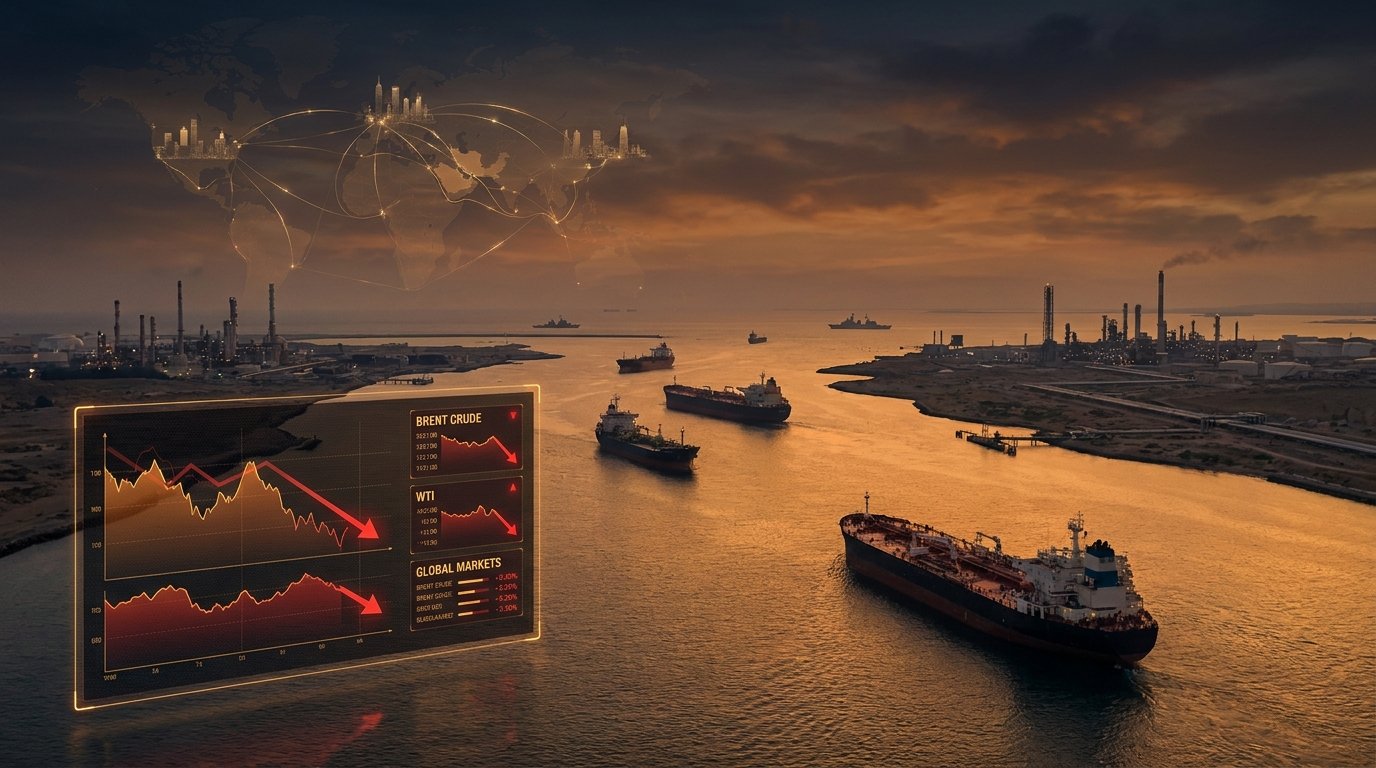
Why Oil Prices Are Falling Despite the World’s Biggest Geopolitical Crisis
For decades, global markets have operated under a simple assumption:
When geopolitical tensions escalate in the Middle East, oil prices rise.
The logic has always been straightforward. The Middle East produces roughly one-third of the world’s oil supply, and the Strait of Hormuz serves as one of the most strategically important energy chokepoints on Earth. Any threat to this region has historically triggered panic in energy markets, sending oil prices soaring and fueling inflation across the global economy.
But in 2026, something remarkable happened.
Despite one of the most serious geopolitical crises in recent years, global oil prices have fallen sharply, returning close to their pre-conflict levels. This unexpected move has left investors, economists, and policymakers asking an important question:
Why are oil prices falling when geopolitical risks remain so high?
The answer reveals something much bigger than the oil market itself.
It reveals how the global economy may be changing.
The Crisis That Should Have Sent Oil Soaring
Earlier this year, tensions involving Iran and the broader Middle East created fears of a major energy shock.
Markets worried about disruptions to oil exports, attacks on critical infrastructure, and the possibility of shipping restrictions through the Strait of Hormuz—a waterway responsible for transporting roughly one-fifth of global oil consumption.
Historically, events of this magnitude have produced dramatic market reactions.
The 1973 oil embargo triggered a global economic crisis.
The Gulf War caused major price spikes.
Even temporary disruptions have often generated significant increases in energy costs.
Initially, markets reacted exactly as expected.
Oil prices surged as traders priced in the possibility of severe supply disruptions.
But then something unexpected happened.
The rally collapsed.
The Disappearance of the Geopolitical Premium
Financial markets often price in what economists call a “risk premium.”
When uncertainty increases, traders pay more for commodities like oil because of the possibility that future supplies could become unavailable.
In recent months, much of the increase in oil prices was driven not by actual supply losses, but by fear of what could happen.
As diplomatic negotiations progressed and shipping activity through the Strait of Hormuz gradually resumed, markets began removing this geopolitical premium from oil prices.
This process happened with remarkable speed.
Oil prices that had been trading significantly above their pre-conflict levels rapidly gave back most of their gains.
The market effectively concluded that the worst-case scenarios were becoming less likely.
In other words, traders stopped pricing fear and started pricing fundamentals.
Supply Is Winning the Battle
Another major reason for falling oil prices is simple:
There is a lot of oil available.
Global production has remained stronger than many analysts expected.
OPEC+ recently approved additional production increases, adding further supply to an already well-supplied market. Meanwhile, oil exports through key shipping routes have gradually recovered, reducing fears of prolonged shortages.
At the same time, oil production outside the Middle East has remained robust.
The United States continues to be one of the world’s largest producers.
Countries in South America, Africa, and other regions have also increased output.
This diversification has fundamentally changed the global energy landscape.
Unlike previous decades, the world is no longer dependent on a small number of producers to the same extent.
That doesn’t eliminate geopolitical risk.
But it does reduce its immediate impact.
China’s Demand Problem
There is another factor pushing prices lower:
Weak demand growth.
China has been one of the largest contributors to global oil demand growth for more than two decades.
However, economic growth in China has slowed considerably compared to previous years.
Industrial activity remains uneven, consumer spending has weakened, and imports of crude oil have declined relative to historical trends. As a result, one of the world’s largest sources of energy demand is no longer growing at the pace markets once expected.
This shift matters enormously.
Even modest reductions in Chinese demand expectations can significantly influence global oil prices.
When demand weakens while supply remains strong, prices naturally fall.
The Strategic Reserve Factor
Governments have also become far more sophisticated in managing energy crises.
Strategic petroleum reserves, coordinated international responses, and emergency supply mechanisms now play a much larger role than they did in previous decades.
Countries understand that energy price shocks can rapidly spread throughout the economy.
Higher oil prices lead to:
- Higher transportation costs
- Higher manufacturing costs
- Higher food prices
- Higher inflation
- Slower economic growth
Because of these risks, governments increasingly intervene to stabilize markets before panic can develop.
The result is a global energy system that is far more resilient than it was during previous geopolitical crises.
Markets Are Learning New Rules
Perhaps the most important lesson from recent events is that markets themselves have evolved.
In previous decades, traders often reacted aggressively to geopolitical headlines.
Today’s markets are increasingly data-driven.
Investors focus on:
- Actual production levels
- Shipping volumes
- Inventory data
- Refinery activity
- Consumer demand
- Strategic reserves
This means that geopolitical events alone may no longer be sufficient to sustain elevated prices unless they produce measurable disruptions to physical supply.
In many ways, oil markets are becoming more rational.
Or at least, less emotional.
The New Energy Economy
The global energy transition is also changing how markets behave.
While oil remains critically important, the world’s energy system is becoming more diversified.
Investment in:
- Renewable energy
- Nuclear power
- Battery storage
- Electric vehicles
- Energy efficiency
- Alternative fuels
has accelerated significantly.
These changes do not eliminate the importance of oil.
But they do reduce the long-term vulnerability of the global economy to individual supply disruptions.
Markets increasingly recognize that the energy system of 2026 is fundamentally different from the energy system of 1973, 1990, or even 2008.
Why This Matters Beyond Oil
The implications extend far beyond the energy sector.
Falling oil prices influence:
Inflation
Lower energy costs help reduce inflationary pressures throughout the economy.
Central Banks
Lower inflation gives policymakers greater flexibility regarding interest rates.
Consumers
Lower fuel costs support household spending.
Businesses
Reduced energy expenses improve profitability and investment capacity.
Financial Markets
Lower inflation expectations often support stock market performance.
In other words, falling oil prices may be providing an unexpected source of economic stability during a period of geopolitical uncertainty.
The Hidden Risk
However, investors should not become complacent.
The disappearance of today’s geopolitical premium does not mean geopolitical risk has disappeared.
Oil markets remain vulnerable to:
- New military escalations
- Shipping disruptions
- Infrastructure attacks
- Political instability
- Supply chain interruptions
Current market conditions reflect expectations, not guarantees.
If those expectations change, oil prices could move rapidly.
History repeatedly demonstrates that energy markets can remain calm until suddenly they are not.
Conclusion
The most surprising story in global markets today is not that oil prices are falling.
It is why they are falling.
For decades, geopolitical crises automatically triggered energy shocks.
Today, markets are responding differently.
Greater supply diversity, strategic reserves, changing demand patterns, technological advances, and evolving investor behavior have fundamentally altered how energy markets function.
This does not mean that geopolitics no longer matters.
It means that the rules governing the global economy are changing.
And nowhere is that transformation more visible than in the oil market itself.
The Light Span — Illuminating the Forces Shaping Our World.

