


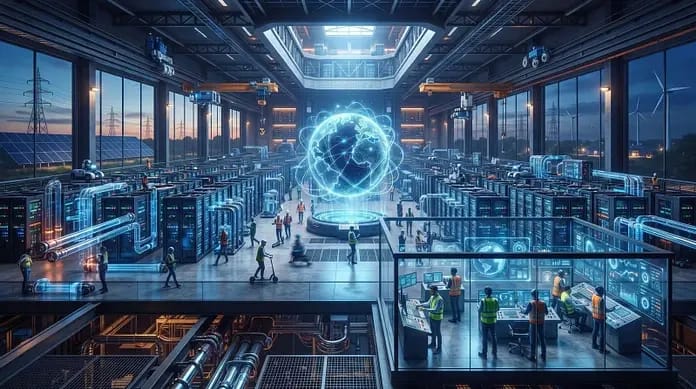
AI Factories: How AI Infrastructure Is Built and Operated
Artificial intelligence may feel like software.
You type a question, ask an AI agent to perform a task or generate an image, and the result appears on your screen within seconds.
But behind that simple experience is an increasingly enormous physical system.
Advanced chips perform trillions of calculations. High-speed networks move information between servers. Cooling systems remove extraordinary amounts of heat. Power infrastructure supplies electricity around the clock. Software coordinates thousands of processors so they can operate as one enormous computing machine.
This physical layer is increasingly being described as the AI factory.
And AI factories in 2026 are becoming much more important than ordinary data centers.
The idea is simple: traditional factories convert raw materials into physical products. AI factories convert computing power, data and electricity into something digital—AI-generated tokens, predictions, reasoning and actions.
NVIDIA describes AI factories as infrastructure designed to “manufacture intelligence” continuously. Its model measures success through metrics such as tokens per second, tokens per watt, cost per token, utilization and uptime.
That change in language reflects something much bigger happening across the technology industry.
Artificial intelligence is moving from an experimental software feature into industrial-scale infrastructure.
AI models are becoming more capable. AI agents are working for longer periods. Businesses are deploying AI into everyday operations. Countries increasingly view computing capacity as a strategic resource.
And all of those trends require more infrastructure.
The rise of AI factories in 2026 therefore isn’t simply another data-center expansion.
It could mark the beginning of a new industrial layer of the digital economy.
Key Takeaways
- AI factories are purpose-built computing facilities optimized for training, reasoning, inference and increasingly autonomous AI agents.
- NVIDIA describes five interconnected layers of an AI factory: energy, chips, infrastructure, models and applications.
- The industry is increasingly measuring AI infrastructure through the amount of useful intelligence produced per unit of energy and cost.
- Agentic AI could make infrastructure demand more continuous because agents can reason, search, use tools and perform multi-step tasks.
- Electricity, cooling, networking and memory are becoming nearly as important as GPUs.
- NVIDIA announced its DSX framework in 2026 for designing and operating gigawatt-scale AI factories.
- The AI factory boom creates major economic opportunities, but enormous capital requirements and electricity demand also create substantial risks.
What Is an AI Factory?
An AI factory is not simply a large room filled with GPUs.
It is better understood as an integrated computing system designed specifically to produce AI outputs at scale.
A traditional data center might host websites, databases, email systems, business applications and cloud storage.
An AI factory is optimized around demanding AI workloads.
That can include:
- model training,
- fine-tuning,
- AI inference,
- reasoning models,
- autonomous agents,
- synthetic data generation,
- robotics simulations,
- scientific computing.
The distinction is becoming more important as AI moves from relatively simple prompt-and-response systems toward complex reasoning and agentic workloads.
NVIDIA’s current AI-factory architecture brings together energy, chips, infrastructure, models and applications as parts of one system rather than treating servers as isolated hardware.
That means optimizing an AI factory involves much more than buying the fastest processor.
The facility needs enough power.
The processors need memory.
Servers need high-speed connections.
The system needs effective cooling.
Software needs to keep hardware utilized.
And the applications running on top must create enough value to justify the enormous infrastructure underneath.
That is what makes AI factories in 2026 different from the data centers most people are familiar with.
They are being designed around the economics of producing intelligence.
1. AI Factories Are Starting to Look Like Industrial Infrastructure
For most of the internet era, computing infrastructure remained largely invisible.
Users cared about websites and applications, not the buildings running them.
AI is changing that.
The amount of physical infrastructure required for advanced artificial intelligence has become so large that data centers are increasingly discussed alongside power plants, semiconductor factories and telecommunications networks.
This is why the term factory is useful.
A conventional factory measures how efficiently it converts materials and energy into products.
An AI factory can increasingly be evaluated through measures such as:
tokens per second
tokens per watt
cost per token
hardware utilization
system uptime
These metrics connect AI performance directly with physical economics.
Suppose two facilities contain similar amounts of expensive hardware.
If one generates significantly more useful AI output using the same electricity, that facility has an economic advantage.
NVIDIA’s 2026 DSX architecture takes this idea further by focusing on maximizing token output per megawatt and lowering the cost of intelligence across the infrastructure stack.
That represents a fundamental change.
The AI industry is moving from asking:
“How powerful is this chip?”
toward:
“How much useful intelligence can the entire facility produce for every dollar and megawatt?”
That is a much more industrial way of thinking about computing.
2. AI Agents Are Changing What AI Factories Need to Do
The original AI infrastructure boom was driven heavily by model training.
Companies needed enormous GPU clusters to train increasingly capable large language models.
Training remains important.
But another workload is becoming critical:
inference.
Inference occurs when a trained model actually responds to users or performs work.
And agentic AI could make inference dramatically more demanding.
A conventional chatbot may receive a question, generate an answer and stop.
An AI agent can behave differently.
It may reason through a problem, search for information, call several tools, read documents, write code, verify its work and continue operating until a task is completed.
NVIDIA says agentic workloads are longer, deeper and more compute-intensive because autonomous systems can reason, plan, retrieve information, use tools and create sub-agents.
That distinction is crucial for understanding AI factories in 2026.
An AI assistant that generates a paragraph uses computing resources briefly.
An autonomous agent completing a complicated business workflow could require many model calls and much longer reasoning.
Multiply that across millions of users and thousands of businesses, and the infrastructure requirements become very different.
This is why our analysis of how AI agents are entering their next phase matters directly to the AI-factory story.
The more AI shifts from answering questions to continuously doing work, the more valuable reliable, always-available inference capacity becomes.
3. GPUs Are Only One Part of the AI Factory
GPUs receive most of the attention in AI infrastructure.
There is a good reason.
They perform the parallel calculations that make modern AI possible.
But building an efficient AI factory requires far more than processors.
Modern facilities depend on an interconnected system of:
- GPUs and CPUs,
- high-bandwidth memory,
- storage,
- high-speed networking,
- fiber optics,
- power distribution,
- cooling,
- orchestration software,
- cybersecurity.
A bottleneck in one layer can reduce the value of everything else.
Imagine buying thousands of extremely powerful AI accelerators but connecting them through inadequate networking.
The processors may spend valuable time waiting for data.
Or imagine constructing a massive data center but discovering that the local electricity grid cannot provide enough additional power.
The servers cannot simply operate at full capacity because the chips exist.
This is why the AI infrastructure race is increasingly becoming a full-stack engineering challenge.
The pressure is already spreading into components that receive less public attention. Our analysis of the worsening AI memory shortage shows how rapidly growing AI demand can affect memory supply and ultimately technology costs.
The AI factory is therefore best viewed as one giant machine.
The GPU may be its engine.
But an engine alone cannot operate a factory.
4. Electricity Is Becoming a Strategic AI Resource
The AI revolution has created an unexpected connection between two industries:
technology and energy.
AI factories need enormous amounts of electricity.
And unlike some industrial facilities, they often need power continuously.
The International Energy Agency says electricity demand in advanced economies is rising again after roughly 15 years of stagnation, with AI, data centers, advanced manufacturing and broader electrification among the important drivers.
That changes the AI competition.
For years, companies competed primarily over:
chips,
models,
data,
engineers.
Now they also need:
megawatts.
The challenge becomes even greater as facilities move toward gigawatt-scale development.
This is why NVIDIA and energy companies are experimenting with flexible AI factories that could interact more intelligently with electricity grids. In March 2026, NVIDIA and Emerald AI announced work with energy companies including AES, Constellation, Invenergy, NextEra Energy, Nscale Energy & Power and Vistra on AI factories that can support grid flexibility.
NVIDIA and Emerald AI’s flexible AI factory initiative
This is an important development.
Future AI factories may not simply consume electricity.
Their computing workloads could potentially be scheduled or adjusted around grid conditions where appropriate.
The goal is to make computing infrastructure more compatible with the power systems supporting it.
That will become increasingly important because AI growth cannot continue indefinitely if electricity infrastructure fails to grow with it.
5. Cooling and Efficiency Could Decide Which AI Factories Win
Electricity entering an AI processor eventually becomes heat.
That makes cooling one of the least glamorous but most important parts of AI factories in 2026.
Traditional air cooling becomes increasingly difficult as computing density rises.
High-performance AI systems therefore use more advanced thermal-management techniques, including liquid cooling.
But cooling is not simply about preventing hardware from overheating.
It affects the economics of the entire facility.
Every unit of electricity spent cooling equipment is energy that cannot directly produce AI output.
That creates strong incentives to improve efficiency across the system.
This is where tokens per watt becomes especially important.
A more efficient AI factory can potentially produce more useful AI output without requiring the same increase in electricity.
The industry is therefore optimizing multiple layers simultaneously:
better processors,
better memory,
faster networking,
more efficient software,
improved cooling,
higher utilization.
Efficiency matters because AI demand could expand enormously.
If every improvement in AI capability required electricity demand to rise at exactly the same rate, scaling would become increasingly difficult.
Better infrastructure must therefore allow the industry to produce more intelligence from each unit of energy.
This is one reason the AI factory concept is more useful than simply talking about bigger data centers.
The objective isn’t just scale.
It is productive scale.
6. AI Factories Are Becoming a Financial Asset Class
Building this infrastructure is extraordinarily expensive.
Land must be acquired.
Data-center buildings must be constructed.
Electrical connections need to be secured.
Advanced processors must be purchased.
Cooling, networking and storage must be installed.
And much of the investment occurs before customers generate enough revenue to repay it.
That is turning AI infrastructure into a major financing story.
On August 10, 2026, NVIDIA announced a partnership with six major financial institutions aimed at creating financing platforms capable of raising more than $500 billion in third-party capital for AI infrastructure. The institutions include Apollo, BlackRock, Blackstone, Brookfield, Goldman Sachs and KKR.
This tells us something important about where the AI boom is heading.
AI factories are becoming large enough that technology companies alone may not finance every stage of expansion.
Infrastructure investors, private capital, banks, utilities and governments could all play growing roles.
That resembles earlier infrastructure revolutions.
Railways needed financing.
Electric grids needed financing.
Telecommunications networks needed financing.
Cloud infrastructure needed enormous capital investment.
AI is beginning to follow a similar path.
This is closely connected with The Light Span’s analysis of AI infrastructure spending in 2026, which focuses on whether the huge capital commitments behind the AI boom can ultimately generate adequate financial returns.
The distinction between these two articles is important.
That article focuses on the money.
This article focuses on the machine the money is building.
7. AI Factories Are Becoming Part of National Strategy
AI infrastructure is no longer purely a corporate technology issue.
Governments increasingly care about where AI computing capacity is located.
That is understandable.
AI could influence:
economic productivity,
scientific research,
healthcare,
manufacturing,
cybersecurity,
defense,
education,
and government services.
A country dependent entirely on foreign computing infrastructure may therefore face strategic limitations.
That is why access to advanced chips, electricity, cloud infrastructure and AI talent is becoming part of national competitiveness.
The United States remains particularly important because it hosts many of the companies designing advanced AI systems and computing hardware. NVIDIA says its U.S. manufacturing and infrastructure network now spans dozens of states and describes AI infrastructure as part of a wider effort to strengthen domestic manufacturing and supply chains.
Other countries are pursuing their own strategies.
The competition is not simply about who creates the smartest model.
It is increasingly about who controls the physical capacity required to run AI at scale.
This is why our broader global race for AI leadership increasingly revolves around infrastructure as much as algorithms.
Countries with abundant electricity, capital, advanced semiconductor access, strong networks and suitable land may gain an important advantage.
In that sense, AI factories are becoming geopolitical assets.
AI Factories Could Change the Economics of Intelligence
One of the most interesting ideas behind the AI factory is that intelligence itself becomes something measurable and scalable.
Traditional factories seek to lower the cost of producing physical goods.
AI factories seek to lower the cost of producing useful AI output.
If the cost of generating intelligence falls dramatically, applications that are currently too expensive could become practical.
Imagine advanced AI agents continuously helping:
small businesses,
scientists,
engineers,
doctors,
teachers,
software developers,
manufacturers.
The important variable becomes cost per useful task.
If AI inference becomes cheaper while capabilities improve, businesses can deploy far more intelligence without increasing spending proportionally.
That could create a feedback loop:
Better infrastructure → cheaper AI → more applications → more demand → more AI factories.
But the opposite is also possible.
If infrastructure remains expensive and businesses fail to generate enough value from AI, demand could disappoint.
That is why utilization matters so much.
An expensive AI factory operating near capacity for paying workloads can be valuable.
An expensive AI factory filled with underused hardware can become a financial problem.
What Could Go Wrong With the AI Factory Boom?
The scale of investment makes the risks impossible to ignore.
Too much capacity
Companies could build infrastructure faster than profitable AI demand grows.
Electricity bottlenecks
Data centers may be planned faster than grids can connect them.
Hardware depreciation
AI chips can become outdated far faster than conventional infrastructure.
Financing risk
More debt and external capital increase financial exposure if AI returns disappoint.
Supply shortages
Memory, networking equipment, transformers, cooling components or advanced chips can become bottlenecks.
Local opposition
Large facilities can face concerns involving electricity, land, water and grid capacity.
Technology shifts
More efficient models or radically different computing architectures could change how much infrastructure future AI requires.
None of these risks means AI factories are unnecessary.
It means the winners may not simply be the companies that build the biggest facilities.
The winners could be those that build the most economically efficient facilities.
How AI Factories Connect to the Future of Work
The physical infrastructure story eventually reaches ordinary workers.
As AI factories make inference cheaper and more widely available, businesses can deploy more autonomous software.
That could accelerate the transition explored in our article on how AI is learning how to do jobs through virtual workplaces.
AI factories also create jobs directly.
Building and operating them requires people working in:
electrical engineering,
construction,
network engineering,
power systems,
cooling,
semiconductors,
cybersecurity,
data-center operations,
AI software.
So the AI infrastructure boom produces an interesting economic contradiction.
AI may automate some digital work while simultaneously creating demand for people who build and maintain the physical infrastructure behind that automation.
The AI economy is not purely virtual.
It depends on a very physical industrial base.
What Will the Next Generation of AI Factories Look Like?
The direction is already becoming clearer.
NVIDIA introduced its DSX platform in May 2026 as a framework for designing, building and operating large AI factories. The architecture integrates computing, software, facilities, power, cooling and operations rather than treating them as separate problems.
NVIDIA DSX AI Factory platform
Future facilities are likely to become increasingly automated.
Digital twins could help engineers simulate data centers before construction.
AI itself could optimize cooling and workload scheduling.
More efficient processors could reduce cost per token.
Optical networking could help move enormous amounts of data.
Energy-management software could coordinate workloads with grid conditions.
And facilities could increasingly be designed around specific AI workloads rather than general-purpose cloud computing.
The result may resemble a new industrial architecture built specifically for machine intelligence.
FAQs
What is an AI factory?
An AI factory is specialized computing infrastructure designed to train, run and scale artificial intelligence. It combines chips, networking, storage, software, power and cooling to produce AI outputs efficiently.
How is an AI factory different from a traditional data center?
Traditional data centers support many general computing workloads. AI factories are designed specifically around intensive AI training, inference, reasoning and agentic workloads, with greater emphasis on accelerated computing and efficiency per token.
Why are AI factories important in 2026?
AI is moving from experimentation into large-scale production. Reasoning models and autonomous agents require substantial computing capacity, making efficient AI infrastructure increasingly important.
Do AI factories use a lot of electricity?
Yes. Large AI facilities can require enormous power capacity, making electricity availability and grid infrastructure major constraints on future expansion. The IEA identifies AI and data centers among the drivers pushing electricity demand higher in advanced economies.
Why do AI agents need more computing power?
Agents may perform multiple reasoning steps, search for information, call tools, write code and verify results rather than generating one simple response. These longer workflows can require substantially more inference.
Are AI factories only built by NVIDIA?
No. “AI factory” is increasingly used as a broader infrastructure concept. NVIDIA has strongly promoted the term and offers its own hardware, software and reference architectures, while cloud providers, enterprises, governments and infrastructure companies are building large AI computing facilities using different technologies.
Could AI factories become overbuilt?
Yes. If infrastructure grows much faster than profitable AI usage, some projects could struggle to generate adequate returns. Utilization, cost per token and electricity efficiency are therefore crucial economic measures.
The Light Span Perspective
The rise of AI factories in 2026 reveals something fundamental about artificial intelligence.
AI is not becoming less physical as it becomes more advanced.
It is becoming more physical.
Every improvement in reasoning ultimately depends on chips.
Those chips need memory.
They need networking.
They need cooling.
And above everything else, they need electricity.
The invisible AI assistant on a phone or laptop therefore sits at the end of an enormous industrial chain.
That chain increasingly stretches from semiconductor factories to electrical grids, data centers, fiber networks and global capital markets.
This is why the AI factory could become one of the defining infrastructure concepts of the decade.
The biggest winners may not simply build the smartest model.
They may build systems capable of producing useful intelligence more cheaply, reliably and efficiently than competitors.
That changes the AI race.
It turns electricity into a technology resource.
It turns data centers into production facilities.
It turns tokens into an economic output.
And it turns computing infrastructure into something governments, investors and businesses increasingly view as strategic.
The next phase of the AI revolution may therefore be built less visibly than the first.
People will continue seeing smarter assistants, better software and increasingly autonomous AI agents.
But behind those advances will be enormous machines operating day and night.
Those machines are the factories of the AI economy.
And the race to build them is only beginning.
Continue reading more

